
About
Samvarana — King of Hastinapura, Husband of Tapati and Father of Kuru
Samvarana · Samparana · son of Riksha · the exiled and restored king
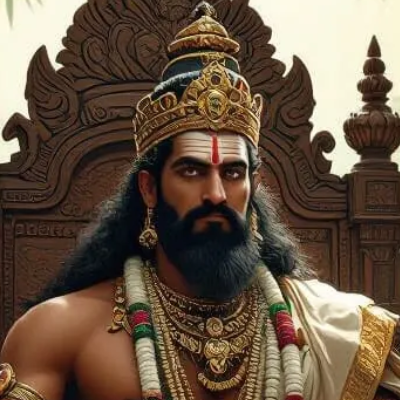
Samvarana is a king of Hastinapura in the Puru branch of the Lunar dynasty, celebrated chiefly for two events: his prolonged exile from Hastinapura following military defeat at the hands of the Panchala king, and his extraordinary marriage to Tapati, the daughter of Surya (the Sun God). He is the son of Riksha — himself a son of Ajamidha — and is designated in the Mahabharata as the perpetuator of the royal line through his son Kuru, the founding ancestor of the Kuru dynasty. His story is narrated in the Mahabharata's Adi Parva both in the genealogical sections and in the Chaitraratha Parva, where a Gandharva recounts the tale of Tapati and Samvarana to Arjuna as an episode from the history of Arjuna's own ancestors.
✦ The Name
The name Samvarana derives from a Sanskrit root conveying restraint, containment, or the drawing together of forces. It may connote a king who holds or consolidates his people, though no explicit etymological gloss is offered in the primary sources. The Vyasa Mahabharata online source cites him as being described in the primary text as one who was fourth in descent from a certain Ikshvaku, though this lineage reference is likely an error in that secondary source, as Samvarana belongs unambiguously to the Puru (Lunar) rather than the Ikshvaku (Solar) dynasty across all primary texts.
✦ Lineage
- Father: Riksha — king of Hastinapura, son of Ajamidha (the great ancestor of the Kuru and Panchala royal lines) by his wife Riksha (also called Dhumini in some recensions). Riksha became king of Hastinapura after being the eldest among the heirs at the time of succession.
- Wife: Tapati — celestial princess, daughter of Surya (the Sun God) and a figure of surpassing beauty. Their marriage was arranged through the mediation of the sage Vasishtha after Samvarana performed twelve days of prayer on a mountain where he had encountered her.
- Son: Kuru — the dynasty-founding king who gave his name to the Kuru line, Kurukshetra, and the collective designation Kaurava for all his descendants. Kuru was exceedingly virtuous and was installed on the throne by his own people.
✦ The Panchala Defeat and Exile
During Samvarana's reign, the kingdom of Hastinapura suffered an extraordinary concatenation of disasters: famine, pestilence, drought, and disease afflicted the people, and powerful enemies invaded the territory. The Panchala king advanced against the Bharatas with a great army, defeated Samvarana in battle, and seized dominion over the land. Samvarana was compelled to flee with his entire household — wife, children, ministers, and relatives — and took refuge in a fortified settlement in the forests along the banks of the Sindhu (Indus) river, at the foot of the mountains. The Bharata clan remained in this exile for a lengthy period, the primary text characterising the duration in epic terms. Eventually the sage Vasishtha came to the exiled king, offered his services as royal priest, and through his spiritual power re-established Samvarana on the throne of Hastinapura, restoring his sovereignty over all the Kshatriya kings of the earth.
✦ The Marriage with Tapati
The Mahabharata's Chaitraratha Parva narrates this episode in lyrical detail. While wandering on a mountain — accounts vary as to whether his horse had died or he was hunting — Samvarana encountered a young woman of incomparable beauty. He was overcome by love and addressed her, but she vanished before he could learn who she was. She reappeared briefly to tell him that she was the daughter of Surya (Vivasvat, the Sun God) and that only her father could decide the matter of her marriage. Samvarana remained on the mountain, consumed by longing, and directed his meditation toward the Sun for twelve days. Vasishtha, perceiving through his yogic vision what was happening, appeared to the king and offered to act as his emissary to Surya. Vasishtha approached the Sun God, who willingly consented to give his daughter Tapati to the virtuous Samvarana. Vasishtha then performed the marriage rites. After the wedding, Samvarana and Tapati retired to the mountains and lived together for twelve years, neglecting the duties of kingship — a dereliction that caused drought and hardship in the realm until Vasishtha recalled them to their responsibilities. Upon Samvarana's return to Hastinapura, prosperity was restored, and Tapati bore him a son, Kuru.
✦ Character and Royal Qualities
Secondary traditional sources describe Samvarana as an ardent devotee of Surya (the Sun God), whose divine favour manifested in Tapati's marriage to him. He is described in secondary Hindu devotional sources as a king with golden hands — a figure of legendary generosity who distributed wealth to Brahmins, opened food shelters in his kingdom, and was praised by the gods. After establishing his son Kuru as king, Samvarana is said in these traditions to have retired to the Himalayas for meditation and to have attained the heavenly realm of Indra at death. These elements of his characterisation derive from secondary and regional sources rather than the Mahabharata text itself.
✦ References
- Mahabharata, Adi Parva, Chapter 94–95 (Sambhava Parva): Primary genealogical source naming Riksha as Samvarana's father, listing his exile by the Panchalas, his restoration by Vasishtha, and his fathering of Kuru by Tapati.
- Mahabharata, Adi Parva, Chaitraratha Parva (Chapters 160–163): Full narrative of Samvarana's encounter with Tapati, the mediation of Vasishtha, the marriage, the twelve-year retirement, and the birth of Kuru.
- Sacred Texts Archive, Mahabharata Book I, Section XCV (K.M. Ganguli translation): English translation of the primary genealogical passage confirming Samvarana as perpetuator of the dynasty and Riksha as his father.
- Wikipedia, Samvarana entry: Secondary source summarising the Panchala exile episode and the Tapati marriage narrative with primary source references.
- HinduPad, Samvarana entry: Secondary devotional source providing traditional characterisation of Samvarana's generosity and spiritual attributes.
- Jatland Wiki, Samvarana entry: Secondary genealogical compilation reproducing the Adi Parva genealogical passage.
- Mahabharata Stories blog (mahabharata-stories.blogspot.com): Narrative retelling of the Tapati and Samvarana episode identifying the moral significance of the episode as discussed in traditional commentary.