
About
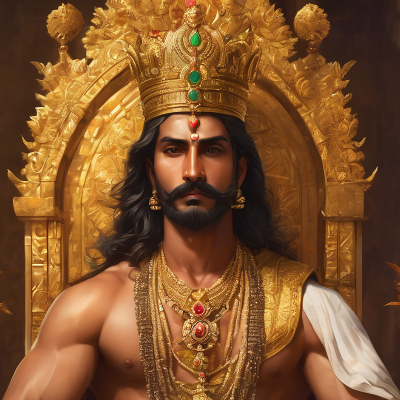
Kuru — Founder of the Kuru Dynasty and Sanctifier of Kurukshetra
Kuru · Kuruvamsha progenitor · son of Samvarana and Tapati
Kuru is the founding king of the dynasty that bears his name — the Kuru dynasty, whose descendants the Pandavas and the Kauravas are the principal subjects of the Mahabharata epic. He is the son of Samvarana — a king of the Puru line who, after a long exile on the banks of the Indus, reclaimed Hastinapura with the help of the sage Vasishtha — and of Tapati, the daughter of Surya (the Sun God) and a figure celebrated in her own right in the Mahabharata's Chaitraratha Parva. Kuru is celebrated for performing such intense austerities on the plain thereafter named Kurukshetra that the gods themselves acknowledged him, and it is from his name that the entire lineage of the Kauravas (sons of the Kuru line) derives its collective designation. He appears as a major genealogical anchor in the Mahabharata's Adi Parva, in the Vishnu Purana, the Bhagavata Purana, and numerous other Puranic texts.
✦ The Name and Epithets
The name Kuru gives rise to multiple derivative terms that pervade the Mahabharata: Kurukshetra (the field of Kuru, where he practised austerities and where the great war was later fought), Kurujangala (the Kuru forest-land), and Kaurava (descendant of Kuru), the collective name for the hundred sons of Dhritarashtra as well as the broader Kuru dynastic line. His ascetic deeds on the plain of Kurukshetra were considered so meritorious that both gods and ancestors agreed to grant special boons to those who died or performed sacrifices on that land — a tradition recorded in the Mahabharata's own account of why Kurukshetra became a sacred field.
✦ Lineage
- Father: Samvarana — king of Hastinapura and descendant of Ajamidha (an ancestor of the Puru line), who was exiled from his kingdom by the Panchala forces and restored by the sage Vasishtha. He is the son of Riksha, son of Ajamidha.
- Mother: Tapati — daughter of Surya (the Sun God) and a celestial figure who appeared to Samvarana on a mountain; their marriage was arranged through the intercession of the sage Vasishtha. Their union is narrated at length in the Mahabharata's Chaitraratha Parva.
- Wife (principal): Shubhangi — princess of the Dasarha kingdom; mother of Viduratha, the son who continued the main royal line.
- Wife (second): Vahini — mother of five sons: Ashvavat (also called Avikshit), Abhishyanta, Chitraratha, Muni, and Janamejaya (a second king of this name), as recorded in the list of characters in the Mahabharata.
- Sons (by Shubhangi): Viduratha — the son through whom the direct line of descent to Pratipa, Shantanu, and Bhishma runs.
- Sons (by Vahini): Ashvavat, Abhishyanta, Chitraratha, Muni, and Janamejaya — five sons who founded collateral lines.
✦ The Sanctification of Kurukshetra
The Mahabharata records that Kuru performed severe austerities on the field that would bear his name. The region was already known as Kurujangala (the Kuru forest-land) in earlier Vedic literature, and Kuru's ascetic activity on this plain — ploughing it himself with a golden plough given by Indra, performing tapas, and dedicating the merits of dying in battle on that field — gave it its unique sanctity. The gods, pleased by his austerities, granted that anyone who died on the field of Kurukshetra would ascend directly to the highest heavens regardless of the manner of their death, making the field the supreme sacred battlefield of the later tradition.
✦ Significance in the Dynastic Tradition
Kuru represents the pivotal moment at which the broader Puru and Bharata lineage narrows into the specific dynastic line known as the Kuru vamsha. Before Kuru, the dynasty is identified as the Puru or Bharata line. From Kuru onward, his descendants are specifically termed Kurus or Kauravas, a terminology that persists throughout the Mahabharata narrative. The Kuru dynasty as it appears in later Vedic literature — the powerful kingdom with capitals first at Asandivat and later at Hastinapura, which became the dominant political and ritual centre of northern India in the Iron Age — has its founding moment in Kuru's reign as reconstructed from these sources.
✦ Textual Variants
The Mahabharata lists of chapters 94 and 95 give slightly different enumerations of Kuru's sons. Chapter 95 focuses on the line through Viduratha as the main succession. The list of Mahabharata characters drawn from the Adi Parva gives both Shubhangi (mother of Viduratha) and Vahini (mother of the five other sons). The Puranic accounts — Vishnu Purana, Bhagavata Purana, Matsya Purana — give different successions after Kuru, sometimes inserting kings not found in the Epic lists, reflecting independent Puranic genealogical traditions.
✦ References
- Mahabharata, Adi Parva, Chapters 94–95 (Sambhava Parva): Primary genealogical source establishing Kuru as the son of Samvarana and Tapati, husband of Shubhangi and Vahini, and father of Viduratha and others.
- Mahabharata, Adi Parva, Chaitraratha Parva (Chapters 160–163): Narrative of Samvarana's love for Tapati and the divine marriage through Vasishtha, establishing Kuru's parentage.
- Wikipedia, List of characters in the Mahabharata — King Kuru entry: Secondary source listing Kuru's two wives and six sons with references to Adi Parva.
- Jatland Wiki, Samvarana entry: Secondary genealogical compilation with direct quotation from Mahabharata Adi Parva Chapter 90 on Kuru's birth and the naming of Kurukshetra.
- Geni.com, River Tapati and Samvarana genealogy: Secondary compilation reproducing the Mahabharata passage on Kuru being born to Samvarana and Tapati and installed by his people.
- Raychaudhuri, H.C., Political History of Ancient India (1923): Historical reconstruction of the Kuru kingdom with reference to Vedic-era sources corroborating the dynasty's early kings.