
About
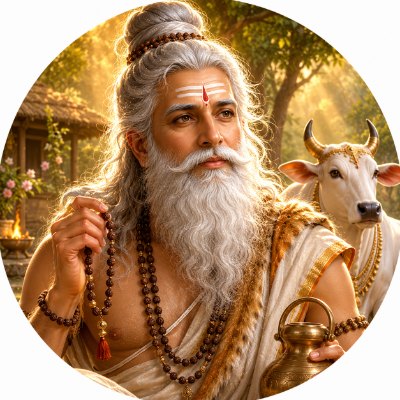
Sage Vasishtha — Brahmarishi, Chief of the Saptarishis, Preceptor of the Solar Dynasty
Vasishtha · Brahmarishi · Saptarishi · Manasaputra · Arundhati-Natha · Kulapati · Trishanku-guru · Ikshvaku-purohita
Vasishtha is one of the Saptarishis — the seven great sages — and one of the ten Manasaputras, the mind-born sons of Brahma. He is the chief author of Mandala 7 of the Rigveda. Adi Shankara called him the first sage of the Vedanta school of Hindu philosophy. He is the possessor of the divine wish-fulfilling cows Kamadhenu and her calf Nandini. He is the royal preceptor and purohita of the Ikshvaku dynasty — the solar dynasty to which King Dasharatha and Lord Rama belonged — and the spiritual teacher of Rama and his brothers. He is married to Arundhati, who is regarded in the tradition as his equal in spiritual stature. His legendary conflicts with Vishvamitra are among the most celebrated episodes of the Puranic tradition. He is considered a Chiranjeevi — an immortal — who experiences multiple births across different Manvantaras. The Sanskrit word vasishtha means most excellent, best, or richest.
✦ The Name
Vasishtha derives from the Sanskrit superlative of vasu — wealth, excellence, goodness — meaning most excellent, best, or most wealthy. It is a name that declares him the finest exemplar of the qualities he embodies — learning, ascetic power, moral authority, and Vedic mastery. He is also called Arundhati-Natha — husband of Arundhati — a designation that reflects the tradition's recognition of his marriage as the ideal of conjugal dharma. He is further called Kulapati — head of a great school — because hundreds of students were trained at his hermitage on the banks of the Sarasvati River.
✦ Multiple Births
The Puranas record that Vasishtha has three births. In his first birth he was a Manasaputra of Brahma — mind-born, the direct creation of the god's contemplative will. In this birth he was destroyed following the events of the Daksha Yajna. In his second birth he emerged from the seed of Mitra and Varuna — the two Adityas — who, upon seeing the apsara Urvashi during a yajna, became aroused; their seed fell into a jar and Vasishtha was born from it. This account appears in Mandala 7 of the Rigveda and is retold in many later Puranas. In some traditions a third birth is additionally recorded. Across all births his wife in both the first and subsequent incarnations was Arundhati.
✦ Lineage
- Father (first birth): Brahma — mind-born son of the creator god
- Parents (second birth): Mitra and Varuna — the Adityas — and the apsara Urvashi; born from a jar into which their seed fell
- Wife: Arundhati — daughter of Kardama Prajapati and Devahuti in some traditions; daughter of Kashyapa in others; described as a yogini and Brahmarishi in her own right, equal in stature to the Saptarishis
- Eldest son: Shakti (Saktri) — who was killed by a rakshasa empowered by Vishvamitra
- Other sons: Chitraketu, Surochi, Virajas, Mitra, Ulbana, Vasubhridyana, and Dyumat — the seven sons most commonly listed in the Puranas; other traditions record up to one hundred sons
- Grandson: Parashara — son of Shakti and Adrishyanti; born after Shakti's death; from his mother's womb he chanted Vedic mantras, bringing comfort to Vasishtha and Arundhati who had resolved to end their lives in grief
- Great-grandson: Krishna Dvaipayana Vyasa — son of Parashara and Satyavati; the composer of the Mahabharata, the Brahma Sutras, and the arranger of the Vedas
- Hermitage: On the banks of the Sarasvati River, where he maintained a Gurukula attended by hundreds of students
- Second hermitage: On the banks of the river Iravati (Ravi) and later at Meru Savarni
✦ Kamadhenu and Nandini
Vasishtha is the possessor of Kamadhenu — the divine wish-fulfilling cow — and her daughter Nandini. Kamadhenu provided Vasishtha, his family, and his students with all their needs for sacrifices and worldly life. The Mahabharata records Nandini as residing with Vasishtha; she is stolen by the divine Vasus, who are then cursed by Vasishtha to be born on earth — making Vasishtha's curse the origin of Bhishma's mortal birth, as Bhishma is an incarnation of one of those Vasus. The Raghuvamsa of Kalidasa records that King Dilipa — ancestor of Rama — was cursed to childlessness for failing to pay respects to Kamadhenu; Vasishtha then advised Dilipa to serve Nandini, who upon being propitiated blessed him with a son, Raghu.
✦ The Conflict with Vishvamitra
The long and celebrated feud between Vasishtha and Vishvamitra is one of the most extended conflict narratives in the Puranic tradition. King Vishvamitra coveted Vasishtha's divine cow Nandini, who could fulfil material desires. When Vasishtha refused to part with her, Vishvamitra attempted to seize her by force. Nandini, at Vasishtha's suggestion, produced armies of warriors — Pahlavas, Shakas, Yavanas, Kambojas, Haritas, and Kiratas — who destroyed Vishvamitra's army and all his sons. Vishvamitra responded by acquiring celestial weapons from Shiva, attacking Vasishtha's hermitage, and killing his sons. Vasishtha repelled all Vishvamitra's divine weapons with his Brahma-staff — a feat that made Vishvamitra recognise the supreme power of Brahmic knowledge over martial prowess. The conflict became the turning point of Vishvamitra's life: he renounced his kingdom and undertook thousands of years of austerities to become a Brahmarishi himself. He eventually attained that status and reconciled with Vasishtha.
The Battle of the Ten Kings, recorded in Mandala 7 of the Rigveda, also involved Vasishtha. King Sudas of the Bharata tribe appointed Vasishtha as his main priest in preference to Vishvamitra, who had previously held the position. This appointment was the original source of the enmity between the two sages. Under Sudas and Vasishtha, the Trtsu-Bharatas won the Battle of the Ten Kings — Vasishtha's sacred poetics securing Indra's blessings for Sudas.
✦ The Curse of Nimi and the Second Birth
Vasishtha had been invited by King Nimi of the Ikshvaku dynasty to officiate a great yajna. However, he had already committed to performing a yajna for Indra and asked Nimi to wait. Nimi, not wishing to delay, appointed another priest in Vasishtha's absence. When Vasishtha returned and found himself replaced, he was enraged and cursed Nimi to die. Nimi, equally enraged, cursed Vasishtha in return. Frightened by the counter-curse, Vasishtha fled to Brahma, who suggested he merge into Mitra and Varuna. When the apsara Urvashi was subsequently seen by those two gods, Vasishtha was reborn from them — his second birth from the jar.
✦ In the Ramayana
Vasishtha was the royal preceptor and family priest of the Ikshvaku dynasty and the principal teacher of Rama, Lakshmana, Bharata, and Shatrughna. He instructed them in dharma and the sacred sciences. He advised King Dasharatha to invite Rishyashringa — whose specialised knowledge of the Yajurveda and exceptional purity made him uniquely qualified — to perform the Putrakameshti yajna for the birth of sons. He guided the royal family through all the major ritual events of the Ramayana narrative. In the Uttarakanda, Arundhati played a significant role in receiving Sita after her abandonment by Rama. The sixth canto of Kalidasa's Kumarasambhava records Arundhati's role in persuading Shiva to accept Parvati as his wife.
✦ In the Mahabharata
Vasishtha appears in the Mahabharata in multiple capacities. The Adi Parva records his genealogy and the Bhargava-Vasishtha conflicts. He is recorded as the preceptor of Manu — the progenitor of the Kshatriyas — and of the Ikshvaku kings. The Mahabharata describes Arundhati as an enlightened soul and a powerful ascetic capable of giving spiritual discourses to the Saptarishis themselves — a woman of unsurpassed chastity whose form even the wife of Agni could not replicate. He is identified across the Mahabharata's genealogical passages as the great-grandfather — through Parashara and Vyasa — of the Pandavas themselves, making the entire Pandava dynasty a descendant of Vasishtha's lineage through Vyasa.
✦ The Death of His Sons and the Survival of His Line
In the conflict with Vishvamitra, Vasishtha lost all his sons — killed by a rakshasa empowered by Vishvamitra. Overcome with grief, Vasishtha attempted to end his life — leaping from a mountain, falling into the Vipasha (Beas) River, leaping into fire, and attempting to drown in the Sarasvati — all without success. The Sarasvati, to prevent the sacrilege of a great sage's suicide, split into hundreds of shallow channels and carried him gently to the other side. It was his grandson Parashara's survival that ultimately restored his will to live. Adrishyanti — Shakti's pregnant widow — heard Vedic mantras being recited from within her womb and told Vasishtha, who recognised his future grandson speaking from within the womb. This knowledge revived him from his grief and he resolved to continue living.
✦ Arundhati — His Wife and Equal
Vasishtha and Arundhati are regarded across the tradition as the ideal married couple — equal in dharmic commitment, equal in spiritual stature, complementing each other in every respect. In Indian astronomy, the star Mizar in the Saptarishi constellation (Ursa Major) is identified as Vasishtha, and its fainter companion star Alcor is identified as Arundhati. The fact that these two stars orbit each other is held to symbolise equality in marriage. During traditional Hindu wedding ceremonies in many communities, the groom shows the bride the Arundhati star as a symbol of the marital harmony they aspire to. Vasishtha is therefore called Arundhati-Natha — the husband of Arundhati — a name that honours his wife as much as it identifies him.
✦ Texts Attributed to Vasishtha
The Yoga Vasishtha (also called Maha Ramayana or Jnana Vasishtham) — a major philosophical text on non-dualism and the nature of consciousness — is attributed to him, presented as his instructions to Rama. The Vasishtha Samhita is attributed to his authorship. Some versions of the Agni Purana and the Vishnu Purana are attributed to him — the latter co-authored with Pulastya. He is also credited as one of the sages who arranged and preserved the Vedas.
✦ References
- Rigveda — Mandala 7 (the Vasishtha Mandala): the principal body of hymns attributed to Vasishtha; Mandala 10.167.4: reference to Vasishtha and his family; records his parents as Mitra, Varuna, and Urvashi
- Mahabharata (Vyasa) — Adi Parva: genealogy of Vasishtha, his sons, Parashara, and the Bhargava-Vasishtha conflicts; Anushasana Parva: Arundhati described as a yogini giving discourses to the Saptarishis; the curse of the Vasus by Vasishtha leading to Bhishma's birth
- Valmiki Ramayana — Vasishtha as royal preceptor of the Ikshvaku dynasty; his counsel to Dasharatha; his instruction of Rama and brothers; Arundhati's reception of Sita in the Uttarakanda
- Bhagavata Purana — Vasishtha as Manasaputra of Brahma; his multiple births; genealogy through Parashara to Vyasa
- Raghuvamsa (Kalidasa) — Vasishtha's counsel to King Dilipa to serve Nandini; Nandini's blessing of a son
- Kumarasambhava (Kalidasa, Canto 6) — Arundhati's role in persuading Shiva to marry Parvati
- Yoga Vasishtha — philosophical dialogue between Vasishtha and Rama on the nature of consciousness and liberation
- Kamadhenu entry, Wikipedia — records Nandini residing with Vasishtha; the Vasus' theft of Nandini; Vasishtha's curse leading to Bhishma's birth
- Wikipedia — Vasishtha; Vyasa Online — Vasishtha; Hinduism Today — Arundhati: modern summaries drawing from the above primary sources