
About
Arundhati — Wife of Vasishtha, Embodiment of Conjugal Devotion, the Star Alcor in Ursa Major
Arundhati · Arundhatī · Arundhathi · Vasishtha-patni · Arundhati-Natha-priya · Sandhya-punarjanma · Medhatithi-putri · Parashara-pitamahi · Vyasa-prapitamahi · Saptarshi-samkaksha
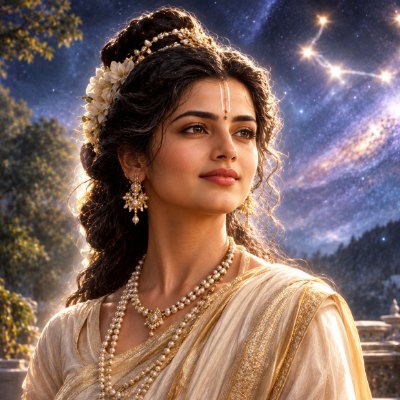
Arundhati is the wife of Vasishtha — one of the seven Saptarishis, the royal preceptor of the Ikshvaku Solar Dynasty, and the family priest of Rama's Raghu lineage — and one of the most universally venerated women in the Hindu tradition. She is described across the Vedic, Puranic, and epic tradition as the supreme exemplar of pativrata dharma — devoted wifehood as a spiritual discipline — whose chastity and single-pointed devotion to her husband gave her a spiritual power that surpassed that of ordinary beings. The Mahabharata states that her chastity and service to her husband are unparalleled — Svaha, the wife of Agni who had the power to assume the form of every other wife among the Saptarishi wives, could not assume Arundhati's form alone. She gave discourses on dharma to the seven sages themselves. She performed intense tapas to invoke Shiva's grace and end a twelve-year drought that had afflicted the Saptarishis in the Himalayas. She is the grandmother of the sage Parashara and the great-grandmother of the sage Vyasa through her son Shakti. She is identified in traditional Indian astronomy with the star Alcor — the faint companion of the brighter star Mizar (identified as Vasishtha) in the constellation Ursa Major — and the ritual of showing this double star to the bride during the Hindu marriage ceremony, performed as part of the Saptapadi, is one of the most ancient and widely observed rites in the tradition: the groom points out the Arundhati-Vasishtha star-pair to his new wife as the model of eternal conjugal loyalty. Her parentage is recorded differently across the primary texts — four distinct traditions give her four different fathers — and all are recorded honestly below.
✦ The Name
The Sanskrit name Arundhati — written Arundhatī — is derived from arun (the rays of the sun, the reddish light of dawn) and dhati (washed, bathed, absorbed); the compound meaning she who is washed by the rays of the sun, the dawn-radiant one. An alternate traditional etymology interprets the name as a (not) and rundhati (one who obstructs or blocks) — making the name mean she who never obstructs dharma, the unobstructing one. Vasishtha is accordingly called Arundhati Natha — the lord of Arundhati, the husband of Arundhati — throughout the tradition, identifying himself by his relationship to her as much as by his own name. The Sanskrit logical maxim Arundhatidarshananyaya — the method of inferring the unknown from the known by approaching it step by step through visible intermediaries, used in Navya Nyaya philosophical reasoning — is named after the traditional method of showing the faint Arundhati star by first pointing to brighter nearby stars and then gradually directing the gaze to the barely visible Alcor. The maxim records her name permanently in the technical vocabulary of Indian logic.
✦ Parentage — Four Traditions
Four distinct and incompatible accounts of Arundhati's parentage are found across the primary texts, each belonging to a different textual tradition. The Bhagavata Purana identifies Arundhati as the eighth of the nine daughters born to the sage Kardama and his wife Devahuti — the same Devahuti who is the middle daughter of Svayambhuva Manu and the mother of the divine philosopher Kapila. In this tradition Arundhati is the sister of Kapila and the eight other daughters of Kardama given to the nine Prajapatis; and she was given in marriage to Vasishtha by her parents in accordance with the dharmic arrangement that matched Kardama's daughters with the greatest sages of the age. The Shiva Purana and the Vedadhara account identify her as a reincarnation of Sandhya — Brahma's mind-born daughter — who had performed tapas to purify herself of passion, jumped into the sacred fire of the sage Medhatithi at Shiva's instruction, and was reborn as Medhatithi's daughter. In this tradition her father is Medhatithi and her previous identity is the cosmic figure Sandhya who personifies the twilight. A third tradition found in multiple Puranas identifies her as the daughter of Kashyapa — the universal progenitor, father of all species — and sister of Narada and Parvata. In this tradition it was her brother Narada who offered her in marriage to Vasishtha. A fourth tradition identifies her as the daughter of the sage Kardama Prajapati and Devahuti, which is consistent with the Bhagavata Purana account above, though some sources cite this separately as if the Kardama of the prajapati tradition were a different figure from the Kardama of the Bhagavata. All four traditions agree on the central facts: she married Vasishtha, she was a woman of supreme spiritual attainment, and her devotion to her husband was the source of her extraordinary power.
✦ Lineage
- Father (Bhagavata Purana): Kardama — the Prajapati sage; son of Brahma; whose wife was Devahuti (daughter of Svayambhuva Manu); who performed tapas on the banks of the Saraswati river for ten thousand years before Brahma directed him to marry
- Mother (Bhagavata Purana): Devahuti — daughter of Svayambhuva Manu (the first Manu) and Shatarupa; the middle of Manu's three daughters; who also bore the divine philosopher Kapila and eight other daughters given to the nine Prajapatis
- Father (Shiva Purana): Medhatithi — the sage whose sacrificial fire Sandhya was reborn from; making Arundhati his daughter in this tradition
- Previous birth (Shiva Purana): Sandhya — the mind-born daughter of Brahma; the personification of the twilight; who performed tapas to purify herself of passion and was reborn as Arundhati
- Brothers (third tradition): Narada — the divine wandering sage and devotee of Vishnu; and Parvata — another sage; both sons of Kashyapa in this tradition and her brothers who arranged her marriage to Vasishtha
- Husband: Vasishtha — one of the seven Saptarishis; one of Brahma's ten mind-born sons; the royal preceptor and family priest of the Ikshvaku Solar Dynasty and the Raghu lineage; who is identified with the star Mizar in Ursa Major; whose divine cow Nandini (calf of the wish-fulfilling Kamadhenu) was the occasion of his famous feud with the king-turned-sage Vishvamitra
- Sons: one hundred sons — cursed to death by Vishvamitra in the context of his feud with Vasishtha, as recorded in the Valmiki Ramayana (Bala Kanda); after their deaths she bore more sons — the most celebrated being Shakti and Suyagya, who studied at Vasishtha's hermitage alongside Rama; some traditions record eight sons including Shakti and Chitraketu
- Son of primary genealogical significance: Shakti — whose son was Parashara; whose son was Vyasa (Krishna Dvaipayana) — the sage who compiled the Vedas, composed the Mahabharata, and narrated or arranged the eighteen Puranas; making Arundhati the grandmother of Parashara and the great-grandmother of Vyasa
✦ The Power No Other Wife Shared
The Mahabharata records one of the tradition's most precise statements of Arundhati's spiritual stature through a negative definition. When Agni — the fire god — was inflamed with desire for the wives of the Saptarishis, the god Svaha — Agni's wife and the personification of the sacrificial offering-call — assisted him by assuming the forms of six of the seven Saptarishi wives in succession. She was able to take the exact form of each one: Shiva, Arundhati, Puloma's wife, and others — except one. The one form Svaha could not assume was Arundhati's. The explanation given in the tradition is that Arundhati's devotion to Vasishtha was so total, so undivided, and so concentrated that it had made her person impenetrable to impersonation — her identity as Vasishtha's wife had become identical with her deepest spiritual nature, and nothing external could replicate that identity. The same episode also records that Arundhati was not even present for the encounter, being engaged in ascetic practice — her absence from the episode was itself a mark of her quality.
✦ The Twelve-Year Drought
The Mahabharata records a sustained episode of twelve years of drought in which the Saptarishis were severely afflicted — without roots, without fruits, without adequate nourishment. Arundhati performed intense tapas and invoked Shiva's grace to end the drought and bring rain. Her intercession succeeded. The rains came. The Saptarishis and the devas praised her. The episode records what the tradition consistently asserts about her: that the power generated by her devotion and purity was not merely a personal virtue but a cosmically effective force — she was capable of intervening in natural catastrophes and reversing them through concentrated spiritual energy. Her tapas was not only for her own liberation but for the welfare of the world and of the sages — the power of pativrata dharma channelled outward as a cosmic resource.
✦ The Death of a Hundred Sons — Vishvamitra's Curse
The Valmiki Ramayana (Bala Kanda) records the long-standing and bitter rivalry between Vasishtha and Vishvamitra — originally a king of the Kusika dynasty who became the sage Vishvamitra after his encounter with Vasishtha's divine cow Nandini. In the course of this rivalry, Vishvamitra cursed the hundred sons of Vasishtha and Arundhati to die. The hundred sons perished. Arundhati, having lost all her children, continued her life with Vasishtha. She bore more children afterward — the most celebrated being Shakti, from whose line the sages Parashara and Vyasa descended, giving the tradition its greatest mythological genealogist in Vyasa himself. The loss of a hundred sons and the continuation of life, purpose, and devotion despite that loss is one of the tradition's quiet statements about Arundhati's spiritual endurance — a quality that receives less narrative attention than her chastity but that runs through the entire arc of her canonical story.
✦ In the Ramayana — The Gurupatni
Vasishtha was the family priest and royal preceptor of the Ikshvaku Solar Dynasty — the dynasty of Rama's Raghu lineage — and taught Rama and his brothers at his hermitage. Arundhati, as the wife of Rama's guru, held the status of Gurupatni — a position accorded the same respect as that of a mother in the tradition. Rama and Sita both bowed before her and sought her blessings. The tradition records that she was like a guardian angel of Sita — a protector and mentor of the Raghu lineage and its women. In Kalidasa's Kumarasambhava (the sixth canto), Arundhati played a significant role in pleading with Shiva to accept Parvati's tapas and agree to marry her — placing her at the centre of the most celebrated divine marriage in the tradition, as an advocate whose voice carried sufficient weight to influence the supreme ascetic's decision.
✦ The Star and the Marriage Ritual
In traditional Indian astronomy, the double star system of Mizar and Alcor in the constellation Ursa Major is identified as Vasishtha and Arundhati. Mizar — the brighter star — is Vasishtha; Alcor — the fainter companion that orbits close to Mizar — is Arundhati. The two stars are physically close together in the sky and move together as a pair, mirroring the tradition's image of the inseparable couple. During the Saptapadi — the seven steps taken together that constitute the central ritual of a Hindu marriage ceremony — the groom shows the bride the Arundhati-Vasishtha star pair as the model for their own marriage: the couple who travel eternally together through the sky, each visible best in the other's proximity, the brighter one and the fainter companion permanently united. The faintness of the Alcor star gave rise to the folk belief that a person near death cannot see the Arundhati star — its visibility in good health and its invisibility in declining health being read as a marker of vitality. The Sanskrit logical maxim Arundhatidarshananyaya — named after the method of gradually pointing the eye from bright visible stars toward the faint Alcor — became one of the standard technical terms of Indian philosophical reasoning, recording her name permanently in the vocabulary of epistemology.
✦ References
- Bhagavata Purana — Arundhati as the eighth of the nine daughters of Kardama and Devahuti; her marriage to Vasishtha; her son Shakti as the grandfather of Vyasa
- Shiva Purana — Arundhati as the reincarnation of Sandhya, Brahma's mind-born daughter; Sandhya's tapas to purify herself of passion; Shiva's instruction to jump into Medhatithi's fire; rebirth as Medhatithi's daughter; marriage to Vasishtha
- Valmiki Ramayana (Bala Kanda) — the rivalry between Vishvamitra and Vasishtha; the curse on Vasishtha and Arundhati's hundred sons; their death; the births of Shakti and Suyagya afterward; Arundhati as Sita's guardian and Gurupatni of the Raghu lineage
- Mahabharata — Arundhati as the supreme ascetic who gave discourses to the Saptarishis; her chastity described as unparalleled; the Svaha episode — Svaha's inability to assume her form; the twelve-year drought episode and her tapas that brought rain; Shakti and Parashara as her son and grandson
- Ramcharitmanas (Uttara Kanda) — Brahma's instructions to Arundhati; her meetings with Rama and Sita; her role as mentor of the Raghu lineage
- Kalidasa — Kumarasambhava (Sixth Canto) — Arundhati's role in pleading with Shiva to accept Parvati as his wife; her intercession in the most celebrated divine marriage of the tradition
- Jagadguru Rambhadracharya — Arundhati (Hindi epic poem, 1994) — the most comprehensive modern literary treatment of her life
- Wikipedia — Arundhati (Hinduism); Wikipedia — Vasishtha; Vedadhara — Arundhati; HinduScriptures.in — Arundhati; Mythoworld — Arundhati the Wife of Sage Vashishtha; Hindu Blog — Story of Arundhati; Athmavidyafoundation — Vasishtha and Arundhati Stars; Indianmirror — Vasishtha's Ardhangini: modern summaries drawing from the above primary sources