
About
Mena — Eldest Daughter of Svadha, Wife of Himavat, Mother of Parvati
Mena · Menaka · Menavati · Mainavati
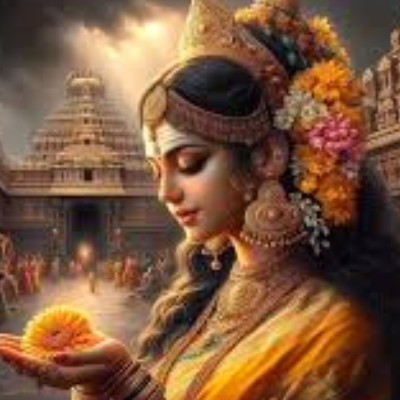
Mena is a celestial figure of considerable genealogical and theological importance within the Puranic tradition. She is the eldest of the three mind-born daughters of the Pitrs — the class of ancestral forefathers — who are conventionally regarded as daughters of Svadha, a daughter of Daksha and Prasuti, herself a daughter of Svayambhuva Manu and Shatarupa. Mena is the wife of Himavat, the divine personification and king of the Himalaya mountains, and she is most prominently celebrated as the mother of Parvati, the consort of Shiva. She also appears as mother of the river goddess Ganga and of the mountain son Mainaka. Her narrative is concentrated in the Shiva Purana, particularly its Rudra Samhita, Parvati Khanda, and she is further mentioned in the Bhagavata Purana, the Vishnu Purana, the Vayu Purana, the Brahmanda Purana, and the Saurapurana.
✦ The Name
The name Mena (also rendered Mena or Menaka) derives from a Sanskrit root connected with the concept of a mountain-woman or one dwelling among peaks; the form Menaka is a common feminised derivative used interchangeably with Mena in Puranic literature. The epithet Menavati — meaning "she who possesses or belongs to the mountain" — occurs in some recensions of the Parvati story. The Ramayana uses the form Mainavati in association with Himavat's consort, though some scholars treat Mainavati as a distinct figure (see Textual Variants below). The Shiva Purana itself uses both Mena and Menaka without distinction, treating them as the same person. She is not to be confused with the Apsara Menaka who appears in the Mahabharata as the celestial dancer who interrupts Vishvamitra's austerities and becomes the mother of Shakuntala; that Menaka is a wholly separate figure who belongs to the class of celestial nymphs.
✦ Lineage
- Maternal grandmother: Prasuti — daughter of Svayambhuva Manu and Shatarupa, the first primordial human couple; mother of the twenty-four daughters of Daksha
- Maternal grandfather: Daksha — the Prajapati, a lord of created beings and son of Brahma; father of numerous daughters distributed among the celestial orders
- Mother (conventional): Svadha — daughter of Daksha and Prasuti, given in marriage to the Pitrs (the ancestral forefathers); the sacred syllable of offering to ancestors bears her name
- Father (generative): The Pitrs collectively — the class of ancestral forefathers, of whom Kavi is named as their representative or presiding member in some recensions of the Shiva Purana; Mena is described as mind-born of the Pitrs and not born from Svadha's womb, yet she is conventionally counted as Svadha's daughter
- Sisters: Dhanya — the middle sister, fated to become wife of King Janaka and mother of Sita; Kalavati — the youngest sister, fated to become wife of Vrishabhanu and mother of Radha
- Husband: Himavat — the divine king and personification of the Himalaya mountains, worshipped as lord of mountains (Parvateshvara), a devoted follower of Shiva
- Sons: Mainaka — a mountain son who is described as the most powerful of Mena's one hundred sons and who becomes a friend of the ocean; Krauñcha — another son named in certain Puranic genealogies
- Daughters: Parvati — the great goddess, second consort of Shiva, born as a reincarnation of Sati; Ganga — the river goddess who descends from heaven to earth
✦ The Ayonija Birth
The Shiva Purana takes care to establish that Mena and her two sisters are ayonija — beings not born from the womb. Although Svadha is named as their mother by convention, the three daughters are described as mentally conceived by the Pitrs, arising through the power of the ancestral forefathers rather than through ordinary biological birth. This mode of origin places them in the category of extraordinary divine beings for whom standard genealogical description is a courtesy rather than a literal biological account. The text notes that merely uttering the names of the three sisters was considered capable of fulfilling the wishes of those who called upon them.
✦ The Episode at Shvetadvipa and the Curse of Sanatkumara
The pivotal narrative episode involving Mena and her sisters is set at Shvetadvipa, the island abode of Vishnu in the Ocean of Milk. The three sisters, possessing freedom of movement throughout the three worlds by virtue of their yogic power, arrived at this holy place and bowed before Vishnu. Thereafter, the four Kumaras — the great celibate sages Sanaka, Sanandana, Sanatana, and Sanatkumara, all sons of Brahma renowned for their spiritual attainment — arrived in the assembly. All those gathered rose to honour the Kumaras except the three sisters, who did not rise. The Shiva Purana attributes their failure to rise to the operation of Shiva's maya, a divine illusory power that obscured their perception in that moment. The Kumaras, and Sanatkumara in particular, were displeased by what appeared as disrespect from daughters of the Pitrs.
Sanatkumara pronounced that the three sisters would be born on earth as a consequence. When the sisters understood what had occurred and pleaded for relief, the sage relented and transformed the curse into a series of blessings. He declared that Mena, as the eldest, would become the wife of Himavat, the king of the mountains, and that the great goddess herself would be born as her daughter. That daughter — Parvati — would become the wife of Shiva, and through this union the purposes of the gods would be fulfilled. Thus what began as a curse became, within the Puranic logic of the text, the mechanism for a series of supreme divine incarnations across three worlds.
✦ Marriage to Himavat
Following Sanatkumara's declaration, the gods approached the abode of the Pitrs and requested that Mena be given in marriage to Himavat, who desired to marry so that he might extend his lineage and serve the gods and the ancestors. The Pitrs, mindful of Sanatkumara's pronouncement and satisfied with the proposal, consented. The marriage was celebrated with great ceremony, with the gods invited as witnesses and offering gifts to the couple. After the marriage, Mena and Himavat settled in the mountain realm.
✦ Mena's Care of Sati and Her Penance
The Shiva Purana records that while Sati — the first wife of Shiva and daughter of Daksha — used to sport in the Himalayan region, Mena and Himavat treated her with maternal care and affection. Mena regarded Sati as her own daughter. When Sati sacrificed her life at Daksha's yajna after being dishonoured there, Mena mourned her deeply. The text further notes that before her death, Sati resolved that she would be reborn as the daughter of Mena. After Sati's death, the gods, led by Vishnu, approached Mena and Himavat in the mountains and entreated the goddess Shakti to take birth again and reunite with the grieving Shiva. The goddess agreed, and on their advice, both Mena and Himavat undertook intense austerities — tapas — for twenty-seven years, devoted to Shiva and the goddess. Mena fashioned clay images of the goddess and worshipped them on the banks of the Ganga at Aushadhiprastha, observing fasts, making charitable gifts, and sustaining herself on water alone and at times on air alone. At the close of her austerities, the goddess appeared before her and granted the boon that she would be born as Mena's daughter.
✦ Birth of Parvati and Mena's Grief
Following the birth of the son Mainaka, Parvati was born to Mena at midnight in the month of Chaitra, under the Mrigashira constellation, as described in the Shiva Purana. The birth was accompanied by divine signs — rain of flowers and water from the sky, the assembly of gods — and Mena's city was filled with prosperity. When the sage Narada visited and revealed that Parvati's destiny was to perform severe austerities and win Shiva as her husband, Mena resisted. She could not bear the thought of her daughter leading the hard life of an ascetic. The narrative describes her attempting repeatedly to dissuade Parvati from her chosen path, and at the moment when Parvati's impending marriage to the unconventional, matted-haired Shiva appeared imminent, Mena gave voice to strong objections. Vishnu is described as visiting the household and explaining to Mena the greatness of Shiva, after which she relented — but only on the condition that Shiva assume a beautiful form. When Shiva appeared before her in a handsome guise at Narada's suggestion, Mena withdrew her objection and gave her blessing to the marriage.
✦ Textual Variants and Inconsistencies
Several significant variations exist across the primary sources.
Number of daughters and their names: The Shiva Purana's Rudra Samhita names three daughters of the Pitrs from Svadha — Mena, Dhanya, and Kalavati — and narrates the full story of their curse and blessed destinies. The Bhagavata Purana (Fourth Skandha, Chapter 1) names only two daughters of Svadha from the Pitrs — Vayuna and Dharini — and describes both as Brahmavadinis (women learned in the knowledge of Brahman) with no reference to a third daughter named Kalavati or to the Shvetadvipa episode. The Vishnu Purana similarly records two daughters, named Mena (equated with Vayuna in the Vayu Purana tradition) and Dharini. The Saurapurana also names two daughters — Mena and Dharini. This discrepancy between the two-daughter tradition of the older Puranas and the three-daughter tradition of the Shiva Purana is a clear inter-textual inconsistency that is not resolved in any single source.
Identity of the second sister: In the Bhagavata Purana, Vishnu Purana, and Saurapurana tradition, the second daughter is named Dharini and is given in marriage to Meru, not to Janaka. Dharini is thus a different figure from Dhanya, and the alignment of Dhanya with Sita's mother is confined to the Shiva Purana tradition and does not appear in the older Vaishnava Puranas.
Identity of Mena's name: The Vayu Purana employs the form Vayuna as the name of the elder daughter who is elsewhere called Mena. Whether this represents the same figure under a different name or a distinct figure in the Vayu Purana tradition is unclear from the available evidence.
Wife of Himavat in the Ramayana: The Ramayana names the wife of Himavat as Mainavati, daughter of Mount Meru, rather than as Mena daughter of Svadha. The Wikipedia article on Himavat notes this directly. These two accounts — Mena as daughter of the Pitrs via Svadha versus Mainavati as daughter of Meru — are not reconciled in the texts and represent a genuine discrepancy between the Valmiki Ramayana tradition and the Shiva Purana tradition.
Children of Mena: The Saurapurana records that Himavat and Mena had two sons, Mainaka and Krauñcha, and two daughters, Gauri (Parvati) and Ganga. The Shiva Purana speaks of one hundred sons, of whom Mainaka is the most powerful. The number one hundred is likely a conventional expression of abundance rather than a literal count.
✦ Theological and Genealogical Significance
Mena occupies a specific structural role in the Puranic genealogy of the Shakta tradition. She stands at the intersection of two lineages: she descends from Daksha through Svadha and the Pitrs, and she unites with Himavat to produce the great goddess in her earthly birth as Parvati. The Shiva Purana, which treats her most extensively, uses her figure to connect the lineage of Daksha — the patriarch whose conflict with Shiva led to Sati's death — with the restoration of the divine couple through a different genealogical line. Mena's own pious austerities and her prior maternal care of Sati become the mechanism through which the goddess chooses to be reborn in her household. She is thus not merely a passive genealogical link but an active devotee whose spiritual effort is presented as a necessary condition for the divine incarnation she carries.
Her ancestry from Svadha places her within the sacrificial economy of the Vedic tradition: Svadha is the sacred sound of offering poured to the Pitrs, and Mena is therefore, at a symbolic level, the fruit of that ancestral piety made personal and genealogically embodied.
✦ Connection to the Wider Genealogy
Mena's place in the Puranic genealogical scheme connects her to several major lineages. Through her mother Svadha she descends from Daksha and Prasuti, making her a great-granddaughter of Svayambhuva Manu and Shatarupa, the progenitors of humanity. Through her husband Himavat she is connected to the sacred geography of the Himalayan mountains. Through her daughter Parvati she is the mother-in-law of Shiva and the maternal grandmother of Ganesha and Kartikeya, two of the most widely worshipped deities of the Hindu tradition. Through her daughter Ganga she is the mother of the most sacred river in the Hindu world. Her sisters Dhanya and Kalavati, through their own destinies as mothers of Sita and Radha respectively, make Mena's family the one household from which the divine mothers of the three supreme avatara-related goddesses — Parvati, Sita, and Radha — all descend.
✦ References
Primary Sources
- Shiva Purana, Rudra Samhita, Parvati Khanda, Chapters 1–6 and Chapter 54: The principal source for Mena's biography; provides her origin, the Shvetadvipa episode, the pronouncement of Sanatkumara, her marriage to Himavat, her care of Sati, her tapas, the birth of Parvati, and her grief at Parvati's proposed marriage to Shiva.
- Bhagavata Purana, Fourth Skandha, Chapter 1, verses 63–64: Names the two daughters of the Pitrs from Svadha as Vayuna and Dharini rather than Mena and Dhanya; describes both as Brahmavadinis. This is the Vaishnava Puranic tradition's account of the lineage.
- Vishnu Purana, Book I, Chapter 7, verses 25–27 and Chapter 10, verse 19: Records Mena as a daughter of Svadha and the Pitrs; gives her as wife of Himavat.
- Vayu Purana, Chapter 1 verse 77; Chapter 10 verse 28; Chapter 52 verse 40; Chapter 55 verse 43: Uses the form Vayuna for the elder daughter equated with Mena; records the lineage from Svadha.
- Brahmanda Purana, Book II, Chapter 9 verse 57 and Chapter 13 verse 29: Confirms the lineage of Svadha's daughters.
- Saurapurana, Vamsha section: Names Mena and Dharini as the two daughters of the Pitrs and Svadha; records Mena's marriage to Himavat and their children as Mainaka, Krauñcha, Gauri, and Ganga.
- Valmiki Ramayana: Names the wife of Himavat as Mainavati, daughter of Meru, providing a divergent tradition from the Shiva Purana account.
Secondary and Reference Works
- Wisdomlib.org — definitions of Svadha, Mena, Menaka, and Dhanya: Aggregates cross-references from multiple Puranic indices and provides Cologne Digital Sanskrit Dictionary citations; useful for tracking textual variants across sources.
- Wikipedia — Himavat, Menaka, Parvati, Sati (Hindu goddess) articles: Provides a summary of secondary scholarship, cross-references to primary texts, and notes on the Ramayana variant of Himavat's wife.
- Glorious Hinduism website (summary of Shiva Purana, Parvati Khanda): Presents a narrative summary of Mena's story drawing on the Shiva Purana.
- Greenmesg.org (Shiva Purana, Parvati Khanda summary): Provides a detailed narrative summary of the incarnation of Devi Parvati as given in the Rudra Samhita of the Shiva Purana.