
About
Goddess Saraswati — Mother of the Vedas, Goddess of Knowledge, Speech, and the Arts
Saraswati · Vak · Vani · Bharati · Sharada · Vedamata · Vagishvari · Brahmi · Hamsavahini · Veenavaadini · Shatarupa · Putkari
Saraswati is the Hindu goddess of knowledge, learning, wisdom, speech, music, and the arts. She is one of the Tridevi — the trinity of principal goddesses — alongside Lakshmi and Parvati, who unite with the Trimurti of Brahma, Vishnu, and Shiva to create, preserve, and regenerate the universe. She is the consort of Brahma the creator. She is called Vedamata — mother of the Vedas — and is described in the Shanti Parva of the Mahabharata as the celestial creative symphony who appeared when Brahma created the universe. She is the inventor of Sanskrit. She is described as ayonija — not born from any womb, but divinely manifested. She is worshipped by students, scholars, poets, musicians, and artists as the source of all human creative and intellectual capacity. Her earliest appearance in sacred literature is in the Rigveda, where she is first invoked as a sacred river — one of the most powerful rivers of the Vedic world — before her transformation into the fully developed goddess of knowledge and speech that the Puranas establish.
✦ The Name
The name Saraswati is derived from saras — flowing water, lake, pool — and wati — she who possesses. Together: she who possesses flowing water or she who flows. The World History Encyclopedia also records the meanings elegant and flowing as part of the name's semantic range. The name's evolution in meaning traces the evolution of the goddess herself — from flowing sacred river to the flow of speech, from the flow of speech to the flow of knowledge, from the flow of knowledge to the cosmic creative force that purifies all it touches. She is known by over a hundred names in ancient Hindu literature, including Bharati (eloquence), Sharada (the autumnal one), Vagishvari (queen of speech), Brahmi (the Brahmic one), Vedamata (mother of the Vedas), and Hamsavahini (she who rides the swan).
✦ Origins — Across Traditions
The Puranas offer multiple accounts of Saraswati's origin. In the most widely known account, she emerged from Brahma's mouth during creation — symbolising the inseparable bond between knowledge and the act of creation. She was created by Brahma to assist him in the creative process, and immediately became the embodiment of that process. The Brahma Vaivarta Purana and Devi Bhagavata Purana offer a more cosmic account: at the onset of creation, the Atman divided into two — the right half becoming the male principle and the left half becoming Prakrti. Through the divine will of Para-Brahman, Prakrti assumed five forms — Durga, Radha, Lakshmi, Saraswati, and Savitri. In this account Saraswati is one of the five primary manifestations of primordial nature. The Matsya Purana records a third account in which Brahma created Saraswati and, as she circumambulated him, he developed additional faces on each side to follow her — the event that gave him his four heads. She is described as ayonija — not born from a womb — across all Puranic traditions.
In a Puranic variant recorded in the Brahmavaivarta Purana, Saraswati was originally the wife of Vishnu but after a conflict with her co-wife the Ganga, she became Brahma's wife. The Bhagavata Purana depicts her as the divine consort of Vishnu in his form as Hayagriva — the horse-faced avatar — where she aided him in retrieving the Vedas stolen by the demons Madhu and Kaitabha.
✦ Lineage and Divine Relationships
- Consort: Brahma — the creator god; she is his shakti — the active energy and power through which his creative function operates
- Alternate consort (some traditions): Vishnu — in the Brahmavaivarta Purana tradition
- Divine Trinity: Part of the Tridevi alongside Lakshmi (Vishnu's shakti) and Parvati (Shiva's shakti)
- Identification with Vac: In the Rigveda and Brahmanas she is explicitly identified with Vac — the goddess of sacred speech; by the time of the Mahabharata, Vac as a distinct entity fades entirely and Saraswati takes her place completely
- Identification with Gayatri and Savitri: In some Puranic traditions she is identified with Gayatri (the mother of the Vedas) and Savitri (the mother of the four Vedas); in others they are her co-wives or distinct aspects of the same divine feminine principle
- As Shatarupa: The World History Encyclopedia records Shatarupa — the first woman born from Brahma's body — as one of her names, identifying her with the primordial feminine form at the very beginning of creation
✦ In the Rigveda — Sacred River
Saraswati's earliest appearances in the Rigveda present her as one of the most powerful sacred rivers of the Vedic world — praised alongside the Ganga and the Yamuna as a source of fertility, purification, and good fortune. The Rigveda's earlier books describe her as a mighty flood, a nourisher of crops and communities, a destroyer of enemies, and a bestower of abundance. By the tenth Mandala she is already declared the possessor of knowledge. The Taittiriya Brahmana calls her the mother of eloquent speech and melodious music. The Shatapatha Brahmana explicitly identifies her with Vac — speech — establishing the connection between the river and the goddess of knowledge that would fully flower in the epic and Puranic periods. The Yajurveda describes her as both the mother of Indra and as his consort — reflecting the multiple cosmic roles she was understood to hold simultaneously.
In late Vedic texts the Saraswati River is described as having disappeared underground — becoming invisible while maintaining sacred significance. This disappearance is incorporated into the tradition of the Triveni Sangam at Prayagraj: where the Ganga and Yamuna meet physically, the Saraswati is said to join them invisibly as a mythical underground river — the unseen third stream of the triple confluence that millions visit at the Kumbh Mela.
✦ In the Mahabharata
The Mahabharata marks a decisive transformation in Saraswati's identity. She appears in the epic both as a sacred river for pilgrimage and as the fully developed goddess of speech, knowledge, and creation. In the Shanti Parva she is called the mother of the Vedas. Narayana tells Narada: Behold goddess Saraswati, the mother of the Vedas, established in me — affirming her as the source of divine knowledge. She is described as entering the bodies of sages, dwelling on the tongue, and inspiring sacred speech and composition. She is called Vishnu's tongue. She is invoked in the Sabha Parva as adding lustre to Indra's court. In the Vana Parva she serves as a passage for Shiva's chariot. In the Shanti Parva she appears in the vision of Yajnavalkya the moment he meditates on her. The epic records that the entire Mahabharata itself was narrated through her inspiration — she assumed the form of a river to aid Vyasa in composing the epic, imbuing it with poetic and intellectual depth.
✦ Iconography
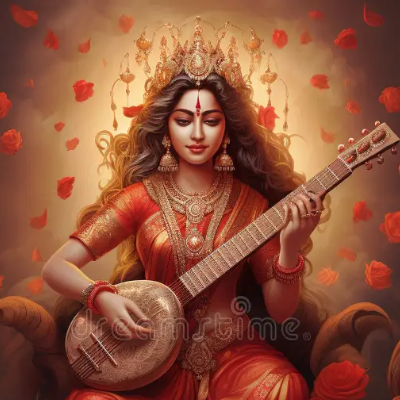
Saraswati is depicted as a beautiful woman of white or golden complexion, dressed in pure white — symbolising purity, knowledge, and truth. She wears a white sari with a blue border. She is typically not adorned with heavy jewellery, reflecting her indifference to worldly wealth. She may have a crescent on her forehead. She is depicted with four arms, representing the four aspects of human personality in learning: mind, intellect, alertness, and ego. Her four hands hold symbolic objects — in the classic four-armed form established by the Matsya Purana: a book (the Vedas — knowledge), a mala (rosary — discipline and meditation), a water pot (purity and discrimination), and a veena (the arts, harmony, and creative expression). In some forms the fourth hand is held in the varada mudra (boon-conferring) or abhaya mudra (fearlessness).
Her vehicle is the hamsa — the swan or goose — which symbolises wisdom and the capacity to discriminate between the real and the unreal, the eternal and the transient. She is also associated with the peacock — symbolising colourful splendour, celebration, and the capacity to transmute negativity into enlightenment. She is typically seated on a white lotus or a rock beside flowing water. She is called Hamsavahini for her swan-vehicle and Veenavaadini for her association with the veena.
Her Maha Saraswati form — described in the Devi Mahatmya — is eight-armed, depicted holding a bell, trident, ploughshare, conch, pestle, discus, bow, and arrow, with a lustre like the moon shining in the autumn sky.
✦ Domains
Saraswati governs the full range of human intellectual and creative life. She is the presiding deity of all forms of knowledge — from sacred Vedic learning to secular scholarship, from classical music to dance and poetry. She is regarded as the inventor of Sanskrit — the language of the gods and of the Vedas. She is recorded in the World History Encyclopedia as having given Ganesha the gifts of pen and ink — establishing her as the patron of writing and literature. She is the source of inspiration invoked at the beginning of most Sanskrit texts and at the opening of Vedic lessons through the Saraswati Vandana. Students invoke her blessings before examinations; musicians invoke her before performances; poets and writers invoke her at the beginning of composition.
✦ Worship and Festivals
Vasant Panchami — the fifth day of spring — is the principal festival dedicated to Saraswati, celebrated with great enthusiasm across India, Nepal, and the Hindu diaspora worldwide. During this festival devotees wear yellow — associated with wisdom and prosperity — and place their books, manuscripts, and musical instruments before her image seeking her blessings. Children are taught to write their first letters on this day. Students pray for academic success. The festival marks the beginning of preparation for spring harvests and the celebration of new beginnings in all fields of human endeavour. Saraswati is also worshipped as part of the Navaratri celebrations and features in Saraswati Puja across multiple regional traditions.
✦ Beyond Hinduism
Saraswati is revered outside Hinduism across multiple traditions and geographies. She is worshipped in Jainism as the goddess of learning. In Mahayana Buddhism she became the consort of Manjushri and a protectress of the Dharma — depicted in a martial, weapon-bearing form in texts like the Golden Light Sutra. In Japan she became Benzaiten — one of the seven gods of fortune — where she is among the most widely worshipped of all deities. She is also venerated in Vietnam, Indonesia, Myanmar, and Cambodia, where her form and associations with music, learning, and flowing water were absorbed into local Buddhist and Hindu traditions.
✦ References
- Rigveda — Books 1–7: Saraswati as the most sacred river of the Vedic world; Books 6 and 7: descriptions of her as destroyer of enemies and nourisher of creation; Book 10: declared possessor of knowledge; Mandala 10.17.7: listed alongside Ganga and Yamuna
- Yajurveda — describes Saraswati as both the mother of Indra and his consort
- Taittiriya Brahmana (Book 2) — called the mother of eloquent speech and melodious music
- Shatapatha Brahmana — explicitly identifies Saraswati with Vac (sacred speech)
- Mahabharata (Vyasa) — Sabha Parva (2.7.19): Saraswati in Indra's court; Vana Parva (3.34.34): passage for Shiva's chariot; Shanti Parva (12.306): entering sages' bodies, dwelling on the tongue; Shanti Parva (12.326.5): Narayana declares her mother of the Vedas; Shanti Parva (12.231.8): dwelling on the tongue; Shanti Parva (12.318.14): appearing in Yajnavalkya's vision; Bhishma Parva (6.61.56): called Vishnu's tongue
- Brahma Vaivarta Purana — Saraswati as one of the five forms of Prakrti; her conflict with Ganga leading to her becoming Brahma's wife
- Devi Bhagavata Purana — Saraswati as one of the five primary manifestations of Mula Prakrti
- Matsya Purana — the classic four-armed iconographic description; Brahma's additional faces arising as Saraswati circumambulated him
- Devi Mahatmya — the eight-armed Maha Saraswati form
- Bhagavata Purana — Saraswati as consort of Vishnu-Hayagriva; her role in recovering the stolen Vedas
- Wikipedia — Saraswati; Britannica — Saraswati; World History Encyclopedia — Saraswati; Exotic India Art — Saraswati from Vedas to our Altar: modern summaries drawing from the above primary sources