
About
The Pitris — the Ancestral Beings, Husbands of Svadha
Pitaras · Pitrs · Ancestors · Recipients of the Shraddha · Lords of the Pitriloka
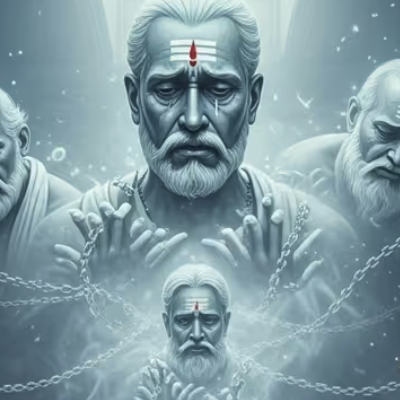
The Pitris are the collective body of ancestral beings who inhabit their own realm, the Pitriloka, and receive the oblations offered by their living descendants in the rites of shraddha and tarpana. In the Puranic genealogical tradition, the Pitris as a collective are reckoned as the husbands of Svadha, a daughter of Daksha Prajapati and his consort Prasuti, making Svadha a Dakshayani — one born of Daksha. The Pitris receive nourishment through Svadha, whose very name denotes the sacred utterance by which oblations are dedicated to the ancestors. They appear prominently in the Vishnu Purana, the Bhagavata Purana, the Markandeya Purana, the Vayu Purana, the Matsya Purana, the Shiva Purana, and the Mahabharata, where their classes, origins, and the rites owed to them are elaborated in considerable detail.
✦ The Name
The term Pitri derives from the Sanskrit root meaning father, and Pitaras is its plural form — the fathers, or more broadly, the ancestral ones. The designation encompasses not only one's own deceased forefathers but the entire class of ancestral beings who have attained a specific post-mortem existence in the Pitriloka. They are also referred to as the Pitrs in Vedic usage. The word Svadha, which names their collective consort, itself means self-sustaining power or the sacred formula of offering, and it is through this oblatory utterance that the living feed the Pitris. The connection between Svadha as a goddess and Svadha as the ritual formula is deliberately maintained in the Puranic tradition, identifying the Pitris' wife with the very substance of ancestral nourishment.
✦ Lineage
- Consort: Svadha — daughter of Daksha Prajapati, the great progenitor and lord of creation, and his wife Prasuti, herself a daughter of Svayambhuva Manu; Svadha is one of Daksha's daughters assigned to the Pitris as their collective wife and is the presiding deity of ancestral oblations
- Eldest daughter: Mena (also Menaka, Maina) — mind-born of the Pitris from Svadha, not born from the womb; a Yogini endowed with freedom of movement through the three worlds; wife of Himavat, the divine king of the Himalaya mountains; mother of the goddess Parvati, consort of Shiva, and of the river goddess Ganga; her marriage to Himavat was arranged by the gods with the consent of the Pitris
- Middle daughter: Dhanya — mind-born of the Pitris from Svadha; described in the Shiva Purana as a Yogini; wife of Janaka, the philosopher-king of Videha and Mithila; mother of Sita, who became the wife of Rama in the Treta Yuga
- Youngest daughter: Kalavati — mind-born of the Pitris from Svadha; the youngest of the three sisters; declared by Sanatkumara at Shvetadvipa to become the wife of Vrishabhanu the cowherd chief of Vraja; in her rebirth as Kirtida (also Kirti, Kirtikumari) she became the earthly mother of Radha, the supreme consort of Krishna in the Dvapara Yuga and identified in the devotional tradition as an incarnation of Mahalakshmi
✦ Classes of the Pitris
The Puranic texts do not treat the Pitris as a single undifferentiated group but enumerate several distinct classes. The Vishnu Purana and the Vayu Purana describe the Pitris as divided broadly into two categories: those with bodily form (Samurtimantah) and those without form (Amurtimantah). Among the named groups, the Somasads are described as the Pitris of the gods, born of Viraj; the Agnishvattas are the Pitris of the sages; the Barhishads are Pitris associated with the performance of fire rites; and further groups such as the Havishmats, Ajyapas, and Sukalins are named in various texts. The Mahabharata's Anushasana Parva and the Vayu Purana provide some of the most detailed enumerations of these classes, though precise membership and origin stories vary between accounts.
The Markandeya Purana identifies certain Pitri groups as sprung from specific progenitors — such as the Agnishvattas being associated with the mind-born sons of Brahma who did not maintain domestic fires — while the Bhagavata Purana presents variant accounts of their origins. In several texts the Pitris as a collective body are described as offspring of the great Prajapatis or of Brahma himself, situating them within the primary cosmic generation rather than as merely mortal ancestors who have died.
✦ The Three Daughters and the Episode at Shvetadvipa
The Shiva Purana's Rudra Samhita, Parvati Khanda (2.3.2) records a significant narrative concerning the three daughters of the Pitris and Svadha. All three daughters — Mena, Dhanya, and Kalavati — were mind-born rather than womb-born, endowed with yogic power and freedom of movement through the three worlds. On one occasion the three sisters travelled to Shvetadvipa, the divine island of Vishnu in the Ocean of Milk. When the four Kumaras — the perpetually celibate sages Sanaka, Sanandana, Sanatana, and Sanatkumara, all mind-born sons of Brahma — arrived at the same assembly, every person present rose in respect except the three sisters. The Shiva Purana attributes this lapse to the operation of Shiva's maya. Sanatkumara pronounced that they would take birth on earth.
When the three sisters appealed for relief, Sanatkumara transformed the pronouncement into a declaration of divine destiny. Mena would become the wife of Himavat and mother of Parvati. Dhanya would become the wife of King Janaka and mother of Sita. Kalavati, the youngest, would become the wife of Vrishabhanu the cowherd chief, and Radha — described as a companion of Krishna — would be born as her daughter. Through this single episode the Shiva Purana frames the three sisters as the pre-ordained maternal vessels through which three successive divine births of the great goddess were accomplished across the Treta and Dvapara Yugas.
✦ The Pitriloka and the Shraddha Rite
The Pitris dwell in the Pitriloka, a specific realm of existence described in both the Mahabharata and the Puranas as lying between the terrestrial world and the higher celestial realms, governed in many accounts by Yama, the lord of the dead. The sustenance of the Pitris depends upon the shraddha and tarpana rites performed by their descendants — offerings of water, sesame, and cooked food made with the utterance of svadha. This dependence is treated as cosmologically significant: the maintenance of the ancestral world is understood as one of the three debts (rinas) owed by every twice-born man, the others being the debt to the gods repaid through yajna and the debt to the sages repaid through Vedic study.
The Mahabharata's Vana Parva and Anushasana Parva, as well as several Puranas, describe the cosmic importance of shraddha in extensive terms, identifying the Pitris as beings who can bless their descendants with progeny, prosperity, health, and heavenly attainment when properly propitiated, and who are neglected at great peril.
✦ Textual Variants and Inconsistencies
The number and names of the daughters born of the Pitris and Svadha differ significantly between textual traditions. The older Puranic stratum — the Vishnu Purana, Bhagavata Purana, Vayu Purana, Brahmanda Purana, and Matsya Purana — records only two daughters: Mena (or Vayuna in some versions) and Dharini. Kalavati and Dhanya do not appear in any of these older texts. The tradition of three daughters — Mena, Dhanya, and Kalavati — is specific to the Shiva Purana's Parvati Khanda and to the later Vaishnava devotional texts including the Padma Purana, the Garga Samhita, and the Brahma Vaivarta Purana, all of which elaborated the theological apparatus surrounding Radha's birth.
The identity of the middle sister is itself inconsistent between sources. The Shiva Purana names her Dhanya and identifies her as wife of Janaka and mother of Sita. A variant found in the Garga Samhita tradition — as summarised in secondary accounts of that text — names the three daughters of the Pitris as Kalavati, Ratnamala, and Menaka, with Ratnamala in the middle position corresponding to Janaka's wife. Whether Dhanya and Ratnamala are two names for the same figure or represent distinct traditions about the middle sister cannot be resolved from the available evidence.
The origin of the Pitri classes is similarly inconsistent across sources. The Vishnu Purana and Vayu Purana assign different progenitors to the various Pitri groups than does the Bhagavata Purana. These are genuine inter-textual discrepancies for which no harmonised resolution is offered in the primary sources themselves. On the question of whether the Pitris are one husband of Svadha or a plurality, the Puranic texts treat the matter as a collective marriage — Svadha is assigned to the Pitris as a group, not to any one ancestral being individually. This is the consistent presentation across the Vishnu Purana, Bhagavata Purana, Shiva Purana, and Markandeya Purana.
✦ Theological Significance
The Pitris occupy a cosmologically essential position in the Hindu understanding of the three-world order, forming the middle tier of a hierarchy of obligation that runs from the human world upward through the ancestral realm to the divine. The Rigveda addresses the Pitris directly in hymns concerned with death and the afterlife, and the Atharvaveda contains material relevant to ancestral rites. In the later Puranic synthesis, the Pitris are integrated into the genealogical framework through Svadha's descent from Daksha, connecting the cosmic ancestral function to the primary act of creation associated with the Prajapati lineage. The monthly dark fortnight known as Pitripaksha, and the annual fortnight of Mahalaya, are understood as periods especially consecrated to the propitiation of the Pitris. Through the Shiva Purana's construction of the three daughters, the Pitris are further elevated to the status of the paternal ancestors of three of the most celebrated goddess-figures of the tradition — Parvati, Sita, and Radha — making their lineage, through Svadha, the common maternal root of three successive divine births across the Treta and Dvapara Yugas.
✦ Connection to the Wider Genealogy
Through their marriage to Svadha, the Pitris are connected to the line of Daksha Prajapati, one of the great progenitors of beings, son of Brahma in most Puranic accounts, and father of a large number of daughters assigned as wives to gods, sages, and cosmic principles. Svadha is among these daughters, alongside Sati (first wife of Shiva), Aditi (mother of the Adityas), Diti (mother of the Daityas), and others. Through their eldest daughter Mena — wife of Himavat and mother of Parvati — the Pitris are the maternal grandparents of the great goddess who became Shiva's consort. Through their middle daughter Dhanya — wife of Janaka and mother of Sita — they are the maternal grandparents of the consort of Rama. Through their youngest daughter Kalavati — who was reborn as Kirtida, wife of Vrishabhanu, in the Dvapara Yuga — they are the maternal grandparents of Radha, identified in the devotional tradition as an incarnation of Mahalakshmi and the supreme consort of Krishna. This triple connection, constructed principally by the Shiva Purana and elaborated in the later Vaishnava devotional corpus, makes the Pitris the shared ancestral source of the three great divine feminine births celebrated across successive yugas in the Puranic tradition.
✦ References
- Vishnu Purana, Book I, Chapter 7 and Book II, Chapter 6: Lists Svadha as a daughter of Daksha assigned to the Pitris; names Mena and Dharini as daughters born of this union; describes the Pitriloka and the classes of Pitris including Somasads, Agnishvattas, and Barhishads.
- Bhagavata Purana, Book IV, Chapters 1 and 6: Enumerates Daksha's daughters and their assignments, including Svadha to the Pitris; names Mena as daughter of the Pitris and wife of Himavat; provides accounts of Parvati's descent.
- Shiva Purana, Rudra Samhita, Parvati Khanda, Chapter 2.3.2: The primary source for the tradition of three daughters — Mena, Dhanya, and Kalavati; narrates the episode of the three sisters at Shvetadvipa, Sanatkumara's pronouncement, and the pre-ordained destinies linking each sister to the birth of a great goddess.
- Markandeya Purana (trans. Pargiter): Discusses classes of Pitris, their origins from various progenitors, and the nature of the shraddha rite; provides variant details on Svadha's offspring.
- Vayu Purana, Chapter 73 (Shraddha Kalpa section): One of the most detailed Puranic accounts of the classes of Pitris, their names, origins, and the proper rites for their propitiation.
- Matsya Purana: Contains accounts of Daksha's daughters and their assignments, including Svadha; enumerates Pitri classes in the context of ancestral rites.
- Padma Purana: Preserves the previous-birth narrative of Kalavati and her husband Suchandra; records Brahma's boon that they would be reborn and receive the goddess Lakshmi as their daughter Radha; also gives the account of Radha's discovery as a divine infant on the Yamuna.
- Garga Samhita, Chapter 16 (Sri Radhika vivaha varnana) and Tulasi-worship episode: Explicitly identifies Radha as daughter of Kalavati; confirms the previous-birth identities of Vrishabhanu as Suchandra and Kirtida as Kalavati; preserves the verse in which Tulasi addresses Radha as daughter of Kalavati; also contains a variant naming the three daughters of the Pitris as Kalavati, Ratnamala, and Menaka.
- Brahma Vaivarta Purana: One of the principal texts elaborating the theology of Radha and Krishna; situates Vrishabhanu and Kirtida as Radha's parents in the Dvapara Yuga; contains material on Kalavati's previous-life identity within the genealogical apparatus of Radha's birth.
- Mahabharata, Anushasana Parva (Book XIII): Contains extensive passages on the importance of the shraddha rite, the nature of the Pitris, and the blessings they confer on properly observant descendants.
- Mahabharata, Vana Parva (Book III): Contains narrative and didactic material on the obligations owed to the Pitris and the consequences of neglecting ancestral rites.
- Rigveda, Book X (hymns to the Pitris): The earliest stratum of Vedic address to the ancestral beings; foundational textual basis for the concept of the Pitris as a distinct class of beings receiving oblations.
- Atharvaveda: Contains hymns and formulae relevant to ancestral propitiation and the departure of the dead to the ancestral realm.
- V. S. Apte, The Practical Sanskrit-English Dictionary: Provides etymological notes on the terms Pitri and Svadha.
- Vettam Mani, Puranic Encyclopaedia: Consolidates cross-textual references to the Pitris, Svadha, Mena, Dhanya, Kalavati, and the shraddha tradition across the major Puranas.