
About
Tara — Wife of Brihaspati, Abducted by Chandra, and Mother of Budha
Tara · Taradevi · Brihaspatitpatni · Chandrapriya · Tarakamayajanani
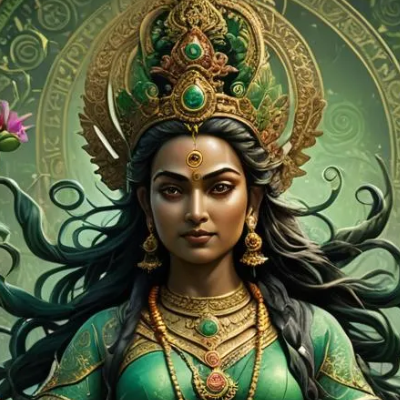
Tara is the wife of Brihaspati — the divine preceptor of the gods, lord of sacred wisdom, and the teacher of the Adityas and the divine assembly — and the mother of Budha, the planetary deity identified with the planet Mercury and the progenitor of the Lunar dynasty from whose line the principal royal and heroic figures of the Mahabharata descend. Tara is the central figure of one of the most cosmologically consequential episodes in the Puranic tradition: her abduction by Chandra, the moon god, who refused to release her despite the repeated demands of Brihaspati and the gods, precipitated the Tarakamaya war — a cosmic conflict in which the gods and demons divided into opposing factions — and ultimately produced, through Chandra's union with her, the child Budha, whose birth links the divine lunar sphere directly to the human royal dynasties of the epics. Tara appears in the Vishnu Purana, the Bhagavata Purana, the Mahabharata, the Brahma Purana, and several other texts. Her personal narrative is concentrated in the Tarakamaya episode, and she is not the subject of any extended independent narrative beyond it.
✦ The Name
The name Tara derives from the Sanskrit root tr, meaning to cross over, to traverse, or to save, and carries the primary meanings of star, the pupil of the eye, and a saviour or one who helps cross over. In its astronomical sense, Tara designates a fixed star as distinct from the planets — the wandering lights — and this meaning is directly relevant to her narrative context, in which her abduction by the moon god — a wandering luminary — from the household of Brihaspati — whose name means lord of the vast or lord of prayer and sacred speech — can be read as a mythological encoding of the relationship between the moon and the fixed stars through which it passes. The patronymic Brihaspatitpatni means "wife of Brihaspati." The designation Tarakamayajanani means "she who gave rise to the Tarakamaya war" — a designation that marks her specifically as the occasion of the cosmic conflict rather than as its agent.
✦ Lineage
- Parentage: The primary texts do not record Tara's parentage. The Vishnu Purana, Bhagavata Purana, and Mahabharata introduce her as the wife of Brihaspati without naming her father or mother. This profile accordingly makes no claim regarding her origin beyond what the sources state.
- Husband: Brihaspati — the divine preceptor of the gods, son of the sage Angiras and one of the most important figures in the divine hierarchy. Brihaspati is the teacher of sacred learning, the master of ritual procedure, and the counsellor of Indra and the Adityas. His name is etymologically connected to brihati — the vast or the expansive — and pati — lord — yielding the sense of "lord of the vast" or "lord of sacred speech." He is identified with the planet Jupiter in the Navagraha system of Jyotisha and is regarded as the most learned and wise of all divine beings. His household is thus a household of supreme sacred dignity, making Chandra's violation of it a transgression of the gravest order.
- Son: Budha — the planetary deity identified with the planet Mercury, born of Tara's union with Chandra during her period of abduction. Budha is of extraordinary brilliance and learning. His birth is narrated in the context of the Tarakamaya war's resolution, when Tara — returned to Brihaspati after Brahma's intervention — revealed under questioning that the child she bore was Chandra's son rather than Brihaspati's. Budha is the progenitor of the Chandravamsha, the Lunar dynasty, through his son Pururavas.
✦ The Abduction by Chandra and the Tarakamaya War
The episode of Tara's abduction is narrated in the Vishnu Purana's fourth book, the Bhagavata Purana's ninth book, the Mahabharata's Adi Parva, and the Brahma Purana, with some variation in detail between accounts. Chandra — the moon god, son of the sage Atri — was overcome by desire for Tara and abducted her from Brihaspati's household by force. Brihaspati demanded her return. Chandra refused. The gods, recognising the seriousness of the transgression — the violation of the household of their own divine preceptor was an act of the gravest disrespect toward the sacred teacher-disciple bond and toward the principle of dharmic order that Brihaspati embodied — sided with Brihaspati and pressed Chandra repeatedly to release Tara. Chandra continued to refuse.
The conflict escalated into the Tarakamaya war — named after Tara as its occasion. The gods, led by Indra, took the side of Brihaspati. The demons — specifically the Daityas and Danavas — took the side of Chandra, seeing in this conflict an opportunity to challenge the divine order. The sage Shukra — Shukracharya, the preceptor of the demons and himself a figure of immense learning and power who is in perpetual rivalry with Brihaspati — aligned himself and his demon disciples with Chandra's cause, giving the war a dimension of the eternal rivalry between the two divine preceptors. Other beings of ambiguous alignment — including certain sages and cosmic powers — were also drawn in. The Vishnu Purana's account is the most detailed in describing the sides of the conflict; the Bhagavata Purana's account is more compressed but consistent in its essential facts.
The war caused great destruction and disorder in the three worlds. Brahma — the creator, whose authority stood above the conflict between the gods and demons — finally intervened directly. He commanded Chandra in the most unambiguous terms to return Tara to Brihaspati immediately, declaring that Chandra's conduct was a disgrace unworthy of a divine being and that the continuation of the abduction was a violation of cosmic order that Brahma himself would not permit. Faced with Brahma's direct command, Chandra complied and returned Tara to her husband.
✦ The Revelation of Budha's Paternity
When Tara was returned to Brihaspati, she was visibly pregnant. The assembled gods, Brihaspati, and Brahma himself were greatly concerned: the paternity of the child would determine whether the child belonged to the household of the gods' preceptor or to the domain of the moon god who had transgressed against that household. Brahma pressed Tara to speak the truth about the child's father. The Vishnu Purana and Bhagavata Purana both narrate that Tara remained silent for some time, overcome by shame — shame at having been the occasion of a cosmic war, shame at the circumstances of the child's conception, and shame before her husband and the assembled divine court. Brahma repeated his demand that she speak with directness and without concealment. Tara then acknowledged that the child was Chandra's son.
Chandra, on hearing this confirmation, acknowledged the child and expressed great joy at having fathered a son of such extraordinary radiance and brilliance. The child born was Budha — whose luminous quality was evident from birth, surpassing in certain respects even his remarkable parentage on both sides. Brihaspati, the wronged husband, acknowledged the child's extraordinary qualities but did not claim him as his own, since the paternity had been honestly declared. The episode in this way closes with Tara's shame publicly recorded, the child's parentage established as irregular but honestly admitted, and Budha identified as Chandra's son — the first link in the chain of the Lunar dynasty.
Tara's silence before Brahma's questioning is a detail that the primary texts present with some care. The Vishnu Purana notes that the gods and sages, as well as Brihaspati, urged her to speak during the period of her silence, and that it was specifically Brahma's repeated and insistent demand that finally moved her to answer. The tradition does not comment directly on what Tara's silence during this period signified in terms of her own internal state, but the structure of the episode — with its public questioning, its repeated demands, and its eventual honest admission — positions Tara as a figure of profound shame rather than concealment: she does not deny the truth but delays its utterance.
✦ Tara's Agency and Characterisation
The primary texts present Tara as a figure of essentially passive experience in the Tarakamaya episode: she is abducted, detained, returned, questioned, and ultimately honest, but she does not speak, act, or make choices that drive the narrative at any point until her final admission of Budha's paternity. The tradition does not record her own account of her experience during the abduction or her response to Chandra's conduct. This silence of the primary sources about Tara's inner experience and her own agency during the episode is a genuine feature of the texts as they survive and should not be supplemented by inference or assumption. What the texts do record is her honest answer under Brahma's questioning — an act that required personal courage given the circumstances — and the fact that her honesty, however delayed, was the act that resolved the narrative and established the Chandravamsha genealogy on accurate foundations.
✦ Textual Variants and Inconsistencies
The sides in the Tarakamaya war: The Vishnu Purana, Bhagavata Purana, and Mahabharata agree on the broad alignment — gods with Brihaspati, demons with Chandra — but differ on which specific beings sided with Chandra and on the role of Shukra. The Vishnu Purana gives the most detailed account of Shukra's alignment with Chandra and the demons' opportunistic involvement. The Mahabharata's account in the Adi Parva is the most compressed and does not name all the participants. The Brahma Purana's version is broadly consistent with the Vishnu Purana.
Tara's subsequent relationship with Brihaspati: The texts do not narrate what happened to Tara's relationship with Brihaspati after her return and the revelation of Budha's paternity. The primary sources record her return and the birth of Budha but do not continue her personal narrative beyond these facts. Whether she remained in Brihaspati's household, whether the relationship between husband and wife was restored to its prior state, or whether Brihaspati regarded her differently after the episode — none of these questions are addressed in the surviving primary literature. This profile makes no claim about these matters in the absence of textual evidence.
A separate figure named Tara in the Ramayana: The Ramayana tradition contains a figure named Tara who is the wife of Vali — the monkey king of Kishkindha — and who is a prominent character in the Kishkindha Kanda of the Valmiki Ramayana. This Tara is an entirely separate figure from Brihaspati's wife Tara and the two must not be conflated. The shared name reflects the common Sanskrit word for star and carries no genealogical or narrative connection between the two figures.
✦ Theological Significance
Tara's theological significance in the tradition operates principally through her role as the occasion of the Tarakamaya war and as the mother of Budha. As the occasion of the war, she is the pivot around which the tradition explains the ancient rivalry between Brihaspati and Shukra — the two divine preceptors of opposing cosmic factions — and the cosmic instability that results when the principle of desire (embodied in Chandra's act) overrides the principle of sacred order (embodied in Brihaspati's household). As the mother of Budha, she is the birth-mother of the entire Chandravamsha, giving the Lunar dynasty's origin not only the divine lunar ancestry of Chandra but also the connection — through Tara's position in Brihaspati's household — to the world of divine wisdom and sacred learning that Brihaspati governs. Budha's extraordinary brilliance and learning, noted in all the primary texts, can thus be read as reflecting both his lunar father's luminous power and his mother's proximity to the divine preceptor's household of sacred knowledge.
✦ Connection to the Wider Genealogy
Through her son Budha and his son Pururavas — born of the celestial nymph Urvashi — Tara is the divine grandmother of Pururavas and the remote ancestress of all the royal figures of the Chandravamsha. The line from Pururavas descends through Ayu, Nahusha, and Yayati — whose division of the earth among his sons generates the major Puranic dynastic traditions — and through Yayati's son Puru to the Paurava line, from which descend Dushyanta, Bharata, Kuru, Shantanu, and ultimately the Pandavas and Kauravas of the Mahabharata. Every figure of the Lunar dynasty is thus Tara's descendant at a remove of several generations, making her — despite the painful and irregular circumstances of Budha's conception — one of the most genealogically consequential female figures in the entire Puranic tradition. Her husband Brihaspati, through his identity as the planet Jupiter and the divine preceptor, is structurally connected to Chandra — the planet Moon — in the astronomical tradition in a relationship of teacher and student and of rival sacred preceptors, a relationship whose mythological origin the Tarakamaya episode provides.
✦ References
Primary Sources
- Vishnu Purana, Book 4, chapter 6: The most detailed Mahapuranic account of the Tarakamaya war — naming the sides in the conflict, describing Brahma's intervention, and narrating the return of Tara, her questioning by Brahma, and the revelation of Budha's paternity. The primary Puranic narrative source for Tara's biography.
- Bhagavata Purana, Book 9, chapter 14: A more compressed but consistent account of the Tarakamaya episode and the birth of Budha; provides the Bhagavata Purana's version of the questioning and admission of paternity and of the transition to the Chandravamsha genealogy.
- Mahabharata, Adi Parva, sections 75–76: The epic's account of the Tarakamaya war, providing a third major version of the episode with some variation in the detail of participants and course of events.
- Brahma Purana, chapters 24–26: Contains an account of the Tarakamaya war broadly consistent with the Vishnu Purana version; provides comparative material on the episode.
- Matsya Purana, chapters 23–24: Narrates the Tarakamaya episode and the birth of Budha in a version with some distinctive details relative to the Vishnu and Bhagavata Purana accounts.
- Harivamsa, chapter 1: Contains genealogical material on the Chandravamsha beginning with Budha, affirming Tara's role as Budha's mother within the Lunar dynasty's foundational genealogy.
Modern Reference Works
- Vettam Mani, Puranic Encyclopaedia (1975): Entry on Tara (wife of Brihaspati); collates the primary references across texts, summarises the Tarakamaya war, and distinguishes this Tara from the Ramayana's Tara wife of Vali.
- Wendy Doniger O'Flaherty, Women, Androgynes, and Other Mythical Beasts (1980): Includes analysis of the Tarakamaya episode and Tara's position within it as a passive figure around whom active male violence is organised; relevant to understanding the narrative structure of the episode and Tara's characterisation within it.
- Sukumari Bhattacharji, The Indian Theogony (1970): Examines the Tarakamaya war in the context of the rival divine preceptors Brihaspati and Shukra and the broader cosmic significance of the conflict, situating Tara's role within the theological framework of the tradition.
- A. A. Macdonell and A. B. Keith, Vedic Index of Names and Subjects (1912): Entry on Tara; establishes the Vedic background of the name and its astronomical associations as a designation for the fixed stars.