
About
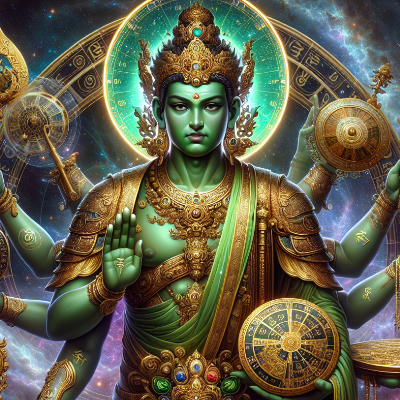
Budha — Son of Chandra and Tara, Lord of Mercury, and Progenitor of the Lunar Dynasty
Budha · Saumya · Chandraputra · Rohinisuta · Tarasuta · Rauhineya · Prajnapati · Navagraha-Budha
Budha is the son of Chandra — the moon god, lord of the nakshatras, and a figure of central importance in the Vedic and Puranic tradition — and of Tara, the wife of Brihaspati the divine preceptor of the gods, who was abducted by Chandra and returned to her husband after the Tarakamaya war. Budha is identified as the planetary deity presiding over the planet Mercury — the second of the inner planets in the solar system, known in Indian astronomical tradition as the swift-moving planet closest in appearance to the sun. He is one of the nine Navagrahas — the planetary deities whose positions govern human destiny in the Jyotisha tradition — and is celebrated in the tradition for extraordinary intelligence, learning, and eloquence. Most significantly for the genealogical tradition, Budha is the progenitor of the entire Chandravamsha — the Lunar dynasty — through his son Pururavas, born of the celestial nymph Urvashi. Through Pururavas the line descends through the great royal and heroic figures of the Mahabharata, making Budha the first fully human-world link in a chain of descent that connects the divine lunar sphere to the kings and warriors of the epics. Budha appears in the Vishnu Purana, the Bhagavata Purana, the Harivamsa, the Mahabharata, and several other texts.
✦ The Names
The name Budha derives from the Sanskrit root budh, meaning to know, to understand, to be awake, or to be intelligent. The name thus means "the wise one," "the intelligent one," or "he who knows" — a designation that the tradition consistently reinforces through descriptions of Budha's extraordinary learning and intellectual brilliance. This root also gives the word buddhi — intellect or discerning wisdom — and is cognate with the name of Siddhartha Gautama as the Buddha — the awakened one — though the two figures are entirely distinct. The tradition itself does not draw a connection between Budha the planetary deity and the Buddha of the Buddhist tradition, and the shared root reflects only a common Sanskrit etymology rather than any conceptual or narrative linkage within the Hindu canonical texts. The name Saumya — meaning "of or relating to Soma" or "the son of Soma" — is one of Budha's most common epithets and directly identifies him as Chandra-Soma's son. Chandraputra means "son of Chandra." Rohinisuta means "son of Rohini" — the minority attribution of his mother discussed below. Tarasuta means "son of Tara." Rauhineya similarly means "born of Rohini." Prajnapati means "lord of wisdom or intelligence." In the Navagraha system, he is designated simply as Budha Graha — the planet Mercury.
✦ Lineage
- Father: Chandra — the moon god, also called Soma, Indu, and Sasanka. Son of the sage Atri and his wife Anusuya in the dominant Puranic genealogical account. Chandra is the lord of the twenty-seven nakshatras, the presiding deity of the night sky, the vessel of the soma drunk by the gods and the ancestors, and the progenitor of the Lunar dynasty through Budha. He is one of the Navagrahas and is identified with the principle of mind in the Upanishadic and Puranic philosophical traditions.
- Mother (dominant tradition): Tara — the wife of Brihaspati, the divine preceptor of the gods. Tara was abducted by Chandra and detained in his possession during the period of the Tarakamaya war. Budha was conceived during this abduction. When Tara was returned to Brihaspati after Brahma's intervention ended the war, she was pregnant. Brahma pressed her to name the child's father, and she acknowledged under questioning that the child was Chandra's son. Budha was thus born into an acknowledged situation of irregular parentage — his mother was the wife of another man, and his father was the one who had wronged that man. The primary texts record this honestly without attempting to minimise or obscure the circumstances. Tara — a daughter of Brihaspati's household and the wife of the divine preceptor — is the mother whose identity gives Budha his connection, however indirect, to the sphere of divine wisdom and sacred learning.
- Mother (variant tradition): A minority of texts — certain passages of the Harivamsa and some Mahabharata genealogical sections — identify Rohini rather than Tara as Budha's mother. Rohini is the most beloved of Chandra's twenty-seven wives, the daughters of Daksha the Prajapati, and is identified with the fourth nakshatra and the bright star Aldebaran. The Rohini attribution makes Budha the product of Chandra's most legitimate and beloved conjugal relationship rather than of the irregular abduction of another man's wife. The dominant tradition of the Vishnu Purana and Bhagavata Purana, however, is unambiguous in naming Tara as Budha's mother, and the Rohini attribution is the minority position. These two accounts are not reconciled within the texts.
- Wife: Ila — a figure of extraordinary complexity in the tradition, who is alternately male and female under a curse. Ila was originally born as Sudyumna, the son of Vaivasvata Manu — the progenitor of the current human race and son of Vivasvat the solar deity — in one account, or as the daughter Ila directly in another account. Sudyumna, having entered a forest sacred to Shiva and Parvati where all beings became female upon entering, was transformed into a woman named Ila. Through Shiva's grace, or in some accounts through the intervention of Vishnu, the curse was mitigated so that Ila alternated between male form as Sudyumna and female form as Ila in monthly cycles. In her female form as Ila, she encountered Budha and became his wife. Their union produced Pururavas. The account of Ila and Budha is narrated in the Vishnu Purana, the Bhagavata Purana, the Mahabharata, and the Harivamsa, with some variation in the details of how Ila came to Budha and the nature of their relationship.
- Son: Pururavas — the first great king of the Chandravamsha, born of Budha and Ila. Pururavas is celebrated in the tradition as a figure of extraordinary beauty and power and is the subject of the celebrated episode of his love for the celestial nymph Urvashi, narrated in the Rigveda, the Shatapatha Brahmana, the Mahabharata's Shanti Parva, and the Vishnu Purana. Through Pururavas and his sons — particularly Ayu — the Chandravamsha descends to Nahusha, Yayati, Puru, Bharata, Kuru, and the entire royal lineage culminating in the Pandavas and Kauravas of the Mahabharata.
✦ The Birth of Budha and His Reception
The Vishnu Purana and Bhagavata Purana both record that when Tara gave birth after her return to Brihaspati, the child's extraordinary radiance and beauty were immediately apparent. The Vishnu Purana notes that the assembled gods and sages, seeing the child, were struck by his incomparable brilliance — a quality that the tradition associates with both his lunar father's luminous power and with the intellectual and spiritual environment of Brihaspati's household in which his mother had lived. Chandra, on acknowledging paternity, expressed great joy and pride in the child. The texts do not record Brihaspati's response to the child in detail beyond the confirmation of his not being the father; the primary sources are silent on whether Brihaspati had any subsequent role in Budha's upbringing or relationship with him.
Budha's name — the wise or intelligent one — is presented in the tradition as reflecting his innate qualities rather than as a merely conventional designation. The Bhagavata Purana consistently emphasises Budha's intelligence and learning as defining characteristics, and this emphasis is carried forward in the Jyotisha tradition where Budha-Mercury is the graha associated with intellect, communication, commerce, and analytical skill. The circumstances of his birth — irregular and publicly known — do not diminish his standing in the tradition; he is received as a figure of divine quality and his genealogical importance as the first progenitor of the Chandravamsha is treated with full seriousness across all the primary texts.
✦ Budha and Ila — the Union that Founded the Lunar Dynasty
The narrative of Budha's encounter with Ila is among the more unusual passages in the genealogical sections of the Puranas and deserves careful narration. Ila — as described in the Vishnu Purana and Bhagavata Purana — was the son of Vaivasvata Manu, the current Manu and progenitor of the present human race, who was born male as Sudyumna through a sacrificial rite performed with the desire for a male heir. Through various accounts of how the transformation occurred — the forest of Shiva and Parvati in the Vishnu Purana, an error in the sacrifice in the Bhagavata Purana's version — Sudyumna became a woman named Ila. In her female form, wandering in the forest, Ila encountered Budha. Budha was captivated by her beauty and she became his wife. Their union produced Pururavas. Subsequently — through Shiva's grace in most accounts, or through Vishnu's intervention in others — the curse was mitigated so that Sudyumna-Ila alternated between male and female form in monthly cycles, spending one month as the man Sudyumna and the following month as the woman Ila. As Sudyumna, the male form, he performed royal functions and fathered three sons — Utkala, Gaya, and Vinata — who became kings of different regions. As Ila, the female form, she lived with Budha and is the mother of Pururavas through him.
The account of the alternating male-female nature of Budha's partner Ila-Sudyumna is one of the most structurally complex genealogical situations in the Puranic tradition. Pururavas, as the son of Budha and Ila-in-female-form, is thus simultaneously the child of the moon god's son and the child of a figure who is also the son of Vaivasvata Manu — connecting the Chandravamsha at its very founding moment to both the Lunar line through Budha and the Solar line through Manu's son Sudyumna. The Vishnu Purana and Bhagavata Purana both acknowledge this complexity without fully systematising its implications, and different parts of the tradition foreground different aspects of Pururavas's dual genealogical inheritance depending on the dynastic context being emphasised.
✦ Budha as a Navagraha — the Planet Mercury
In the Jyotisha tradition, Budha is the planetary deity presiding over the planet Mercury and is the fourth of the nine Navagrahas in the standard iconographic and ritual ordering. Mercury is the planet that in modern astronomy is closest to the sun and moves most swiftly through the zodiac. In Indian astronomical tradition, Budha's swift movement through the sky is connected to the qualities of agility and quickness of mind associated with his divine nature. Budha is regarded as the graha of intellect (buddhi), speech, communication, analysis, commerce, skill with language, and the analytical sciences. His day of the week is Wednesday — Budhavar, Budha's day. His gemstone is emerald. His metal is associated with mixed alloys. His direction in the cosmic geography is north. He is considered neither exclusively benefic nor exclusively malefic in the Jyotisha tradition but rather a neutral graha whose nature is modified by the planets with which he associates in a given horoscope — becoming benefic when associated with benefic planets and malefic when associated with malefic ones.
Budha's relationship to his father Chandra in the astrological tradition is one of structural proximity and tension simultaneously. The moon and Mercury are in certain configurations of the horoscope placed in adjacent signs or nakshatras, reflecting the mythological proximity of father and son. At the same time, the circumstances of Budha's conception — Chandra's abduction of Tara from Brihaspati's household — encode a transgressive beginning for the planet Mercury's divine identity, and Budha's neutrality in the astrological tradition has been connected by some commentators within the tradition to the ambiguity of his origin: born between two households, acknowledged by his father but not part of his mother's husband's family, he occupies a liminal position that is reflected in Mercury's astrological neutrality.
✦ Textual Variants and Inconsistencies
The mother of Budha — Tara or Rohini: As stated in the Lineage section, the dominant tradition of the Vishnu Purana and Bhagavata Purana names Tara as Budha's mother, making him the product of Chandra's abduction of Brihaspati's wife. A minority of passages in the Harivamsa and certain Mahabharata genealogical sections name Rohini — the most beloved of Chandra's twenty-seven legitimate wives and the daughter of Daksha — as his mother instead. The Rohini attribution would make Budha the legitimate son of Chandra's most honoured conjugal relationship rather than the product of a transgression. These two accounts stand in direct contradiction to each other and are not reconciled within the primary texts. The Vishnu Purana and Bhagavata Purana versions — which name Tara — are the most extensively elaborated and narratively developed, and are accordingly treated as the principal account in this profile, with the Rohini attribution noted as a genuine textual variant.
The manner of Ila's transformation and Pururavas's birth: The account of Sudyumna's transformation into Ila varies between the Vishnu Purana, the Bhagavata Purana, the Mahabharata, and the Harivamsa in its details — the mechanism of the transformation, the precise nature of the curse, the deity invoked to mitigate it, and the terms of the monthly alternation are given differently in different sources. The Vishnu Purana emphasises Shiva's grove as the location of the transformation and Shiva's grace as the source of the mitigation. The Bhagavata Purana's version differs in certain particulars. The Mahabharata contains yet another variant. What is consistent across all versions is the core fact: Sudyumna was transformed into Ila, in female form encountered Budha, and their union produced Pururavas. The details of the transformation mechanism are variant; the genealogical outcome is consistent.
Budha and the name Saumya: The epithet Saumya — meaning "of Soma" or "son of Soma" — is used both for Budha specifically and as a general adjective meaning "gentle," "pleasant," or "relating to the moon." In some texts, Saumya as a name can therefore refer to Budha the planet and in others to any gentle or moonlike quality. The astrological tradition uses Saumya specifically as a designation for Budha-Mercury as a planet of mild and intellectual temperament, distinguishing him from the fiercer grahas like Mangala (Mars) and Shani (Saturn). This dual usage of the name requires contextual reading and should not cause the reader to assume that every occurrence of Saumya in the primary texts refers to Budha as an individual.
✦ Theological and Philosophical Significance
Budha's theological significance operates at two distinct but related levels. At the genealogical and dynastic level, he is the figure who translates the divine lunar principle — embodied in Chandra — into the first specifically terrestrial human royal lineage. Through his union with Ila and the birth of Pururavas, the abstract cosmic sovereignty of the moon descends into the material world of kingdoms, human generations, and historical time. Every subsequent figure of the Chandravamsha — from Pururavas through Nahusha, Yayati, Puru, Bharata, Kuru, and down to the Pandavas and Kauravas — exists as a result of this single generative act. Budha is thus not merely a genealogical link but the hinge between the cosmic and the terrestrial orders, the point at which divine lunar power becomes embodied in human royal succession.
At the intellectual and philosophical level, Budha's identity as the lord of intelligence and the son of the mind — since the moon is identified with the principle of mind (manas) in the Upanishadic and Puranic traditions — makes him a figure who embodies the quality of discerning intellect in its most divine form. His name, meaning the wise or awakened one, and his consistent characterisation in the primary texts as a being of extraordinary brilliance position him as the deity of that quality of mind that perceives, analyses, and communicates with precision. The Jyotisha tradition's assignment of intellect, speech, and analytical skill to Budha-Mercury is thus grounded in this deeper mythological identification of the planet with the son of the principle of mind.
✦ Connection to the Wider Genealogy
Budha stands at the pivotal node between the cosmic genealogy and the human royal genealogy. Above him in the line of descent: his father Chandra is the son of Atri, who is a mind-born son of Brahma — making Budha Brahma's great-grandson through the sage lineage. His mother Tara was the wife of Brihaspati, who is the son of Angiras, himself one of the primordial sages and a son of Brahma — giving Budha a collateral connection to the Angiras line as well. Below him: his son Pururavas, born of Ila, is the first king of the Chandravamsha and the figure whose sons — six in number according to the Vishnu Purana: Ayu, Srutayus, Satyayus, Raya, Vijaya, and Jaya — generate the multiple branches of the Lunar dynasty. Of these sons of Pururavas, Ayu is the most important for the main dynastic line, as he is the father of Nahusha. Nahusha's son Yayati is among the most significant figures in the Puranic genealogical tradition, whose division of his kingdom among his five sons generates the Yadava, Paurava, Druhyu, Anu, and Turvasa lineages. The Paurava line descends through Yayati's son Puru to Bharata and Kuru, and from Kuru through Shantanu to the Pandavas and Kauravas. The Yadava line descends through Yayati's son Yadu to Krishna and the Yadava clan. Both the Pandavas and Krishna are thus descendants of Budha — one through the Paurava branch and the other through the Yadava branch — making Budha the common Lunar dynasty ancestor of both the protagonists and the divine figure of the Mahabharata.
✦ References
Primary Sources
- Vishnu Purana, Book 4, chapters 1 and 6: The primary Mahapuranic source for Budha's birth from Tara and Chandra, the confirmation of his paternity, and his union with Ila producing Pururavas; also provides the genealogy of the Chandravamsha descending from Pururavas through Ayu, Nahusha, and Yayati. Essential for the genealogical framework of this profile.
- Bhagavata Purana, Book 9, chapters 1 and 14: Chapter 14 narrates the birth of Budha in the context of the Tarakamaya war's resolution. Chapter 1 narrates the account of Sudyumna-Ila and Budha's union, with the Bhagavata Purana's version of the transformation and the production of Pururavas.
- Mahabharata, Adi Parva, sections 75–80: The epic's account of the Chandravamsha genealogy beginning with Chandra and Budha; also contains the account of Pururavas and Urvashi that follows from Budha's union with Ila.
- Harivamsa, chapters 1–3: Supplement to the Mahabharata containing the most detailed genealogical account of the Chandravamsha from Chandra through Budha and Pururavas; also the primary source for the variant attribution of Rohini as Budha's mother.
- Rigveda, Mandala 10, hymn 95 (Pururavas-Urvashi dialogue): While Budha himself does not appear in this hymn, the dialogue between Pururavas and Urvashi — Budha's son and the celestial nymph — represents the oldest textual layer of the Chandravamsha's founding generation and is essential background for understanding Budha's dynastic significance.
- Shatapatha Brahmana, Book 11, chapter 5: Contains the Brahmana-level account of Pururavas and Urvashi, providing the mythological elaboration of the tradition that Budha's son founded.
- Matsya Purana, chapters 23–24: Contains the account of Budha's birth and the Chandravamsha genealogy in a version comparable to the Vishnu and Bhagavata Purana accounts.
- Vayu Purana, chapters 90–91: Contains genealogical material on Budha and the Chandravamsha; provides a comparison point for variant details in the main genealogical line.
- Brihat Parashara Hora Shastra (Jyotisha): The foundational text of the Parashari Jyotisha tradition; describes the nature, qualities, and astrological significations of Budha as the Navagraha Mercury, including his association with intellect, speech, and his neutral temperament.
Modern Reference Works
- Vettam Mani, Puranic Encyclopaedia (1975): Entries on Budha, Ila, Pururavas, and the Chandravamsha; comprehensive collation of all primary references and identification of the key variant accounts including the Rohini-versus-Tara question.
- A. A. Macdonell and A. B. Keith, Vedic Index of Names and Subjects (1912): Entry on Pururavas and the early Chandravamsha tradition; establishes the Vedic stratum of the genealogy from the Rigveda and Shatapatha Brahmana materials.
- David Pingree, Jyotihshastra: Astral and Mathematical Literature (1981): Scholarly analysis of the Navagraha system and the astronomical and astrological identity of Budha-Mercury; essential for understanding the Jyotisha dimension of Budha's significance.
- Wendy Doniger O'Flaherty, Women, Androgynes, and Other Mythical Beasts (1980): Contains analysis of the Ila-Sudyumna transformation narrative and its significance within the tradition's handling of gender fluidity and dynastic genealogy; directly relevant to the account of Budha's union with Ila.
- Sukumari Bhattacharji, The Indian Theogony (1970): Examines the Chandravamsha genealogy and the position of Budha as the link between the divine lunar sphere and the terrestrial royal lineages, with discussion of the structural significance of his irregular birth within the Puranic genealogical framework.
- Alf Hiltebeitel, The Ritual of Battle: Krishna in the Mahabharata (1990): Contains material relevant to the Chandravamsha genealogy and the descent of the Mahabharata's principal figures from Budha through Pururavas and Yayati.