
About
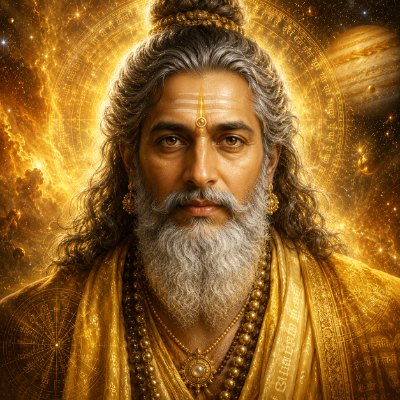
Brihaspati — Divine Preceptor of the Gods, Lord of Sacred Wisdom, and Planet Jupiter
Brihaspati · Brahmanaspati · Devaguru · Angirasa · Jiva · Vachaspati · Dhi · Suraguru · Taranapati · Maitravaruni
Brihaspati is the divine preceptor of the gods — the Devaguru — a figure of supreme sacred learning who presides over the celestial sphere of Jupiter in the Navagraha system of Jyotisha, and one of the most prominent divine beings in the Vedic, Puranic, and epic traditions. He is the son of Angiras — the primordial sage and one of the mind-born sons of Brahma — and the younger brother of Utathya, through whose wife Mamata his own transgression brought about the birth of the blind sage Dirghatamas. His wife is Tara, the celestial being whose abduction by Chandra the moon god precipitated the Tarakamaya war — a cosmic conflict whose resolution, and the birth of Budha from the union of Tara and Chandra, established the genealogical foundation of the entire Lunar dynasty from which the Pandavas and Kauravas descend. He is the teacher of the Adityas, the counsellor of Indra, the lord of sacred speech and prayer, the master of ritual knowledge, and the perpetual rival in intellectual and spiritual authority of Shukracharya — the preceptor of the demons. Brihaspati appears across the Rigveda, the Atharvaveda, the Shatapatha Brahmana, the Mahabharata, the Ramayana, and virtually every major Mahapurana.
✦ The Names
The name Brihaspati is among the most ancient and theologically significant in the Vedic tradition. It is a compound of brihati — the vast, the extensive, or the sacred utterance — and pati — lord, master, husband — yielding the sense of "lord of the vast" or "lord of the sacred utterance." In the Rigveda the term brihati is associated with a specific Vedic metre — the Brihati metre of thirty-six syllables — and with the expansive quality of sacred speech more broadly. Brihaspati as "lord of the vast sacred speech" is thus a name that directly encodes his essential function as the master of Vedic utterance, prayer, and sacred learning. The variant name Brahmanaspati — "lord of brahman" or "lord of sacred power" — is an older Vedic form that appears frequently in the Rigveda and carries essentially the same meaning with a slightly different emphasis: where Brihaspati stresses the mastery of sacred speech, Brahmanaspati stresses the mastery of the sacred power (brahman) that speech embodies. Devaguru means "preceptor of the gods." Vachaspati means "lord of speech." Jiva — "the living one" — is the name used for Jupiter as a Navagraha. Suraguru means "teacher of the Suras or gods." The epithet Maitravaruni — "born of Mitra and Varuna" — refers to one account of Brihaspati's rebirth after the Nimi episode, discussed below.
✦ Lineage
- Father: Angiras — one of the most ancient primordial sages, a mind-born son of Brahma, progenitor of the Angirasa lineage, and one of the Saptarishis. Angiras is associated with fire, with the Atharvaveda, and with the Angirasa family of Rigvedic hymn-composers. He is the father of both Utathya and Brihaspati, making the two great brothers of contrasting character — Utathya the sage of dharmic conduct whose household Brihaspati violated, and Brihaspati the divine preceptor whose transgression produced Dirghatamas.
- Elder brother: Utathya — a sage of great power and dharmic standing, whose wife Mamata was approached by Brihaspati while she was pregnant with Utathya's child, as narrated in the Utathya profile in this series.
- First wife: Shuba — named in some Puranic accounts as Brihaspati's first wife, about whom the primary texts provide minimal biographical detail.
- Principal wife: Tara — the celestial being whose abduction by Chandra the moon god caused the Tarakamaya war and whose biography and role in producing Budha — the progenitor of the Lunar dynasty — is given in full in the Tara profile in this series. Tara's abduction by Chandra is the most consequential event connected to Brihaspati in the narrative tradition — an event that brought cosmic war to the divine realm, established the precedent of the supreme deity Brahma intervening directly to restore dharmic order, and produced Budha, the founding ancestor of the Chandravamsha.
- Another wife: Mamata — Utathya's wife, to whom Brihaspati approached and with whom he conceived a child despite her explicit refusal and her pregnancy with Utathya's son. The child of this union — cursed in the womb by Brihaspati himself in anger at the embryo's protest — was Dirghatamas. Whether this makes Mamata Brihaspati's wife in any formal sense or simply the unwilling occasion of his transgression is not framed in the primary texts as a question of marital status; she remained Utathya's wife throughout.
- Son — Bharadvaja: The most significant of Brihaspati's sons in terms of genealogical and narrative importance is Bharadvaja — a sage of immense standing who is the founder of one of the most important gotras in the brahminical tradition, the teacher of Drona in the Mahabharata, and a major figure of the Rigvedic hymn tradition. Bharadvaja's birth involves an extraordinary narrative concerning his abandonment — he was born of Brihaspati's union with a woman who was not Tara, and was abandoned at birth. His profile is given separately in this series.
- Son — Kacha: Named in the Mahabharata as a son of Brihaspati who was sent to Shukracharya — the preceptor of the demons and Brihaspati's great rival — to learn the Mritasanjivani vidya, the knowledge of restoring the dead to life. Kacha's story — his repeated deaths at the hands of the demons, his restorations by Shukracharya, his eventual acquisition of the knowledge, and his relationship with Shukracharya's daughter Devayani — is narrated in the Mahabharata's Adi Parva and is one of the tradition's most celebrated narratives of a student's quest for forbidden knowledge.
- Rebirth account: The Vishnu Purana contains a passage in which Brihaspati loses his body as a result of Nimi's counter-curse — the episode in which the Solar dynasty prince Nimi cursed Brihaspati in return for Brihaspati's curse upon him, both curses taking effect simultaneously. Brihaspati was subsequently reborn as the son of Mitra and Varuna through the Apsara Urvashi — the account in which Vasistha and Agastya were born from a single jar that received the seed of both Mitra and Varuna when they saw Urvashi. In this account Brihaspati and Agastya are born as brothers in a second life.
✦ Brihaspati in the Rigveda
Brihaspati — or Brahmanaspati, his older Vedic name — is one of the most significant divine figures invoked in the Rigveda. In the Rigveda he is the lord of sacred speech and the embodiment of the power of Vedic prayer and utterance. He is the god who first uttered the sacred syllable and thereby generated the cosmos — a cosmogonic function that gives him primordial creative significance beyond his role as a teacher. He is associated with Indra as Indra's great ally and counsellor — the divine intellect that directs and augments the divine martial power. Several Rigvedic hymns are addressed to Brihaspati alone or to Brihaspati paired with Indra, and the tradition of Brihaspati hymns in the Rigveda is one of the more developed minor divine traditions in the collection. He is invoked for wisdom, for eloquence, for success in debate, and for protection against adversaries. The identification of Brihaspati with the planet Jupiter in the Navagraha tradition is a later development that brings the Vedic lord of sacred speech into the astronomical and astrological framework of the classical period.
✦ Brihaspati as Devaguru and His Rivalry with Shukracharya
In the Puranic and epic traditions, Brihaspati's primary institutional role is as the Devaguru — the preceptor and counsellor of the gods, particularly of Indra and the Adityas. He teaches the gods the Vedic sciences, advises them on matters of strategy and governance, and presides over their religious and intellectual life. This role places him in perpetual structural opposition to Shukracharya — the preceptor of the Asuras and the Daityas — whose own mastery of sacred knowledge, particularly the Mritasanjivani vidya, gave the demon race a specific advantage that the gods' side did not possess. The rivalry between the two preceptors — Brihaspati of the gods and Shukracharya of the demons — is one of the fundamental structural tensions of the Puranic universe, a divine intellectual rivalry that mirrors and enables the cosmic political conflict between the gods and the anti-gods.
The episode of Kacha's quest for the Mritasanjivani vidya is the most elaborated narrative expression of this rivalry. Brihaspati, knowing that the gods were at a disadvantage because Shukracharya could restore the dead Asuras to life while no comparable knowledge existed among the gods' own teachers, sent his son Kacha to Shukracharya's ashrama as a devoted student with the covert intention of acquiring this knowledge. Kacha's story — his acceptance by Shukracharya, his relationship with Devayani, his repeated killings by the demons, his repeated restorations by Shukracharya, and his eventual successful acquisition of the knowledge through a final extraordinary circumstance — is narrated at length in the Mahabharata's Adi Parva. The episode illuminates the nature of Brihaspati's role as a strategic intelligence in the divine economy: he works not through force but through knowledge, and his achievement through Kacha's mission was the acquisition of the one piece of sacred learning that the gods' side lacked.
✦ The Tarakamaya War and Tara's Abduction
The most cosmologically consequential episode in Brihaspati's biography is the abduction of his wife Tara by Chandra the moon god and the Tarakamaya war that resulted. This episode is narrated in full in the Tara profile and the Chandra profile in this series. From Brihaspati's perspective, the episode is one of the most fundamental violations of his household and his dignity as the gods' own preceptor — the figure whose authority was second only to Brahma in the divine assembly had his wife taken by another divine being in a brazen act of desire, and the gods who should have been most obligated to support him — his own students, the Adityas and Indra — had to fight a prolonged war to secure Tara's return. The episode casts a shadow over the otherwise authoritative portrait of Brihaspati as the supreme divine intellectual: his household was violated, his wife was taken, and the subsequent birth of Budha from Tara's union with Chandra introduced an element of contested paternity into the very line that Brihaspati's own household might otherwise have generated.
✦ The Episode with Mamata and Brihaspati's Transgression
As narrated in the Utathya and Dirghatamas profiles in this series, Brihaspati approached his elder brother Utathya's pregnant wife Mamata and, despite her explicit refusal and protest from the embryo already within her, proceeded to plant his seed in her. The child of this union — Dirghatamas — was cursed blind by Brihaspati himself in anger at the embryo's protest. This episode is one of the tradition's most direct portraits of Brihaspati as a figure capable of significant ethical failure — the teacher of dharma to the gods transgressed against the most fundamental obligations of the brotherhood relationship and of respect for a pregnant woman's explicit refusal, and compounded the transgression by cursing the innocent child he had unwillingly generated. The tradition does not reconcile this portrait with the portrait of Brihaspati as the supreme divine teacher; it presents both without harmonisation, giving Brihaspati the full moral complexity that the texts record.
✦ Brihaspati as a Navagraha — the Planet Jupiter
In the Jyotisha tradition, Brihaspati is the planetary deity presiding over Jupiter — called Brihaspati or Guru in Indian astronomical tradition — the largest planet of the solar system and the one whose sidereal period of approximately twelve years gives it the role of marking major temporal cycles in Indian calendar systems. Jupiter is regarded in the Jyotisha tradition as the most benefic of the nine grahas — the most auspicious and the most powerful for conferring wisdom, prosperity, spiritual growth, and well-being. His day of the week is Thursday — Brihaspativar or Guruvar, the day of the preceptor. His gemstone is yellow sapphire or yellow topaz. His metal is gold. His colour is yellow. His direction is northeast. He is exalted in Cancer and debilitated in Capricorn. The moon is exalted in Taurus — the nakshatra of Rohini — and Jupiter's exaltation in Cancer is understood in the tradition as reflecting the complementary relationship between the two principal luminaries of sacred wisdom (Brihaspati-Jupiter) and mind (Chandra-Moon) — a relationship given its mythological expression in the Tarakamaya war.
✦ The Brihaspati Smriti and the Political Philosophy Tradition
A text of political philosophy and statecraft called the Brihaspati Smriti — or Brihaspati Niti — is attributed in the tradition to the sage Brihaspati. This text, of which significant fragments survive in quotation within the Arthashastra tradition and in compilations of political maxims, represents Brihaspati as one of the foundational teachers of the niti or statecraft tradition in ancient India — a teacher of political wisdom whose authority was used by subsequent political philosophers to legitimise the niti tradition. The Brihaspati Smriti's precise relationship to the divine Brihaspati of the Vedas and Puranas is the same kind of question as the relationship between the Rigvedic sage Gautama and the Nyaya philosopher Gautama Akshapada — the attributed authorship connects the philosophical text to the divine figure's authority without necessarily claiming biographical identity between the two.
✦ Textual Variants and Inconsistencies
The rebirth of Brihaspati: The account of Brihaspati losing his body through Nimi's counter-curse and being reborn as the son of Mitra and Varuna is given in the Vishnu Purana in connection with the Nimi episode. However, the same Mitra-Varuna-Urvashi birth account is also given in different texts for the sage Vasistha — with some texts identifying Vasistha as the son of Mitra and Varuna through Urvashi and others giving Brihaspati in the same role. The Vishnu Purana's account of the Nimi episode gives both Vasistha and Agastya as born from the jar, with Brihaspati's second birth being the same event. Different texts handle the relationships between these rebirths differently, and the accounts are not fully consistent across the tradition.
The children of Brihaspati: The tradition gives various accounts of Brihaspati's children without full consistency. Bharadvaja and Kacha are the most consistently attributed sons. Some texts add further sons and daughters, and the precise list varies across Puranic sources. The circumstances of Bharadvaja's birth — his abandonment and adoption — are narrated in the Bharadvaja profile in this series.
✦ Theological Significance
Brihaspati's theological significance spans the cosmological, the intellectual, and the ritual dimensions of the tradition simultaneously. As the lord of sacred speech and prayer in the Rigveda, he is the divine principle of the power of words to create, sustain, and transform reality — the deity who embodies the Vedic understanding that sound, properly used, is the most fundamental creative force in the cosmos. As Devaguru, he is the institutional custodian of divine wisdom — the teacher through whom the accumulated sacred learning of the Vedic tradition is transmitted to the gods themselves. As Jupiter in the Navagraha system, he is the most benefic of the celestial powers — the planet of wisdom, prosperity, and spiritual grace. And as a figure of biographical complexity — one who transgressed against his brother's wife, one whose wife was abducted, one whose household was violated — he is a divine teacher who is himself imperfect, whose moral failures do not disqualify his intellectual authority but do give that authority the texture of a lived rather than an ideally perfect wisdom.
✦ Connection to the Wider Genealogy
Through his father Angiras and the primordial Angirasa lineage, Brihaspati connects to the mind-born son of Brahma and thereby to the primordial creative genealogy. Through his wife Tara's abduction and the birth of Budha, Brihaspati is indirectly connected — through the violation of his household — to the entire Chandravamsha, the Lunar dynasty whose descendants include the Pandavas, the Kauravas, Krishna, and all the major figures of the Mahabharata. Through his son Bharadvaja he is the grandfather of Drona — the supreme teacher of arms of the Mahabharata's central generation — and the great-grandfather of Ashvatthama. Through his son Kacha he is connected to Devayani — whose story of marriage to Yayati and the consequent genealogical complications is one of the Mahabharata's most significant dynastic sub-narratives. Through the Bharadvaja gotra — one of the most widely distributed in the brahminical tradition — his lineage extends across the entire brahminical social world of the subcontinent.
✦ References
Primary Sources
- Rigveda, Mandala 2, hymns 23–24; Mandala 10, hymn 68: The primary Vedic hymns addressed to Brahmanaspati-Brihaspati; establish his identity as lord of sacred speech, ally of Indra, and cosmic creator through prayer.
- Mahabharata, Adi Parva, sections 71–80 (Kacha and Devayani): The narrative of Kacha's quest for the Mritasanjivani vidya — Brihaspati's son sent to learn the secret of restoring the dead from Shukracharya, his rival; the most extended narrative in which Brihaspati's strategic intelligence as Devaguru is demonstrated.
- Mahabharata, Adi Parva, sections 98–104 (birth of Dirghatamas): The episode of Brihaspati's transgression against Mamata and his cursing of the embryo Dirghatamas in the womb; the primary source for Brihaspati's moral failure.
- Vishnu Purana, Book 4, chapter 5 (Tarakamaya war); Book 4, chapter 1 (Nimi episode and Brihaspati's rebirth): The Tarakamaya war account and the rebirth narrative.
- Bhagavata Purana, Book 9, chapter 14 (Tarakamaya war): The Bhagavata Purana's account of the Tarakamaya war and Tara's abduction.
- Brihat Parashara Hora Shastra (Jyotisha): The foundational Jyotisha text describing Brihaspati's qualities, exaltation, debilitation, and significations as the Navagraha Jupiter.
Modern Reference Works
- Vettam Mani, Puranic Encyclopaedia (1975): Entry on Brihaspati; comprehensive collation of all primary references across the Vedas, epics, and Puranas.
- A. A. Macdonell, Vedic Mythology (1897): Analysis of Brahmanaspati-Brihaspati in the Rigvedic tradition; establishes the Vedic dimension of his identity and his relationship with Indra.
- David Pingree, Jyotihshastra (1981): Scholarly analysis of the Navagraha system including Brihaspati-Jupiter; essential for the astronomical and astrological dimension of his identity.
- J. A. B. van Buitenen (translator), The Mahabharata, Volume 1 (1973): Critical translation of the Adi Parva with scholarly notes on the Kacha-Devayani narrative.