
About
Mamata — Wife of Utathya, Mother of Dirghatamas, and Figure of Contested Maternity
Mamata · Utathyapatni · Angirasakula-vadhu · Dirghatamaspita · Brihaspatisambhoga-patita
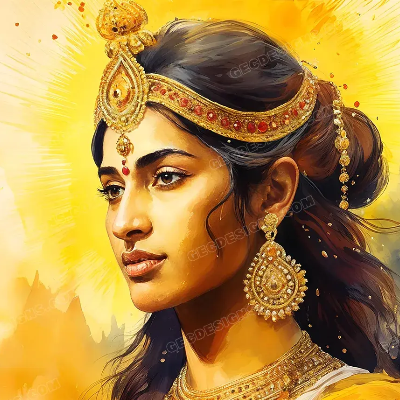
Mamata is the wife of Utathya — the sage of the Angirasa lineage, son of Angiras and elder brother of Brihaspati — and the mother of Dirghatamas, the blind sage of extraordinary philosophical depth whose hymns in the Rigveda's first Mandala include the celebrated Asya Vamasya hymn. Her biography in the primary sources is concentrated entirely in the episode surrounding Dirghatamas's conception and birth — an episode in which she was approached against her will by Brihaspati, her husband's younger brother, while she was pregnant with Utathya's child, and in which the child she bore as a result of that encounter was cursed blind before birth by Brihaspati himself. Mamata subsequently abandoned the blind infant on the riverbank. Her name — meaning "mine" or "possessiveness" in Sanskrit — is the most theologically and narratively ironic aspect of her story: the woman whose name means possessiveness and attachment abandoned the very child she bore. The primary texts treat her with limited elaboration beyond this episode, and this profile is proportionate to the available evidence while engaging fully with what the sources record.
✦ The Name
The name Mamata derives from the Sanskrit mama — meaning "mine" — combined with the abstract suffix ta, yielding mamata as the noun of the quality of mineness, possessiveness, or attachment — the sense that something belongs to one, that one has a proprietary claim upon it. In the Sanskrit philosophical and devotional traditions, mamata is one of the central terms for the kind of possessive attachment to worldly things and relationships that is considered a primary source of suffering and a primary obstacle to liberation. The Bhagavad Gita uses the term in the context of the psychology of bondage — the clinging to what one considers "mine" that binds the soul to the cycle of action and consequence. As a personal name applied to this specific woman, the irony is acute and presumably deliberate in the tradition's naming: the woman named Possessiveness is the one who abandoned her child. The primary texts do not comment on this irony explicitly, but it is present in the structure of the narrative and would not have been lost on the tradition's audiences, for whom the philosophical vocabulary of the name would have been immediately apparent. The patronymic Utathyapatni means "wife of Utathya." Dirghatamaspita means "mother of Dirghatamas."
✦ Lineage
- Parentage: The primary texts do not record Mamata's own parentage. The Mahabharata's Adi Parva introduces her simply as the wife of Utathya without naming her father, mother, or her own family lineage. This profile accordingly makes no claim about her birth family beyond what the sources state.
- Husband: Utathya — a sage of the Angirasa lineage, son of Angiras, and elder brother of Brihaspati. Utathya is a figure of great ascetic standing, celebrated in the Mahabharata's Shanti Parva for the episode in which he demonstrated the sovereignty of brahminical spiritual power over royal authority by drinking the ocean dry in a dispute with King Mandhata. His profile is given separately in this series.
- Son by Utathya: The child that Mamata was carrying when Brihaspati approached her — the child whose presence in the womb is specified in the Mahabharata's account — was Utathya's son. The Mahabharata narrates that this embryo, already in the womb, was aware of Brihaspati's intrusion and protested. From this original pregnancy the blind child Dirghatamas was born — though the tradition's account is specific that the blindness was a consequence of Brihaspati's curse on the protesting embryo rather than of the conception itself being Brihaspati's rather than Utathya's. The precise biological question of whether Dirghatamas was Utathya's son or Brihaspati's son is complicated by the episode's narrative — the Mahabharata's account implies that the embryo already present was Utathya's, and that the blind child born was the continuation of that pregnancy, though some later texts read the episode as producing a child of Brihaspati.
- Son by Brihaspati (in certain accounts): Some Puranic accounts — and the ambiguity of the Mahabharata's own narrative — leave open the possibility that Bharadvaja, the son of Brihaspati who was also abandoned at birth, was born of Mamata rather than of another unnamed woman. If this identification is accepted, Mamata is the mother of both Dirghatamas and Bharadvaja — two children of different fathers, both abandoned, both of extraordinary significance in the tradition. The evidence for this identification is discussed in the Textual Variants section below.
✦ The Central Episode — Brihaspati's Approach and the Cursing of the Embryo
The Mahabharata's Adi Parva narrates the episode in which Mamata figures as its central female figure with considerable moral clarity about the nature of what occurred. Mamata was pregnant with Utathya's child when Brihaspati — her husband's younger brother, the divine preceptor of the gods, and a figure of immense religious authority — came to her and expressed his desire for union with her. The Mahabharata is unambiguous that this was an unsolicited and unwanted approach: Mamata protested. She told Brihaspati explicitly that she was already pregnant with her husband Utathya's child, that the act he proposed was inappropriate on every count — she was the wife of his elder brother, she was pregnant, and the approach was a violation of the most fundamental obligations of the extended family bond — and that he should desist.
The child already in the womb added its own protest. The Mahabharata narrates that the embryo — already sentient and aware, as the tradition understands embryos to be from conception — called out from within the womb that there was no room for another being alongside the child already present, and that Brihaspati's seed should not be planted where another already grew. This protest from the unborn child is one of the more dramatically vivid moments in the tradition's genealogical narrative — the embryo defending its own spatial and spiritual territory against an intrusion that even it perceived as a violation.
Brihaspati proceeded despite both protests — Mamata's explicit refusal and the embryo's vocal objection. The Mahabharata does not dwell on this fact or elaborate it beyond the narrative statement, but the moral weight of what is described is clear: the divine preceptor of the gods violated his elder brother's pregnant wife against her explicit refusal. This is not presented as an ambiguous situation or as one whose moral character requires interpretation. After the act, Brihaspati's discharged seed had nowhere to settle alongside the existing embryo — as the embryo had protested — and fell to the ground. Brihaspati, in anger at having been thus obstructed by the protesting embryo, turned his anger on the unborn child and cursed it: that it would be born into long darkness, that it would be blind. This curse pronounced in anger by the very person who had forced the situation was the origin of the blind sage Dirghatamas's blindness.
✦ Mamata's Abandonment of Dirghatamas
After the birth of the blind child Dirghatamas, Mamata abandoned him. The Mahabharata's account of the abandonment is brief — it records the fact without extended psychological elaboration of her reasons or her emotional state. The child was left on the bank of the Ganga and was found and raised by others.
The tradition's handling of Mamata's abandonment of her child is notable for what it does not do: it does not defend the abandonment, but it also does not condemn Mamata in extended terms. The episode is presented as a fact — she abandoned the blind child — and the tradition moves on to what became of that child, which is the main subject of the narrative. The context of the abandonment — a child born blind under a curse that was the consequence of a violation she had not consented to, in circumstances of profound disruption and suffering — is implicitly present for the reader even when not explicitly articulated. Some later and regional retellings of the episode supply more emotional context for Mamata's state at the time of the abandonment; the Mahabharata's own account is more compressed.
It is worth noting that the name Mamata — possessiveness, the feeling that something is "mine" — stands in pointed ironic relation to the act of abandonment. The woman named for the quality of maternal possessive attachment abandoned the child who should have been the primary object of that attachment. Whether this irony was always intended as a commentary on the gap between a name and the life it designates, or whether it reflects the tradition's sense that circumstances can force even the most naturally possessive love to surrender, the structure of the name and the act creates one of the tradition's quieter but more persistent moral paradoxes.
✦ Mamata in the Context of the Angirasa Household
Mamata's position as the wife of Utathya and the daughter-in-law of Angiras places her in one of the most distinguished sage households of the tradition. The Angirasa lineage is among the most ancient and prolific of the Vedic sage families — responsible for a large proportion of the Rigvedic hymns, associated with Agni and with the power of fire, and progenitors of multiple significant lines of descent. Mamata entered this household as Utathya's wife and was thus surrounded by figures of immense sacred learning and power. The violation of her household's sanctity by Brihaspati — himself a member of that very household as Utathya's younger brother — was therefore a violation not merely of Mamata's personal dignity but of the sacred order of one of the tradition's most revered family structures.
The Mahabharata's account does not elaborate Utathya's response to the episode — whether he knew what had happened, how he regarded the birth of the blind child, or what transpired between him and Brihaspati as a result. The narrative focuses on the birth of Dirghatamas and his subsequent life rather than on the family dynamics of the ashrama in the episode's aftermath. Mamata's continuing relationship with Utathya after the birth of Dirghatamas is not narrated in the primary texts.
✦ Textual Variants and Inconsistencies
Whether Mamata is the mother of Bharadvaja: The most significant textual question regarding Mamata's biography is whether the child born of Brihaspati's seed — which fell to the ground during the episode and did not take root alongside the existing embryo — eventually became Bharadvaja, making Mamata his mother as well as Dirghatamas's. The Mahabharata's Adi Parva account of the Dirghatamas birth episode states that Brihaspati's seed fell to the ground without taking root in Mamata's womb. Some Puranic accounts elaborate this detail by saying that the seed fell onto a reed-bed or onto the earth and that the child born from it was Bharadvaja. If this is accepted, Bharadvaja is not technically Mamata's biological child in the womb sense but was generated from the seed that fell from Brihaspati's contact with her situation. Other accounts give a different unnamed woman as the mother of Bharadvaja entirely, treating the Mamata episode and the Bharadvaja birth as separate occurrences both involving Brihaspati but connected to different women.
The textual evidence does not permit a definitive resolution of this question. The Mahabharata's account is compressed enough that both readings are possible from within the text, and the Puranic accounts that elaborate the episode give different answers. What can be stated with confidence is that Mamata was the woman present in the episode that led to the cursing of the embryo Dirghatamas, that Dirghatamas is her biological son by Utathya, and that the question of Bharadvaja's connection to this episode — and to Mamata specifically — is an open one across the primary sources. This profile notes the question honestly without asserting a resolution that the texts themselves do not provide.
The biological paternity of Dirghatamas: As noted in the Lineage section, the Mahabharata's narrative implies that Dirghatamas was the embryo already present in Mamata's womb — Utathya's son — and that the blindness came from Brihaspati's curse rather than from Brihaspati's paternity. However, the episode's ambiguity — whether Brihaspati's seed combined with the existing pregnancy or whether the blind child born was entirely Utathya's child simply cursed by Brihaspati — has been read differently in different parts of the tradition. Some later texts treat Dirghatamas as Brihaspati's son cursed in the womb; others treat him as Utathya's son cursed by Brihaspati. The Mahabharata's own language is susceptible to both readings, and the primary texts do not resolve this question with sufficient clarity to make a definitive statement.
✦ Theological and Narrative Significance
Mamata's theological significance in the tradition is concentrated in the paradox her name and her actions together create, and in what the episode of her violation and its consequences demonstrates about the moral complexity of the tradition's treatment of women who are harmed rather than guilty. She is not the agent of wrongdoing in this episode — the wrong was done to her, by a figure of immense authority who disregarded her explicit refusal. Yet the consequence fell upon her and upon her child: she gave birth to a blind son under the most distressing circumstances, and she then abandoned him. The tradition does not resolve the question of whether she is blameworthy for the abandonment — it simply records the fact — and the record of that fact, combined with the record of how it came to be, creates a portrait of a woman whose situation contained no good options and who made the choice she made in circumstances that were entirely not of her making.
The name Mamata functioning as a philosophical term for possessive attachment gives the episode a further layer of significance when read through the tradition's soteriological framework. The attachment named Mamata abandoned what was most naturally "hers" — her own child. In the tradition's understanding, the consequences of violating sacred boundaries do not fall only on the violator; they distribute themselves through the household and through the vulnerable. The blind child on the riverbank — cursed before birth by the very person whose desire had disrupted the womb he was in — is the most immediate and most innocent bearer of consequences in a chain of transgression that began with Brihaspati's desire and ended with Mamata's abandonment.
✦ Connection to the Wider Genealogy
Through her husband Utathya and his father Angiras, Mamata is embedded — by marriage — in the primordial creative genealogy of the Angirasa lineage, which descends from Brahma through Angiras. Through her son Dirghatamas — born blind, abandoned, and yet the author of some of the Rigveda's most philosophically significant hymns and the father of five royal sons by Queen Sudeshna — Mamata is the remote matriarchal ancestor of the five eastern kingdoms of Anga, Vanga, Kalinga, Pundra, and Suhma whose names correspond to major regions of eastern India. Through Dirghatamas's son Kakshivat, the Rigvedic hymn tradition of the Angirasa lineage was continued into the next generation. Through the possible identification of Bharadvaja as the child of Brihaspati's seed from the same episode — and through Bharadvaja's son Drona and Drona's son Ashvatthama — Mamata's connection to the Mahabharata's central generation of warriors, however indirect, is present in the genealogical tradition's own account of how these figures came to exist.
✦ References
Primary Sources
- Mahabharata, Adi Parva, sections 98–104: The primary and most detailed source for Mamata's biography — the episode of Brihaspati's approach, her explicit refusal, the embryo's protest from the womb, Brihaspati's cursing of the embryo with blindness, the birth of Dirghatamas, and Mamata's abandonment of the blind child on the Ganga's bank. This is the foundational text for the entire episode and for everything that can be established about Mamata from the primary sources.
- Vishnu Purana, Book 3, chapters 6–7: Genealogical material on the Angirasa lineage that provides the context for Mamata's position within the Angirasa household as Utathya's wife.
- Bhagavata Purana, Book 9, chapter 20: Genealogical references to Dirghatamas and his lineage that confirm the basic facts of his birth from Mamata within the Bhagavata Purana's genealogical framework.
- Various Puranic accounts of Bharadvaja's birth: The Puranic texts that discuss the circumstances of Bharadvaja's birth — in several of which the seed falling from the Brihaspati-Mamata episode is connected to Bharadvaja's generation — are relevant to the textual variant concerning whether Mamata is Bharadvaja's mother. These include passages in the Brahma Purana and related texts that deal with the Angirasa lineage's genealogy.
Modern Reference Works
- Vettam Mani, Puranic Encyclopaedia (1975): Entry on Mamata; identifies her role in the Dirghatamas birth episode and notes the relevant genealogical connections with cross-references to the Utathya, Dirghatamas, and Brihaspati entries.
- J. A. B. van Buitenen (translator), The Mahabharata, Volume 1 (1973): Critical translation of the Adi Parva with scholarly notes; the most authoritative English-language treatment of the primary source for Mamata's episode, providing the textual basis for the narrative presented in this profile.
- Wendy Doniger O'Flaherty, Women, Androgynes, and Other Mythical Beasts (1980): Contains analysis relevant to the broader pattern of the Sanskrit tradition's treatment of women who are the objects of unwanted divine desire and who bear the consequences of violations done to them; provides the scholarly framework within which Mamata's episode is most clearly contextualised in terms of gender, power, and the distribution of narrative consequence.
- Sukumari Bhattacharji, The Indian Theogony (1970): Examines the Angirasa lineage and its genealogical significance in the Puranic tradition; provides context for understanding Mamata's position within the household of one of the tradition's most important sage families.