
About
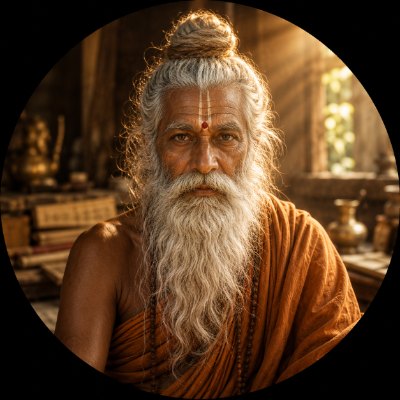
Bharadvaja — Son of Brihaspati, Founder of a Great Gotra, and Teacher of Drona
Bharadvaja · Brihaspatinandana · Vitahavya · Bharadvaja-gotra-janaka · Dronacharya-pita · Saptarishi · Angirasakula
Bharadvaja is one of the seven primordial sages — the Saptarishis — in the configuration of the current Vaivasvata Manvantara, the founder of the Bharadvaja gotra — one of the most widely distributed patrilineal brahminical lineages in the Indian subcontinent — a major composer of hymns in the Rigveda's sixth Mandala, and the father of Drona — the supreme teacher of arms in the Mahabharata who trained both the Pandavas and the Kauravas in the science of warfare. Bharadvaja's birth is attended by unusual circumstances narrated in the Mahabharata and the Puranas: he was born of a union between Brihaspati and a woman who was not Brihaspati's wife — some accounts name the woman as Mamata (Utathya's wife), making Bharadvaja and Dirghatamas half-brothers; others give a different unnamed woman — and he was abandoned at birth before being adopted and raised. His name encodes the circumstances of his upbringing rather than his birth. Bharadvaja appears in the Rigveda, the Mahabharata, the Ramayana, the Vishnu Purana, the Bhagavata Purana, and numerous other texts. He is also the figure to whom Rama and his companions came for guidance during their forest exile, appearing in the Valmiki Ramayana's Ayodhya Kanda at his ashrama near the confluence of the Ganga and Yamuna at Prayaga.
✦ The Names
The name Bharadvaja is a compound that the tradition interprets in two related ways. The most common interpretation connects it to bharad — carrying or bearing — and vaja — strength, vigour, nourishment, or the prize of a race — yielding the sense of "he who carries nourishment" or "the bearer of vigour." This interpretation is supported by the birth narrative: when the infant was abandoned by his mother and found, he was described as being nourished in some accounts by divine beings or by the care of the Maruts. A second interpretation connects the name to the specific bird — the lark or a species of swallow — called bharadvaja in Sanskrit, whose name itself carries the meaning of swift movement and bright activity. The tradition uses both interpretations without firmly preferring one. The patronymic Brihaspatinandana means "son of Brihaspati." Bharadvaja-gotra-janaka means "the founder of the Bharadvaja gotra." Dronacharya-pita means "father of Drona."
✦ Lineage
- Father: Brihaspati — the divine preceptor of the gods, son of Angiras, lord of sacred speech and wisdom, and the deity identified with Jupiter in the Navagraha system.
- Mother — variant accounts: The mother of Bharadvaja is given differently across different primary sources and constitutes one of the genuine textual ambiguities of his biography. One account — found in certain Puranic passages — identifies her as Mamata, the wife of Utathya and the mother of Dirghatamas, making Bharadvaja the second child of Brihaspati's union with Mamata and a half-brother of Dirghatamas. A second and more widely attested account gives a different unnamed woman whom Brihaspati approached and from whose union the child was born and immediately abandoned. Some Puranic texts name no mother at all. The Mahabharata's account is more compressed than the Dirghatamas narrative and does not specify the mother with consistent naming.
- Adoption by King Bharata as Vitatha: Bharadvaja was abandoned at birth and subsequently presented to the emperor Bharata — son of Dushyanta and Shakuntala — by the Maruts, the Vedic storm gods who brought the child to the king after he was left without an heir following the killing of his nine sons by their mothers. Bharata adopted the infant and named him Vitatha — meaning "without fruit" or "rendered vain" — as an allusion to the vain birth of his nine murdered sons. Through this adoption Bharadvaja became simultaneously a Brahmin by birth, as the son of Brihaspati, and a royal heir by adoption, generating descendants in both the brahminical and Kshatriya traditions. The adoption is confirmed across the Vishnu Purana (Book IV, chapter XIX), the Bhagavata Purana (Skandha IX, chapters 20–21), the Matsya Purana (chapter 49, verse 32), the Vayu Purana (chapter 99, verse 156), the Agni Purana, and the Mahabharata's Adi Parva.
- Wife: The primary texts do not give Bharadvaja's wife's name with full consistency across sources. Some secondary sources name her as Sushila. The births of Drona and Shrutavati through the Ghritachi episodes do not involve a named wife, as both arose from involuntary seed-emission rather than conjugal union.
- Son — Drona: The most genealogically and narratively significant of Bharadvaja's children; born from Bharadvaja's seed preserved in a drona vessel after an involuntary encounter with the apsara Ghritachi, as narrated in the Mahabharata's Adi Parva (chapter 149); his name is derived directly from the vessel of his birth. Drona — also called Dronacharya — trained the Kaurava and Pandava princes in the science of warfare and served as the supreme commander of the Kaurava forces in the Mahabharata war after Bhishma's fall. Drona's son Ashvatthama is one of the seven Chiranjivis of the tradition. Source: Mahabharata, Adi Parva, chapters 129–131 and 149.
- Son — Yavakri: The central figure of a multi-generational tragedy narrated by Lomasha to Yudhishthira in the Mahabharata's Vana Parva (chapters 135–138). Yavakri undertook extreme austerities to force Vedic knowledge directly from Indra without studying under a teacher, received the Vedas as a boon, and — despite his father Bharadvaja's explicit warnings — allowed arrogance to lead him to violate the daughter-in-law of Raibhya, Bharadvaja's close friend. Raibhya created a Brahmarakshasa from his matted locks to destroy Yavakri, who fled to his father's hermitage and was killed outside its threshold when a blind gatekeeper failed to recognise him. Bharadvaja, overcome with grief at his son's violent death, cursed Raibhya that he would die at the hands of his own son, then immolated himself on Yavakri's funeral pyre. Both father and son were later restored to life through the selfless penance of Raibhya's younger son Arvavasu. Source: Mahabharata, Vana Parva, chapters 135–138.
- Daughter — Shrutavati: Born through a second involuntary encounter between Bharadvaja and the apsara Ghritachi — a separate occasion from the Adi Parva episode that produced Drona — as recorded in the Mahabharata's Shalya Parva (chapter 48, verse 63). Bharadvaja performed all her birth rites from jatakarma onward and named her Shrutavati in an assembly of Devarshis, before departing for the Himalayan forests and leaving her at his ashrama. She lived as a brahmacariṇī of unparalleled beauty, devoting herself entirely to ascetic practice and the study of sacred scripture, with the singular aim of obtaining Indra as her husband. At the sacred tirtha of Badarapachana — encountered by Balarama during his Sarasvati pilgrimage — she performed extraordinary austerities over many years. Indra appeared before her, satisfied with her tapas, and declared that she would dwell with him in Tridiva; she cast off her mortal body and ascended to Svarga. Indra named and consecrated the Badarapachana tirtha in her honour, declaring it a remover of all sins, celebrated in the three worlds, and frequented by Brahmarshis. Source: Mahabharata, Shalya Parva, chapter 48, verse 63.
- Daughter — Katyayani: Identified in the hagiographic tradition as a daughter of Bharadvaja who became the first wife of the sage Yajnavalkya, the great Upanishadic philosopher and receiver of the Shukla Yajurveda from Surya. The Brihadaranyaka Upanishad (2.4.1 and 4.5.1) characterises Katyayani as possessing striprajna — womanly or practical wisdom — in contrast to Yajnavalkya's second wife Maitreyi, who is described as a Brahmavadini. She bore Yajnavalkya three sons: Chandrakanta, Mahamegha, and Vijaya. This identification of Katyayani as Bharadvaja's daughter rests on the secondary hagiographic tradition — specifically the Divine Life Society, Hindupedia, and Sanskriti Magazine accounts — rather than on a primary Puranic or Vedic text that names her as such in an explicit statement, and should be treated with the corresponding degree of caution. Sources: Brihadaranyaka Upanishad 2.4.1 and 4.5.1 (for her identity as Yajnavalkya's wife); DLSHQ, Hindupedia, Sanskriti Magazine (for her parentage as Bharadvaja's daughter).
- Daughter — Devavarnini (in some accounts): Some texts mention a further daughter of Bharadvaja by this name, but she is not given narrative significance in the principal primary sources consulted.
✦ The Birth and Abandonment of Bharadvaja
The Mahabharata and several Puranic texts provide accounts of Bharadvaja's unusual birth — specifically the fact that he was born outside the boundaries of legitimate conjugal union and was abandoned by his mother immediately after birth. Different versions of this narrative give different details of the circumstances of the conception and the identity of the mother, as noted in the Lineage section. What is consistent across the tradition is that the child was abandoned — set aside or left without care — and that the infant Bharadvaja was subsequently raised through means other than the normal parental care of his biological parents.
Some accounts describe the abandoned infant being found and nurtured by the Maruts — the storm gods who are among the most active of the Vedic divine beings — who took compassion on the child. Others describe him as being found by a sage or by divine beings who recognised his extraordinary potential and raised him in an ashrama setting. The tradition of naming him Bharadvaja — the bearer of nourishment or vigour — in some accounts reflects this miraculous nurturing in the absence of parents: he was borne and nourished by forces outside the normal family structure.
✦ The Birth of Drona
The birth of Drona from Bharadvaja is one of the more unusual birth episodes in the Mahabharata's genealogical narrative, and it was not the only occasion on which the apsara Ghritachi was involved in the birth of one of Bharadvaja's children. The Mahabharata records two separate encounters between Bharadvaja and Ghritachi — the first narrated in the Adi Parva (chapter 149) and producing Drona, the second recorded in the Shalya Parva (chapter 48, verse 63) and producing his daughter Shrutavati. In both cases the encounter arose from the involuntary arousal of Bharadvaja upon beholding Ghritachi's beauty rather than from a conventional union. The Adi Parva narrates that Bharadvaja was performing austerities near a river when he saw Ghritachi emerge from her bath. His seed was involuntarily discharged, and rather than letting it fall to the ground or into the water, Bharadvaja collected it in a vessel — a drona, the Sanskrit word for a particular type of wooden vessel or trough. From this seed preserved in the vessel, Drona was born. The name Drona thus means "the one born of the vessel" and encodes directly the unusual manner of his birth.
This birth narrative — like the birth of Dirghatamas from Brihaspati's seed and like other such episodes in the Mahabharata's genealogical tradition — reflects the tradition's understanding that great beings often enter the world through extraordinary means, and that the circumstances of birth encode in compressed form the quality of the being born. Drona, born from a collected seed preserved in a sacrificial vessel, carries from birth the association with precision, containment, and the concentrated application of skill that defines his subsequent identity as the supreme martial arts teacher.
✦ Bharadvaja in the Rigveda
Bharadvaja is identified as the author of the hymns of the Rigveda's sixth Mandala — a substantial body of Vedic hymns addressed primarily to Indra, Agni, the Maruts, and other Vedic deities. The sixth Mandala is called the Bharadvaja family book in the scholarly tradition, and its hymns represent one of the most significant contributions of any single sage lineage to the Rigvedic collection. The quality and range of the sixth Mandala's hymns — which include some of the most technically accomplished compositions in the Rigveda — give Bharadvaja a distinguished position in the Vedic poetic tradition. His association with the Maruts — the storm gods who appear in many of the sixth Mandala's hymns — is consistent with the tradition's account of his being raised or nurtured by the Maruts after his abandonment, giving the personal biography and the hymn tradition a connecting thread.
✦ Bharadvaja's Ashrama at Prayaga and the Ramayana
One of the most celebrated appearances of Bharadvaja in the narrative tradition is in the Valmiki Ramayana's Ayodhya Kanda, where he is the sage at whose ashrama near the confluence of the Ganga and the Yamuna at Prayaga — the sacred site known as Allahabad in modern usage — Rama, Sita, and Lakshmana stop during the first stage of their forest exile. Bharadvaja receives them with great honour and hospitality, recognises Rama's divine nature, and directs them toward Chitrakoota — a more secluded mountain — as an appropriate place for their forest sojourn. The ashrama of Bharadvaja at Prayaga is one of the tradition's most sacred sites, and his role as the sage who directs Rama in the first stage of his exile gives him a significant presence in the devotional tradition of the Ramayana. He appears again later in the Ramayana's Uttara Kanda in connection with the final stages of the narrative.
✦ Bharadvaja's Austerities and the Wish for Three Lifetimes of Study
The tradition contains a celebrated story about Bharadvaja's devotion to Vedic learning — one that captures both the immensity of the Vedic scriptural corpus and the tradition's understanding of the limits of any individual's capacity to master it. According to this account, preserved in several Puranic and narrative sources, Bharadvaja performed austerities before Indra and asked for three full lifetimes of human life — rather than one — so that he might have sufficient time to master all the knowledge of the Vedas completely. Indra appeared before him and showed him three enormous mountains of Vedic knowledge, then took three handfuls from the mountains and told Bharadvaja that these three handfuls were all that even three complete lifetimes of study could encompass — that the totality of the Vedic tradition was so vast that no human lifetime, or three, could contain it. The story is used in the tradition as a teaching about the inexhaustibility of sacred knowledge and the appropriate humility before the vastness of what is to be learned. Bharadvaja's desire for more knowledge — his unwillingness to accept the limitations of a single life — is presented as a mark of his extraordinary dedication to learning rather than as hubris.
✦ The Bharadvaja Gotra
The Bharadvaja gotra — the patrilineal brahminical lineage traced back to the sage Bharadvaja — is one of the most widely distributed and significant gotras in the brahminical genealogical system. It is found across a vast geographical range of the subcontinent and encompasses communities of brahmins associated with multiple Vedic recitation traditions. The gotra's wide distribution reflects both the ancient standing of the Bharadvaja sage lineage in the Vedic tradition and the historical spread of brahminical communities that claimed or received this gotra designation. The rules of gotra-exogamy — that members of the same gotra may not marry each other — make the Bharadvaja gotra's distribution a significant factor in the marriage networks of brahminical communities across the subcontinent.
✦ Vitatha — The Adoption by King Bharata and the Royal Name
Bharadvaja's connection to the Puru-Bharata royal lineage is one of the most genealogically significant facts of his biography, directly relevant to understanding the dynastic chain that descends through Manyu, Garga, Shini, and Gargya to Kalayavana. The adoption is recorded with consistency across the Vishnu Purana (Book IV, Chapter XIX), the Bhagavata Purana (Skandha IX, Chapter 20, verse 36, and Chapter 21, verse 1), the Matsya Purana (Chapter 49, verse 32), the Vayu Purana (Chapter 99, verse 156), and the Agni Purana, as well as in the Mahabharata's Adi Parva.
The occasion for the adoption arose from a crisis in the royal lineage of the great emperor Bharata — son of Dushyanta and Shakuntala — who gave his name to the Bharata dynasty and is considered the ancestor of both the Pandavas and the Kauravas. Bharata had fathered nine sons by three wives, but when he saw them, he was not satisfied that they truly resembled him. The mothers of the sons, fearing that Bharata would reject them and desert the women themselves, took the matter into their own hands and killed all nine children. Bharata was thus left without a legitimate heir despite years of effort. The Mahabharata Adi Parva records this episode plainly, noting that the birth of his sons had proven entirely without fruit.
Bharata then performed great sacrifices directed at the Maruts — the powerful Vedic storm deities — praying for a son. The Maruts, compassionate toward the king's distress and pleased by the sincerity of his worship, brought to him the infant Bharadvaja, who had been abandoned by both Brihaspati and Mamata at birth as described above. The Vishnu Purana's account records that when the Maruts gave the child to Bharata, the king named him Vitatha. The Agni Purana compresses the same sequence into a single verse: the son of Brihaspati, being taken by the winds, was transferred with sacrifice and was Vitatha. The Bhagavata Purana corroborates this, and the Vishnu Purana's own commentator states the matter plainly: the name of Bharadvaja in the condition of son of Bharata was Vitatha.
The name Vitatha carries its meaning directly from the circumstances of the adoption. Vitatha in Sanskrit means "without fruit," "unprofitable," or "rendered vain," and the Vishnu Purana explicitly glosses it as an allusion to the unprofitable birth of Bharata's nine sons — the children whose deaths had made the succession vain. The adopted Bharadvaja thus received a name that encoded the royal crisis he resolved by his very presence. Through this adoption, Bharadvaja became simultaneously a Brahmin by birth — son of Brihaspati, one of the greatest of the brahmin sages — and a king by adoption, the royal heir of the Bharata dynastic line. The Vishnu Purana notes the consequence: from Bharadvaja descended both Brahmins and Kshatriyas, the children of two fathers, meaning the dual heritage — brahminical by birth and royal by adoption — produced descendants in both the brahmin and Kshatriya varnas.
The Mahabharata's Adi Parva preserves a textual variant that does not contradict the adoption but adds a further layer: in one passage (Ganguli edition, verse 3710), it states that Bharata, having found the birth of his children vain, obtained from Bharadvaja himself — through great sacrifices — a son named Bhumanyu. In another passage (verse 3785), Bhumanyu is given as the son of Bharata by his wife Sunanda, daughter of Sarvasena, king of Kashi. The Vishnu Purana's footnote on this passage notes that the two accounts are not incompatible: Bharadvaja as the sage who officiated over the yajna that produced Bhumanyu, and Bhumanyu as born of Bharata's wife Sunanda in the context of that same yajna, can both be true simultaneously. Either way, Bhumanyu is confirmed as Bharata's successor and Vitatha's son across all major sources.
✦ The Royal Descendants Through Vitatha — Manyu, Garga, and the Chain to Kalayavana
Through his adoption as Vitatha, Bharadvaja became the progenitor of a royal dynastic sequence that runs through the Puru-Bharata line. The Vishnu Purana (Book IV, Chapter XIX) and the Bhagavata Purana (Skandha IX, Chapter 21, verse 1) both record that the son of Vitatha was Bhavanmanyu, also called Manyu — a king in the Puru-Bharata succession. Bhavanmanyu in turn had many sons, of whom the Vishnu Purana names the principal ones as Vrihatkshatra, Mahavirya, Nara, and Garga. It is through this last — Garga, son of Manyu and great-great-grandson by adoption of Bharata Daushyanti — that the lineage relevant to this genealogical series continues.
Garga's son was Shini, whose descendants bore the collective designations Gargya and Shainya. Shini's son was Gargya — the Brahmin preceptor of the Andhaka and Vrishni Yadava clans who, after being publicly shamed as impotent, performed twelve years of iron-dust penance to Mahadeva and obtained a son, Kalayavana, who became the Yavana king whose invasion of Mathura drove Krishna to found Dvaraka. The full chain that begins with Bharadvaja's adoption by Bharata as Vitatha therefore runs: Vitatha (Bharadvaja) — Bhavanmanyu (Manyu) — Garga — Shini — Gargya — Kalayavana.
It is important to note the dual character of this genealogical thread. Bharadvaja himself — as the sage and Saptarishi — belongs to the brahminical tradition descending from Brihaspati and Angiras. His adoption as Vitatha by Bharata created a separate royal line of descent through the Puru-Bharata dynasty. These two identities are not contradictory: the Vishnu Purana explicitly acknowledges that from Bharadvaja descended both Brahmins and Kshatriyas. The Garga-Shini-Gargya line represents the royal-turned-brahmin thread of this dual heritage — the Vishnu Purana notes specifically that the Garga-Shini descendants, though Kshatriyas by birth, became Brahmins — which is why Gargya, a descendant of this line, functions as a Brahmin preceptor of the Yadavas rather than as a Kshatriya king.
Additional primary source references for the sections above:
- Vishnu Purana, Book IV, Chapter XIX (Sacred-texts.com and Wisdomlib primary text): The principal genealogical source for the adoption of Bharadvaja as Vitatha by Bharata, the etymology of the name Vitatha as allusion to the unprofitable birth of Bharata's sons, the succession through Bhavanmanyu (Manyu), and the enumeration of Manyu's sons as Vrihatkshatra, Mahavirya, Nara, and Garga.
- Bhagavata Purana, Skandha IX, Chapter 20, verse 36 and Chapter 21, verse 1: Confirms the adoption of Bharadvaja by Bharata, delivered by the Maruts, and names Bhavanmanyu as the son of Vitatha.
- Matsya Purana, Chapter 49, verse 32: Corroborates the Vitatha designation as the name of Bharadvaja after adoption by Bharata, confirmed through the Wisdomlib Vitatha entry.
- Vayu Purana, Chapter 99, verse 156: Corroborates the Vitatha-as-Bharadvaja identification in the context of the Puru-Bharata dynastic succession.
- Agni Purana: Compresses the entire adoption episode into a single verse: the son of Brihaspati, taken by the winds, was transferred with sacrifice and was Vitatha — cited in the Vishnu Purana footnotes.
- Mahabharata, Adi Parva, Section XCIV (Ganguli edition, verses 3710 and 3785): Contains the two variant accounts of Bhumanyu's birth — one through a yajna conducted by Bharadvaja, the other through Bharata's wife Sunanda daughter of Sarvasena of Kashi — and records the killing of Bharata's nine sons by their mothers as the background to the adoption.
- Wisdomlib.org, "Vitatha: 23 definitions": Aggregates the primary source citations across the Matsya, Vayu, Vishnu, and Bhagavata Puranas confirming Vitatha as the post-adoption name of Bharadvaja and father of Manyu.
- Wisdomlib.org, "Bharadvaja: 39 definitions": Confirms the Bhagavata Purana account of the adoption and the dual brahmin-Kshatriya heritage descending from Bharadvaja-Vitatha.
✦ Textual Variants and Inconsistencies
The identity of Bharadvaja's mother: As noted in the Lineage section, the mother of Bharadvaja is given differently across different primary sources. The identification of the mother as Mamata — Utathya's wife — would make Bharadvaja the full or half-brother of Dirghatamas through both Brihaspati's paternity and Mamata's maternity. Other sources give a different unnamed woman. The textual evidence does not permit a confident identification of Bharadvaja's mother across all major primary sources, and this uncertainty is the single most significant point of textual inconsistency in his biography.
The Saptarishi lists: Bharadvaja's inclusion in the list of the seven primordial sages varies across different Puranic enumerations of the Saptarishis for different Manvantaras. In the standard enumeration of the current Vaivasvata Manvantara's seven sages — Kashyapa, Atri, Vasistha, Vishvamitra, Jamadagni, Gautama, and Bharadvaja — he is consistently included. Some Puranic texts give slightly different lists.
The Ghritachi episode: The Mahabharata's account of Drona's birth from the seed preserved in a vessel after the sight of Ghritachi is the standard version. Some regional and later texts vary the specific Apsara involved or the precise circumstances of the encounter. The core narrative of the vessel-birth is consistent across all major traditions.
✦ Theological and Philosophical Significance
Bharadvaja's theological significance operates at multiple levels. As a Saptarishi and Rigvedic hymn-composer he is one of the foundational progenitors of the Vedic sacred knowledge tradition — a figure of cosmic standing whose compositions form part of the eternal body of revealed knowledge. As the sage of the ashrama at Prayaga he is the guardian of one of the most sacred confluences in the tradition — the Triveni Sangam, where the Ganga, the Yamuna, and the invisible Sarasvati meet — and his reception of Rama at this site makes him a figure in the devotional geography of the Ramayana tradition. As the father of Drona he is the progenitor of the most consequential teacher of the Mahabharata's generation — the man whose training of both the Pandavas and the Kauravas in the martial arts made the war's specific form possible, since both sides of the conflict had been trained by the same teacher.
The story of Bharadvaja's wish for three lifetimes of Vedic study is one of the tradition's most compact statements of the principle that sacred knowledge is inexhaustible — that the proper response to the vastness of what is to be learned is not despair but sustained commitment to the learning of what can be learned within the time available, with humility before what remains beyond reach. This pedagogical and epistemic humility is presented as a defining quality of the truly great student and teacher, and Bharadvaja — who asked for more lifetimes in order to learn more — embodies it in the most literal possible form.
✦ Connection to the Wider Genealogy
Through his father Brihaspati and grandfather Angiras, Bharadvaja descends from the primordial creative line of Brahma through the Angirasa sage lineage. Through his son Drona — and through Drona's son Ashvatthama, one of the seven Chiranjivis of the tradition — Bharadvaja is the grandfather of one of the most powerful and morally complex figures of the Mahabharata war generation. Ashvatthama's actions at the war's conclusion — the night attack on the Pandava camp in which he killed the sons of the Pandavas while they slept, and the launching of the Brahmastra against Parikshit in the womb — make him the figure responsible for the near-extinction of the Pandava line at the war's end and the figure whose immortal existence carries the burden of those acts forward beyond the war. Through the Bharadvaja gotra — one of the most widely distributed brahminical lineages — Bharadvaja's genealogical legacy extends across the entire brahminical social world of the subcontinent, and hundreds of thousands of families across India trace their patrilineal ancestry to his name.
✦ References
Primary Sources
- Rigveda, Mandala 6 (the Bharadvaja family book) in its entirety: The primary Vedic source for Bharadvaja as a hymn-composer; the sixth Mandala's hymns attributed to the Bharadvaja lineage constitute one of the most significant family traditions in the Rigvedic collection.
- Mahabharata, Adi Parva, sections 129–131 (birth of Drona): The primary narrative source for Bharadvaja's encounter with Ghritachi, the collection of his seed in the drona vessel, and the birth of Drona; establishes the unusual circumstances of his son's birth.
- Mahabharata, Adi Parva, sections 2–4 (genealogical framework): Contains the positioning of Bharadvaja within the Angirasa sage lineage and among the seven Saptarishis of the current Manvantara.
- Valmiki Ramayana, Ayodhya Kanda, chapters 54–56: The episode of Rama, Sita, and Lakshmana's visit to Bharadvaja's ashrama at Prayaga during the forest exile; Bharadvaja's hospitality and his direction of Rama toward Chitrakoota.
- Vishnu Purana, Book 3, chapters 1–3: The Saptarishi lists confirming Bharadvaja's position and genealogical material on the Angirasa lineage.
- Bhagavata Purana, Book 12, chapter 11: The Saptarishi configuration of the current Manvantara including Bharadvaja.
- Mahabharata, Shanti Parva, sections 340–345: The story of Bharadvaja's wish for three lifetimes of Vedic study and Indra's demonstration of the inexhaustibility of sacred knowledge.
Modern Reference Works
- Vettam Mani, Puranic Encyclopaedia (1975): Entry on Bharadvaja; comprehensive collation of all primary references across the Vedas, epics, and Puranas; notes the key narrative episodes and genealogical connections including the question of his mother's identity.
- A. A. Macdonell and A. B. Keith, Vedic Index of Names and Subjects (1912): Entry on Bharadvaja; establishes the Vedic background of the figure and the sixth Mandala's family tradition.
- Robert P. Goldman (translator), The Ramayana of Valmiki — Ayodhya Kanda (1986): Critical translation with scholarly notes on the Bharadvaja ashrama episode in the Ramayana.
- J. A. B. van Buitenen (translator), The Mahabharata, Volume 1 (1973): Critical translation of the Adi Parva with scholarly notes on the birth of Drona narrative in which Bharadvaja's role is central.
- Alf Hiltebeitel, The Ritual of Battle: Krishna in the Mahabharata (1990): Contains analysis of Drona's role in the Mahabharata war and the significance of his lineage through Bharadvaja for the tradition's treatment of the teacher-student relationship in the martial arts.
- Mahabharata, Vana Parva, chapters 135–138: The primary source for Yavakri as son of Bharadvaja; narrates his penance, his acquisition of Vedic knowledge from Indra, his violation of Raibhya's daughter-in-law, his death at the hands of a Brahmarakshasa, Bharadvaja's curse of Raibhya and self-immolation, and the eventual resurrection of all three through Arvavasu's penance.
- Mahabharata, Shalya Parva, chapter 48, verse 63: The primary source for Shrutavati as daughter of Bharadvaja, born through a second Ghritachi episode; narrates her brahmacariṇī life, her penance at Badarapachana, Indra's grant of the boon, her ascension to Svarga, and the naming and consecration of the Badarapachana tirtha.