
About
Vishrava — Sage Son of Pulastya, Father of Ravana and Kubera
Vishrava · Vishravas · Visravas · Visrava · son of Pulastya
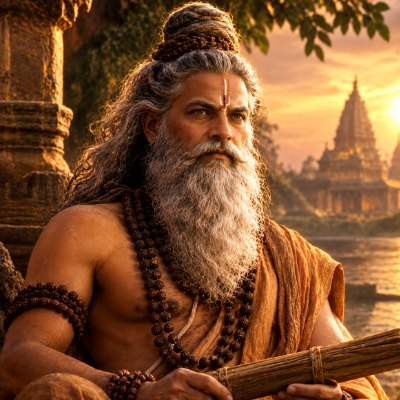
Vishrava is a celebrated sage and the son of Pulastya — one of the Saptarishis, the seven great sages foundational to the Brahmanical tradition, and a mind-born son of Brahma the creator — and Manini, the daughter of Trinabindu, a king of the solar race of the Nedishtha branch. He is most widely known in the Hindu tradition as the father of Kubera, the god of wealth and lord of the Yakshas, by his first wife Ilavida, and of Ravana, Kumbhakarna, Vibhishana, and Shurpanakha by his second wife Kaikesi. As the father of Ravana, the demon-king of Lanka and principal antagonist of the Valmiki Ramayana, Vishrava occupies a genealogically and narratively pivotal position in the epic tradition. He is attested in the Valmiki Ramayana, the Mahabharata, the Vishnu Purana, the Bhagavata Purana, the Vayu Purana, and numerous other Puranic texts. He is himself a sage of great learning and ascetic power, and his own spiritual accomplishments are acknowledged across the tradition independently of his celebrated sons.
✦ The Name
The name Vishrava is derived from the Sanskrit root shru, meaning "to hear" or "to be heard," combined with the prefix vi, which here functions as an intensifier or directional modifier. The derived noun vishravas means "widely heard," "celebrated," "renowned," or "of great fame." The name is thus an epithet of fame and wide repute, and its significance is confirmed by the tradition recorded in the Valmiki Ramayana in which Pulastya, pleased with Manini's virtue, declares that their son would be widely renowned — the name itself encoding the prophecy of his future reputation. The name appears across sources in the forms Vishrava, Vishravas, and Visravas, all representing the same Sanskrit original with minor orthographic variation.
✦ Lineage
- Paternal grandfather: Brahma — the creator deity, one of the three principal gods of the Puranic tradition, from whom Pulastya was born as a mind-born son. Vishrava is thus two generations removed from Brahma on the paternal side.
- Father: Pulastya — one of the ten Prajapatis and one of the Saptarishis, a mind-born son of Brahma who emerged from Brahma's ear according to the Bhagavata Purana. He is the transmitter of the Vishnu Purana from Brahma to Parashara, and a narrator of several Puranic texts. His union with Manini produced Vishrava.
- Mother: Manini — daughter of Trinabindu, a king of the solar race of the Nedishtha branch descended from Vaivasvata Manu through the line of the emperor Marutta, and of his wife Alambusa, a celebrated Apsara. Manini became Pulastya's wife in the circumstances of his curse at Trinabindu's ashrama, and her virtue is explicitly cited in the tradition as the source of Vishrava's distinguished character.
- Maternal grandfather: Trinabindu — a king of the solar race, belonging to the Nedishtha branch of the Suryavansha, noted for his ashrama on the slopes of Mount Meru and his marriage to the Apsara Alambusa.
- First wife: Ilavida — also rendered Ilavila or Idavida, described in the Valmiki Ramayana as a woman of great virtue and the daughter of the sage Bharadvaja in some accounts. Through her Vishrava fathered Kubera.
- Second wife: Kaikesi — also known as Nikasha and Keshini in some sources, a Rakshasi and the daughter of the demon Sumali and his wife Ketumati. It is through Kaikesi that the Rakshasa line of Lanka descended from Vishrava. Through her he fathered Ravana, Kumbhakarna, Vibhishana, and Shurpanakha.
- Son: Kubera — also known as Vaishravana, a patronymic meaning "son of Vishrava," and as Dhanada, "giver of wealth." He is the god of wealth, lord of the Yakshas, and the original king of Lanka before being displaced by his half-brother Ravana. He is counted among the eight Lokapalas, the guardians of the cardinal and intermediate directions, presiding over the north.
- Son: Ravana — the ten-headed demon-king of Lanka, the principal antagonist of the Valmiki Ramayana, renowned for his abduction of Sita and his eventual defeat and death at the hands of Rama. Despite his role as villain of the epic, Ravana is described across the tradition as a brahmin by birth through his father Vishrava, a master of the Vedas, and a devoted worshipper of Shiva.
- Son: Kumbhakarna — Ravana's brother, celebrated in the Ramayana for his colossal size and his curse-induced sleep of six months at a stretch. He is described as fundamentally righteous in disposition despite fighting on Ravana's side, and meets his death at Rama's hands during the siege of Lanka.
- Son: Vibhishana — Ravana's younger brother, renowned for his righteousness and his defection from Lanka to join Rama's cause, for which he was crowned king of Lanka by Rama after Ravana's defeat. He is counted among the Chiranjivis, the immortal or long-lived beings of the Hindu tradition.
- Daughter: Shurpanakha — Ravana's sister, whose encounter with Rama and Lakshmana in the Dandaka forest, and whose subsequent disfigurement at Lakshmana's hands, serves as the immediate trigger for Ravana's abduction of Sita and thereby for the central conflict of the Ramayana.
✦ Birth and Early Life
Vishrava's birth is narrated in the Uttara Kanda of the Valmiki Ramayana in the context of the episode of Pulastya's austerities at Trinabindu's ashrama. His father Pulastya, upon marrying Manini, declared that their son would inherit her virtues and would be widely renowned. Vishrava fulfilled this prophecy by becoming a sage of extraordinary learning and ascetic accomplishment in his own right. He is described across the sources as having mastered the Vedas and all branches of sacred knowledge, and as having attained through his own tapas a degree of spiritual power that earned him great respect among both sages and gods.
The Uttara Kanda records that Vishrava received the knowledge of Brahman — the supreme spiritual wisdom — directly from his father Pulastya, establishing him as an inheritor of his father's spiritual tradition as well as his bloodline. This transmission of knowledge from Pulastya to Vishrava is presented as a significant event, after which Vishrava's own spiritual stature is acknowledged as being comparable to that of Pulastya himself.
✦ The Marriage to Ilavida and the Birth of Kubera
Vishrava's first wife is Ilavida, described in the Valmiki Ramayana as a woman of great beauty and virtue. The Ramayana records that the sage Bharadvaja — one of the great sages of the tradition — gave his daughter Ilavida to Vishrava as a mark of honour and reverence for the sage's spiritual attainments. Through this union was born Kubera, who became the lord of wealth and the king of the Yakshas. Kubera initially ruled from the city of Lanka, which had been built by the divine architect Vishvakarma, before being displaced from that city by his half-brother Ravana. After his displacement Kubera established himself in the Himalayan city of Alaka, also known as Alakapuri, on Mount Kailasa.
Kubera's patronymic Vaishravana — meaning son of Vishrava — is one of his most commonly used names across the tradition, indicating the degree to which his identity is bound up with his distinguished paternal lineage.
✦ The Marriage to Kaikesi and the Birth of the Rakshasas
The second and more narratively consequential marriage of Vishrava is to Kaikesi, a Rakshasi and the daughter of Sumali, a powerful demon lord, and his wife Ketumati. The circumstances of this marriage are narrated in the Uttara Kanda of the Valmiki Ramayana. Sumali, desiring to improve the standing of the Rakshasa lineage, instructed his daughter Kaikesi to seek out Vishrava as a husband, reasoning that a son born of such a distinguished sage father would be a being of extraordinary power.
Kaikesi approached Vishrava at an inauspicious hour — the tradition specifies that she came to him at twilight, a time considered ritually inauspicious for such encounters. Vishrava, recognising both the inauspiciousness of the hour and nonetheless moved by compassion for her, accepted her but warned that the children born of this union at this inauspicious time would reflect the darkness of the hour. The children born of Kaikesi — Ravana, Kumbhakarna, and Shurpanakha — were accordingly of fierce and terrible nature, while Vibhishana, who was born later under more auspicious circumstances according to some versions of the tradition, inherited a righteous disposition. This narrative device — the inauspicious hour determining the nature of the offspring — is a recognised motif in the Puranic tradition for explaining the mixed moral nature of figures born into lineages where both sacred and demonic ancestry converge.
✦ Vishrava as a Sage
Vishrava's identity as a sage is an important dimension of his profile that the tradition maintains consistently alongside his role as the father of Ravana and Kubera. He is described as a brahmin of the highest order through his paternal lineage from Pulastya and Brahma, a master of the Vedas and of ascetic practice, and a figure whose spiritual standing was acknowledged even by Ravana, who is described in the Ramayana as having received instruction from his father and as having inherited through both parents — Vishrava the brahmin and Kaikesi the Rakshasi — a dual nature that made him simultaneously one of the most learned and one of the most destructive beings of his age.
The tension between Vishrava's sacred heritage and the nature of the children he produced through Kaikesi is a recurring theme in texts that deal with Ravana's origins. Several sources present Vishrava as having been a fundamentally righteous sage whose great misfortune lay in the consequences of his union with Sumali's daughter — consequences that played out not in his own life but in the lives and actions of his sons.
✦ Textual Variants and Inconsistencies
The principal inconsistency affecting Vishrava's profile concerns his mother's identity, which flows directly from the unresolved inconsistency in Trinabindu's lineage discussed in those profiles. The Valmiki Ramayana names his mother as Manini, daughter of Trinabindu, and this is the most narratively elaborated account. The Bhagavata Purana in its fourth Skanda names Pulastya's wife as Havirbhu rather than Manini, making Havirbhu the mother of Vishrava and Agastya. A third tradition preserved in some Puranic texts names Pulastya's wife as Priti. Whether these represent different wives of Pulastya, the same figure known by different names, or genuinely conflicting traditions about Vishrava's maternal parentage cannot be resolved from the available sources.
There is additionally some variation across sources regarding Ilavida's parentage. The Valmiki Ramayana identifies her in connection with the sage Bharadvaja, while other sources give different accounts of her origin. The Bhagavata Purana's ninth Skanda, as noted in the Trinabindu and Manini profiles, places Ilavila as the daughter of Trinabindu rather than as the daughter of Bharadvaja, making her Vishrava's wife rather than his half-sister's contemporary — a further layer of the same unresolved genealogical inconsistency that runs through the entire family group.
✦ Theological and Narrative Significance
Vishrava's theological significance lies primarily in his genealogical position as the bridge between the lineage of Brahma through Pulastya and the generation of Ravana, whose story the Ramayana tradition uses to explore the consequences of pride, transgression, and the misuse of power derived from genuine spiritual achievement. The tradition is careful to establish Ravana's brahminical heritage through Vishrava precisely in order to make clear that Ravana's downfall is not the result of ignorance but of a wilful turning away from the dharmic inheritance he received from his father and grandfather.
Vishrava himself is not a figure of theological veneration or independent worship in the tradition. His significance is relational — he is the son through whom Pulastya's line continues into the generation of Kubera and Ravana, and the father through whom both the god of wealth and the demon-king of Lanka receive their identity and their power.
✦ Connection to the Wider Genealogy
Vishrava stands at one of the most consequential genealogical junctions in the entire Puranic and epic tradition. On his paternal side he carries the lineage of Brahma through Pulastya, placing him among the descendants of the creator at two removes. On his maternal side he carries the lineage of the solar dynasty through Manini and Trinabindu, connecting him to Vaivasvata Manu and through him to the sun god Vivasvat. Through his first wife Ilavida he becomes the father of Kubera, one of the eight Lokapalas and the lord of wealth. Through his second wife Kaikesi he becomes the father of Ravana, whose story drives the entire central narrative of the Ramayana, and of Vibhishana, who becomes the righteous king of Lanka after Ravana's defeat. The range of Vishrava's genealogical connections — from Brahma at one end to the central dramatic conflict of the Ramayana at the other — makes him one of the most genealogically significant figures in the tradition, even though his own individual narrative is relatively spare compared to those of his more celebrated sons.
✦ References
- Primary Sources
- Valmiki Ramayana, Uttara Kanda: The principal narrative source for Vishrava's birth, his receipt of spiritual knowledge from Pulastya, his marriage to Ilavida and the birth of Kubera, his marriage to Kaikesi at the inauspicious twilight hour, and the birth of Ravana, Kumbhakarna, Vibhishana, and Shurpanakha; provides the fullest account of his life and family.
- Valmiki Ramayana, Bala Kanda: Contains genealogical references to Vishrava as the father of Kubera and Ravana in the context of establishing the background of the Ramayana's central antagonist.
- Bhagavata Purana, Skanda IV: Names Pulastya's wife as Havirbhu and identifies her as the mother of Vishrava and Agastya, presenting the alternative maternal tradition.
- Bhagavata Purana, Skanda IX, Chapter 2: Places Ilavila as the daughter of Trinabindu and the wife of Vishrava, mother of Kubera, representing the alternative tradition regarding Ilavida's parentage.
- Vishnu Purana, Book I: Records Pulastya's lineage including Vishrava as his son, and Kubera and Ravana as Vishrava's sons, within the broader genealogy of the mind-born sons of Brahma.
- Vayu Purana: Contains genealogical material on the Pulastya lineage including Vishrava and his descendants, providing supplementary Puranic attestation for the family structure.
- Mahabharata, Adi Parva and Vana Parva: Contains references to Vishrava as the father of Kubera and Ravana within the broader genealogical and narrative context of the epic.
- Secondary Sources
- Mani, Vettam. Puranic Encyclopaedia. Motilal Banarsidass, 1975: Provides a consolidated entry on Vishrava summarising his parentage, his two marriages, the birth of his children, and the textual variants affecting his mother's identity.
- Goldman, Robert P. et al. (trans.). The Ramayana of Valmiki, Vol. 7: Uttarakanda. Princeton University Press, 2017: Provides a critical translation and scholarly annotation of the Uttara Kanda including the narrative of Vishrava's birth, marriages, and the origin of Ravana and Kubera.
- Wisdomlib (wisdomlib.org): Offers cross-referenced citations of Vishrava across digitised Sanskrit texts, confirming his attestation in the Ramayana, Mahabharata, and multiple Puranas.