
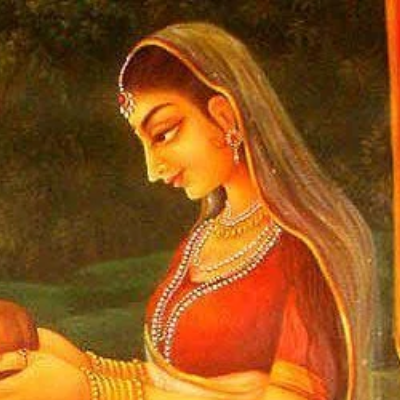
About
Manini — Daughter of Trinabindu, Wife of Pulastya
Manini · Ilavila · Ilavida · Idavida
Manini is a princess of the solar race, daughter of Trinabindu — a king of the Suryavansha belonging to the Nedishtha branch of the dynasty descending from Vaivasvata Manu — and his wife Alambusa, a celebrated Apsara of the heavenly realms. She is known primarily from the Uttara Kanda of the Valmiki Ramayana, where her marriage to the sage Pulastya — one of the Saptarishis and a mind-born son of Brahma the creator — is narrated in connection with the birth of Vishrava, who is in turn the father of Ravana, the demon-king of Lanka, and Kubera, the god of wealth. Manini's significance in the tradition derives entirely from this genealogical position: she stands as the mother of Vishrava and the paternal grandmother of some of the most consequential figures in the Ramayana. However, her name and her precise role in this lineage are subject to a significant and unresolved inconsistency across the primary sources, with the Bhagavata Purana recording Trinabindu's daughter under the name Ilavila and placing her in a different generation of the same family tree.
✦ The Name
The name Manini is a Sanskrit feminine form derived from the root mana, meaning "honour," "pride," "self-respect," or "high-mindedness." The suffix -ini forms a feminine noun or adjective, yielding a meaning of "she who has pride," "she who is honoured," or "a woman of self-respect." In Sanskrit poetic usage manini is also a recognised term for a proud or spirited woman, particularly one who is righteously indignant or possessed of dignified temperament. The name is thus an epithet encoding a quality of character — dignified pride and self-possession — consistent with the image of a princess of noble lineage. The alternate name Ilavila, used in the Bhagavata Purana for what may be the same figure or a closely related one, is of different derivation; ila can mean "the earth," "speech," or "refreshment," and vila may relate to a lair or dwelling, though the compound's precise intended meaning in this context is not elaborated upon in the sources.
✦ Lineage
- Father: Trinabindu — a king of the solar race belonging to the Nedishtha branch of the Suryavansha, descending from Vaivasvata Manu through the line of the celebrated emperor Marutta. He is noted for his ashrama on the slopes of Mount Meru and for his marriage to the Apsara Alambusa.
- Mother: Alambusa — a celebrated Apsara, one of the celestial nymphs of the heavenly realms, who accepted Trinabindu as her husband and bore him several children including Manini and the sons Visala, Sunyabandhu, and Dhumraksha.
- Brother: Visala — son of Trinabindu and Alambusa, credited in the Vishnu Purana and Bhagavata Purana with founding the ancient city of Visala, identified with Vaishali in the region of present-day Bihar.
- Brother: Sunyabandhu — son of Trinabindu and Alambusa, named in genealogical lists without further individual narrative detail.
- Brother: Dhumraksha or Dhumraketu — son of Trinabindu and Alambusa, named in the lineage lists; the Bhagavata Purana gives the name as Dhumraketu while other sources render it as Dhumraksha.
- Husband: Pulastya — one of the ten Prajapatis and one of the Saptarishis, the seven great sages foundational to the Brahmanical tradition, and a mind-born son of Brahma the creator. He is said in the Bhagavata Purana to have emerged from the ear of Brahma. He is the transmitter of the Vishnu Purana from Brahma to Parashara, and the narrator of several other Puranic texts. His union with Manini produced the sage Vishrava.
- Son: Vishrava — born of Manini and Pulastya, a great sage and ascetic in his own right, celebrated for his learning and spiritual power. He is the father of Kubera by his wife Ilavida, and of Ravana, Kumbhakarna, Vibhishana, and Shurpanakha by his wife Kaikesi.
✦ The Episode of Pulastya's Curse and the Marriage
The narrative surrounding Manini's marriage is preserved in the Uttara Kanda of the Valmiki Ramayana and explains the birth of Vishrava in circumstances that are unusual even by the standards of the Puranic tradition. Pulastya was engaged in intense austerities in the ashrama of Trinabindu on the slopes of Mount Meru. A group of young maidens — daughters of other sages, Naga maidens, and Apsaras — came to that place and disturbed his penance with their music, singing, and dancing. Enraged by the disturbance to his meditation, Pulastya pronounced a curse upon the area: any woman who came under his gaze in that place would instantly become pregnant.
Terrified by the force of a sage's curse, the maidens immediately fled the ashrama. Manini, however, had not been present when the curse was pronounced. She wandered into the area sometime afterward, searching for her companions, and found herself suddenly with child as a result of falling inadvertently under Pulastya's gaze. Alarmed and bewildered, she went directly to her father Trinabindu and reported what had happened to her.
Trinabindu, understanding the situation, approached Pulastya and formally requested that the sage take his daughter as his wife. Pulastya agreed to the marriage. The two then lived together in the ashrama, and Pulastya, observing the virtue and purity of Manini's character throughout their life together, declared with satisfaction that their child would inherit her virtues. The child born of this union was named Vishrava — a name meaning "renowned" or "widely celebrated" — and he fulfilled his father's prophecy by becoming a sage of extraordinary learning and ascetic power. Pleased with his wife's conduct, Pulastya is described as having held Manini in high regard throughout their union.
✦ Textual Variants and Inconsistencies
The identity of Trinabindu's daughter is subject to a significant and irreconcilable inconsistency between the two principal sources that speak of her.
In the Valmiki Ramayana's Uttara Kanda, Trinabindu's daughter is named Manini. She becomes the wife of the sage Pulastya and the mother of Vishrava. In this account, Manini belongs to the generation of Pulastya's wives, and Vishrava is her son — making her the paternal grandmother of Ravana, Kubera, Kumbhakarna, Vibhishana, and Shurpanakha.
In the Bhagavata Purana, Skanda IX, Trinabindu's daughter is named Ilavila or Ilavida. She is not the wife of Pulastya but the wife of Vishrava — Pulastya's son — and she is the mother of Kubera rather than the mother of Vishrava. In this account, Trinabindu's daughter belongs to the generation below that given in the Ramayana: she is Vishrava's wife rather than Pulastya's wife, and Kubera's mother rather than Vishrava's mother.
Some sources further complicate the picture by naming Pulastya's wife as Havirbhu rather than Manini, making her the mother of both Vishrava and Agastya. This tradition — found in the Bhagavata Purana's own fourth Skanda and in related texts — is distinct from both the Manini account of the Ramayana and the Ilavila account of the ninth Skanda. The multiplicity of names given to Pulastya's wife or wives across different texts — Manini, Havirbhu, and in some accounts Priti — suggests either that Pulastya had more than one wife in different textual traditions, or that the same figure is known by different names in different sources, or that different traditions about the parentage of Vishrava were preserved independently and were never fully harmonised in the surviving canon.
The Valmiki Ramayana's Uttara Kanda is the sole primary source that names Trinabindu's daughter as Manini and narrates her marriage to Pulastya in detail. The Puranic Encyclopaedia of Vettam Mani follows this tradition in identifying Manini as the daughter of Trinabindu and mother of Vishrava through Pulastya. No primary source gives Manini any role, episode, or identity beyond this marriage and the birth of Vishrava.
✦ Theological and Narrative Significance
Manini's significance in the tradition is genealogical and narrative rather than theological or devotional. She is not worshipped independently, and no iconographic or cultic tradition attaches to her. Her importance lies in her position as the link between the solar royal lineage of Trinabindu and the sage lineage of Pulastya, and through them to the generation of Vishrava, whose sons Ravana and Kubera are among the most important figures in the Ramayana's narrative architecture.
Within the episode itself, Manini is portrayed with dignity. She is presented as an innocent party in the circumstances of her pregnancy — she did not knowingly transgress upon Pulastya's space or penance, and her conduct after marriage is explicitly praised by Pulastya himself as virtuous. The tradition's emphasis on her virtue as the quality her son Vishrava would inherit is significant: it positions her not merely as a passive vessel in a genealogical chain but as the active moral source of her son's character. In this respect the episode, though brief, accords her a measure of individual moral agency within the Puranic framework.
✦ Connection to the Wider Genealogy
Through her father Trinabindu, Manini belongs to the solar race and the Nedishtha branch of the Suryavansha, connecting her to the long line of kings descending from Vaivasvata Manu through the celebrated emperor Marutta. Through her mother Alambusa she is connected to the celestial order of the Apsaras. Through her husband Pulastya she is connected to the lineage of the Saptarishis and to Brahma the creator, of whom Pulastya is a mind-born son. Through her son Vishrava she becomes the paternal grandmother of Kubera — the god of wealth and lord of the Yakshas — and of Ravana, Kumbhakarna, Vibhishana, and Shurpanakha, the principal members of the Rakshasa royal family of Lanka whose story forms the narrative core of the Valmiki Ramayana. Manini thus stands at the precise genealogical junction between the solar royal lineage and the Pulastya sage lineage, making her a figure of considerable importance in the Puranic genealogical map even in the absence of a rich individual narrative.
✦ References
- Primary Sources
- Valmiki Ramayana, Uttara Kanda: The sole primary source to name Trinabindu's daughter as Manini, narrate the episode of Pulastya's curse and her inadvertent pregnancy, describe her marriage to Pulastya, record Pulastya's praise of her virtue, and identify her as the mother of Vishrava.
- Bhagavata Purana, Skanda IX, Chapter 2, verses 30–32: Names Trinabindu's daughter as Ilavila rather than Manini, places her as the wife of Vishrava rather than Pulastya, and identifies her as the mother of Kubera; presents the irreconcilable alternative tradition regarding this figure's identity and generation.
- Bhagavata Purana, Skanda IV: Names Pulastya's wife as Havirbhu rather than Manini, identifying her as the mother of Vishrava and Agastya; represents a third distinct tradition regarding Pulastya's consort that is neither identical with the Manini account nor the Ilavila account.
- Vishnu Purana, Book I: Provides genealogical context for Pulastya as one of the Saptarishis and a mind-born son of Brahma, and records his lineage including Vishrava, contributing background for Manini's husband and son.
- Vishnu Purana, Book IV, Chapter I: Records Trinabindu's place in the Nedishtha branch of the solar dynasty and names his daughter Ilavila in the Bhagavata-aligned tradition, alongside his sons Visala and others.
- Secondary Sources
- Mani, Vettam. Puranic Encyclopaedia. Motilal Banarsidass, 1975: Follows the Valmiki Ramayana tradition in identifying Manini as the daughter of Trinabindu and the mother of Vishrava through Pulastya; provides the key cross-reference linking the Trinabindu episode to the broader genealogy of the Ramayana.
- Wisdomlib (wisdomlib.org): Offers cross-referenced citations across digitised Sanskrit texts for both the Manini tradition of the Ramayana and the Ilavila tradition of the Bhagavata Purana, confirming the existence and textual basis of both accounts.