
About
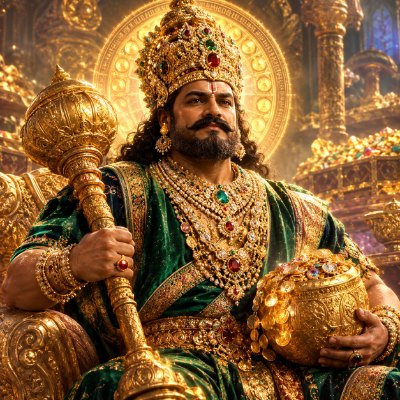
Kubera — God of Wealth, Lord of the Yakshas, Guardian of the North
Kubera · Kuvera · Vaishravana · Dhanada · Dhanapati · Yaksheshvara · Rajaraja · Naravahana · Paulastya · Ilavila · Tryambakasakha · Manushyadharma
Kubera is the god of wealth and material prosperity in the Hindu tradition, the lord and king of the Yakshas — a class of semi-divine nature spirits associated with forests, mountains, and hidden treasures — and one of the eight Lokapalas, the guardian deities who preside over the eight cardinal and intermediate directions of the cosmos, Kubera presiding specifically over the north. He is the son of the sage Vishrava — himself the son of Pulastya, one of the Saptarishis and a mind-born son of Brahma the creator — and Ilavida, a woman of distinguished lineage. He is the half-brother of Ravana, Kumbhakarna, Vibhishana, and Shurpanakha through their shared father Vishrava. He appears across the full breadth of the Hindu canonical tradition — in the Rigveda, the Atharvaveda, the Mahabharata, the Valmiki Ramayana, all eighteen Mahapuranas, the Upapuranas, and numerous Agamic and Tantric texts — making him one of the most consistently attested divine figures in the entire tradition. His role encompasses not only the guardianship of wealth but also the stewardship of all the earth's material resources, the command of the divine treasury, and the governance of the Yaksha and Kinnara races.
✦ The Names and Epithets
Kubera bears a large number of names and epithets across the tradition, each encoding a distinct aspect of his identity and function. The name Kubera itself is of uncertain etymology, and the tradition offers several interpretations. One derivation connects it to the root ku, meaning "earth" or "bad," and bera or vera, meaning "body" — yielding "he of the deformed body," a reference to his distinctive iconographic appearance. Another tradition connects the name to kumbha in a contracted form, associating it with a pot or vessel as a symbol of stored wealth. The name Kuvera is an orthographic variant of the same name used interchangeably across sources.
Vaishravana, meaning "son of Vishrava," is his most widely used patronymic and serves almost as a second primary name across the Mahabharata and Ramayana. Dhanada means "giver of wealth," Dhanapati means "lord of wealth," and Dhaneshvara means "god of wealth" — all three encoding his primary divine function. Yaksheshvara and Yaksharaja mean "lord of the Yakshas" and "king of the Yakshas" respectively. Rajaraja means "king of kings," reflecting his status as the sovereign of a class of divine beings. Naravahana means "he whose vehicle is a man" or "he who is carried by humans," a reference to his palanquin borne by human attendants. Paulastya is a patronymic meaning "descendant of Pulastya," connecting him to his grandfather. Tryambakasakha means "friend of the three-eyed one," referring to his close friendship with Shiva. Ilavila is a matronymic used occasionally in some sources, meaning "son of Ilavida." Manushyadharma, used in some texts, means "he who follows human dharma" or "he who is bound by the laws of men," a reference to his status as a Lokapala bound to his directional guardianship.
✦ Lineage
- Paternal great-grandfather: Brahma — the creator deity, one of the three principal gods of the Puranic tradition, from whom Pulastya was born as a mind-born son. Kubera is thus three generations removed from Brahma on the paternal side.
- Paternal grandfather: Pulastya — one of the ten Prajapatis and one of the Saptarishis, a mind-born son of Brahma who emerged from Brahma's ear according to the Bhagavata Purana. He is the transmitter of the Vishnu Purana and a narrator of several Puranic texts.
- Father: Vishrava — a celebrated sage, son of Pulastya and Manini, renowned for his mastery of the Vedas and his ascetic power. He received the knowledge of Brahman directly from Pulastya. Through his second wife Kaikesi he fathered Ravana, Kumbhakarna, Vibhishana, and Shurpanakha.
- Mother: Ilavida — also rendered Ilavila or Idavida, described in the Valmiki Ramayana as a woman of great virtue and beauty given to Vishrava by the sage Bharadvaja as a mark of honour. The Bhagavata Purana's ninth Skanda alternatively identifies Ilavida as the daughter of Trinabindu rather than of Bharadvaja — a textual inconsistency that cannot be resolved from the available sources.
- Paternal half-brother: Ravana — the ten-headed demon-king of Lanka, principal antagonist of the Valmiki Ramayana, son of Vishrava by his second wife Kaikesi. Despite their half-brotherhood, Ravana forcibly displaced Kubera from Lanka, an act that precipitated a permanent estrangement between the two.
- Paternal half-brother: Kumbhakarna — son of Vishrava and Kaikesi, celebrated for his enormous size and his curse-induced sleep, who fought and died on Ravana's side during the siege of Lanka.
- Paternal half-brother: Vibhishana — son of Vishrava and Kaikesi, renowned for his righteousness, who defected from Lanka to join Rama's cause and was crowned king of Lanka after Ravana's defeat. He is counted among the Chiranjivis, the long-lived or immortal beings of the Hindu tradition.
- Paternal half-sister: Shurpanakha — daughter of Vishrava and Kaikesi, whose encounter with Rama and Lakshmana in the Dandaka forest served as the immediate trigger for Ravana's abduction of Sita.
- Wife: Bhadra — daughter of the Danava Mura, named in the Mahabharata and Puranic texts as Kubera's principal wife, also rendered as Charvi in some sources.
- Son: Nalakubara — also rendered Nalakuvara, a son of Kubera celebrated in the Puranas, most notably in the Bhagavata Purana's account of his cursing by the sage Narada and his subsequent liberation by Krishna.
- Son: Manigriva — a son of Kubera, named alongside Nalakubara in the Bhagavata Purana's account of the two brothers' liberation from a curse by the infant Krishna in the episode of the Yamala-Arjuna trees.
- Son: Mayuraja — named in some Puranic texts as a son of Kubera, though less consistently attested than Nalakubara and Manigriva.
- Daughter: Minakshi — named in some regional and Puranic traditions as a daughter of Kubera, though her attestation is not universal across all primary sources.
✦ Origins and Early Mythology
Kubera's origins in the earliest stratum of the Vedic tradition are distinct from his fully developed Puranic identity. In the Atharvaveda he appears as a figure associated with the north and with hidden wealth, and the name Vaisravana — used as both a name and a title — appears in Vedic contexts as a deity of the northern quarter. He is here associated with forests and wild places, consistent with his later role as lord of the Yakshas, who are themselves beings of forests and mountains. The Rigveda does not mention Kubera by name, though Vaisravana appears in some Vedic contexts.
In the Puranic tradition his origins are narrated at greater length. His birth to Vishrava and Ilavida is recorded across multiple texts, and his spiritual development as a devoted practitioner of tapas is emphasised. Several Puranic accounts describe Kubera performing intense austerities directed toward Brahma, as a result of which Brahma granted him the status of a Lokapala and the guardianship of the north, together with the divine treasury Nidhi and the celestial city of Alakapuri on Mount Kailasa. This motif — a figure attaining divine status through austerity and the grace of Brahma — is a standard Puranic narrative pattern, and Kubera's version of it is among the most fully elaborated in the tradition.
✦ Kubera as King of Lanka
One of the most important episodes in Kubera's mythology concerns his original kingship of Lanka. The Valmiki Ramayana and several Puranic texts record that Lanka — the magnificent island city built by the divine architect Vishvakarma — was originally Kubera's capital and the seat of his kingdom. He ruled from Lanka as the lord of the Yakshas and the guardian deity of wealth, presiding over a prosperous and well-ordered realm.
This situation changed when Ravana, his half-brother through their shared father Vishrava, performed severe austerities and obtained tremendous powers from Brahma, including near-invulnerability to gods, demons, and celestial beings. Emboldened by these boons, Ravana returned to Lanka — which he regarded as rightfully belonging to the Rakshasa lineage through their maternal grandfather Sumali — and forcibly expelled Kubera from the island. Kubera, unwilling to wage war against his own brother, yielded Lanka without a battle and departed. This displacement of Kubera by Ravana is presented across the sources as one of the earliest manifestations of Ravana's hubris and the beginning of the chain of events that would eventually lead to his destruction at Rama's hands.
After leaving Lanka, Kubera established his new capital at Alakapuri — also called Alaka — situated on or near Mount Kailasa in the Himalayas. This city is described across the Puranas and the Mahabharata as a place of extraordinary beauty and abundance, filled with divine trees, celestial music, and the assembled Yakshas, Kinnaras, and Gandharvas who constitute Kubera's divine court. The Mahabharata's Sabhaparvam contains a celebrated description of Kubera's assembly hall, which rivals those of the other Lokapalas in its magnificence.
✦ The Pushpaka Vimana
Among the most celebrated possessions of Kubera is the Pushpaka Vimana — a magnificent aerial vehicle, described across the Ramayana and Puranic texts as a self-propelled flying conveyance of extraordinary beauty and capacity, capable of travelling at the speed of thought and expanding or contracting to accommodate any number of passengers. The Pushpaka was originally fashioned by the divine architect Vishvakarma and given to Brahma, who in turn gave it to Kubera as a gift befitting his status as lord of wealth.
When Ravana displaced Kubera from Lanka, he also seized the Pushpaka Vimana by force, adding this theft to the grievance of the expulsion from Lanka. It is in the Pushpaka that Ravana subsequently abducted Sita and carried her to Lanka, making it an instrument of the central crime of the Ramayana. After Ravana's defeat and death at Rama's hands, Rama used the Pushpaka to transport himself, Sita, Lakshmana, and their allies from Lanka back to Ayodhya. Rama subsequently returned the Pushpaka to Kubera, its rightful owner, restoring what Ravana had stolen.
✦ Kubera's Warning to Ravana
The Valmiki Ramayana's Uttara Kanda preserves an episode in which Kubera, after being displaced from Lanka, sent a message to Ravana warning him of the consequences of his conduct. Kubera urged his half-brother to abandon the path of adharma and to return to righteous governance, predicting that Ravana's pride and violent nature would ultimately lead to his destruction. Ravana dismissed this warning contemptuously, and the narrative presents Kubera's counsel as both prophetically accurate and tragically unheeded. This episode is significant in establishing Kubera not merely as a displaced victim of Ravana's aggression but as a figure of moral discernment who correctly foresaw the outcome of his brother's transgressions.
✦ Kubera and Shiva
One of the most consistently emphasised relationships in Kubera's mythology is his deep friendship with Shiva, one of the three principal deities of the Puranic tradition. Kubera's epithet Tryambakasakha — "friend of the three-eyed one," Tryambaka being a name of Shiva — reflects the centrality of this relationship. Kubera's city of Alakapuri is situated on or near Mount Kailasa, the Himalayan peak that is Shiva's principal abode, and the proximity of their divine residences is presented across the tradition as reflecting the closeness of their bond.
Several Puranic texts record episodes in which Kubera visits Shiva at Kailasa, participates in the divine assembly there, and enjoys the favour of the great god. The Mahabharata describes Kubera as among the most honoured guests at Shiva's court. Some Shaiva Puranic texts present Kubera as a devoted worshipper of Shiva, and his proximity to Kailasa is read in some traditions as itself a mark of Shiva's special favour toward him. The Shiva Purana contains material elaborating on this friendship and on Kubera's devotion to Shiva as one of the sources of his divine standing.
✦ The Episode of Nalakubara, Manigriva, and Krishna
One of the most celebrated Puranic episodes involving Kubera's family concerns his two sons Nalakubara and Manigriva, narrated in the Bhagavata Purana's tenth Skanda. The two young men, intoxicated with the pride of their divine parentage and their father's wealth, were sporting in a garden with celestial women when the sage Narada came upon them. Displaying a lack of decorum in the presence of the sage, the two brothers failed to conduct themselves appropriately. Narada, compassionate rather than vengeful in his intent according to the Bhagavata Purana's reading of the episode, pronounced a curse upon them: they would become trees — specifically the twin Yamala-Arjuna trees — and would remain in that form until liberated by the touch of the infant Krishna.
The curse was duly fulfilled. The two trees stood in the courtyard of Nanda's home in Vrindavana, and the infant Krishna, crawling between them while bound to a mortar by his foster mother Yashoda as a punishment for his mischief, caused the mortar to become lodged between the two trees and pulled them down, uprooting both simultaneously. From the fallen trees emerged Nalakubara and Manigriva in their divine forms, freed from the curse and liberated by the grace of Krishna. This episode is significant in the Bhagavata tradition as one of the early childhood miracles of Krishna, and it connects Kubera's family directly to the Krishna narrative in the tenth Skanda.
✦ Kubera and the Mahabharata
Kubera appears at several significant points in the Mahabharata. The Sabha Parva contains an extended description of his assembly hall in Alakapuri, delivered by the sage Narada to the Pandavas, which serves to establish the magnificence of the divine courts that Yudhishthira's own new assembly hall — built by Maya the demon architect — would rival. This description presents Kubera surrounded by his Yaksha attendants, his Kinnara musicians, and the assembled wealth of the three worlds, in a court of supernatural beauty and abundance.
The Vana Parva records that during the Pandavas' forest exile, Arjuna travelled to the Himalayan regions and encountered Kubera's realm. Bhima, during his journey to obtain the Saugandhika lotus for Draupadi, passed through territories under Kubera's dominion and encountered Kubera's Yaksha attendants. The Mahabharata also records that Kubera was present at the great assembly of gods and sages at various sacred occasions narrated in the epic, establishing him as a regular participant in the divine councils of the tradition.
✦ The Nine Nidhis
A distinctive and theologically significant aspect of Kubera's divine function is his stewardship of the nine Nidhis — the nine treasures or troves of wealth that constitute the material abundance of the cosmos. These nine Nidhis are named across various Puranic and Agamic texts as Padma, Mahapadma, Shankha, Makara, Kachchhapa, Mukunda, Kunda, Nila, and Kharva, though the precise names vary somewhat across sources. Each Nidhi is conceived not merely as a store of material wealth but as a quasi-divine being or force associated with a particular type of abundance — agricultural fertility, mineral wealth, aquatic resources, and so on.
As the lord of the Nidhis, Kubera is not simply a deity who possesses wealth but one who governs and distributes the material resources of the entire created world. This conception elevates his function beyond that of a personal deity of riches into something closer to a cosmic principle of material sustenance, and it accounts for the breadth of his worship across all levels of Hindu society, from the humblest household seeking material security to royal courts seeking legitimisation of their prosperity through divine patronage.
✦ Kubera as Lokapala
As one of the eight Lokapalas — the guardians of the eight directions — Kubera presides over the north, which in the Hindu cosmological imagination is the direction associated with the Himalayas, with the abodes of the gods, and with the source of sacred rivers. His fellow Lokapalas in the standard eight-fold scheme are Indra presiding over the east, Agni over the southeast, Yama over the south, Nirrti over the southwest, Varuna over the west, Vayu over the northwest, and Ishana — a form of Shiva — over the northeast. In some texts the scheme is expanded to include additional intermediate-direction guardians.
As the northern Lokapala, Kubera's directional guardianship is invoked in Vedic and Tantric ritual, in the consecration of temples and sacred spaces, and in the rituals surrounding the construction of buildings and the establishment of settlements, where the blessing of the directional guardians is sought. His presence in these ritual contexts gives him a practical and functional role in religious life that extends well beyond his narrative appearances in the epics and Puranas.
✦ Iconography and Worship
Kubera's iconography is among the most distinctive of any Hindu deity. He is consistently depicted as a corpulent, dwarfish figure — short and stout, with a pot belly reflecting the abundance he embodies — and his body is described across the textual tradition as bearing specific physical marks that distinguish him. He typically has three legs in some textual descriptions, or is alternatively depicted with a single leg shorter than the other, producing a distinctive gait. He is described as having eight teeth in some texts, and as bearing a deformity or distinctive marking in one eye. His complexion is variously given as yellow, golden, or pale across different sources.
His standard iconographic attributes include a money pot or a bowl overflowing with coins, a club or mace, and occasionally a mongoose — the mongoose being a traditional symbol of wealth in the Indian tradition, associated with spitting out jewels. He is sometimes shown holding a pomegranate, a fruit associated with abundance and fertility. He is typically shown seated or standing on a palanquin borne by human figures, consistent with his epithet Naravahana. He wears rich garments and elaborate jewellery, and is surrounded by his Yaksha attendants and by symbols of material abundance.
Kubera's worship is attested across a wide geographical and temporal range within the Hindu tradition. He is propitiated for the acquisition and protection of wealth, for business prosperity, for the removal of financial obstacles, and for the general increase of material well-being. His worship is particularly associated with Diwali, the festival of lights, during which Lakshmi — the goddess of wealth and consort of Vishnu — and Kubera are jointly propitiated for prosperity in the coming year. In some regional traditions Kubera is worshipped as a primary deity of prosperity rather than a secondary one, and temples dedicated specifically to him exist across India, particularly in South India and in Himalayan regions. His image is frequently installed in the northern direction of temples and sacred spaces as part of the Ashtadikpala scheme of directional guardians.
In the Tantric and Agamic traditions, Kubera is incorporated into more complex ritual and iconographic schemes. He appears in the retinues of various deities, in protective mandalas, and as an object of individual worship in Tantric sadhana directed toward the attainment of material prosperity. His bija mantra and his specific liturgical forms are elaborated in texts of the Agamic tradition.
✦ Kubera in the Buddhist and Jain Traditions
Kubera's significance extends beyond the Hindu tradition into both Buddhist and Jain religious worlds, attesting to his ancient and pan-Indic importance as a deity of wealth and the northern direction. In the Buddhist tradition he is known as Vaishravana or Jambhala, and he is one of the four Heavenly Kings who guard the four cardinal directions in Buddhist cosmology. As the guardian of the north he presides over the Yaksha class of beings in the Buddhist cosmological scheme just as in the Hindu one. His image and his patronage of wealth are incorporated into Buddhist ritual and artistic traditions across South Asia, Central Asia, China, Japan, and Tibet, where he appears in distinctly localised iconographic forms while retaining his fundamental identity as the northern guardian and lord of wealth.
In the Jain tradition, Kubera similarly appears as a yaksha figure associated with wealth and the northern direction, and is incorporated into the attendant deity schemes of Jain temple iconography. His presence across all three of the great Indic religious traditions — Hindu, Buddhist, and Jain — marks him as one of the most ancient and widely shared divine figures in the religious history of South Asia, predating the doctrinal distinctions between these traditions and attesting to a common substratum of belief in a divine lord of wealth associated with the north and with Yaksha beings.
✦ Textual Variants and Inconsistencies
The principal textual inconsistency affecting Kubera's profile is the question of his mother's identity and parentage, which flows from the broader unresolved inconsistency in the Trinabindu-Vishrava lineage discussed in the profiles of those figures. The Valmiki Ramayana identifies his mother Ilavida as a woman given to Vishrava by the sage Bharadvaja. The Bhagavata Purana's ninth Skanda alternatively identifies Ilavida — there called Ilavila — as the daughter of Trinabindu and Alambusa, making her a princess of the solar dynasty rather than a sage's daughter. These two accounts give Kubera different maternal grandparents and place his mother in a different social and genealogical category — brahmin sage's daughter in one account, solar dynasty princess in another.
A further inconsistency concerns Agastya. Some Puranic texts, particularly passages in the Bhagavata Purana's fourth Skanda which name Pulastya's wife as Havirbhu, identify Agastya as the brother of Vishrava — and thus as Kubera's paternal uncle — through this wife. Other texts, including the Valmiki Ramayana, do not present this relationship, treating Agastya's lineage as entirely separate from that of Pulastya's family through Vishrava. This inconsistency reflects the broader complexity of Pulastya's family across different Puranic traditions.
Minor variants also exist in the enumeration of Kubera's wives and children across different sources, with some texts naming additional sons or different wives beyond those most consistently attested.
✦ Theological Significance
Kubera occupies a theologically distinctive position in the Hindu divine hierarchy. He is not one of the supreme deities of the tradition — he is not Vishnu, Shiva, or the great goddess — but he is among the most universally acknowledged of the second tier of divine beings, holding a recognised and formal office within the cosmic governance structure as a Lokapala. His theological significance lies in his function as the embodiment and steward of material prosperity, a divine principle that the tradition affirms as real and worth honouring rather than merely illusory or spiritually insignificant.
The tradition's treatment of Kubera reflects a broader Hindu affirmation of artha — material well-being and prosperity — as one of the four legitimate aims of human life alongside dharma, kama, and moksha. As the divine patron of artha in its most direct material form, Kubera serves as the celestial validation of the human pursuit of wealth when conducted within the bounds of dharma. His story — of an individual who attained divine status through austerity, who was wronged by his own brother but conducted himself with restraint and dignity, who warned the transgressor of the consequences of his actions, and who was ultimately vindicated when Rama restored both the Pushpaka Vimana and the honour of the righteous — encodes a moral narrative about the relationship between dharmic conduct and material prosperity that resonates across the tradition.
✦ Connection to the Wider Genealogy
Kubera stands at the intersection of several major genealogical streams in the Hindu tradition. Through his father Vishrava and grandfather Pulastya he is connected to Brahma and to the lineage of the Saptarishis. Through his mother Ilavida — whether she is the daughter of Bharadvaja per the Ramayana or the daughter of Trinabindu per the Bhagavata Purana — he is connected either to the brahmin sage lineage of Bharadvaja or to the solar dynasty through Trinabindu and Vaivasvata Manu. Through his half-brothers Ravana, Kumbhakarna, and Vibhishana he is connected to the central narrative drama of the Ramayana. Through his sons Nalakubara and Manigriva he is connected to the Krishna narrative of the Bhagavata Purana. Through his divine office as Lokapala he is embedded in the cosmic governance structure shared with Indra, Yama, Varuna, and the other directional guardians. These connections make Kubera one of the most genealogically and cosmologically connected figures in the entire tradition, present at multiple key junctures of both the epic and Puranic narratives.
✦ References
- Primary Sources
- Atharvaveda: Contains among the earliest Vedic references to Vaisravana as a deity of the north and of hidden wealth, establishing the Vedic foundation for Kubera's later Puranic identity.
- Valmiki Ramayana, Uttara Kanda: Narrates Kubera's birth, his original kingship of Lanka, his displacement by Ravana, his warning to Ravana, and the seizure of the Pushpaka Vimana; the most detailed single source for Kubera's narrative biography.
- Valmiki Ramayana, Aranya Kanda and Yuddha Kanda: Contains references to Kubera's Pushpaka Vimana as used by Ravana and subsequently by Rama, and to Kubera's divine court and its relationship to the events of the Ramayana.
- Mahabharata, Sabha Parva: Provides the extended description of Kubera's assembly hall in Alakapuri as narrated by Narada, one of the fullest accounts of Kubera's divine court and its magnificence in the epic literature.
- Mahabharata, Vana Parva: Records Bhima's journey through Yaksha-governed territories during the Pandavas' forest exile and the encounters with Kubera's domain.
- Bhagavata Purana, Skanda IX, Chapter 2: Records the genealogical tradition placing Ilavila as daughter of Trinabindu and wife of Vishrava, mother of Kubera; represents the alternative maternal lineage tradition.
- Bhagavata Purana, Skanda X: Narrates the episode of Nalakubara and Manigriva — Kubera's two sons — their curse by Narada and their liberation by the infant Krishna in the episode of the Yamala-Arjuna trees.
- Vishnu Purana, Book I: Records Pulastya's lineage through Vishrava to Kubera and Ravana, placing Kubera within the genealogy of the mind-born sons of Brahma.
- Vayu Purana: Contains detailed genealogical material on the Pulastya lineage including Vishrava and Kubera, and descriptions of Kubera's divine city and his role as lord of the Yakshas.
- Shiva Purana: Elaborates on Kubera's friendship with Shiva, his proximity to Kailasa, and his devotion to the great god as one of the sources of his divine standing.
- Skanda Purana: Contains additional material on Kubera's worship, his role as a Lokapala, and regional traditions of his veneration across sacred sites in India.
- Agni Purana: Provides iconographic specifications for Kubera's image in the context of temple construction and image consecration, contributing to the understanding of his visual representation in the tradition.
- Matsya Purana: Contains genealogical and narrative material on Kubera within the broader account of the solar and sage lineages, providing supplementary Puranic attestation.
- Secondary Sources
- Mani, Vettam. Puranic Encyclopaedia. Motilal Banarsidass, 1975: Provides a comprehensive entry on Kubera summarising his parentage, his major narrative episodes, his iconography, his divine offices, and the textual variants affecting his family's genealogy across the primary sources.
- Kramrisch, Stella. The Hindu Temple. 2 vols. University of Calcutta, 1946: Discusses Kubera's iconographic role in temple architecture as one of the Ashtadikpalas and the specifications for his placement and representation in sacred space.
- Sutherland, Gail Hinich. The Disguises of the Demon: The Development of the Yaksha in Hinduism and Buddhism. State University of New York Press, 1991: Analyses Kubera's role as lord of the Yakshas across both Hindu and Buddhist traditions, tracing the development of his identity from Vedic to Puranic contexts.
- Pargiter, F. E. Ancient Indian Historical Tradition. Oxford University Press, 1922: Analyses the Puranic dynastic lists relevant to Kubera's maternal lineage, providing scholarly context for the conflicting accounts of Ilavida's parentage.
- Wisdomlib (wisdomlib.org): Offers extensively cross-referenced citations of Kubera across digitised Sanskrit texts, confirming his attestation across the Vedic, epic, and Puranic corpus and providing access to the specific passages cited in this profile.