
About
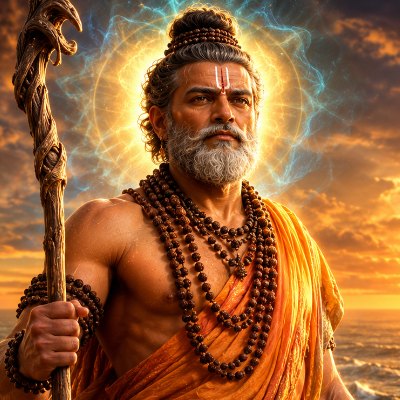
Agastya — Vedic Seer, Saptarishi, Civiliser of the South
Agastya · Agasti · Agathiyar · Kumbhayoni · Kumbhaja · Kalasaja · Mana · Maitravaruni · Pitrnama · Samudra-Culuka
Agastya is one of the most widely attested and theologically significant sages in the entire Hindu canonical tradition. He is a named author of hymns in the Rigveda, one of the Saptarishi in certain Vedic and Puranic lists, a central figure in both the Valmiki Ramayana and the Mahabharata, and a figure of paramount importance in the Tamil Shaiva tradition, where he is venerated as the founder of the Tamil language and the father of Siddha medicine. He appears in all four Vedas, in the Brahmanas, Aranyakas, and Upanishads, across the eighteen Mahapuranas, in the Harivamsha, and in inscriptions and temple sculpture across South Asia and Southeast Asia. In the Puranic tradition, the one in which this profile is primarily situated, he is named as the son of Pulastya — one of the ten Prajapatis and one of the mind-born sons of Brahma — and is therefore a grandson of Brahma. His birth is simultaneously attributed to the Vedic gods Mitra and Varuna through the apsara Urvashi, giving him two competing but thematically complementary origin accounts. He married Lopamudra, a princess of Vidarbha, and with her had a son named Dridhasyu. His canonical narrative episodes — the taming of the Vindhya mountains, the destruction of the demons Vatapi and Ilvala, the drinking of the ocean, and his instruction of Rama on the battlefield of Lanka — are among the best-known adventure stories of the Puranic tradition. His identification with the star Canopus, the second-brightest star in the night sky, gives him a unique cosmological dimension shared by few other sages.
✦ The Name
Multiple etymologies for Agastya circulate across Sanskrit and Tamil scholarship. The Wikipedia article on Agastya, drawing on established scholarship, records four principal proposals. The first derives the name from the root Aj or Anj, meaning "to brighten" or "to be effulgent," linking Agastya to the concept of "one who brightens in darkness" — an interpretation consistent with his identification as the star Canopus. The second is a folk etymology preserved in verse 2.11 of the Valmiki Ramayana, which derives the name from aga (mountain, the unmoving) and gam (to move), yielding the meaning "mover of mountains" or "one who moves the unmoving" — a clear allusion to the episode of the Vindhya mountains. A third proposed etymology links the name through Iranian cognates to a root meaning "not foul, not sinful." The Mahabharat-Puran Kosh notes that the name Mana, one of his epithets, derives from the fact that he was born inside a kumbha (earthen pot) whose capacity could be measured (mana means measure), and that Kumbhayoni, Kumbhaja, and Kalasaja all straightforwardly mean "born from a pot" or "born from a water vessel." The epithet Maitravaruni identifies him as the son of Mitra and Varuna. The epithet Samudra-Culuka means "he who swallowed the ocean." The form Agathi or Agathiyar is the Tamil rendering of the name, widely used in South Indian and Tamil Shaiva literature.
✦ Lineage
- Grandfather: Brahma — the creator god, from whom the Prajapatis are mind-born; the ultimate ancestor of Agastya through Pulastya
- Father (Puranic account): Pulastya — one of the ten Prajapatis and one of the Saptarishi of the first Manvantara; a mind-born son of Brahma; the sage through whom the Vishnu Purana was transmitted to humanity (Pulastya received it from Brahma and communicated it to Parashara); also the progenitor of Vishravaas, and through Vishravaas the ancestor of Ravana, Kumbhakarna, Vibhishana, and Kubera
- Mother (Puranic account): Havirbhu — named in the Bhagavata Purana as the wife of Pulastya and mother of Agastya and Vishravaas; described as a daughter of the sage Kardama; in the Saurapurana she is instead called Priti, a daughter of Daksha
- Divine progenitors (Vedic and older Puranic account): Mitra and Varuna — the paired Vedic gods; their seed, falling into an earthen vessel at the appearance of the apsara Urvashi, is the medium from which Agastya and in some tellings also Vashishtha are born; this account is attested in the Rigveda itself (7.33.10–13) and elaborated in the Mahabharat-Puran Kosh and other sources; the Bhagavata Purana confirms that Agastya and Vashishtha are the common sons of Mitra and Varuna
- Brother (in the Pulastya-lineage account): Vishravaas — Pulastya's other son, who became the father of Ravana, Kumbhakarna, Vibhishana, and Kubera; Agastya and Ravana are thus, in the Puranic genealogical scheme, uncle and nephew
- Brother (in some Vedic accounts): Vashishtha — in certain mythologies Agastya and Vashishtha are described as co-born from the same vessel of Mitra and Varuna; this twin-birth account is preserved in the Rigveda (7.33) and elaborated in the Ramayana; the Saurapurana tradition, which makes Agastya a son of Pulastya by Priti (daughter of Daksha), specifically calls Vashishtha his elder brother
- Wife: Lopamudra — a brahmin woman, also known as Kaveri, Kaushitaki, and Varaprada; her origin is narrated in two mutually inconsistent accounts: in the Mahabharata she is constructed by Agastya himself from the most beautiful parts of various creatures and placed in the household of the childless king of Vidarbha, who raised her as his daughter; in another tradition she is simply described as a princess of Vidarbha whom Agastya sought in marriage; the name Lopamudra means "she at whose creation animals and creatures suffered the loss (lopa) of their distinctive beauties (mudra)"; she is a Rigvedic Brahmavadini in her own right, credited as author of hymn 1.179
- Son: Dridhasyu — also called Idhmavaha; described in the Mahabharata as having learned the Vedic hymns while still in his mother's womb and as having been born reciting them
✦ The Miraculous Birth
The oldest surviving account of Agastya's miraculous birth is found in the Rigveda itself (7.33.10–13), where his birth alongside Vashishtha is linked to the divine pair Mitra and Varuna and to the apsara Urvashi. The Puranic and epic elaborations develop this into a narrative: Mitra and Varuna, enflamed by the beauty of the apsara Urvashi who appears before them during a sacrifice, shed their seed; this seed falls into an earthen pitcher (kumbha), and from this vessel Agastya is born, along with Vashishtha in certain versions. Agastya's emergence from a pot rather than from a womb gives him the ayonija (womb-free) quality shared with other figures of exceptional origin in the tradition. His epithets Kumbhayoni, Kumbhaja, and Kalasaja all record this pot-birth directly.
The Puranic tradition, including the Bhagavata Purana and the Shiva Purana, assigns Agastya a second birth-account running in parallel: as the son of Pulastya by his wife Havirbhu. The Mahabharat-Puran Kosh notes that these two accounts are not treated as contradictory in the tradition but as two dimensions of the same figure — one representing his divine, non-womb origin through the seminal power of the Vedic gods, the other locating him within the social and genealogical structure of the Prajapati lineages descending from Brahma. The Saurapurana preserves a further variant in which Pulastya's wife is named Priti (a daughter of Daksha) rather than Havirbhu, and their son is named Datta, identified as Agastya.
✦ Vedic Authorship and Significance
Agastya is one of a small number of sages for whom authorship of Rigvedic hymns is attested by the text itself. He is named as the seer of hymns 1.165 through 1.191 of the Rigveda, a substantial corpus. These hymns are notable for their verbal complexity — their use of similes, wordplay, riddles, and layered imagery — and for their theological content. Among them, one hymn (1.179) is attributed to his wife Lopamudra, recording a dialogue between the two on the competing claims of ascetic discipline and the householder life. Another set of hymns (1.165–1.171) records a narrative tension between the sage and the god Indra over the rights of offering, in which Agastya is described as seeking to reconcile Indra and the Maruts after a dispute — an act of cosmic mediation unusual for a mortal sage. Agastya is mentioned not only in the first mandala but also in the older seventh mandala (7.33), and his name appears in all four Vedas, the Brahmanas, the Aranyakas, and the Upanishads.
✦ The Encounter with His Ancestors and the Creation of Lopamudra
A pivotal episode from the Mahabharata (Vana Parva) narrates how Agastya, having lived a long life as an ascetic, one day encountered the spirits of his ancestral forefathers (pitrs) hanging upside down in a pit. On asking them the reason, they told him they would remain in this state until he produced a son who would perform ancestral rites on their behalf and thereby release them from their suspended condition. Faced with this obligation, Agastya resolved to marry. Unable to find a woman suited to be his wife among those already in the world, he assembled the most beautiful qualities from all the creatures of the forest — the eyes of a deer, the slenderness of a palm tree, and other such gifts — and fashioned a woman from them. He placed this newly created child in the palace of the king of Vidarbha, who had been performing austerities to obtain a child. The king raised her as his own daughter and named her Lopamudra, the name being derived from the loss (lopa) inflicted on animals and creatures whose beauties were taken to form her. When Lopamudra reached marriageable age, Agastya approached the king and sought her as his bride. Though the king was reluctant — knowing that his daughter, raised in luxury, would face the hard ascetic life of Agastya's forest hermitage — Lopamudra agreed to the marriage, stating that the wealth of virtue was the true wealth. The Mahabharata records that Lopamudra ultimately requested Agastya to procure certain comforts before she would consent to consummate the marriage, which led him to seek resources from several kings and, finally, from the demon Ilvala — setting the stage for the Vatapi-Ilvala episode described below.
✦ The Destruction of Vatapi and Ilvala
The episode of Vatapi and Ilvala is one of the best-known narrative episodes associated with Agastya in both the Ramayana and the Mahabharata, where it appears in closely parallel versions. Ilvala and his brother Vatapi were two demons who killed brahmins through a repeating deception: Vatapi would transform himself into an animal (most commonly a goat or buffalo), be cooked, and served as food to brahmin guests; when the meal was finished, Ilvala would call out his brother's name, and Vatapi would tear his way out through the stomach of whoever had eaten him, killing the guest. They had killed thousands of men by this method. Agastya, approaching Ilvala in the course of his quest for wealth for Lopamudra, was served the same meal. Knowing Ilvala's plan, Agastya ate the food and then, using his yogic power of digestion, simply digested Vatapi completely. When Ilvala called out his brother's name, nothing emerged. Vatapi was gone. Agastya then turned his gaze on Ilvala and destroyed him. He received the wealth he had come for and returned to his wife.
✦ The Taming of the Vindhya Mountains
Among the episodes recorded in the Ramayana and the Mahabharata, the taming of the Vindhya range is one of the most significant in terms of its cosmological implications. The Vindhya mountains, in the narrative, had begun to grow without limit, driven by rivalry — or in some versions by hubris at not being honoured by the sun — to the point that they threatened to block the passage of the sun, the moon, and all living beings across the subcontinent. The gods, alarmed, went to Agastya for help. Agastya, accompanied by Lopamudra and travelling southward from the Himalayan region, approached the Vindhya range. He requested the mountains to lower themselves and remain prostrated until he returned from his journey into the southern regions. The Vindhyas complied. Agastya crossed into the south, and — the tradition holds — never returned north. The mountains, having pledged to remain bowed until his return, have remained at their relatively modest height ever since. This episode is presented in the texts as the mythological explanation for why the Vindhya range is lower than the Himalayas and for why the southern subcontinent became accessible to Vedic civilisation through Agastya's migration.
✦ The Drinking of the Ocean
The Vana Parva of the Mahabharata records a cosmic episode in which a class of demons (the Kalakeyas, also in certain versions described as asuras or demons hiding from the gods) took refuge at the bottom of the ocean, from which the gods were unable to dislodge them. All the armies of the heavens were powerless, since the demons could not be reached beneath the waters. The gods approached Agastya and petitioned him for help. Agastya went to the ocean, cupped the waters in his hands, and drank the entire ocean in a single draught, exposing the sea-bed and all its concealed demons to the gods, who then destroyed them. The problem this created — that the ocean remained empty — was resolved in a later era when the sage Bhagiratha brought the celestial river Ganga down to earth to refill the ocean. This episode gives Agastya the epithet Samudra-Culuka, meaning "he who cupped the ocean."
✦ Agastya and Rama in the Ramayana
In the Valmiki Ramayana, Agastya plays multiple roles in the narrative of Rama's exile and the war against Ravana. His hermitage is located on the banks of the Godavari in the Dandaka forest on the southern slopes of the Vindhyas. During his exile, Rama, Sita, and Lakshmana visit the hermitage. The sage receives them warmly and gifts Rama with divine weapons — including a bow of Vishnu and arrows associated with Brahma — and warns Rama about the nature of Ravana. Later, on the battlefield of Lanka, on the final day of the war, when Rama stands exhausted and uncertain before Ravana in his chariot, the sage Agastya appears in company with the gods who have assembled to witness the battle. It is at this moment that Agastya teaches Rama the Aditya Hridayam — a hymn of thirty-one verses in praise of the sun god Surya — and instructs him to recite it three times in order to gain strength and invincibility. Having delivered this teaching, Agastya withdraws. Rama recites the hymn, is restored, and slays Ravana. The Aditya Hridayam is presented in the text as an ancient and secret teaching that Agastya himself possessed as a member of the Saptarishi tradition.
✦ The Curse of Nahusha
The Mahabharata records an episode in which the king Nahusha, who had temporarily occupied the throne of Indra in heaven and had grown arrogant in his power, demanded that the seven sages (Saptarishi) carry his palanquin. During this act of humiliation, Agastya was struck on the head by Nahusha's foot when Nahusha impatiently urged the sages forward with the word "Sarpa" (move quickly). Agastya, enraged by this disrespect, pronounced a curse on Nahusha: that he would become a great serpent (the word sarpa meaning both "move" and "serpent" serving as the vehicle of the curse). Nahusha descended from Indra's throne and was transformed into a giant python, in which form he remained for a long period until the Pandava Bhima encountered him in the forest and the sage's curse was ultimately lifted through the intervention of Yudhishthira's wisdom.
✦ Agastya as Civiliser of the South
Across both the Sanskrit and Tamil traditions, Agastya occupies the singular position of the sage who brought Vedic civilisation, language, and spiritual knowledge to the southern subcontinent. In the Tamil Shaiva tradition, he is revered as Agathiyar, the father of the Tamil language, the compiler of the first Tamil grammar (Agattiyam or Akattiyam), and one of the eighteen Siddhars — the perfected masters of the Tamil Shaiva yogic tradition. He is also credited with a foundational role in the development of Siddha medicine and in the spiritual traditions of ancient Sri Lanka. Lord Shiva is said in this tradition to have personally instructed Agastya in the Tamil language at Shiva's command, so that it could be transmitted to the south. In the Sanskrit Puranic tradition, the motif of Agastya's southward migration — articulated through the Vindhya episode — is the narrative device by which his role as cultural transmitter is explained. His hermitage, correspondingly, is placed in southern sources in Tamil Nadu, most often in the Pothigai Hills (also called the Agastya Hills) of present-day Tirunelveli district, and in Kerala at Agastyarkoodam.
✦ Association with the Star Canopus
In Indian astronomical tradition, Agastya is the Indian name for the star Canopus, the second most brilliantly shining star visible from the Indian subcontinent after Sirius. The star is described in the Brihat Samhita of Varahamihira and in other jyotisha texts as sacred to the sage Agastya, and the regent of the star is said to be Agastya himself. The Puranas describe him as having been appointed regent of Canopus after his earthly career. The star Canopus was invisible from most of northern India due to its low declination on the southern horizon; it becomes visible only as one travels southward past the Vindhya range. The narrative of Agastya's migration south — crossing the Vindhya mountains and settling in the south — has therefore been read by scholars, ancient and modern, as a mythological encoding of the southward journey required to first observe this bright southern star. The Wikipedia article on Agastya cites the astronomer K. D. Abhyankar's research arguing that the star was named after the sage because the sage crossed the Vindhya and saw the star for the first time.
✦ Textual Variants and Inconsistencies
Parentage: The primary inconsistency in Agastya's profile is the question of his father. In the Vedic tradition (Rigveda 7.33) and the Bhagavata Purana (6.18.5), Agastya and Vashishtha are both described as sons of Mitra and Varuna, born from a sacred pitcher at the appearance of Urvashi. In the Puranic genealogical tradition, Agastya is assigned to the Prajapati lineage as a son of Pulastya by Havirbhu (Bhagavata Purana, Shiva Purana), making him a direct descendant of Brahma through Pulastya. The Saurapurana gives a further variant: Pulastya's wife is Priti (a daughter of Daksha), and their son is named Datta, identified as Agastya in a previous birth. These three accounts — Mitra-Varuna origin, Pulastya-Havirbhu origin, and Pulastya-Priti origin — are not harmonised in any single text and represent genuine inter-textual inconsistencies. The tradition as a whole appears to have treated the Mitra-Varuna birth as the sacred, cosmological account and the Pulastya filiation as the genealogical-social account, without treating them as exclusive alternatives.
Relationship to Vashishtha: In some sources Agastya and Vashishtha are described as co-born from the same vessel (suggesting twin or simultaneous birth from Mitra and Varuna), while in others — particularly the Saurapurana — Vashishtha is called Agastya's elder brother. These two framings carry different implications for the relative seniority of the two sages and are not consistently maintained across all texts.
Mother of Agastya: In the Pulastya-lineage account, Agastya's mother is Havirbhu in the Bhagavata Purana and Priti (daughter of Daksha) in the Saurapurana. These are different figures and cannot be reconciled as the same person. The Shiva Purana's Purana Index, as recorded by Wisdomlib, names Havirbhu and describes her as a daughter of Kardama — yet another variant. No single Purana acknowledges or resolves this inconsistency.
Hermitage location: Ancient and medieval sources are comprehensively inconsistent on the location of Agastya's ashrama. Northern and eastern sources place it variously in Maharashtra (Godavari banks near Nashik), in Uttar Pradesh (near Kannauj), or in Uttarakhand (near Rudraprayag). Southern sources, including the Devi-Bhagavata Purana, place it in Tamil Nadu — at the Pothigai Hills (Tirunelveli), at Thanjavur, or at Kanyakumari. These are mutually exclusive geographical placements and reflect the different regional communities that claimed the sage as their own.
Lopamudra's origin: In the Mahabharata account, Agastya himself constructs Lopamudra and places her with the king of Vidarbha. In a different account within the Mahabharata tradition, she is simply a princess whose parents resisted the match before consenting. These two accounts of her origin coexist without resolution in the Mahabharata itself.
✦ Theological and Philosophical Significance
Agastya occupies a theologically productive position at the intersection of several major traditions. Within Shaivism, particularly in the Tamil Shaiva Siddha lineage, he is the paradigmatic sage-receiver: Shiva teaches him the Tamil language, the yogic sciences, and the Siddha medicines, and he transmits these to humanity. Within Vaishnavism, he is the teacher who arms Rama with the Aditya Hridayam at the decisive moment of cosmic battle, and is described in various Puranas as a narrator and transmitter of Puranic knowledge. Within the Vedic and Shakta traditions, he is credited with receiving from Hayagriva (a manifestation of Vishnu) the Lalita Sahasranama, the thousand names of the goddess, which he then transmitted to the world. His role as a civiliser — controlling the Vindhya range, establishing Vedic presence south of it, taming demonic forces — makes him, structurally, a figure who enacts the expansion of a sacred cultural order into territories understood as belonging to its periphery. His identity as the star Canopus gives him a celestial permanence that matches his status as a Chiranjivi — one who is immortal — in certain traditions.
✦ Connection to the Wider Genealogy
In the Pulastya-lineage account, Agastya is a grandson of Brahma, a son of Pulastya, and therefore a half-uncle to the Rakshasas. The lineage runs: Brahma — Pulastya — Agastya (one branch) and Brahma — Pulastya — Vishravaas — Ravana, Kumbhakarna, Vibhishana, Kubera (another branch). This places Agastya and Ravana in an uncle-nephew relationship, a genealogical irony noted in some retellings of the Ramayana, where the sage who arms Rama with the decisive weapon against Ravana is, in the Puranic lineage, Ravana's own paternal uncle. Through his son Dridhasyu and through his disciple traditions, Agastya's lineage extends into several important sectarian and textual genealogies. His marriage to Lopamudra, who belongs to the Vidarbha kingdom and is associated with the Yadava cultural world, connects him genealogically to that royal tradition as well. Through the Mitra-Varuna origin account, he is also a co-born kinsman of Vashishtha — one of the other Saptarishi — placing him within the most distinguished tier of Vedic sage genealogy.
✦ References
Primary Sources
- Rigveda, Mandala 1, hymns 165–191: The primary corpus of hymns attributed to Agastya as seer, including hymn 1.179 attributed to Lopamudra; foundational for establishing his Vedic authorship and antiquity.
- Rigveda, Mandala 7, hymn 33 (verses 10–13): The oldest surviving account of Agastya's birth from the seed of Mitra and Varuna at the appearance of Urvashi; also records his co-birth with Vashishtha.
- Bhagavata Purana, Book 6, Chapter 18, verse 5: Confirms that Agastya and Vashishtha are the common sons of Mitra and Varuna; also Book 4, Chapter 1, names Havirbhu as mother of Agastya in the Pulastya-lineage account.
- Valmiki Ramayana, Aranya Kanda and Yuddha Kanda: Narrates Agastya's role in Rama's exile — the hermitage on the Godavari, the gifts of divine weapons, the taming of the Vindhyas referenced by Rama, the defeat of Vatapi and Ilvala — and the climactic scene of the Aditya Hridayam teaching on the battlefield of Lanka.
- Mahabharata, Vana Parva (Book 3), Chapters 95–99 (Tirthabatra and Tirtha-yatra sections): Narrates the encounter with ancestral spirits, the creation and marriage of Lopamudra, the Vatapi-Ilvala episode, the taming of the Vindhyas, the drinking of the ocean, and additional episodes; also the major source for the story of Nahusha's transformation.
- Mahabharata, Shanti Parva: Contains references to Agastya's knowledge of Dhanur Veda and related sciences.
- Shiva Purana, Purana Index: Names Pulastya as father of Agastya (identified as Dhragni in another birth) and Havirbhu (daughter of Kardama) as mother.
- Saurapurana, Vamsha section: Provides the alternative account naming Priti (daughter of Daksha) as Pulastya's wife and their son as Datta, identified as Agastya; also states Vashishtha as Agastya's elder brother.
- Matsya Purana, Chapter 61; Padma Purana, Chapter 22: Among the Mahapuranas that provide extended biographical accounts of Agastya; cited by the Wikipedia article on Agastya as providing full Puranic biographies.
- Brihat Samhita of Varahamihira, Chapter 12: Records Agastya's association with the star Canopus and his cosmological role as the sage who drank the ocean and suppressed the Vindhyas.
- Bhagavad Gita, Chapter 10, verse 25: Krishna names Agastya among the great sages in his list of divine manifestations (some traditions include this reference; the verse names the seven Saptarishi).
Secondary and Reference Works
- Wikipedia — Agastya article: Provides a comprehensive secondary synthesis of Agastya's attestation across the Vedic, epic, Puranic, and Tamil traditions, including etymology analysis, hermitage locations, and textual-variant surveys.
- Wikipedia — Lopamudra article: Provides detailed accounts of the three versions of Lopamudra's origin legend (Rigveda, Mahabharata, and Giridhara Ramayana).
- Wikipedia — Pulastya article: Establishes Pulastya's genealogy as a mind-born son of Brahma and clarifies the Pulastya-lineage account of Agastya's paternity.
- Wisdomlib.org — definition of Agastya: Aggregates cross-references from the Brihat Samhita, Shaivism, Vaishnavism, and Jyotisha texts regarding Agastya's multiple roles and identities.
- Wisdomlib.org — definition of Pulastya: Aggregates Shiva Purana, Bhagavata Purana, and Saurapurana citations for Pulastya's wives and sons, documenting the inconsistencies in Agastya's maternal lineage.
- Mahabharat-Puran Kosh (Netaji Institute for Asian Studies): Provides a detailed etymological and textual analysis of Agastya's birth from the Rigvedic account, including the derivation of his names Kumbhayoni and Mana.
- Mythfolklore.net — Agastya entry: Concise survey of his narrative episodes drawing on the Mahabharata and Ramayana traditions.