
About
Lopamudra — Vedic Seer, Wife of Agastya, Brahmavadini
Lopamudra · Kaveri · Kaushitaki · Varaprada
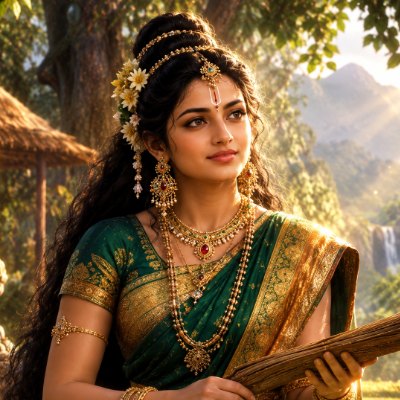
Lopamudra is one of the few women in the Vedic canonical tradition to whom authorship of Rigvedic hymns is directly attributed. She is the wife of the sage Agastya — a Saptarishi, son of Pulastya, and grandson of Brahma — and is herself recognised as a Rishika (female seer) and Brahmavadini (a woman devoted to the knowledge of Brahman) in her own right. Her hymn, Rigveda 1.179, is a dialogue on desire, asceticism, and conjugal duty and stands as one of the most discussed examples of a female-authored composition in the Vedic corpus. In the Shakta Tantric tradition she is further credited as the seer of the Hadi Panchadasi mantra, a variant of the Srividya tradition whose lineage is traced to her and was historically prevalent in Kerala. She appears with narrative detail in the Mahabharata (Vana Parva), where her origin, marriage, and resolution of a conflict between Agastya's ascetic vows and his ancestral obligations are all recorded. Her son is Dridhasyu, also called Idhmavaha, who is said in some texts to have learned the Vedas in the womb. In certain regional traditions, particularly in Karnataka, Lopamudra is identified with the river Kaveri, which is held to be her earthly transformation.
✦ The Name
The name Lopamudra is a Sanskrit compound of lopa (loss, disappearance, omission) and mudra (seal, mark, or distinctive beauty). The Mahabharata and all sources drawing on its account explain the name as a record of the act of her creation: Agastya assembled the most beautiful qualities of animals and other creatures to construct her form, and those creatures thereby suffered the loss (lopa) of their distinctive beauties (mudra). The name thus means "she at whose creation distinctive beauties were lost" or more precisely "the seal of the lost." The Grokipedia article, drawing on Vana Parva 3.97, confirms this etymological derivation and notes that it also suggests a recovery or synthesis — wholeness achieved through the gathering of fragmented beauties.
Her epithet Varaprada means "she who grants boons" or "boon-granter," signalling an auspicious and beneficent quality. Kaushitaki is another name used for her in certain texts, though this same name also belongs to a Vedic school, and the relationship between the two usages is not clarified in the available sources. Kaveri is the name under which she is identified with the sacred river of the same name in the regional Karnataka tradition, explained by the legend of her transformation into that river.
✦ Lineage
- Creator and foster-father (in the Mahabharata account): Constructed by Agastya — the Saptarishi and Vedic sage — from assembled animal beauties; placed by him in the household of the childless king of Vidarbha to be raised as a daughter; Agastya intended her as his future wife from the moment of her creation
- Adoptive father: The king of Vidarbha — unnamed in most sources, described as childless and performing austerities to obtain a child when Agastya introduced Lopamudra into his palace; he raised her as his daughter in conditions of royal luxury
- Husband: Agastya — one of the most celebrated sages of the Hindu tradition, a Saptarishi, author of Rigvedic hymns 1.165–1.191, son of Pulastya (one of the ten Prajapatis and a mind-born son of Brahma); also described in the Vedic account as born from a jar through the seed of the gods Mitra and Varuna; famed for subduing the Vindhya mountains, destroying the demons Vatapi and Ilvala, drinking the ocean, and teaching Rama the Aditya Hridayam
- Son: Dridhasyu — also called Idhmavaha; the Mahabharata records that he learned the Vedic hymns while still in his mother's womb and was born reciting them; described in some accounts as having become a poet
✦ Origin and the Three Versions of Her Story
There are three distinct accounts of Lopamudra's origin, preserved in different textual strata and not reconcilable with each other.
The first and oldest, which underlies the Rigvedic hymn itself, presents Lopamudra simply as a woman of the Vedic period whose dialogue with Agastya is preserved in hymn 1.179. The hymn gives no birth-account. Her identity as a princess of Vidarbha is associated with this Vedic layer in many retellings but is not stated within the hymn itself.
The second and most elaborate account is the Mahabharata's Vana Parva (Book 3, Tirtha-yatra Parva, Chapters 95–99). Here Agastya encounters his ancestral spirits suspended upside down in a pit; they tell him their condition will persist until he has a son to perform their ancestral rites. Unable to find a woman suited to his ascetic life, Agastya constructs a girl from the most graceful attributes of different creatures — the eyes of a deer, the grace of a panther, the slenderness of a palm tree, the fragrance of a champak flower, and other such qualities — and secretly places the child in the palace of the childless king of Vidarbha. The king raises her as his own daughter. When Lopamudra reaches marriageable age, Agastya comes and demands her hand. The king, though deeply reluctant to give his beloved daughter to an austere forest sage, eventually consents. Lopamudra willingly departs with Agastya. After the marriage, she demands from him comparable comforts before she will consent to bear a child; this demand compels him to re-enter society, seek wealth from kings, and ultimately obtain it from the demon Ilvala — which in the Mahabharata links the marriage narrative to the Vatapi-Ilvala episode. The Wikipedia article on Lopamudra notes that this version of the story has been interpreted by scholars as a demonstration of the incompleteness of a life of pure asceticism and as a celebration of the householder ideal.
The third account is from the Giridhara Ramayana, a vernacular Hindi retelling of the Rama story. In this version, Agastya approaches the king of Kanyakubja seeking a daughter in marriage. The king promises him a girl but, having married off all his daughters by the time Agastya returns, disguises his son as a girl and presents him to the sage. Miraculously, Lopamudra is transformed into a woman after the wedding. This version exists as a regionally specific tradition and has no parallel in the Sanskrit primary sources examined for this profile.
✦ Rigveda 1.179 — The Dialogue Hymn
Lopamudra's primary textual monument is Rigveda 1.179, which consists of six verses and is structured as a three-way dialogue. The first two verses are attributed to Lopamudra, two to Agastya, and the final two to a student of Agastya. In the Brihaddevata attributed to Shaunaka, the structural movement of the hymn is described: Lopamudra in her two verses expresses desire for union with her husband; Agastya in his two verses responds, capitulating to her entreaties; the student, who has become aware by yogic perception of what is transpiring between the two and feels he has inadvertently witnessed something private, then composes verses celebrating the resolution.
In Lopamudra's verses, she articulates the passage of time and her desire, noting that while many ancient sages performed their austerities, they did not on that account abandon the pleasures proper to a woman's time. She appeals to Agastya to turn toward her. The hymn is notable for its frankness, its invocation of Rati (the goddess of love and pleasure), and for placing the wife's desire as a theologically legitimate claim upon the sage rather than merely an obstacle to his practice. Scholar Laurie L. Patton, as recorded in the Wikipedia article on Lopamudra, has characterised the hymn as representing Lopamudra in a state of "voracious sexuality," while Dr. Rameshchandra Mukhopadhyaya's reading emphasises that Lopamudra's expressions argue that all men, including sages who have attained divine knowledge, rightly seek women. The final verse of the hymn, in Patton's reading, celebrates Agastya as having achieved immortality through both progeny and ascetic practice — while Lopamudra in the text remains characterised by her desire. The commentator M. Bergaigne has proposed a mystical reading in which the hymn operates at a symbolic level, with Agastya representing the heavenly Soma and Lopamudra his feminine energetic complement who draws him out of his withdrawn state.
Among the twenty-seven female seers credited with hymns in the Rigveda, Lopamudra belongs to the second group — those whose works appear within a shared hymn alongside a male seer. The Wikipedia article on Lopamudra records this classification using the taxonomy of the Rigvedic rishika tradition.
✦ Lopamudra as Brahmavadini and Mantra-Seer
Lopamudra is classified in the tradition as a Brahmavadini — one of the women who committed their lives to the pursuit and exposition of Vedic and spiritual knowledge and who were regarded as independent intellectual and spiritual authorities, not merely as extensions of their husbands. This status is confirmed by her Rigvedic authorship. The tradition holds that she and Agastya together were instrumental in transmitting the Lalita Sahasranama — the thousand names of the goddess — though the primary transmission is associated with Agastya receiving it from the divine figure Hayagriva and then teaching it, with Lopamudra as co-teacher and co-transmitter.
In the Shakta Tantric tradition, Lopamudra holds a place as the founding seer of the Hadi variant of the Srividya (Panchadasi) mantra. The Srividya tradition has two principal lineages defined by the letter with which the mantra begins: the more widely known Kadi tradition, and the Hadi tradition, whose lineage is traced to Lopamudra. The Tantraja Tantra and Vamakeshvara Tantra are the chief authorities for the Hadi tradition, and its prevalence was historically especially marked in Kerala. The Tripurupanishat is identified as the principal text on which this transmission rests. Several secondary sources, including the Srividya mantra study preserved on srividyasadhana000101.blogspot.com, confirm that the Hadi tradition's guru-lineage specifically names Lopamudra as the founding figure from whom it descends.
✦ Identification with the River Kaveri
A regional tradition, well established in Karnataka and recorded in the Wikipedia article on Lopamudra, identifies her with the Kaveri, one of the sacred rivers of the south. The legend preserved in this tradition states that Lopamudra agreed to marry Agastya on the condition that he would not leave her alone for extended periods. On one occasion, Agastya became absorbed in a long discourse with his disciples and was absent from her for far too long. Lopamudra, angered, admonished her husband and turned away in fury; the force of her anger and movement caused the pleats of her garment to rearrange themselves in an unusual manner — said to account for the distinctive way Kodava women of Coorg wear the sari, with the folds over the right shoulder. She then leapt into a divine tank on the summit of the Brahmagiri Hill, was reborn as the Kaveri, flowed underground, and re-emerged at Bhagamandala before flowing east toward the sea. This identification of Lopamudra with the Kaveri is a regional mythological tradition; it is not attested in the Sanskrit primary texts examined for this profile and should be understood as a later or regional development rather than a Pan-Puranic account.
✦ Textual Variants and Inconsistencies
Her origin: The three versions of Lopamudra's story — Rigveda (no birth account, princess of Vidarbha implied), Mahabharata (constructed from animal beauties, placed with king of Vidarbha), Giridhara Ramayana (king of Kanyakubja's son transformed into a woman) — are mutually incompatible and belong to different textual traditions across very different periods of composition. The Mahabharata account is by far the most influential in subsequent Puranic and secondary literature. The Matsya Purana confirms the construction-account. The Rigveda itself is silent on her origins.
Her caste and class: Most sources describe Lopamudra as having been raised as a Kshatriya princess, daughter of the king of Vidarbha — making her, at the level of her upbringing, a member of the royal class who married a brahmin sage. This is explicitly noted in the ancient Indian history blog sources reviewed. The tension this creates with brahmin orthodoxy is partially addressed in the tradition by her role as a Brahmavadini: her knowledge and spiritual practice make her eligible within the ascetic-learning tradition even across varna lines.
Authorship of Rigveda 1.179: The hymn is attributed in the Sarvanukramani (the ancient Rigvedic index) to both Lopamudra and Agastya as joint seers, with the student as a third voice. The Brihaddevata preserves the internal division of authorship across the six verses. Some modern scholars, as noted in the Wikipedia article, have analysed the hymn as primarily Lopamudra's utterance, others as a dramatic dialogue constructed for the purpose of theological exposition. The text itself, in the ancient indexing tradition, attributes the first two verses specifically to Lopamudra.
The Kaveri identification: The identification of Lopamudra with the river Kaveri is a regional tradition and is not found in the Mahabharata, the Valmiki Ramayana, or any of the eighteen Mahapuranas consulted for this profile. It should be treated as a regional mythological development rather than a pan-Puranic canonical account.
✦ Theological and Philosophical Significance
Lopamudra's significance in the tradition operates at several intersecting levels. At the Vedic level, her hymn is evidence for the participation of women as seers and composers in the earliest stratum of Sanskrit religious literature, and her voice in the dialogue with Agastya articulates one of the Vedic tradition's recurring concerns: the proper relationship between the renunciant ideal and the householder's duties. Her argument — that the passage of time makes the fulfilment of conjugal and ancestral duty urgent, and that both ascetic merit and progeny are legitimate aims that need not cancel each other — is presented without narrative condemnation and ultimately prevails. The Mahabharata tradition, in the way it structures the larger story (Lopamudra's demand leading Agastya to re-enter the world and thereby encounter and defeat Vatapi and Ilvala), subtly frames her insistence as the catalyst for Agastya's greatest worldly achievements.
In the Shakta Tantric tradition, Lopamudra's role as the founding seer of the Hadi lineage places her within the select group of beings — which includes Shiva, Brahma, Vishnu, and Kamadeva in various lists — credited with receiving or transmitting one of the twelve variants of the supreme Srividya mantra. This elevates her from a figure known primarily as a sage's wife to an independent vehicle of the goddess's grace and of the esoteric knowledge tradition. The mantra-tradition that bears her name (sometimes called Lopamudra Vidya or Hadi Vidya) continues to be practised in living lineages.
✦ Connection to the Wider Genealogy
Lopamudra's genealogical position is unusual: she has no recorded human parents in the mainstream Mahabharata account and was raised by adoption rather than birth. Through her husband Agastya — who in the Puranic lineage scheme is a son of Pulastya, who is a mind-born son of Brahma — she becomes a daughter-in-law of the Pulastya line, and thereby a kinswoman by marriage to the Rakshasa lineage (Pulastya's other son Vishravaas being the father of Ravana, Kumbhakarna, Vibhishana, and Kubera). Through her son Dridhasyu, who is credited with Vedic scholarship from birth, she contributes to the continuing transmission of the Vedic tradition. Through her Hadi mantra lineage, she is the founding figure of a tradition that connects her to the Tantric Shakta tradition of the Kerala region. Through the regional Kaveri identification, she is genealogically linked to the sacred geography of the southern subcontinent as the goddess embodied in one of its most revered rivers.
✦ References
Primary Sources
- Rigveda, Mandala 1, Hymn 179: The primary textual source for Lopamudra as a seer and author; a six-verse dialogue between Lopamudra, Agastya, and a student, preserved in the Sarvanukramani with attribution of the first two verses to Lopamudra; the oldest evidence for her existence and independent religious standing.
- Brihaddevata attributed to Shaunaka: Provides the ancient exegetical account of Rigveda 1.179, identifying the internal structure of the dialogue and the distribution of verses among the three speakers; records that Lopamudra's two verses express desire and Agastya's two verses represent his capitulation.
- Mahabharata, Vana Parva (Book 3), Chapters 95–99 (Tirtha-yatra Parva): The primary narrative source for Lopamudra's constructed origin, her upbringing as a princess, her marriage to Agastya, her demand for comfort before bearing a child, and the link between this demand and the Vatapi-Ilvala episode; also records the birth of Dridhasyu.
- Matsya Purana: Records the construction-of-Lopamudra account, confirming and elaborating the Mahabharata's narrative of her creation from natural elements and placement with the king of Vidarbha.
- Giridhara Ramayana: Preserves the variant account involving the king of Kanyakubja and the transformation of his son into Lopamudra after marriage to Agastya; a vernacular text of later date than the Mahabharata and Sanskrit Puranas.
- Tantraja Tantra and Vamakeshvara Tantra: The chief Tantric authorities for the Hadi lineage of the Srividya mantra tradition, which traces its founding to Lopamudra; confirm her role as seer and transmitter of the Hadi Panchadasi mantra.
- Tripurupanishat: Named as the principal text of the Hadi tradition whose lineage descends from Lopamudra, according to the Srividya mantra textual tradition.
Secondary and Reference Works
- Wikipedia — Lopamudra article: Provides a thorough secondary synthesis of the three versions of her legend, Rigvedic hymn analysis, her Brahmavadini status, the Kaveri identification, and the Hadi mantra tradition; also cites Laurie L. Patton and Dr. Rameshchandra Mukhopadhyaya's interpretive positions on hymn 1.179.
- Historified.in — "From Kamandala to Kaveri": Provides a narrative summary of the three legend versions and the Kaveri regional tradition, including the Kodava sari-draping story.
- Grokipedia — Lopamudra article: Provides etymological analysis of the name Lopamudra drawing on Vana Parva 3.97 and notes on the Matsya Purana account; also cites Vasudha Narayanan's reading of Lopamudra's role in the Mahabharata narrative.
- Srividyasadhana000101.blogspot.com and srividyamantra sources: Confirm the Hadi lineage attribution to Lopamudra and its prevalence in Kerala; identify the Tripurupanishat as the principal text of this tradition.
- Wisdomlib.org — Brihaddevata on Rigveda 1.179: Provides the ancient exegetical record of the dialogue structure of hymn 1.179, confirming the attribution of verses to Lopamudra, Agastya, and the student.
- Ancient Indian History blog (historyindianized.blogspot.com): Notes Lopamudra Vaidarbhi as a daughter of the king of Vidarbha and a Kshatriya who married a brahmin sage; provides the classification of Rigvedic female seers.