
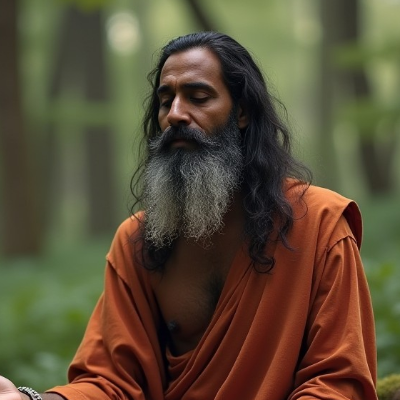
About
Idhmavaha — Son of Drdhacyuta, Descendant of Agastya
Idhmavaha · Idhma-vaha · Idhmavahana
Idhmavaha is a son of Drdhacyuta, who is himself a son of Dridhasyu, who is in turn a son of the great sage Agastya and his wife Lopamudra. Idhmavaha thus stands as the fourth generation in the lineage descending from Agastya, one of the Saptarishis — the seven great sages of the Hindu tradition — and one of the most celebrated figures across the Rigveda, the Mahabharata, the Ramayana, and numerous Puranas. Idhmavaha is named in Puranic genealogical passages concerned with tracing the multi-generational descent from Agastya, and his textual presence does not extend beyond these enumerative contexts. No individual narrative episode involving him is preserved in the currently available primary sources, and his profile is accordingly kept brief and honest about the limits of the evidence.
✦ The Name
The name Idhmavaha is a Sanskrit compound of two elements. The first, idhma, means "fuel" — specifically the sacred fuel-wood, typically of the palasha or other ritually appropriate trees, that is used to feed the sacrificial fire in Vedic ritual. The kindling and feeding of the sacred fire is one of the foundational acts of Vedic religious practice, and idhma as a word is closely associated with the maintenance of the agni, the sacred fire, which is the central vehicle of Vedic sacrifice. The second element, vaha, is derived from the root vah, meaning "to carry," "to bear," or "to convey," and is a common productive suffix in Sanskrit names denoting one who carries or bears something. The compound name Idhmavaha thus means "he who carries the sacred fuel-wood" or "the bearer of the sacrificial kindling." This name encodes a ritual identity, identifying its bearer with the act of tending and supplying the sacrificial fire — a role of great honour and religious significance in the Vedic household and in the ashrama of a sage. The name is consistent with the priestly and ascetic identity expected of a descendant of Agastya, one of the supreme exemplars of Vedic learning and sacrifice in the tradition.
✦ Lineage
- Father: Drdhacyuta — a son of Dridhasyu and grandson of Agastya, named in Puranic genealogical lists as part of the descent from the Agastya lineage. His name combines the Sanskrit elements drdha, meaning firm or resolute, and cyuta, meaning fallen or descended, and he is known solely through lineage enumeration passages in the Puranic texts.
- Paternal grandfather: Dridhasyu — a son of the sage Agastya and Lopamudra, named in Puranic genealogical passages as a descendant of the Agastya line. His name similarly contains the element drdha, meaning firm or strong, suggesting a deliberate continuity of naming convention across the generations of this family.
- Paternal great-grandfather: Agastya — one of the Saptarishis, the seven great sages foundational to the Brahmanical and spiritual traditions of Hinduism, and among the most widely attested figures in the Rigveda, the Mahabharata, the Ramayana, and the Puranas. He is the son of the Vedic deities Mitra and Varuna, born from a water jar according to the most widely recorded account of his origin. He is celebrated for drinking the ocean, subduing the Vindhya mountains, defeating the demons Vatapi and Ilwala, and for his role in bringing Vedic culture to the southern regions of the subcontinent.
- Paternal great-grandmother: Lopamudra — wife of Agastya, a woman of exceptional learning and spiritual accomplishment, and the composer of a hymn preserved in the Rigveda, making her one of the very few women in the Vedic canon to whom a hymn is attributed. She is also referred to as Kaushitaki in some sources.
✦ Textual Base and Attestation
Idhmavaha's attestation in the primary sources is limited to genealogical enumeration. He appears in Puranic passages that trace the descent from Agastya across successive generations, recording the names of sons and grandsons as part of the broader Puranic project of documenting the progeny of the Saptarishis. The Vishnu Purana and related texts are among those in which such multi-generational sage lineages are preserved. Beyond his name and his filial relationship to Drdhacyuta, the surviving sources provide no further detail about his individual life, spiritual practice, or descendants.
Idhmavaha represents the fourth generation of a lineage whose founding figure, Agastya, is one of the most extensively documented sages in the entire Hindu canonical tradition. The progressive diminution of individual narrative detail across the generations — from Agastya's richly attested biography to the bare name-record of Idhmavaha — is characteristic of the way in which Puranic genealogical texts function: they preserve names and descent relationships with care, while concentrating narrative elaboration upon the founding and most significant figures of each lineage.
✦ Connection to the Wider Genealogy
Idhmavaha's position in the wider genealogical tradition is determined by his descent from Agastya. Through Agastya, he is connected to Mitra and Varuna, two of the twelve Adityas — the great solar deities of the Vedic pantheon — and thus carries a lineage that reaches back into the divine order itself. In some Puranic accounts Agastya is additionally identified as a manasaputra, a mind-born son of Brahma the creator, though the account of his birth from Mitra and Varuna is the more universally preserved tradition.
As a fourth-generation descendant of Agastya, Idhmavaha belongs to the Agastya gotra, the ancestral lineage-group bearing Agastya's name, which remains one of the recognised and living gotras within Brahmanical tradition. His name, with its explicit ritual connotation of carrying sacred fuel-wood, suggests that the Puranic tradition understood the descendants of Agastya as continuing his legacy of Vedic sacrificial practice across the generations, even as their individual biographical details recede from the textual record.
✦ References
- Primary Sources
- Vishnu Purana: Contains genealogical enumerations of the descendants of the Saptarishis including the Agastya lineage, within which Idhmavaha is named as a son of Drdhacyuta in the line descending from Agastya.
- Mahabharata, Vana Parva: Provides extensive narrative on Agastya and his family, establishing the lineage and context from which Idhmavaha descends across four generations.
- Rigveda, Book I, Hymn 179: Preserves the hymn of Lopamudra, Idhmavaha's paternal great-grandmother, establishing the Vedic significance of his ancestral line.
- Secondary Sources
- Mani, Vettam. Puranic Encyclopaedia. Motilal Banarsidass, 1975: Provides entries on Agastya and his descendants, within which the lineage extending through Dridhasyu, Drdhacyuta, and Idhmavaha is noted.
- Wisdomlib (wisdomlib.org): Offers searchable cross-references to the name Idhmavaha across digitised Sanskrit texts, assisting in identifying the specific Puranic genealogical passages in which the name appears.