
About
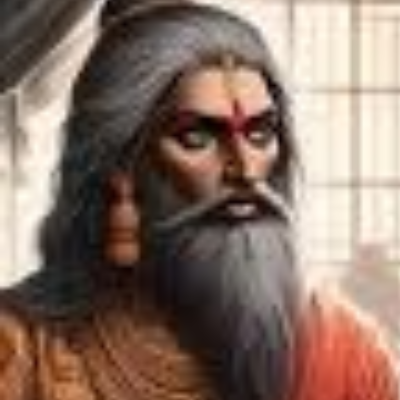
Trinabindu — Solar Dynasty King of the Nedishtha Branch, Father of Manini
Trinabindu · Trnabindu · Trnavindhu · Trna-bindu · Trinvindu
Trinabindu is an ancient king of the solar race, belonging to the branch of the Suryavansha that descends from Nabhanedishta — also rendered as Nedishtha or Dishta depending on the source — one of the sons of Vaivasvata Manu, the progenitor of the current human race. Within this branch, Trinabindu stands as a remote descendant of the celebrated emperor Marutta, son of Aviksit, who is renowned across the Puranas for the unparalleled splendour of his great sacrifice. Trinabindu is named in the Vishnu Purana, the Bhagavata Purana, the Valmiki Ramayana, and related genealogical texts. He is notable for his marriage to Alambusa, a celebrated Apsara of the heavenly realms, and for the children born of this union — among them a daughter whose name and exact identity varies between sources, and three sons including Visala, the founder of the ancient city of Vaishali. Through his daughter, Trinabindu's lineage connects to the sage Pulastya, one of the Saptarishis, and through him to Vishrava, Ravana, and Kubera, some of the most consequential figures in the Ramayana tradition.
✦ The Name
The name Trinabindu is a Sanskrit compound. The first element, trna, means "grass" or "blade of grass," a word used frequently in Sanskrit philosophical discourse as a symbol of something slight or of little worldly consequence, connoting the renunciant's indifference to material things. The second element, bindu, means "drop," "point," or "dot," and carries associations of concentrated essence or a single point of focus. The compound may be rendered as "drop among the grass" or "point of grass." The name appears in variant spellings across sources — Trinabindu, Trnavindhu, and Trinvindu — reflecting minor orthographic differences across manuscripts rather than distinct names.
✦ Dynasty and Lineage Context
Trinabindu belongs to the Suryavansha, the solar race, which traces its origin to Vivasvat, the sun god, through his son Vaivasvata Manu. However, he does not belong to the Ikshvaku branch — the most celebrated line of the solar dynasty, which produced Rama and the kings of Ayodhya — but to a distinct branch descending from a different son of Vaivasvata Manu. The two major Puranic sources differ on which son founded this branch: the Vishnu Purana names the founding ancestor as Nedishtha, also rendered Nabhanedishta, while the Bhagavata Purana names him as Dista. Whether Nedishtha and Dista are two separate sons of Manu whose lineages were conflated in transmission, or whether Nabhanedishta is a compound name that some texts split into Nabhaga son of Dista, is a question on which the Puranic commentarial tradition itself is not settled, as the Vishnu Purana's own annotations acknowledge. The most precise description of Trinabindu's dynastic identity is therefore: Suryavanshi, of the Nedishtha branch according to the Vishnu Purana, or of the Dista branch according to the Bhagavata Purana.
Within this branch, the line from the founding ancestor to Trinabindu passes through a long succession of kings. The Bhagavata Purana gives the sequence as: Nabhaga, Bhalandana, Vatsapriti, Pramshu, Pramati, Khanitra, Cakshusa, Vivimsati, Rambha, Khaninnetra, Karandhama, Aviksit, Marutta, Dama, Rajyavardhana, Sudhrti, Nara, Kevala, Dhundhuman, Vegavan, Budha, and then Trinabindu. The Vishnu Purana gives a broadly parallel sequence leading through the same key figures. Marutta, son of Aviksit, is thus a direct patrilineal ancestor of Trinabindu standing approximately nine generations above him in the line. He is not a dynastic title or epithet but a specific historical ancestor, and his fame as an emperor — particularly the celebrated sacrifice at which all utensils were of gold — lends distinction to the entire lineage descending from him.
✦ Lineage
- Dynasty: Suryavansha (solar race), Nedishtha branch per Vishnu Purana; Dista branch per Bhagavata Purana. Distinct from the Ikshvaku branch of the same solar dynasty.
- Remote patrilineal ancestor of distinction: Marutta — son of Aviksit, celebrated emperor of the solar race, renowned across the Puranas for performing a sacrifice of unparalleled magnificence in which all implements were fashioned from gold, and in which Indra and the gods themselves attended. He stands approximately nine generations above Trinabindu in the direct patrilineal line.
- Father: Budha — the immediate father of Trinabindu in both the Vishnu Purana and Bhagavata Purana lineage lists. This Budha of the Nedishtha-Dista line is distinct from the more celebrated Budha of the lunar dynasty who is the son of the moon god Soma and the father of Pururavas.
- Wife: Alambusa — a celebrated Apsara, one of the celestial nymphs who inhabit the heavenly realms. She is named in the Bhagavata Purana as having accepted Trinabindu as her husband, following the well-attested Puranic pattern of a celestial being descending to become the consort of a distinguished and righteous earthly king.
- Son: Visala — credited in the Vishnu Purana and Bhagavata Purana with founding the city bearing his name, identified with the ancient city of Vaishali in the region of present-day Bihar, one of the great cities of ancient India significant in both Hindu and Buddhist traditions.
- Son: Sunyabandhu — named in genealogical lists alongside Visala without further individual narrative detail in the available sources.
- Son: Dhumraksha or Dhumraketu — named as a third son; the Bhagavata Purana gives the name as Dhumraketu while some other sources render it as Dhumraksha. No individual narrative is preserved for him.
- Daughter: Called Ilavila or Ilavida in the Bhagavata Purana, and Manini in the Valmiki Ramayana. See the section on textual variants below for the full account of this significant discrepancy.
✦ The Ashrama of Trinabindu and the Episode with Pulastya
The most narratively detailed episode associated with Trinabindu is preserved in the Uttara Kanda of the Valmiki Ramayana and concerns the sage Pulastya — one of the ten Prajapatis, one of the Saptarishis, and a mind-born son of Brahma the creator — who was performing severe austerities in Trinabindu's ashrama on the slopes of Mount Meru. A group of young maidens — daughters of other sages, Naga maidens, and Apsaras — disturbed his penance with their music and dancing. Enraged, Pulastya pronounced a curse: any woman who came under his gaze in that place would instantly become pregnant. Terrified, the maidens fled.
Trinabindu's daughter — named Manini in this account — had not been present when the curse was pronounced. She wandered into the area searching for her companions and found herself suddenly pregnant as a result of inadvertently falling under the sage's gaze. She reported her condition to her father, who approached Pulastya and requested that he take his daughter as his wife. Pulastya agreed. Pleased with Manini's virtuous conduct, Pulastya declared that their child would inherit her virtues. That child was Vishrava, who became the father of Kubera by his wife Ilavida, and of Ravana, Kumbhakarna, Vibhishana, and Shurpanakha by his wife Kaikesi. Trinabindu is thus the maternal grandfather of Vishrava and the maternal great-grandfather of both Kubera and Ravana in the Ramayana tradition.
✦ Textual Variants and Inconsistencies
Three distinct layers of textual inconsistency surround Trinabindu and must each be stated clearly.
The first concerns the founding ancestor of his dynasty. The Vishnu Purana places this lineage under Nedishtha, son of Manu, treating Nedishtha and Nabhaga as either a compound name or a father-son pair at the head of the branch. The Bhagavata Purana places the same lineage under Dista, a different son of Manu, with Nabhaga as Dista's son. The Vishnu Purana's own annotations acknowledge that the name Nabhanedishta appears variously across sources as a single compound and as two separate names, and that no consensus exists among the texts. This is a genuine unresolved inconsistency in the primary sources.
The second concerns the name and identity of Trinabindu's daughter. In the Valmiki Ramayana's Uttara Kanda she is named Manini, becomes the wife of the sage Pulastya, and is the mother of Vishrava. In the Bhagavata Purana she is named Ilavila or Ilavida, is the wife of Vishrava rather than Pulastya, and is the mother of Kubera rather than Vishrava. These two accounts place Trinabindu's daughter in different generations of the same genealogy and assign her a different husband and a different son. They are irreconcilable as they stand, and both rest on authoritative primary sources.
The third is a minor variant in the name of one of Trinabindu's sons, rendered Dhumraksha in some sources and Dhumraketu in the Bhagavata Purana.
✦ Visala and the Founding of Vaishali
Trinabindu's son Visala is credited in both the Vishnu Purana and the Bhagavata Purana with the founding of the city bearing his name — identified with the ancient city of Vaishali, one of the great cities of the northern Indian plains. Vaishali holds lasting significance in the ancient Indian tradition and is associated in later history with the Licchhavi clan. Its founding through Visala, son of Trinabindu, places Trinabindu at the head of a lineage with enduring geographical and cultural significance extending well beyond his own individual narrative.
✦ Connection to the Wider Genealogy
Trinabindu occupies a significant node in the Puranic genealogical system. As a Suryavanshi of the Nedishtha or Dista branch, he belongs to the solar race but to a distinct sub-lineage from the Ikshvaku kings of Ayodhya. Through his remote ancestor Marutta he is connected to one of the most celebrated imperial figures of the Puranic tradition. Through his wife Alambusa he is connected to the celestial order of the Apsaras. Through his son Visala he is connected to the founding of one of the tradition's significant ancient cities. Through his daughter — whether identified as Manini wife of Pulastya in the Ramayana tradition, or Ilavila wife of Vishrava in the Bhagavata tradition — he stands in a direct genealogical relationship to Kubera the god of wealth and to Ravana the demon-king of Lanka, making him a figure whose family connections reach across the entire span of the Ramayana's central dramatis personae.
✦ References
- Primary Sources
- Vishnu Purana, Book IV, Chapter I: The principal genealogical source for Trinabindu's lineage within the Nedishtha branch of the solar dynasty, tracing the descent from Nedishtha through Nabhaga, Bhalandana, and the long succession of kings including Marutta, down to Budha and Trinabindu; names Ilavila as his daughter and Visala as founder of Vaishali.
- Bhagavata Purana, Skanda IX, Chapter 2, verses 23–33: Records the same lineage under the branch of Dista rather than Nedishtha; names Trinabindu's wife as Alambusa, his sons as Visala, Sunyabandhu, and Dhumraketu, and his daughter as Ilavila; places Ilavila as wife of Vishrava and mother of Kubera.
- Valmiki Ramayana, Uttara Kanda: The principal narrative source for the episode of Pulastya's austerities in Trinabindu's ashrama, Manini's inadvertent pregnancy under Pulastya's curse, her marriage to Pulastya, and the birth of Vishrava; names Trinabindu's daughter as Manini rather than Ilavila.
- Mahabharata, Vana Parva: Contains references to Trinabindu in connection with a sacred lake named after him, visited by the Pandavas during their forest exile, attesting to his standing as a figure of religious significance beyond the genealogical lists.
- Padma Purana, Chapter 20: Records Trinabindu as a sage who performed penance at a place called Rishitirtha, presenting him in an ascetic context supplementary to his royal identity.
- Secondary Sources
- Mani, Vettam. Puranic Encyclopaedia. Motilal Banarsidass, 1975: Provides a consolidated entry on Trinabindu noting both his genealogical position and the episode of Pulastya and Manini, identifying Vishrava as the son of Manini daughter of Trinabindu.
- Pargiter, F. E. Ancient Indian Historical Tradition. Oxford University Press, 1922: Collates the Puranic dynastic lists across multiple texts, resolving where possible the discrepancies between the Vishnu Purana's Nedishtha attribution and the Bhagavata Purana's Dista attribution for Trinabindu's branch of the solar dynasty.
- Wisdomlib (wisdomlib.org): Offers cross-referenced citations of Trinabindu across digitised Sanskrit texts including the Bhagavata Purana passage at 9.2.23–33 and the Vishnu Purana's Book IV genealogical list, confirming both the Manini and Ilavila traditions and their respective textual bases.