
About
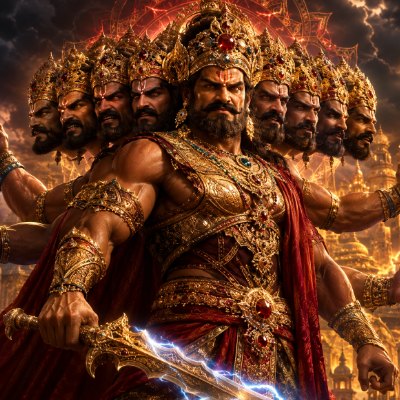
Ravana — King of Lanka, Demon Sovereign, Scholar, and Devotee of Shiva
Ravana · Dashanana · Dashagriva · Dashakantha · Paulastya · Lankeshvara · Lankadipati · Ravaneshvara
Ravana is the principal antagonist of the Valmiki Ramayana and, by extension, of the vast body of Ramayana-related literature across the Hindu, Jain, and Buddhist traditions of South and Southeast Asia. He is the king of Lanka — traditionally identified with present-day Sri Lanka — and the most powerful Rakshasa sovereign recorded in any Hindu text. His parentage is dual and distinctive: his father, Vishrava, is a brahmin sage of the Pulastya lineage and a son of the Saptarishi Pulastya, who is himself a mind-born son of Brahma; his mother, Kaikesi, is a Rakshasi princess, daughter of the Rakshasa king Sumali. This double ancestry — brahmin-sage father and Rakshasa mother — defines Ravana's character as the tradition constructs it: extraordinary learning and spiritual accomplishment on one side, terrible pride and demonic appetite on the other. He mastered the four Vedas and six Shastras, performed austerities of extraordinary duration, obtained boons from Brahma that rendered him invincible to gods and demons alike, conquered the three worlds, ruled Lanka as a magnificent empire, and was a devoted lifelong worshipper of Shiva. He is also, in the Vaishnava theological framework of the Bhagavata Purana, the second incarnation on earth of Jaya, one of the two cursed doorkeepers of Vishnu's celestial abode Vaikuntha, born as an enemy of Vishnu so that through combat with the Lord he might swiftly return to the divine presence. His narrative is most fully preserved in the Valmiki Ramayana, especially its Aranya Kanda, Sundara Kanda, Yuddha Kanda, and Uttara Kanda, with supplementary material in the Mahabharata, the Bhagavata Purana, the Vishnu Purana, the Brahmanda Purana, and many other Mahapuranas, as well as in the Jain Ramayanas, the Buddhist Lankavatara Sutra, and numerous Southeast Asian recensions.
✦ The Name
The name Ravana derives from the Sanskrit root meaning "roaring" or "causing to roar" — an active, causative sense, as against the passive meaning of the name of his half-brother Kubera (Vaishravana, "one who hears distinctly"). Both names are patronymics derived from "son of Vishrava." The Wikipedia article on Ravana notes that the word roravana in Sanskrit means "loud roaring." The name Ravana itself is said to have been conferred on him by Shiva at the moment when the mountain Kailash was pressed down on him and the earth shook with his cry of pain; before that episode he was known by the birth-name Dashagriva.
The epithet Dashanana or Dashakantha means "ten-faced" or "ten-throated" — a direct reference to his traditional depiction with ten heads. Dashagriva means "ten-necked." Paulastya is his gotra name, meaning "descendant of Pulastya." Lankeshvara and Lankadipati mean "lord of Lanka" and "king of Lanka" respectively. In the Jain tradition, Ravana is sometimes called Dashavadana. The ten heads are explained variously across the tradition: some sources treat them as physical features, while others — including texts associated with the Shiva Purana — interpret them symbolically as representing his mastery of the four Vedas and the six Shastras, or as representing ten emotions or states of being.
✦ Lineage
- Great-grandfather: Brahma — the creator god; Pulastya is his mind-born son, making Ravana Brahma's great-grandson
- Paternal grandfather: Pulastya — one of the ten Prajapatis and one of the Saptarishi of the first Manvantara; a mind-born son of Brahma who emerged from his ear according to the Bhagavata Purana; the medium through whom the Vishnu Purana was communicated to humanity; his lineage descends into both the sage tradition (through Vishrava and Agastya) and the Rakshasa tradition (through Vishrava and Kaikesi)
- Father: Vishrava — son of Pulastya and Manini (daughter of the sage Trinabindu, who conceived on hearing Pulastya recite the Vedas); a great scholar-sage in his own right, versed in the Vedas and tapas; he had two wives: Ilavida (daughter of sage Bharadvaja), by whom he had Kubera, and Kaikesi, by whom he had Ravana and the others; the Brahmanda Purana names Kaikesi's father as Malin, while the Ramayana's Uttara Kanda identifies him as Sumali
- Mother: Kaikesi — also known as Nikasha and Keshini; daughter of the Rakshasa king Sumali and his wife Ketumati (described as a Gandharva princess in some sources); Kaikesi was sent by her father Sumali to obtain children from the most powerful being in the world, and she chose Vishrava; Vishrava warned her that approaching him at an inauspicious hour would result in rakshasa-natured sons, with only the last-born inheriting his own good nature
- Maternal grandfather: Sumali — king of the Rakshasas, son of Sukesha, and a grandson of the demon lineage traced in the Brahmanda Purana through Praheti and Heti back to the primordial Rakshasa ancestry; an important advisor and strategist behind Ravana's rise to power
- Maternal grandmother: Ketumati — a Gandharva princess in some accounts
- Paternal half-brother: Kubera — eldest son of Vishrava, born of Ilavida; god of wealth and original king of Lanka, from whom Ravana wrested the kingdom; also the keeper of the divine aerial chariot Pushpaka Vimana, which Ravana seized; Kubera is among the Dikpalas (guardians of the directions)
- Full brothers: Kumbhakarna — younger brother of Ravana; a Rakshasa of immense size and appetite; described in the Bhagavata Purana as the reincarnation of the doorkeeper Vijaya; famed in the Ramayana for sleeping for six months at a stretch due to Brahma's curse (sought as part of a boon gone wrong); loyal to Ravana despite recognising Rama's divinity, fighting on his brother's behalf out of duty and affection; slain by Rama in battle; and Vibhishana — the youngest of the three brothers; born with the righteous disposition Vishrava had promised; a devoted follower of Vishnu-Rama who repeatedly counselled Ravana to restore Sita and renounce adharma; expelled from Lanka by Ravana for his counsel; took refuge with Rama and was given protection; after Ravana's death, installed by Rama as king of Lanka with the Vedic rites of coronation
- Sister: Shurpanakha — also called Chandramukhi in her unmarried form; secretly married the Danava prince Vidyutjihva; encountered Rama and Lakshmana during their forest exile; her humiliation — the cutting of her nose and ears by Lakshmana — is the proximate cause of Ravana's decision to abduct Sita; also sister Kumbhini, mentioned as the wife of the Rakshasa king Madhu
- Chief wife: Mandodari — daughter of Mayasura, the divine architect (king of the Asuras and builder of Lanka), and the apsara Hema; described in the Valmiki Ramayana as extraordinarily beautiful and righteous; she bore Ravana three sons — Meghanada (Indrajit), Atikaya, and Akshayakumara; she is numbered among the Panchakanya, the five virtuous women whose names are recited to dispel sin; she repeatedly counselled Ravana to release Sita and return her to Rama, predicting his destruction if he did not
- Other wives: Dhanyamalini, and a third unnamed wife; the Sundara Kanda of the Valmiki Ramayana states Ravana had over a thousand wives in total
- Sons: Meghanada (Indrajit) — eldest son of Mandodari; the crown prince of Lanka; named Meghanada ("roar of the clouds") at birth because his birth-cry sounded like thunder; received the title Indrajit ("conqueror of Indra") after he bound and captured the god Indra in battle; regarded as one of the greatest warriors in any Hindu text; possessed the Brahmastra, Pashupatastra, and Vaishnavastra, and was skilled in illusion and maya-warfare; slain by Lakshmana during the Lanka war; Atikaya — another son of Mandodari; a great warrior; Akshayakumara — described as a young prince of sixteen; the first to confront Hanuman when he descended upon Lanka and destroyed the Ashoka Vatika; slain by Hanuman; Narantaka, Devantaka, Trishira — sons by other wives, all warriors who fell in the war against Rama; Prahasta — described in some accounts as a son, in others as a minister and general
- Maternal uncles and cousins in the Lanka army: Maricha — son of Tataka; the demon who transformed into the magical golden deer that lured Rama away from Sita, enabling the abduction; Subahu; Dhumraksha; Akampana; Vajramushti; Khara and Dushana — grandsons of Sumali through other daughters, responsible for governing the territory of Janasthana in the Dandaka forest; Malyavan — Ravana's maternal great-uncle; opposed the war with Rama
✦ Birth and Education
The circumstances of Ravana's birth are recorded primarily in the Uttara Kanda of the Valmiki Ramayana and in the Brahmanda Purana. Kaikesi approached Vishrava at what the sage identified as an inauspicious hour — at the twilight juncture — and as a result he warned her that her children, except the last, would inherit the nature of Rakshasas rather than of sages. Accordingly, Ravana, Kumbhakarna, and Shurpanakha were born with Rakshasa nature, while Vibhishana inherited his father's righteous character. The Amar Chitra Katha summary of the Brahma-Ravana episode notes that at Ravana's birth the skies were darkened and omens of turbulence appeared. Despite his Rakshasa nature, Ravana received a thorough education from Vishrava in the Vedas, the Upanishads, the arts of tapas, and the conduct of yajna. He mastered the six Shastras — Sankhya, Yoga, Nyaya, Vaisheshika, Mimamsa, and Vedanta — and the four Vedas, and became accomplished as a musician and veena player; the emblem on his battle-standard was a veena.
✦ Austerities and the Boon of Brahma
Under the instigation of his maternal grandfather Sumali, who wished his descendants to surpass Kubera and rule the three worlds, Ravana and his brothers Kumbhakarna and Vibhishana undertook prolonged austerities on Mount Gokarna. The Valmiki Ramayana's Uttara Kanda records the penance as lasting ten thousand years. Ravana's mode of asceticism was exceptional: he severed each of his nine heads one after another and offered them as sacrifices into the sacred fire, preparing to offer the tenth when Brahma appeared and stopped him. Each time a head was severed, it was restored by Brahma's grace. Pleased with the intensity of his devotion, Brahma offered him a boon. Ravana first asked for immortality, which Brahma refused, as no being born can be exempt from transformation and dissolution. Ravana then reformulated his request: he asked that he never obtain death at the hands of gods, demons, Yakshas, Gandharvas, Rakshasas, Nagas, and other celestial beings. He omitted humans from this list — either through oversight or through contempt, as he could not conceive of any human being capable of posing a threat to him. Brahma granted this boon. Ravana also received weapons, a divine chariot, and the ability to shapeshift. This omission of humans from the boon's protection became the mechanism through which Vishnu chose to incarnate as the human prince Rama in order to bring about Ravana's destruction.
✦ Ravana and Shiva: The Kailash Episode and the Shiva Tandava Stotra
One of the most celebrated episodes associated with Ravana in the Puranic and later Shaiva literature — though the Wikipedia article on Ravana explicitly notes it has little to no evidence in the Valmiki Ramayana itself — is the attempt to lift Mount Kailash. According to this account, Ravana tried to move or uproot the mountain, apparently to carry it to Lanka to demonstrate his power to his mother or to bring it closer to his territory. Shiva, annoyed at this presumption, pressed down on the mountain with his toe, pinning Ravana's hand beneath it. Ravana cried out in enormous pain, and the earth shook — it is from this cry (rava) that, in this account, he received the name Ravana from Shiva himself. Recognising who had trapped him, and moved to devotion, Ravana sang hymns of praise to Shiva while imprisoned beneath the mountain for a thousand years. The composition associated with this episode — the Shiva Tandava Stotra, a hymn of fourteen or more verses in praise of Shiva's cosmic dance — is attributed to Ravana across the Shaiva tradition. Pleased with his endurance and his praise, Shiva released him and granted him the divine sword Chandrahas (the Moon-Blade), along with the instruction that if it were used for an unjust cause it would return to Shiva and Ravana's days would be numbered. The iconic sculpture form known as Ravananugraha (Shiva's favour to Ravana), popular from the Gupta period onwards, depicts Ravana beneath Kailash playing a veena made from his own arm and sinews while Shiva and Parvati sit above.
✦ The Conquest of Lanka, the Three Worlds, and Kubera
Armed with Brahma's boon and his own formidable scholarship and military skill, Ravana extended his power across an immense domain. His half-brother Kubera, who had been given the kingship of Lanka by Brahma, had generously shared his resources and the Pushpaka Vimana — the divine aerial chariot — with his step-brothers. Ravana demanded Lanka itself from Kubera, threatening force. Their father Vishrava, recognising that Ravana was now undefeatable, advised Kubera to cede the kingdom. Kubera withdrew. Ravana took Lanka and ruled it as its lord. The Uttara Kanda describes his subsequent campaigns across the three worlds, conquering the Devas, subduing the Nagas, and bringing Daityas and Gandharvas under tribute. The Mahabharata and Puranas record his subjugation of the Navagrahas (the nine celestial bodies governing destiny); he is said to have forced them all to occupy the eleventh house in his son Indrajit's birth chart to ensure favourable astrological conditions, then imprisoned Shani (Saturn) when that planet resisted. Hanuman discovered Shani in a dungeon during his mission to Lanka and freed him.
He also conquered the king Anaranya of Ayodhya, who cursed Ravana before dying that a descendant of his own lineage would one day slay him — a curse understood as the seed of the Rama-Ravana conflict. He wrestled Kubera and took the Pushpaka Vimana for himself. He captured Indra's celestial elephant Airavata's tusks in battle. The scar-marks on his body from the thunderbolt of Indra, the tusks of Airavata, and the discus of Vishnu are noted in the UCLA MANAS description of the Ramayana, recording the physical marks of his many conquests.
✦ The Defeat by Kartavirya Arjuna
Despite his vast conquests, Ravana suffered a notable humiliation at the hands of the mortal king Kartavirya Arjuna (Sahasrabahu), the thousand-armed emperor of Mahishmati on the Narmada River, who had obtained supernatural powers through the favour of the sage Dattatreya. The Uttara Kanda of the Valmiki Ramayana records the episode: Ravana was performing Shiva worship with a golden linga on the sandy banks of the Narmada when Kartavirya Arjuna, bathing upstream with his wives, stopped the river's flow by holding back its waters with his thousand arms. The surge released when he let go swept away Ravana's ritual offerings and his linga. Ravana, enraged, challenged Kartavirya to battle. The king defeated him and dragged him to his capital Mahishmati, where the humiliated Ravana was tied up in the royal nursery. He remained a prisoner until his grandfather Pulastya personally negotiated and secured his release. The Vayu Purana confirms this episode. This defeat stands as the most significant of Ravana's reversals before his encounter with Rama.
✦ The Encounter with Vali
Another recorded humiliation is Ravana's encounter with Vali, the great vanara king of Kishkindha. In attempting to pick a fight with Vali while the latter was in the midst of his devotional practice, Ravana found himself caught in Vali's tail as the king whirled around during prayer, and was carried through all four corners of the earth without Vali even noticing. Vali only discovered Ravana trapped in his tail when he reached home and released him. Ravana subsequently entered into a pact of friendship with Vali, swearing not to harm each other. This episode is recorded in several versions of the Ramayana and establishes that Ravana himself acknowledged certain individuals as his superiors or equals in power.
✦ Prior Offences Against Women: Rambha and Vedavati
Two episodes in which Ravana violates women are directly connected by the texts to his ultimate destruction. The Valmiki Ramayana records that the apsara Rambha resisted Ravana's advances, telling him she was his daughter-in-law (wife of his son Nalakuvara or nephew); he violated her nonetheless. Her husband Nalakuvara cursed Ravana that if he ever forced himself on a woman who did not consent, his head would split into pieces. This curse is cited in the Ramayana as the reason Ravana, despite holding Sita captive for an extended period, did not physically force himself on her — he could not, without destroying himself.
The episode of Vedavati is recorded in the Valmiki Ramayana's Uttara Kanda. Vedavati was the daughter of the brahmarishi Kushadhvaja and a devoted ascetic, performing penance to become the consort of Vishnu. Ravana encountered her in the forest, was captivated by her beauty, proposed marriage, was rejected, mocked her austerities, and seized her by the hair. Vedavati, her chastity violated beyond recovery, cursed him that she would be reborn and become the cause of his death, then entered the sacred fire and immolated herself. Some later traditions identify this Vedavati with Sita in her previous life, so that the abduction of Sita is the fulfilment of Vedavati's curse. This identification is made in some recensions of the Ramayana but is absent from the core Valmiki text.
✦ The Abduction of Sita
The central act of Ravana's narrative in the Valmiki Ramayana is his abduction of Sita, the wife of Rama, prince of Ayodhya and avatar of Vishnu. The chain of events begins with Shurpanakha, Ravana's sister, who encountered Rama and Lakshmana during their forest exile in the Dandaka forest, became desirous of marriage, and was disfigured — her nose and ears cut off — by Lakshmana when she attempted to attack Sita in frustration. She went to Ravana and inflamed him with descriptions of Sita's beauty. Ravana, consumed by desire, resolved to abduct her. He enlisted the help of his maternal uncle Maricha, who transformed himself into a magical golden deer of irresistible beauty to lure Rama away from Sita. When Rama chased the deer and Lakshmana followed at Sita's insistence, Ravana arrived at the hermitage disguised as a wandering ascetic and, after a brief conversation in which Sita extended hospitality to the supposed brahmin guest, seized her and bore her away in his Pushpaka Vimana. The vulture king Jatayu, a devotee and ally of Rama's father Dasharatha, attempted to stop Ravana and was mortally wounded in the battle; Ravana severed his wing. Sita was brought to Lanka and confined in the Ashoka Vatika, a garden grove, under the watch of rakshasi attendants headed by Trijata.
Throughout her captivity, Ravana repeatedly visited Sita and pressed his suit, promising her queenship of Lanka and threatening her with death if she continued to refuse. Sita refused consistently, placing a blade of grass between them as a symbolic barrier. Due to the curse of Nalakuvara, Ravana could not force himself on her. He set Sita a deadline after which, if she had not consented, she would be executed and eaten — a threat that was never carried out, as Mandodari and others also restrained him. The Ramayana presents this period of captivity as a demonstration of Sita's indomitable purity and devotion. Hanuman, sent by Rama as a messenger, found Sita in the Ashoka Vatika, delivered Rama's ring as a token, and received her chudamani in return before destroying the garden and allowing himself to be captured and brought before Ravana.
✦ The Lanka War and the Fall of Ravana
Rama, having assembled an army of vanaras under Sugriva, built a causeway (the Rama Setu) across the sea to Lanka. Multiple delegations — including that of Angada — were sent to Ravana requesting Sita's peaceful return. Ravana refused each time, dismissing the threat posed by a human and an army of monkeys. His minister Vibhishana urged him to return Sita; Ravana expelled him. Vibhishana came over to Rama's side. The war began. Ravana's generals, sons, and warriors fell one by one: Prahasta, Kumbhakarna (who was awakened from his long sleep only at great effort, and who tried even in the battle to counsel Ravana that Rama was divine, before dying fighting for his brother's cause), Meghanada-Indrajit (who on multiple occasions bound Rama and Lakshmana with the Nagastra, from which they were released each time), and Akshayakumara. As each son fell, Ravana's resolve hardened. After Indrajit was slain by Lakshmana, Ravana himself entered the battlefield.
The duel between Rama and Ravana extended over several days. The Valmiki Ramayana's Yuddha Kanda describes Ravana's formidable power in battle: he defeated the vanara warriors including Hanuman, Sugriva, and Nila, and brought Lakshmana himself to the ground on multiple occasions. Rama continuously cut off Ravana's heads, and each time a new head grew back. Vibhishana revealed to Rama that Ravana possessed a store of nectar (amrita) in his navel, which renewed him endlessly. Rama aimed the Brahmastra — a celestial weapon of supreme power composed according to some accounts of wind and fire — at Ravana's navel, destroying the nectar. Ravana was finally slain. Some accounts describe the killing weapon as the Agneyastra; others the Brahmastra. The accounts agree that the weapon struck Ravana's chest. The Ramayana notes that Rama, recognising Ravana's brahmin descent through Vishrava and Pulastya, ordered that his funeral rites be performed with full honour appropriate to his greatness. It was Vibhishana, at Rama's command, who performed those rites.
✦ The Jaya-Vijaya Framework: Ravana in the Bhagavata Purana
The Bhagavata Purana presents a complete theological re-framing of Ravana's existence that is absent from the Valmiki Ramayana. In this account, Jaya and Vijaya were two gatekeepers of Vaikuntha, the eternal abode of Vishnu. They refused entry to the four Kumaras — the child-sages Sanaka, Sanandana, Sanatana, and Sanatkumara — perceiving them (because of their perpetual youth) as unqualified to enter. The Kumaras, displeased, cursed them to be expelled from Vaikuntha and born on earth. Vishnu himself appeared, acknowledged that the Kumaras' curse was just since the gatekeepers had erred, but mitigated it by offering them a choice: seven births as humble devotees of Vishnu, or three births as powerful enemies of Vishnu, after which they would return. Eager to minimise their separation from the Lord, they chose the three births as enemies. In their first birth they were Hiranyakashipu and Hiranyaksha, slain by Narasimha and Varaha respectively. In their second birth — the Ravana-Kumbhakarna birth — they were slain by Rama in the Treta Yuga. In their third and final birth they were Shishupala and Dantavakra, slain by Krishna in the Dvapara Yuga. After the third birth they returned to Vaikuntha. This framework transforms Ravana from a purely demonic antagonist into a cosmic instrument of divine sport (lila), whose apparent enmity with Vishnu is the means of his liberation.
✦ Ravana as Scholar and Author
The Valmiki Ramayana itself describes Ravana as a great scholar, master of the Vedas and Shastras, who was addressed by Rama as a "Maha Brahman" — a great brahmin — in the context of his learning. The Wikipedia article on Ravana records a range of scholarly and authorial works attributed to him across the tradition. The Shiva Tandava Stotra, the celebrated hymn to Shiva, is the work most universally attributed to him; it remains in active religious use and is among the most widely known Sanskrit devotional compositions. He is also credited as author of the Ravana Samhita (a text on astrology, though some scholars consider it a later composition), the Arka Prakasha (a Sanskrit compendium on the science of distillation and preservation of plant potencies, foundational in certain Ayurvedic traditions), and various works on Rasashastra (Ayurvedic alchemy) and Nadi Pariksha (pulse diagnosis). Before dying, he is said to have imparted political and ethical wisdom to Lakshmana — the so-called Ravana Neeti — including teachings on restraint, statecraft, and the importance of knowledge untainted by ego. He was also a master musician, credited with inventing the Ravanhattha, an ancient bowed string instrument still used in Rajasthan.
✦ Textual Variants and Inconsistencies
The Uttara Kanda as a later text: Scholars including Hermann Jacobi have noted that the Uttara Kanda and the Bala Kanda of the Valmiki Ramayana differ stylistically and narratively from books two through six (the core of the epic), and are considered by many scholars to be later additions. The Wikipedia article on the Ramayana records this consensus explicitly. Material found only in the Uttara Kanda — including the backstory of Ravana's lineage, his previous conquests, the Vedavati episode, the Kartavirya Arjuna defeat, and certain genealogical details — should therefore be understood as belonging to a later compositional layer and not necessarily to the original poem's conception of Ravana.
The number of Ravana's sons: Different recensions list different sons. The Valmiki Ramayana's Sundara Kanda names Meghanada, Atikaya, Akshayakumara, Narantaka, Devantaka, and Trishira. The Wikipedia article adds Prahasta; other sources list seven sons total from three wives. The Mandodari Wikipedia article limits her sons to Meghanada (Indrajit), Atikaya, and Akshayakumara from Mandodari; the other sons are from other wives.
Mandodari as Sita's mother: The Adbhuta Ramayana and certain Jain Ramayanas (including Sanghadasa's) present Sita as the daughter of Ravana (by Mandodari in the Adbhuta account, or discovered through a different mechanism). This is directly contradicted by the Valmiki Ramayana tradition, in which Sita is the daughter of Janaka and is found in a furrow. These variant traditions exist in a separate textual stratum and are not attested in the core Valmiki text.
The Shiva Tandava Stotra episode: As noted in the Wikipedia article on Ravana, the episode of Ravana attempting to lift Kailash and his composition of the Shiva Tandava Stotra has "little to no evidence in Valmiki Ramayana." The episode belongs to the Shaiva Puranic tradition rather than the core epic, and its attribution to Ravana as the hymn's author is a strong devotional tradition rather than a textually established epic fact.
Mother's name: The Ramayana consistently names Ravana's mother as Kaikesi. The Brahmanda Purana, cited in the Hinduism Stack Exchange source, names her as the daughter of Malin rather than Sumali. The Wikipedia article on Ravana names her father as Sumali (or Sumalaya), citing the Valmiki Ramayana's Uttara Kanda. These are different members of the same Rakshasa genealogy and the discrepancy may reflect different branches of that genealogy in different Puranic sources.
Ravana in the Buddhist and Jain traditions: The Buddhist Mahayana Lankavatara Sutra features Ravana as the king of the Yakshas in Lanka who receives the Buddha's teachings; the text presents an entirely different theological framework from the Valmiki Ramayana and does not treat Ravana as a villain. In the Jain Ramayana tradition, Ravana is not killed by a divine avatar but by an adversary within a different cosmology; in some Jain accounts, Ravana will be the future Tirthankara of the next ascending time-cycle. These traditions are independent of the Hindu canonical sources and belong to entirely separate religious cosmologies.
✦ Theological Significance
Ravana operates simultaneously on multiple theological registers. In the Shaiva tradition, he is the paradigmatic devotee — one whose suffering became the occasion for a thousand years of praise, and who composed one of the most celebrated hymns to Shiva. The Ravananugraha image type, widespread in Gupta-period temple sculpture, presents him not in ignominy but in the act of music-making, with Shiva's gracious response from above; this is a devotional icon, not a scene of punishment. In the Vaishnava tradition — specifically the Bhagavata Purana's Jaya-Vijaya narrative — Ravana's enmity with Vishnu is not merely moral failure but a form of inverted devotion: the intensity of desire, even of hatred and conflict with God, brings the devotee into proximity with the divine just as surely as love. The tradition notes, through Prahlada, that constant thought of the Lord, even in the mode of enmity, leads to the same liberation as devotion. In this reading, Ravana's absorption with Rama — his obsession, his refusal to release Sita, his engagement in combat — is not entirely separable from a kind of fixation on the divine.
The UCLA MANAS description captures the ambivalence well: Ravana's extraordinary discipline — maintaining abstinence from Sita for months despite desire, in the presence of his own overwhelming power — is itself a form of tapas, however perverted by context. Rama recognising this, and ordering Ravana's funeral with the honours due a great brahmin, closes the narrative on a note that the tradition refuses to make entirely comfortable.
✦ Connection to the Wider Genealogy
Ravana's genealogical position is singular in the Hindu tradition: he is at once a great-grandson of Brahma through the pure brahmin line of Pulastya and Vishrava, and a grandson of the Rakshasa king Sumali through his mother Kaikesi. He is thus the closest intersection of the brahmin-creative and the Rakshasa-destructive lineages in the entire Puranic genealogical scheme. Through his paternal uncle Agastya — Agastya and Vishrava both being sons of Pulastya — Ravana is the nephew of the sage who subdued the Vindhya mountains, drank the ocean, and armed Rama with the Aditya Hridayam. This means that the sage whose teaching gave Rama the strength to defeat Ravana was, in the genealogical framework, Ravana's own uncle. Through his half-brother Kubera he is connected to the yaksha world and to the divine treasury. Through his son Meghanada-Indrajit, he fathered the warrior who captured the king of heaven Indra himself in battle. Through Vibhishana, installed as king of Lanka after his death, his lineage continued to rule that island under the sovereignty of Rama-dharma.
✦ References
Primary Sources
- Valmiki Ramayana, Aranya Kanda (Book 3): Records Shurpanakha's disfigurement, the golden deer episode, Ravana's abduction of Sita, the encounter with Jatayu, and Sita's confinement in the Ashoka Vatika; the foundational source for the abduction narrative.
- Valmiki Ramayana, Sundara Kanda (Book 5): Records Hanuman's mission to Lanka, his discovery of Sita, the destruction of the Ashoka Vatika, and the confrontation with Ravana in his court; names Ravana's wives and sons; describes Mandodari.
- Valmiki Ramayana, Yuddha Kanda (Book 6): The primary source for the Lanka war; narrates the battles, the deaths of Ravana's sons and generals, the extended duel between Rama and Ravana, and Ravana's death by the Brahmastra (or equivalent weapon) aimed at his navel.
- Valmiki Ramayana, Uttara Kanda (Book 7): Records Ravana's lineage through Pulastya and Vishrava; narrates his birth, his penance at Gokarna and the boon from Brahma; the Vedavati episode; the Kartavirya Arjuna defeat; and his many prior conquests; note that scholars consider this kanda a later addition to the core text.
- Bhagavata Purana, relevant sections on Jaya and Vijaya: The source for the theological reframing of Ravana as the second incarnation of the doorkeeper Jaya, cursed to three births as an enemy of Vishnu.
- Brahmanda Purana, Upodghata Pada, Chapters 7–9: Provides the Rakshasa genealogy tracing the descent from Heti and Praheti through Malyavan, Sumali, and Mali to Kaikesi; and records Vishrava's wives and children, including Ravana.
- Vishnu Purana: Records Ravana's lineage within the Pulastya genealogy.
- Buddhist Lankavatara Sutra: Presents Ravana as the king of the Yakshas of Lanka who receives the Buddha's teachings; an independent non-Hindu tradition whose Ravana is not identical with the Valmiki figure.
- Jain Ramayanas (including Sanghadasa's Vasudevahindi): Present Sita as a daughter of Ravana and give Ravana a different destiny, including the possibility of future Tirthankara status.
- Shiva Tandava Stotra: Attributed to Ravana across the Shaiva tradition; a hymn of praise to Shiva widely used in Shaiva worship.
Secondary and Reference Works
- Wikipedia — Ravana article: A comprehensive secondary synthesis including etymology, lineage, conquests, boons, episodes, wives and sons, death, worship traditions, and attestations in Buddhist and Jain texts; also notes the scholarly debate over the Uttara Kanda and Bala Kanda as later additions.
- Wikipedia — Mandodari, Kumbhakarna, Vishrava articles: Supply specific genealogical and narrative details about Ravana's family members.
- Wikipedia — Ramayana article: Documents the scholarly consensus on the textual layering of the Ramayana, including the later status of the Uttara Kanda.
- Wisdomlib.org — Valmiki Ramayana (Uttara Kanda, Aranya Kanda, Yuddha Kanda translations): Provides translated passages from the Narmada-Kartavirya episode and the abduction episode, confirming textual details.
- Wisdomlib.org — definition of Pulastya: Confirms Pulastya's lineage and his sons including Vishrava and Agastya.
- UCLA MANAS — Ravana entry: Provides a scholarly overview of Ravana's character, his hubris as a fatal flaw, his extraordinary discipline in the presence of Sita, and Rama's decision to honour his funeral.
- Wikipedia — Kartavirya Arjuna article: Confirms the Vayu Purana account of Ravana's defeat and imprisonment by Kartavirya Arjuna.
- Hindu Blog — "Story of Ravana and Kartavirya Arjuna": Provides a narrative summary of the Narmada episode and Ravana's humiliation at Kartavirya's hands, including his release through Pulastya's intercession.