
About
Kumbhakarna — Rakshasa Warrior, Brother of Ravana, Incarnation of Vijaya
Kumbhakarna · Bhanukarna (Jain tradition)
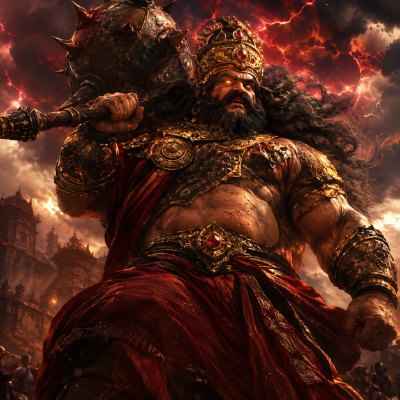
Kumbhakarna is one of the most memorably drawn figures in the Valmiki Ramayana — a warrior of colossal physical power who is simultaneously characterised as righteous, philosophically inclined, and morally lucid about the wrongness of the war he is asked to fight. He is the second son of the brahmin sage Vishrava and the Rakshasi Kaikesi, making him the younger full brother of Ravana, the elder full brother of Vibhishana, and the full brother of Shurpanakha. He is also the half-brother of Kubera through their shared father Vishrava. His distinctive feature — and the source of both his narrative role and his proverbial fame — is the curse of near-perpetual sleep, which kept him largely withdrawn from the affairs of Lanka, awakened for battle only at the most desperate moment of the war with Rama. Despite his Rakshasa nature and his immense destructive capacity, the Ramayana tradition treats him with a degree of honour not extended to most of Ravana's supporters: he recognised Rama's divinity, rebuked Ravana for his folly, and chose to fight and die not from malice but from loyalty to his brother and his homeland. In the Bhagavata Purana's theological framework, he is the second incarnation of Vijaya, one of the two doorkeepers of Vaikuntha cursed to three births as enemies of Vishnu. His narrative is preserved primarily in the Valmiki Ramayana's Yuddha Kanda (Books 60–68 in particular), with backstory in the Uttara Kanda, and supplementary accounts in the Mahabharata, the Bhagavata Purana, and the Puranic Encyclopaedia.
✦ The Name
The name Kumbhakarna is a Sanskrit compound of kumbha (pot, jar, or the Kumbha constellation associated with immense size) and karna (ear). The Wisdomlib definition entry gives the literal meaning as "jar's-ear" or "pot-eared," referring to the immense size of his ears. It is a name that encodes his gigantic physical form directly in its compound. The Jain tradition, recorded in Hemacandra's Trishashtishalakpurusha-charita, gives him the birth-name Bhanukarna ("sun-eared") after the dream his mother had at the time of his conception, with Kumbhakarna as a secondary name by which he became widely known.
✦ Lineage
- Great-grandfather: Brahma — the creator god; Pulastya is his mind-born son
- Grandfather: Pulastya — one of the ten Prajapatis and one of the Saptarishi of the first Manvantara; a mind-born son of Brahma
- Father: Vishrava — son of Pulastya, a powerful brahmin sage accomplished in the Vedas and tapas; he married two lines of wives — Ilavida (daughter of sage Bharadvaja, or in the Saurapurana: daughter of the sage Trinabindu), who gave birth to Kubera; and Kaikesi, who gave birth to Ravana, Kumbhakarna, Vibhishana, and Shurpanakha
- Mother: Kaikesi — daughter of the Rakshasa king Sumali (son of Sukesha) and his wife Ketumati; approached Vishrava to obtain powerful sons; Vishrava warned her at the time she came to him that due to the inauspicious hour, her sons except the last would carry Rakshasa nature; this accounts for the Rakshasa character of Ravana, Kumbhakarna, and Shurpanakha as against the righteous nature of Vibhishana
- Elder full brother: Ravana — king of Lanka, the principal antagonist of the Valmiki Ramayana; master of the Vedas and six Shastras; devoted worshipper of Shiva; slain by Rama in the Yuddha Kanda; in the Bhagavata Purana identified as the second incarnation of the doorkeeper Jaya
- Younger full brother: Vibhishana — the youngest of the three brothers; born with the righteous nature Vishrava had promised; recognised Rama's divinity early and repeatedly counselled Ravana to return Sita; expelled from Lanka by Ravana; joined Rama's forces and after the war was installed as king of Lanka by Rama
- Full sister: Shurpanakha — a Rakshasi; her disfigurement at the hands of Lakshmana during Rama's forest exile is the proximate cause of Ravana's decision to abduct Sita, and thus the trigger of the entire war in which Kumbhakarna ultimately died
- Paternal half-brother: Kubera — eldest son of Vishrava by his first wife Ilavida; the god of wealth and original ruler of Lanka; deposed by Ravana; possessor of the Pushpaka Vimana aerial chariot which Ravana seized
- Wife: Vajrajvala — described in the Wikipedia article on Kumbhakarna as the daughter of Bali (the great vanara king of Kishkindha) and granddaughter of Virochana; she herself fought in the war against Rama's army and was killed; the name Vajrajvala means "vajra-flaming" or "lightning-blazing"
- Sons: Kumbha and Nikumbha — two sons by Vajrajvala, both named in the Valmiki Ramayana (Yuddha Kanda 123.10–11, where they are specifically called "sons of Kumbhakarna"); both fought in the war against Rama and were killed
- Son by another wife (Shiva Purana tradition): Bheema — son by Kumbhakarna's wife Karkati, according to the Shiva Purana; fled to the Sahyadri mountains (Dakini region) with his mother after Kumbhakarna's death; in later Puranic tradition he performed austerities and obtained a boon from Brahma to destroy Vishnu, and launched a campaign of terror before being subdued
✦ Character and Powers Before the War
The Valmiki Ramayana, in the speech of Vibhishana to Rama at Yuddha Kanda 61, establishes Kumbhakarna's extraordinary powers in the following terms: from the very moment of his birth he had subdued both Indra, lord of the gods, and Yama, the god of death; he struck Indra in the chest with a broken tusk wrenched from Airavata, the king of elephants. Even before receiving any boon from Brahma, he ate thousands of living creatures out of raw hunger. The gods, terrified, approached Brahma and reported that if this being received a boon, the three worlds would be consumed. Brahma himself, on seeing Kumbhakarna, was frightened before recovering his composure. These statements establish Kumbhakarna as uniquely, almost anomalously, powerful — a being whose natural state required no supernatural augmentation to threaten the cosmic order.
At the same time, multiple secondary sources record that Kumbhakarna was known for his wisdom, philosophical inclination, and good character. The tradition preserved in several secondary sources states that the sage Narada personally taught him philosophy, because Kumbhakarna was by nature inclined toward contemplation rather than violence. This creates the central paradox of his characterisation: a being of limitless destructive capacity who was in temperament a scholar and a man of ethics.
✦ The Austerities, the Boon, and the Intervention of Sarasvati
Kumbhakarna, together with his brothers Ravana and Vibhishana, performed prolonged penance at Gokarna to obtain boons from Brahma. The Uttara Kanda of the Valmiki Ramayana (Chapter 10) describes each brother's manner of penance: Kumbhakarna stood amid five fires in summer, maintained the Vira posture in the rains, and remained submerged in water in winter — a regimen of severe physical austerity performed continuously over many years. The gods, watching Kumbhakarna's penance and aware of his natural power, were alarmed. According to the Wisdomlib translation of the Uttara Kanda, they petitioned Brahma not to grant him any boon, reminding Brahma that even before receiving one, Kumbhakarna had devoured seven apsaras and ten servants of Indra in the Nandana gardens, as well as sages and men. They feared that a boon would make him an unstoppable force of destruction across all three worlds.
Brahma acceded to the gods' petition and enlisted the goddess Sarasvati — goddess of speech — to intervene at the critical moment. When Brahma appeared and invited Kumbhakarna to ask for his boon, Sarasvati entered Kumbhakarna's mouth and tied his tongue. As a result, Kumbhakarna asked for what he did not intend. He had meant to ask for Nirdevatvam (the annihilation of the gods) and Indrasana (the throne of Indra), but what came from his mouth was Nidrasana (a bed for sleeping) and Nidravatvam (the state of sleep). The boon was immediately granted. Kumbhakarna, realising what had happened, tried to have it reversed — but once granted, Brahma's boon could not be cancelled. On Ravana's desperate plea to mitigate it, Brahma modified the boon: Kumbhakarna would sleep for six months and wake for one day, on which day — starved for six months — he would consume whatever he could reach, then return to sleep. Some secondary accounts, drawing on slightly different versions of the tradition, give the interval as sleeping six months and waking for the other six, but the Valmiki Ramayana's Yuddha Kanda passage (Sarga 61) confirms the one-day waking cycle in Vibhishana's explanation to Rama.
The Vana Parva of the Mahabharata (Chapter 275) provides a parallel account, in which the penance, the boon, and the Sarasvati intervention are also recorded. The Puranic Encyclopaedia, drawing on these sources, notes that Vibhishana's boon was separately negotiated at the same occasion: he asked that in moments of the greatest adversity his mind would remain fixed in righteousness, that he would be able to use the Brahmastra without specific training, and that all his thoughts in all circumstances would conform to dharma. Brahma granted this fully, noting that despite being born in the Rakshasa race, no evil had entered Vibhishana's heart.
✦ Kumbhakarna's Counsel to Ravana
When Kumbhakarna was roused at Ravana's desperate command and brought before him after enormous effort — the Valmiki Ramayana describes the sound of drums, conches, trumpets, and the weight of a thousand elephants being used to wake him, with the demons placing mountains of food before him to sustain him on waking — he was told the full situation: that Ravana had abducted Sita, that Rama had built an army of vanaras, crossed the sea, and was besieging Lanka, and that many of Ravana's greatest warriors had already fallen.
Kumbhakarna's first response, as recorded in the Valmiki Ramayana (Yuddha Kanda 60), was to rebuke Ravana. He told him that this disaster was the result of acting first and consulting wise counsel afterward — a violation of the basic principles of statecraft. He stated directly that Ravana had ignored the counsel of Vibhishana and other advisors, had committed a great wrong in abducting another man's wife, and that Rama was no ordinary human but an avatar of Vishnu, and Sita an avatar of Lakshmi. He urged Ravana to return Sita before more died. The Valmiki Ramayana preserves Kumbhakarna's speech in considerable detail, making it one of the clearest instances within the epic itself of a figure within Lanka recognising the true nature of the conflict and stating it plainly.
When Ravana refused and held firm in his resolve to fight, Kumbhakarna accepted the situation with a different logic: the time for counsel was before the action; now that the war had begun, his duty as a warrior and a brother was to fight for his king and his homeland, even at the cost of his own life on the wrong side of a fight he had not chosen. This distinction — between knowing a cause to be unjust and choosing to fight in it anyway out of duty — is what later commentators and the Kamba Ramayanam tradition specifically highlight as the defining moral quality of Kumbhakarna's character.
✦ The Battle and Death of Kumbhakarna
Kumbhakarna entered the battlefield and immediately devastated Rama's forces. The Valmiki Ramayana records that he slaughtered eight thousand vanaras in the course of his engagement. He injured Hanuman, knocked Sugriva unconscious and took him prisoner — requiring Angada to launch a rescue. He then engaged Lakshmana in a prolonged duel that left both exhausted. The battle between Kumbhakarna and the whole of Rama's army is described in the Yuddha Kanda with sustained intensity: he deployed a rain of fire against Rama's forces, which Rama countered by causing rain; he then cast a rain of stones, which Rama countered with a protective cover.
Rama himself took the field against Kumbhakarna. He severed one of Kumbhakarna's arms with the Vayuastra (weapon of wind) and mutilated the other with the Indrastra (weapon of Indra). Even with both arms severed, Kumbhakarna continued to advance toward Rama, opening his mouth to swallow him whole, and was met with a barrage of arrows. Rama then deployed the Indrastra decisively, decapitating Kumbhakarna. The Valmiki Ramayana describes what followed: Kumbhakarna's enormous severed head, still wearing its crown, tumbled through the sky and smashed into several buildings and fortifications of Lanka before falling into the sea.
When news of Kumbhakarna's death reached Ravana, the Valmiki Ramayana records that he fainted and fell from his throne. On recovering consciousness, he lamented that without Kumbhakarna he had no use for his kingdom, no desire for Sita, and no will to live. The lament of Ravana for Kumbhakarna (Yuddha Kanda 68) is one of the most emotionally direct passages in the epic, expressing the depth of brotherly love that runs beneath Ravana's otherwise imperious exterior. It is at this moment in the primary text — hearing the grief of Ravana — that the words of Vibhishana, which Ravana had once ignored, are acknowledged by him as having been right all along.
✦ The Vijaya Incarnation — Bhagavata Purana Framework
The Bhagavata Purana identifies Kumbhakarna as the second incarnation of Vijaya, one of the two doorkeepers of Vaikuntha, alongside his brother-incarnation Jaya (Ravana). The theological framework is identical to that described for Ravana: Jaya and Vijaya refused entry to the four Kumaras; the Kumaras cursed them; Vishnu gave them the choice of seven births as devotees or three births as powerful enemies; they chose three births to minimise separation from the Lord. Their first birth as enemies was Hiranyakashipu and Hiranyaksha, slain by Narasimha and Varaha respectively. Their second birth — the present one — as Ravana and Kumbhakarna, slain by Rama in the Treta Yuga. Their third and final birth would be as Shishupala and Dantavakra, slain by Krishna in the Dvapara Yuga. This framework transforms Kumbhakarna's defeat at Rama's hands from a straightforward military defeat into a theologically purposeful liberation — being slain by Vishnu's avatar is, within this cosmology, the mechanism of return to the divine presence.
✦ Textual Variants and Inconsistencies
Mother's name: The Valmiki Ramayana's Uttara Kanda names the mother of Ravana, Kumbhakarna, Vibhishana, and Shurpanakha as Kaikesi. The Mahabharata's Vana Parva (Chapter 275) gives a different assignment of Vishrava's children by different wives: Ravana and Kumbhakarna are born of Pushpotkatha, Vibhishana of Raka, and Khara and Shurpanakha of Malini. The Agni Purana resolves this by stating that Pushpotkatha and Kaikesi were the same person. The Saurapurana confirms Kaikesi as the mother of Ravana, Kumbhakarna, Vibhishana, and Shurpanakha. The Brahmanda Purana gives Kaikesi as the daughter of Malin rather than Sumali, a variant of the maternal grandfather's name. These discrepancies across the Mahabharata, the Valmiki Ramayana, and the Puranas are genuine inter-textual inconsistencies not resolved within any single primary source.
The sleep interval: The Valmiki Ramayana's Yuddha Kanda, in Vibhishana's speech (Sarga 61), describes Kumbhakarna as sleeping for six months and waking for one day. Several secondary sources describe the interval as sleeping six months and waking for the other six months of the year. The Valmiki Ramayana's own Sanskrit text, as preserved at valmikiramayan.net, specifies "for a day" (waking) after the six-month sleep. Popular retellings that give equal six-month intervals appear to represent a softening of the original.
What Kumbhakarna intended to ask for: Two variant traditions exist about his intended request. The Uttara Kanda account in the Wisdomlib translation describes the intended request as Nirdevatvam (annihilation of the gods). Other accounts, including the naadopaasana and apnisanskriti retellings, specify that he intended both Indrasana (the throne of Indra) and Nirdevatvam. The core that all accounts agree on is that the goddess Sarasvati tied his tongue at Indra's request, causing the mispronunciation, and that the result was Nidrasana or Nidravatvam (sleep).
Kumbhakarna's son Bheema and the Shiva Purana: The tradition of a third son Bheema, born of a separate wife Karkati, who survived and became a figure of his own mythology in the Sahyadri region of the Deccan, is attested in the Shiva Purana according to the Religion Wiki article. This son is not mentioned in the Valmiki Ramayana and belongs to a separate Puranic strand that developed Kumbhakarna's lineage into the Deccan regional tradition.
Kumbhakarna in the Jain tradition: In Hemacandra's Trishashtishalakpurusha-charita (eleventh century), Kumbhakarna is given the birth-name Bhanukarna ("sun-eared"), with Kumbhakarna as a secondary name. His mother is given as Kaikasi, daughter of Vidyadhari, and his father as Rakshas Ratnavarmas son of Sumali — a different genealogy from the Valmiki account, reflecting the Jain Ramayana tradition's independent reconstruction of the Rakshasa lineage. According to the Wisdomlib definition, one Jain source further records that Kumbhakarna took a vow after the war and went to emancipation at the Narmada River — an account of liberation through death and subsequent release that is entirely absent from the Hindu primary sources.
✦ Theological Significance
Kumbhakarna's theological significance operates on several levels simultaneously. Within the Valmiki Ramayana itself, his most important function is to embody the conflict between dharmic clarity and the obligations of warrior loyalty. He is the figure in the Lanka camp who comes closest to Vibhishana's moral clarity — he knows Ravana is wrong, says so explicitly and to Ravana's face, and still chooses to fight. The Ramayana uses this contrast to explore one of its deepest tensions: whether the duty of a warrior to his king and family can override the duty of a moral agent to recognise and resist adharma. Kumbhakarna's answer — that the time to prevent wrong is before it occurs, and that once it has occurred the warrior's loyalty is still owed — represents one of the tradition's most considered responses to that tension, even as the epic does not endorse it.
In the Bhagavata Purana framework, Kumbhakarna's entire existence — including his enormous appetite, his enforced sleep, his overwhelming power, and his death at the hands of Vishnu's avatar — is the expression of a soul's inverted longing for the divine. The more intensely Vijaya-as-Kumbhakarna is absorbed in conflict with Vishnu's avatar, the more quickly the return to Vaikuntha approaches. His death is liberation, not punishment.
In popular and proverbial usage, Kumbhakarna has become synonymous with deep or excessive sleep — a figure of speech widespread in Indian languages and culture. This usage extracts one specific and comic feature of his narrative from its tragic and theological context, reducing a complex figure to a single attribute. The proverbial tradition is acknowledged in several secondary sources as an incomplete representation of the character as the primary texts actually construct him.
✦ Connection to the Wider Genealogy
Kumbhakarna shares the dual genealogical position that defines all the children of Vishrava and Kaikesi: great-grandson of Brahma through the brahmin line of Pulastya and Vishrava, and grandson of the Rakshasa king Sumali through Kaikesi. Through his half-brother Kubera — who is also his cousin by the coincidence that Agastya, the sage who ultimately armed Rama with the Aditya Hridayam, was Vishrava's uncle — he is connected to the Yaksha world and divine treasury. Through his wife Vajrajvala, daughter of the vanara king Bali, he is connected by marriage to the same vanara lineage that supplies some of Rama's most important warriors: Bali's son Angada fought on Rama's side, making Kumbhakarna's nephews by marriage among the enemies he faced on the battlefield. Through his sons Kumbha and Nikumbha — both slain in the war — his direct male line ended in the Lanka conflict. Through the Bhagavata Purana's Vijaya identification, he is genealogically bound to Ravana as a co-cursed being whose fate and liberation are inseparable from his brother's.
✦ References
Primary Sources
- Valmiki Ramayana, Yuddha Kanda, Sargas 60–68: The primary source for the awakening of Kumbhakarna, Vibhishana's account of his powers and history to Rama, the battle itself, the sequence of combat (Hanuman, Sugriva, Lakshmana, Rama), the severing of his arms by the Vayuastra and Indrastra, his decapitation and death, and Ravana's lament (Sarga 68 in particular provides the primary text of Ravana's grief).
- Valmiki Ramayana, Yuddha Kanda, Sarga 123: Names Kumbha and Nikumbha explicitly as "sons of Kumbhakarna" among the warriors slain in the war.
- Valmiki Ramayana, Uttara Kanda, Chapter 10: Records the penance at Gokarna, the nature of each brother's austerities, the intervention of Sarasvati at Indra's request, the misdirected boon of sleep, Brahma's modification on Ravana's appeal, and the boons received by Vibhishana and Ravana; note that scholars consider the Uttara Kanda a later addition to the core text.
- Mahabharata, Vana Parva, Chapter 275: Provides a parallel account of the lineage of Vishrava's children, assigning Ravana and Kumbhakarna to the wife Pushpotkatha (with the Agni Purana equating Pushpotkatha and Kaikesi); and records the penance and boon episode.
- Bhagavata Purana (relevant sections on Jaya and Vijaya): Identifies Kumbhakarna as the second incarnation of the doorkeeper Vijaya; provides the theological framework of three births as enemies of Vishnu culminating in liberation.
- Saurapurana, Vamsha section: Confirms the genealogy of Vishrava with Kaikesi and records Kumbhakarna among her sons.
- Hemacandra's Trishashtishalakpurusha-charita (Jain Ramayana, 11th century): Names Kumbhakarna as Bhanukarna in the Jain tradition; records his mother as Kaikasi daughter of Vidyadhari; and notes a tradition of his final liberation at the Narmada.
Secondary and Reference Works
- Wikipedia — Kumbhakarna article: Comprehensive secondary synthesis; provides the Bhagavata Purana framework, the boon episode, the battle account, and records the wife Vajrajvala as the daughter of Bali and granddaughter of Virochana.
- Wisdomlib.org — "Story of Kumbhakarna" (Puranic Encyclopaedia): Draws on Vana Parva Chapter 275 and the Uttara Ramayana; records the Mahabharata variant of the mother's identity and the precise account of Sarasvati's intervention; gives Vibhishana's boon in parallel.
- Wisdomlib.org — definition of Kumbhakarna: Aggregates Saurapurana, Jain tradition, and Purana Index citations; notes the Jain name Bhanukarna.
- Valmikiramayan.net — Yuddha Kanda Sargas 60, 61, 68 (Sanskrit text with translation): Direct access to the primary Valmiki Ramayana text for the awakening sequence, Vibhishana's account, and Ravana's lament; confirms the one-day waking interval and the use of the Indrastra in the killing blow.
- Vedicfeed.com and Veergatha.com — Kumbhakarna biographical articles: Provide secondary narrative synthesis drawing on the Valmiki Ramayana, including the rain-of-fire and rain-of-stones battle tactics and the decapitation episode.
- Religion Fandom Wiki — Kumbhakarna article: Records the Shiva Purana tradition of a third son Bheema by wife Karkati who fled to the Sahyadri mountains.
- Wikipedia — List of characters in Ramayana: Confirms the birth-order of Kumbhakarna as second son of Vishrava and Kaikasi, and notes the Sumali-Ketumati genealogy of the maternal line.