
About
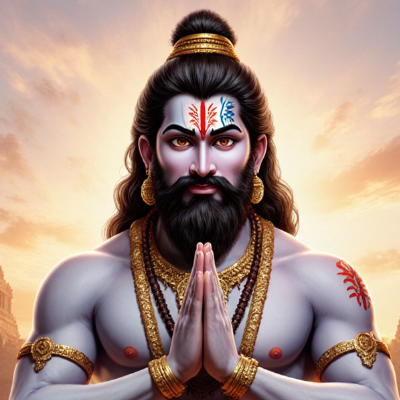
Vibhishana — Youngest Son of Vishrava, King of Lanka, Chiranjivi
Vibhishana · Bibhishan · Lankeshvara (post-war) · Dharmatma
Vibhishana is the youngest of the four children of the brahmin sage Vishrava and the Rakshasi Kaikesi. He is the younger full brother of Ravana and Kumbhakarna, the younger full brother of Shurpanakha, and the half-brother of Kubera. Born at an auspicious hour when his mother approached his father, unlike the inauspicious hour at which Ravana, Kumbhakarna, and Shurpanakha were conceived, he alone among the four inherited the righteous, brahmin-inclined nature of Vishrava. His character throughout the Valmiki Ramayana is defined by a single sustained quality: the sattvic disposition with which he was born, expressed as unwavering commitment to dharma regardless of the personal cost. He counselled Ravana repeatedly and without success to return Sita to Rama; he was expelled from Lanka for doing so; he sought and received asylum from Rama; he contributed intelligence that proved decisive in the Lanka war; and after Ravana's death he was crowned king of Lanka by Rama, with Lakshmana performing the rites. He is counted among the Ashta Chiranjivi — the eight immortal beings of the Hindu tradition who continue to walk the earth until the end of the current yuga — and is associated with the founding of the Ranganathaswamy temple at Srirangam. His narrative is preserved primarily in the Valmiki Ramayana's Yuddha Kanda, with the backstory of his birth, penance, and boon in the Uttara Kanda, supplementary genealogical material in the Mahabharata Vana Parva and the Brahmanda Purana, and theological elaboration in the Bhagavata Purana. He is also present as a guardian deity in Sri Lankan Buddhist-Hindu tradition.
✦ The Name
Vibhishana derives from the Sanskrit root meaning "terrible" or "frightening" — a name of Rakshasa lineage, parallel in form to the names of his brothers. The irony of the name is well-recognised in the tradition: the most frightening of Ravana's siblings proved to be not the largest or most powerful, but the most righteous. He is also called Bibhishan in colloquial North Indian usage. The epithet Dharmatma — "righteous soul" or "one whose soul is dharma" — is applied to him throughout the Valmiki Ramayana in contexts of praise. After the war, as king of Lanka, he bears the same title Lankeshvara once held by Ravana, though now attached to a ruler of explicitly different character. In the Sri Lankan Buddhist-Hindu tradition he is sometimes titled Vibhishana Deviyo.
✦ Lineage
- Great-grandfather: Brahma — the creator god; Pulastya is his mind-born son
- Grandfather: Pulastya — one of the ten Prajapatis and one of the Saptarishi of the first Manvantara; a mind-born son of Brahma; transmitter of the Vishnu Purana; both the brahmin sage lineage and the Rakshasa lineage of Lanka descend from him
- Father: Vishrava — son of Pulastya; a powerful brahmin sage accomplished in the Vedas and tapas; he had multiple wives; from his first wife Ilavida (or Devavarnini in some accounts) he had Kubera; from Kaikesi he had Ravana, Kumbhakarna, Shurpanakha, and Vibhishana; Vishrava reportedly foretold at the time of Vibhishana's birth that because of the auspicious hour of his conception, this last child would inherit his own righteous nature rather than the Rakshasa temperament
- Mother: Kaikesi — daughter of the Rakshasa king Sumali (son of Sukesha) and his wife Ketumati; the same woman who bore Ravana and Kumbhakarna; the Valmiki Ramayana's Uttara Kanda records that when the children were born, Vibhishana alone was born at an auspicious time, and Vishrava declared that this child would be different from his brothers
- Elder full brothers: Ravana — eldest, king of Lanka, slain by Rama; and Kumbhakarna — middle brother, a warrior of colossal power cursed to near-perpetual sleep, who fought and died in the Lanka war after counselling Ravana to return Sita
- Full sister: Shurpanakha — the Rakshasi whose disfigurement at the hands of Lakshmana set the chain of events leading to Ravana's abduction of Sita and thus the Lanka war
- Paternal half-brother: Kubera — god of wealth, original king of Lanka, who was displaced from his throne by Ravana; Vibhishana's relationship with Kubera is not elaborated in the core epic but they share a father and a partial claim on the same territory
- Wife: Sarama — daughter of the Gandharva Shailusa; born on the banks of the Manas Lake; described in the Uttara Kanda as having been obtained by Ravana for his brother Vibhishana as his wife; befriended Sita in the Ashoka Vatika during her captivity; informed Sita of the burning of Lanka by Hanuman; aided Vibhishana's efforts to convert the people of Lanka to righteous conduct after the war; see the Textual Variants section for the scholarly discussion of Sarama's appearance in the text
- Daughter: Trijata — named in multiple post-Valmiki sources as Vibhishana's daughter by Sarama; assigned the role of guardian and comforter of Sita in the Ashoka Vatika; reassured Sita that Rama and Lakshmana were not dead when Ravana showed her a false vision of their severed heads; her identification as Vibhishana's daughter is standard across the Kamba Ramayanam, Govindaraja's commentary, the Oriya Balaramadasa Ramayana, and the Javanese Kakawin Ramayana, though her status in the original Valmiki text is more ambiguous (see Textual Variants)
✦ Character, Birth, and Early Life
From the earliest descriptions in the Valmiki Ramayana and the Uttara Kanda, Vibhishana's defining characteristic is his sattvic nature — a pure, clarity-inclined disposition, free of the rajas and tamas that characterise Rakshasa temperament. The secondary sources uniformly describe him as having spent his childhood in continuous meditation on Vishnu, considering himself a brahmin despite his Rakshasa birth because he identified with the lineage of his father Vishrava and grandfather Pulastya rather than with the maternal Rakshasa line through Kaikesi. He is said to have been taught the scriptures and philosophical texts thoroughly, and to have regarded his brahmin lineage as the truest expression of his own nature. This self-understanding as a brahmin-born-in-Rakshasa-form is given as the motive for the consistency of his conduct throughout the narrative: he measures every situation against the standards of dharmic conduct as a brahmin and scholar would, not as a warrior-king.
✦ Austerities and the Boon of Brahma
Vibhishana joined his brothers Ravana and Kumbhakarna in the great penance at Gokarna described in the Uttara Kanda of the Valmiki Ramayana and independently attested in the Mahabharata Vana Parva (Chapter 275). The Uttara Kanda's account, as preserved in the Wisdomlib translation, records that when Brahma appeared after the long years of austerity, he granted each brother a boon in turn. When Vibhishana's turn came, he asked not for power, weapons, conquest, or immortality. He asked for three things: that even in the greatest adversity his mind would remain fixed in righteousness; that without specific training he would be able to use the Brahmastra (the supreme celestial weapon of Brahma); and that all his thoughts in all circumstances would conform to dharma. Brahma, moved by the purity of the request, granted all three and added a fourth: immortality, noting that although Vibhishana had been born in the Rakshasa race, no evil had ever entered his heart. Some secondary accounts compress these details, recording the boon simply as unwavering devotion to Vishnu at the feet of the Lord — the Vyasaonline.com account and the dollsofindia.com account both preserve the bhakti-oriented framing — but the more detailed account in the Uttara Kanda as cited by the Puranic Encyclopaedia through Wisdomlib.org gives the three-part formulation with the Brahmastra as a distinct element alongside the righteousness boon.
✦ Counsel to Ravana and Expulsion from Lanka
The core narrative role of Vibhishana in the Valmiki Ramayana is played across the Yuddha Kanda. When Ravana abducted Sita and brought her to Lanka, Vibhishana's response was immediate and unambiguous. He approached Ravana and told him plainly that abducting another man's wife was adharma, that Rama's cause was just, that the signs of doom were visible across Lanka, and that the only path to safety and honour was to return Sita at once. He reportedly delivered this counsel on multiple occasions — before the war, as Rama's army built the causeway to Lanka, and again as the war began — each time escalating in urgency as Ravana refused and the situation worsened. The Grokipedia article on Vibhishana notes that the Yuddha Kanda records him repeatedly urging restoration of dharma and warning Ravana that Rama was Vishnu incarnate and Sita was Lakshmi herself, so that war against Rama was not merely a political miscalculation but a cosmological one.
Ravana's response, as recorded in the Valmiki Ramayana, was fury. He told Vibhishana that had anyone else uttered such words they would be dead, and then expelled him from Lanka. Vibhishana responded to the expulsion calmly. He told Ravana that he did not want to witness his brother's death at Rama's hands, declared his departure, and flew from Lanka. Before leaving, according to multiple secondary sources drawing on the text, he instructed Trijata — in the Ashoka Vatika guarding Sita — to take care of Sita, and he informed his wife Sarama of his plans. He left carrying his mace, accompanied by four demons who were close to him — a detail noted in the Yuddha Kanda passage summarised in the Sutradhar account — and flew to the shore of the southern sea where Rama's army was encamped.
✦ Reception by Rama: The Debate and the Acceptance
The episode of Vibhishana's reception at Rameshwaram is one of the most carefully constructed political and ethical scenes in the Yuddha Kanda. When Vibhishana identified himself to Sugriva and the others and announced his desire to offer his allegiance to Rama, the response was not uniformly welcoming. Sugriva warned Rama directly that Vibhishana was a Rakshasa and could not be trusted — he advised Rama to have him captured. The Sutradhar account of Yuddha Kanda cites this exchange precisely. Rama, rather than accepting or rejecting Sugriva's advice outright, followed an explicitly consultative process: he solicited the views of Angada, Sharabha, Jambavan, Mainda, and Hanuman in turn. Only Hanuman argued clearly for accepting Vibhishana, distinguishing the strength of his virtues from the circumstances of his birth and the suspicion his defection would naturally invite. Rama, hearing Hanuman's counsel and consulting his own judgment, accepted Vibhishana without reservation.
The Valmiki Ramayana records Rama's acceptance as unconditional and immediate: he embraced Vibhishana and, before the war had even begun, declared him king of Lanka — "I shall crown you king of Lanka," the text states, in Yuddha Kanda Canto 19.18–19 as cited in the Quora Shriram Sanctorum account. This extraordinary pre-emptive appointment — giving the crown of an unconquered kingdom to a single defector before a single battle had been fought — is treated in the tradition as a demonstration of Rama's own dharmic clarity and his trust in those who surrender to him, as well as a statement that Ravana's rule was already illegitimate in Rama's understanding of the cosmic situation. Rama had Lakshmana fetch sea-water on the spot and consecrate Vibhishana as king of the Rakshasas immediately, before any military engagement.
✦ Role in the Lanka War
Vibhishana's contribution to Rama's military campaign was primarily intelligence rather than direct combat. As a member of Ravana's innermost circle who had lived in Lanka throughout his life, he possessed a comprehensive knowledge of the city's defences, the routines and vulnerabilities of Ravana's forces, and the closely guarded secrets of the Pulastya clan's religious practices. Two intelligence disclosures are specifically cited across multiple sources as decisive.
The first was his revelation of the secret path to the temple of Nikumbhila — the family deity of the Pulastya clan — where Ravana's eldest son Indrajit (Meghanada) was performing a yajna whose completion would render him permanently invincible in battle. Vibhishana identified the hidden route, enabling Lakshmana to reach the site and disrupt the yajna before it was complete. Without the yajna's completion, Indrajit remained vulnerable; Lakshmana killed him in the engagement that followed. The death of Indrajit was the most shattering blow to Ravana's military capacity before the final duel between Rama and Ravana himself.
The second was his disclosure, during the final duel, of the secret of Ravana's apparent invulnerability. When Rama struck off Ravana's heads repeatedly and found that new heads regrew each time, he was bewildered. Vibhishana then revealed to Rama that Ravana had stored the nectar of immortality (amrita) in his navel — the Valmiki Ramayana's Yuddha Kanda Sarga 108, cited in the Crazy Alchemist account, describes the weapon Agastya gave Rama (the Brahmastra) as specifically aimed at the navel to destroy this nectar. With the nectar destroyed, Ravana was killable and was slain. The Gyaandweep account notes that Vibhishana directly told Rama that the nectar in the navel needed to be dried up, and that Rama acted on this information to deliver the killing blow.
✦ The Funeral of Ravana and the Coronation
After Ravana's death, Rama turned to Vibhishana and asked him to perform his brother's funeral rites. Vibhishana initially hesitated — the argument of whether a man who had committed such wrong deserved proper funerary honours is recorded in the text. Rama's response, which became one of the most cited utterances in the Ramayana, was that enmity ends with death: "Enmity ends with death" (the phrase is cited in the Crazy Alchemist account as recorded in the Yuddha Kanda). Ravana, for all his sins, had been a great king, a brahmin by paternal descent through Vishrava and Pulastya, and master of the Vedas; he deserved rites befitting his learning and his station. Vibhishana performed the rites.
The formal coronation of Vibhishana as king of Lanka followed immediately thereafter. The Valmiki Ramayana records this in Yuddha Kanda Sargas 112–113: Lakshmana brought a golden pot filled with sacred sea-water, seated Vibhishana on the throne, and performed the coronation with the rites. Rama then gave his advice to Vibhishana as king: to rule as a righteous, self-controlled, and compassionate king, and to be a just collector of revenues so that all subjects would be attached to him. Vibhishana responded by distributing wealth to Sugriva's army and to all present.
✦ The Ranganatha Vimana and Srirangam
After Rama's coronation at Ayodhya, a gift of transcendent significance was made to Vibhishana: the Sri Ranga Vimana — a sacred icon of Ranganatha (Vishnu as the reclining form on the cosmic serpent Shesha) — which had been in the keeping of the Solar dynasty of Ikshvaku as their family deity. Vibhishana received it with joy and carried it southward toward Lanka. Midway, he stopped to rest and perform his daily worship on the banks of the Kaveri River. When he had completed his prayers and rose to continue his journey, the Vimana refused to move. It had set itself permanently on the Kaveri bank. Vishnu appeared to Vibhishana and declared that he desired to stay in that place, looking southward toward Lanka, as Ranganatha. This site became the Ranganathaswamy Temple at Srirangam in present-day Tamil Nadu, considered the foremost of the 108 Divya Desams in Sri Vaishnavism. The temple's founding legend is thus directly tied to Vibhishana's post-war role. The Wikipedia article on Vibhishana confirms this account and notes that Vishnu also expressed a desire to watch the Brahmotsavam at Tirucherai, making that festival equally sacred. Vibhishana himself became the protector of the temple's sacred tower.
✦ Vibhishana as Chiranjivi
At the end of Rama's earthly reign, when Vishnu prepared to withdraw from his Rama avatar, he appeared before Vibhishana in his own form and gave him a final command: to remain on earth, to guide the people of Lanka and wherever he was known toward the path of dharma, and to remain as a guardian of righteousness until the end of the current age. This commission established Vibhishana as one of the Ashta Chiranjivi — the eight immortal beings of the Hindu tradition. The Ciranjiivishlokas, the traditional verse enumerating the immortals, names him explicitly: Ashwatthama Balir Vyaso Hanumanash cha Vibhishanah / Krupah Parashuramash cha Saptaite Chiranjivinah / Saptaitan Samsmaren Nityam Markandeyam Athashtamam... The sloka declares that meditating on these eight immortals — Ashwatthama, Mahabali, Vyasa, Hanuman, Vibhishana, Kripacharya, Parashurama, and Markandeya as the eighth — confers freedom from ailments and longevity.
The Grokipedia article on Vibhishana cites the Padma Purana Uttara Khanda 71.92 as the specific primary Puranic source for this verse in relation to Vibhishana. The prophetic corollary of his immortality, preserved in Puranic traditions cited by multiple secondary sources, is that Vibhishana will remain active on earth until the end of Kali Yuga, when he will assist in the advent of Kalki, Vishnu's next avatar who will usher in the next Satya Yuga.
A dissenting note is sounded by the Sanskriti magazine article, which states that Vibhishana's immortality boon extends only until the end of Treta Yuga and that he is thus not a "true" Chiranjivi in the sense of the others. This position represents a minority view and does not correspond to the mainstream textual tradition as recorded in the Chiranjivi Wikipedia article or the Padma Purana sloka, both of which include Vibhishana in the standard list without restriction to a single yuga.
✦ The Sathara Waram Deviyo: Sri Lankan Tradition
A distinctly regional and historically layered tradition surrounds Vibhishana in Sri Lanka. The Wikipedia article on Vibhishana and the Grokipedia article both document that for a significant period in Sinhalese history — most prominently during the Kotte period of the fifteenth and early sixteenth centuries — Vibhishana was counted among the Sathara Waram Deviyo, the four guardian deities of the island, alongside Vishnu, Saman, and Skanda. A devala (shrine) dedicated to him was maintained at the Kelaniya Raja Maha Viharaya near Colombo, with murals depicting his coronation by Rama. The 15th-century poem Saelalihinisandesaya by Thotagamuwe Sri Rahula Thera includes an instruction to a myna bird to carry a message to Vibhishana at his temple in Kelaniya. According to the Ravana Katha of Wickramasinghe Adigar, after Ravana's defeat Vibhishana transferred the Yaksha capital from Alaka Mandawa to Kelaniya, grounding his identity as king in a specifically Sri Lankan territorial conception. After the sixteenth century, his position as a guardian deity was displaced by the goddess Pattini, and his worship became confined to a diminishing community in the Kelaniya area. The Grokipedia article on Vibhishana also notes a dedicated temple at Kothandaramaswamy (also known as the Vibhishana Temple) at Rameswaram, Tamil Nadu, marking the site of his surrender to Rama, with idols of Rama, Lakshmana, Sita, Hanuman, and Vibhishana together.
✦ Theological Significance
Vibhishana operates within the Valmiki Ramayana as the paradigm of dharma triumphing over familial loyalty — as distinct from the contrary paradigm embodied by Kumbhakarna. The Wikipedia article on Vibhishana states this explicitly: the Ramayana teaches that neither Vibhishana nor Kumbhakarna strayed from dharma, and that there is no single path through a moral dilemma; Kumbhakarna adhered to the dharma of loyalty to kin when his counsel failed, while Vibhishana chose to oppose his kin when his counsel failed. This contrast — held without either figure being simply condemned or simply praised — is one of the Ramayana's most mature ethical formulations.
In the Vaishnava tradition, Vibhishana is a figure of devotion as radical self-surrender: he gave up kingdom, family, safety, and reputation to be present with the divine. Secondary sources compare him to Prahlada — the Rakshasa-lineage devotee of Vishnu in the Bhagavata Purana who was tormented by his own father for refusing to abandon his devotion, and who is saved by Narasimha. The parallel is structurally identical: birth in a Rakshasa family, sattvic nature retained against all pressure of environment, the family member himself as the source of persecution, and liberation through the Lord's direct intervention. Multiple secondary sources compare Vibhishana also to Yuyutsu in the Mahabharata — the son of Dhritarashtra who crossed to the Pandava side at Kurukshetra because he could not accept fighting for a cause he knew to be adharmic. The comparison underlines that the tradition treats the choice of dharma over family as a recurring heroic act, not a unique aberration.
As a Chiranjivi, Vibhishana's continued presence on earth into Kali Yuga is understood as a living testimony to the viability of dharma in the worst of ages: if a Rakshasa born to Kaikesi and Ravana's brother could choose and sustain righteousness, the tradition holds, then no circumstance of birth or environment eliminates the possibility of dharmic choice.
✦ Textual Variants and Inconsistencies
Mother's name across texts: The Mahabharata Vana Parva (Chapter 275) assigns Vibhishana to a different mother than the Uttara Kanda, giving him the mother Raka — distinct from Pushpotkatha, who is there assigned as Ravana and Kumbhakarna's mother. The Uttara Kanda gives Kaikesi as the mother of all three brothers. The Agni Purana equates Pushpotkatha and Kaikesi. The Saurapurana and the Brahmanda Purana confirm Kaikesi as the mother of all. The Wisdomlib Puranic Encyclopaedia entry on Vibhishana, drawing directly on Vana Parva 275, records both versions side by side without resolving them.
Sarama's identity and status in the text: The Wikipedia article on Sarama (Ramayana) is explicit: according to the scholar Camille Bulcke, Sarama does not appear in the original Ramayana. Her identification as Vibhishana's wife is introduced in the Uttara Kanda — itself regarded by scholars including Hermann Jacobi as a later addition — which states that Ravana obtained Sarama, daughter of the Gandharva Shailusa, as Vibhishana's wife. The Sarama Wikipedia article distinguishes carefully between her appearances in the Sundara Kanda (where she is simply described as the wife of Vibhishana without background detail and appears briefly in two episodes) and her expanded role in the Uttara Kanda. Neither of the two Sundara Kanda episodes in which Sarama appears actually establishes her relationship to Vibhishana — both are independent appearances. The full backstory of her origin on the Manas Lake and her assignment to Vibhishana as wife appears only in the Uttara Kanda, i.e. in the later stratum of the text.
Trijata's identity across traditions: The Wikipedia article on Trijata documents a wide range of positions across the tradition on who Trijata is. The standard post-Valmiki identification — reflected in the Kamba Ramayanam, Govindaraja's commentary on the Ramayana, the Oriya Balaramadasa Ramayana, and the Javanese Kakawin Ramayana — is that Trijata is Vibhishana's daughter. The Ananda Ramayana treats her as his wife. The Marathi Bhavartha Ramayana of Eknath treats her as his sister (and thus Ravana's sister). The Jain Vasudevahindi treats her as a sister of Ravana, Vibhishana, Kumbhakarna, and Shurpanakha. In the Thai Ramakien, Hanuman marries Trijata. The scholar Goldman, as cited in the Trijata Wikipedia article, considers the Govindaraja identification of Trijata as Vibhishana's daughter in the original Valmiki text "strange" given her described age in those passages. The original Valmiki text does not unambiguously establish Trijata as Vibhishana's daughter in the same terms as the post-Valmiki literature does.
Vibhishana taking Mandodari as second wife: The Wikipedia article on Vibhishana notes that in some versions of the epic, Vibhishana takes Ravana's chief queen Mandodari as a second wife after Ravana's death; in other versions he merely seeks her blessings during his coronation. The Mandodari Wikipedia article confirms this split in the tradition. This episode is absent from the core Valmiki Ramayana and represents a later development in the tradition.
The Chiranjivi count (seven vs eight): The Chiranjivi Wikipedia article notes that the Puranas and the epics "generally describe seven immortal personalities," and that some scholars give the count as eight. The standard verse (Ciranjiivishlokas) lists seven names and then adds Markandeya as an eighth. The Sanskriti magazine position — that Vibhishana is "not a true Chiranjivi" because his boon extends only to Treta Yuga — represents a minority textual position; the dominant tradition as reflected in the Padma Purana Uttara Khanda 71.92 and in the widely known daily prayer verse includes Vibhishana in the full list without qualification.
✦ Connection to the Wider Genealogy
Vibhishana shares with his siblings the dual genealogical position that defines the children of Vishrava and Kaikesi: great-grandson of Brahma through the brahmin line of Pulastya and Vishrava, and grandson of the Rakshasa king Sumali through Kaikesi. Among the siblings, he alone actualises the brahmin side of this dual inheritance. Through his wife Sarama — daughter of a Gandharva — he is connected to the celestial musician lineage. Through his daughter Trijata — in the dominant post-Valmiki tradition — he is genealogically present in the Ashoka Vatika narrative as a gentle presence among the guardians assigned to Sita, creating a further link between his line and the story of Sita's captivity and endurance.
Vibhishana's structural position in the narrative also places him at the exact intersection of the two lineages whose conflict organises the Ramayana: the Pulastya-Rakshasa lineage descending through Ravana and the Solar dynasty of Ikshvaku descending through Rama. As the last surviving senior male of his own family after the war, and as the recipient of the Ranganatha Vimana which is the family deity of Rama's Solar dynasty, he becomes in some sense the joining point of those two lineages in peace — receiving into his custody the sacred icon that had been the Ikshvaku dynasty's inheritance, and holding it on the Kaveri bank where it became available to all. Through his Chiranjivi status he carries this intersection forward into subsequent ages. His half-brother Kubera — god of wealth and guardian of the north — remains elsewhere in the cosmic structure; Vibhishana alone holds Lanka and the south under the mark of Rama-dharma.
✦ References
Primary Sources
- Valmiki Ramayana, Yuddha Kanda, Sargas 17–19: The core account of Vibhishana's defection from Lanka, his arrival at Rama's shore-camp, the debate between Sugriva and Hanuman over whether to accept him, Rama's acceptance, the consecration with sea-water, and Rama's pre-war declaration of Vibhishana as king of Lanka; includes the direct quotation from Canto 19 conferring the kingship.
- Valmiki Ramayana, Yuddha Kanda, Sargas 112–113: The formal post-war coronation of Vibhishana by Lakshmana with the golden pot of sea-water; Rama's counsel on governance; Vibhishana's distribution of gifts to the army.
- Valmiki Ramayana, Yuddha Kanda, Sarga 108: The Brahmastra aimed at Ravana's navel on Vibhishana's disclosure of the nectar stored there; the killing of Ravana; cited in the Crazy Alchemist account with the weapon's description from Agastya's verses.
- Valmiki Ramayana, Sundara Kanda: Two episodes in which a woman named Sarama appears — the Maya-sirsha episode (the false head of Rama) and the episode about the burning of Lanka — neither of which explicitly establishes her as Vibhishana's wife in the original text according to the Sarama Wikipedia article.
- Valmiki Ramayana, Uttara Kanda, Chapter 10: The penance at Gokarna; the specific boon of Vibhishana (righteousness in adversity, the Brahmastra without training, thoughts always conforming to dharma); Brahma's additional grant of immortality; the identification of Sarama as Vibhishana's wife; Vibhishana described as born at an auspicious hour inheriting Vishrava's nature; note that the Uttara Kanda is regarded by scholars as a later addition.
- Mahabharata, Vana Parva, Chapter 275: Records the penance episode and the boon; assigns Vibhishana's mother as Raka rather than Kaikesi in a variant genealogy; Agni Purana later equates these names.
- Padma Purana, Uttara Khanda, 71.92: The verse including Vibhishana in the standard list of Chiranjivi; cited by the Grokipedia article on Vibhishana as the authoritative Puranic source for his immortality.
- Bhagavata Purana (Jaya-Vijaya sections): The theological reframing of Ravana and Kumbhakarna as Jaya and Vijaya; Vibhishana is not himself one of the doorkeepers in this schema — he belongs to the Kaikesi-Rakshasa lineage and was always of righteous nature — but the framework contextualises the family of which he is a member.
- Kamba Ramayanam (12th century Tamil): Establishes Trijata firmly as Vibhishana's daughter, a precedent followed by most subsequent South and Southeast Asian Ramayana traditions.
Secondary and Reference Works
- Wikipedia — Vibhishana article: Comprehensive secondary synthesis covering character, defection, role in the war, Ranganatha legend, Srirangam association, Chiranjivi status, and the Sri Lankan guardian deity tradition including the Kotte period prominence and post-sixteenth-century replacement by Pattini; notes the Mandodari variant.
- Wikipedia — Sarama (Ramayana) article: The most detailed scholarly account of Sarama's textual history; documents Camille Bulcke's finding that Sarama does not appear in the original Ramayana; traces her introduction in the Uttara Kanda; distinguishes her two Sundara Kanda appearances from the Uttara Kanda backstory; notes the progressive conflation of Sarama and Trijata in post-Valmiki literature.
- Wikipedia — Trijata article: Documents the full range of identifications of Trijata across the tradition — daughter, wife, and sister of Vibhishana; Ravana's sister in Jain versions; Hanuman's wife in the Thai Ramakien; notes Goldman's scholarly reservation about the daughter-identification in the original Valmiki text.
- Wikipedia — Chiranjivi article: Provides the full Ciranjiivishlokas verse; explains the distinction between chiranjiivitva (lifespan of a kalpa) and amaratva (absolute immortality); notes the textual basis in various Puranas.
- Wisdomlib.org — Puranic Encyclopaedia, "Story of Kumbhakarna": Records the boon episode from Vana Parva 275 and Uttara Ramayana in direct juxtaposition, including Vibhishana's specific three-part boon formulation.
- Grokipedia — Vibhishana article: Provides the Padma Purana Uttara Khanda 71.92 citation for the Chiranjivi sloka; notes the prophetic dimension of Vibhishana's immortality as guardian until Kalki's advent; documents the Kothandaramaswamy Temple at Rameswaram.
- Dollsofindia.com — "Vibhishana — Loyalty Versus Righteousness": A narrative secondary account that preserves details of the departure from Lanka including Vibhishana's carrying of his mace and consultation of his mother Kaikesi before leaving.
- Mysutradhar.com — Yuddha Kanda 1: Summary of the reception debate between Sugriva and Hanuman, and Rama's acceptance; records the immediate Canto 19 declaration of Vibhishana as king before the war began.
- The Hans India — "Vibhishana the Defector with a Difference": Documents the consultative process Rama followed before accepting Vibhishana — opinions of Angada, Sharabha, Jambavan, Mainda, and Hanuman — and contrasts Vibhishana's action with modern political defection.
- Sanskriti magazine — "Chiranjivis: The Eight Immortals of Hinduism": Presents the dissenting scholarly view that Vibhishana's boon extends only to the end of Treta Yuga and that he is not strictly a Chiranjivi in the standard sense; cited here as an honest representation of a minority textual position.