
About
Shurpanakha — Rakshasi of Lanka, Sister of Ravana, Catalyst of the Rama-Ravana War
Shurpanakha · Minakshi (birth name) · Chandranakha (variant birth name) · Suparnakha · Suparnika
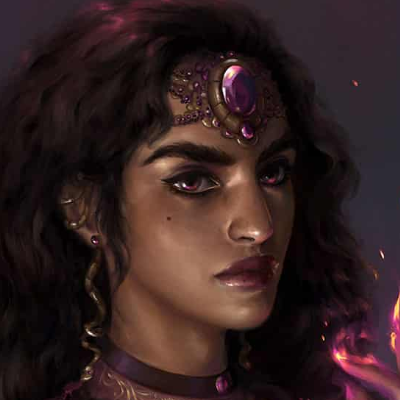
Shurpanakha is the only daughter of the brahmin sage Vishrava and the Rakshasi Kaikesi, the youngest of their four children, the full sister of Ravana, Kumbhakarna, and Vibhishana, and the half-sister of Kubera. Her role in the Valmiki Ramayana is confined to a single episode spanning the Aranya Kanda (Sargas 17–20 and 34), yet that episode is structurally the hinge on which the entire second half of the epic turns: without her encounter with Rama and Lakshmana at Panchavati, and without her subsequent embassy to Ravana's court, the abduction of Sita does not occur and the Lanka war does not begin. Valmiki himself is recorded in secondary tradition as having observed that without Kaikeyi and without Shurpanakha, there would have been no Ramayana. Within the epic she is a minor character with a major narrative function: she is the proximate cause of the catastrophe that destroys her own family. The Valmiki Ramayana describes her, at the moment Rama first sees her, in deliberately unflattering terms — she is the instrument of a catastrophe described in the ugliest available language. The Kamba Ramayanam and several later retellings correct this description markedly, presenting her as beautiful and lonely, her conduct as humanly comprehensible, and her mutilation as genuinely shocking. She is a figure around whom the tradition's most persistent moral disagreements cluster: about the justness of her punishment, the responsibility of Ravana's conduct toward her, and her ultimate status as agent or victim.
✦ The Name
The name Shurpanakha is a Sanskrit compound of shurpa (winnowing fan) and nakha (fingernail or claw), meaning "she whose fingernails are like winnowing fans." The Wikipedia article on Shurpanakha confirms the IAST form as shurpanakha with the literal gloss "she whose fingernails are like winnowing fans." It is a name of physical description, emphasising the sharp and large claws characteristic of the Rakshasa form. According to secondary sources drawing on the Uttara Kanda tradition, her birth name was Minakshi — meaning "fish-eyed" — a name that describes large, beautiful eyes and is also one of the names of the goddess Parvati in her form at Madurai. Some sources also give Chandranakha ("moon-nailed") as a variant birth name. The name Shurpanakha, identifying her by her most conspicuous physical feature in Rakshasa form, displaced the birth name at some point and became the name by which she is universally known. The name Suparnika or Suparnakha appears in some recensions and regional traditions as an alternative.
✦ Lineage
- Great-grandfather: Brahma — the creator god; Pulastya is his mind-born son
- Grandfather: Pulastya — one of the ten Prajapatis and one of the Saptarishi of the first Manvantara; the founding ancestor of the Lanka Rakshasa lineage through his son Vishrava
- Father: Vishrava — brahmin sage son of Pulastya; a scholar of the Vedas; he warned Kaikesi when she approached him at an inauspicious hour that her children would carry Rakshasa nature, with only the last born inheriting his own righteous character; the Vishrava Wikipedia article confirms that Vishrava agreed to wed Kaikesi but forewarned her that only their last child (Vibhishana) would inherit his disposition
- Mother: Kaikesi — daughter of the Rakshasa king Sumali (son of Sukesha) and his wife Ketumati; granddaughter of the Rakshasa dynasty descended through the primordial demon lineage; the same Kaikesi who bore Ravana and Kumbhakarna
- Elder full brothers: Ravana — eldest, king of Lanka; Kumbhakarna — second brother, warrior cursed to near-perpetual sleep; Vibhishana — third brother, the righteous one who defected to Rama
- Paternal half-brother: Kubera — son of Vishrava by his first wife Ilavida; god of wealth and original king of Lanka
- Husband: Vidyutjihva — a Danava prince of the Kalakeya clan; also known in some sources by the parallel name Dushtabuddhi ("evil-minded"); the circumstances of their marriage and his death are discussed below in the narrative section and the Textual Variants section; he had a son by Shurpanakha named Shambhri (or Shambhu Kumara in the Hindu Blog account), who is mentioned in some later traditions as having been accidentally killed by Lakshmana
- Brothers-in-law and regional relatives: Khara and Dushana — commanders governing the territory of Janasthana in the Dandaka forest on Ravana's behalf; described in the List of Characters in Ramayana Wikipedia article as the twin sons of Kaikesi's sister Raka, making them Shurpanakha's maternal cousins rather than full brothers, though she is referred to as their sister in the Aranya Kanda of the Valmiki Ramayana — the Hinduism Stack Exchange Uttara Kanda passage (Chapter 30) records Vibhishana himself explaining this relationship, stating that Kumbhinasi was born of their maternal aunt Anala and was "virtually" their sister; the same relational logic applies to Khara and Dushana in several accounts
✦ Birth, Character, and Early Life
Shurpanakha is the youngest child of Vishrava and Kaikesi, born after Ravana, Kumbhakarna, and Vibhishana. Since Vishrava had foretold that only the last child would inherit his righteous nature, and that child was Vibhishana (the third son), Shurpanakha as the fourth and last child presents a complication to the scheme: by most accounts she shares the Rakshasa nature of her two elder full brothers rather than the sattvic nature of Vibhishana. The creedthinker.blogspot and universalteacher sources record that at birth she was beautiful, resembling her mother Kaikesi and her grandmother Ketumati, and was given the name Minakshi ("fish-eyed," i.e., large and beautiful eyes). The Rakshasa appearance and demeanour for which the Valmiki Ramayana describes her — the protruding belly, coppery hair, and ugliness — represent her natural Rakshasa form rather than a permanent physical condition, since all sources agree she possessed the Rakshasa power to assume any form at will. The contrast between the beautiful form she assumed when approaching Rama and the ugly form in which she actually existed is an important element of how the episode is narrated.
✦ Marriage to Vidyutjihva and Widowhood
When Shurpanakha grew to adulthood she secretly married Vidyutjihva, a Danava prince of the Kalakeya clan. The marriage was clandestine because Rakshasas and Danavas were traditional enemies, and Ravana was furious when he discovered it. He would have punished Shurpanakha and dismissed Vidyutjihva, but Mandodari, Ravana's chief queen, interceded on her sister-in-law's behalf and persuaded Ravana to accept the marriage out of respect for his only sister's wishes. The couple lived at Lanka and Vidyutjihva enjoyed a position in Ravana's court.
The marriage ended in Vidyutjihva's death at Ravana's hands — but the circumstances and textual location of this episode are matters of inter-source inconsistency (discussed in the Textual Variants section). The dominant account, drawn on by multiple secondary sources, is that during Ravana's conquest of Rasatala (the Underworld), either Ravana discovered Vidyutjihva plotting against him, or during the Kalakeya campaign, a conflict arose between them that resulted in Ravana killing his brother-in-law. The Hindu Blog account notes an alternative tradition in which Ravana killed Vidyutjihva accidentally during the campaign against Indra when the Kalakeyas intervened to stop him. By some accounts Vidyutjihva and Shurpanakha had a son, Shambhri, before his death.
Widowed, Shurpanakha divided her time between Lanka and the forests of southern India, spending extended periods with her forest-dwelling relatives Khara and Dushana in the Janasthana territory of the Dandaka forest. Several secondary sources note that this widowhood and her grief and resentment at Ravana for causing it is the background against which her approach to Rama must be understood: some retellings argue that her apparent desire for Rama was actually or partly a calculated strategy to bring about Ravana's destruction in revenge, though the Valmiki Ramayana itself does not make this argument explicitly.
✦ The Encounter at Panchavati: Approach, Rejection, and Mutilation
The Aranya Kanda of the Valmiki Ramayana (Sargas 17–20) records the encounter at the hermitage of Panchavati on the banks of the Godavari River. Rama, Sita, and Lakshmana had settled there during their exile. Shurpanakha arrived in the forest and, on seeing Rama, was immediately attracted to him. She assumed a beautiful form and approached him directly, proposing marriage. Valmiki's description of what she looked like in her actual form — as she appeared to Rama before she transformed — is a sustained inventory of unflattering qualities: facially unpleasant, pot-bellied, wry-eyed, coppery-haired, ugly-featured, brassy-voiced, deplorably old, a crooked talker, ill-mannered, uncouth, and abominable (Valmiki Ramayana 3.17.9b–12a, cited and translated in the vedicfeed.com and valmikiramayan.net sources). These attributes are listed as a deliberate contrast to Rama's beauty, with each of Shurpanakha's qualities opposed explicitly to the corresponding quality in Rama.
Rama's response, as preserved in the Wisdomlib translation of Aranya Kanda Chapter 18, was gentle mockery. He told her he was already married and that a co-wife rivalry would be unbearable for her, then directed her to his unmarried younger brother Lakshmana as a potentially more suitable match. Lakshmana, in the same tone, replied with a parallel jest — he described himself as a mere servant of his brother and said that she, being such a paragon, deserved a better husband than a subordinate. The exchange has a playful, ironic register that the text does not present as entirely innocent on the brothers' part: they are taking pleasure in the situation at her expense. Shurpanakha, misreading Lakshmana's words as sincere, returned to Rama. She approached Sita this time with open menace, making clear that she regarded Sita as the obstacle to her desire. At this point Rama instructed Lakshmana to act. The Valmiki Ramayana records Rama's command in Aranya Kanda 3.18.20–21 as follows: "She is freakish, knavish and overtly ruttish — it will be apt of you to deface this paunchy demoness." Lakshmana thereupon drew his sword and cut off Shurpanakha's nose and ears. The Vedic Bliss account confirms the passage in Sanskrit (Aranya Kanda Sarga 19 Shloka 18) describing her shrieking with her nose and ears severed and hurling insults at Rama as she fled.
Streaming with blood, Shurpanakha fled howling into the forest and made first for Khara at Janasthana. The Wisdomlib translation of the Aranya Kanda describes her as "wild with terror and covered with blood" as she threw herself before Khara and recounted the whole situation. Khara's response was to send fourteen Rakshasa warriors against Rama, all of whom Rama killed. Khara then attacked personally with an army of fourteen thousand — the Wikipedia article on Shurpanakha confirms this as including Khara, all the fourteen thousand soldiers, and Dushana, with only Akampana (identified as Sumali's son and Kaikesi's brother, making him Shurpanakha's maternal uncle) escaping to Lanka. This defeat wiped out the entire Rakshasa military presence at Janasthana.
✦ The Embassy to Ravana: Inciting the Abduction of Sita
After the annihilation of Khara's army, Shurpanakha flew directly to Lanka and presented herself — mutilated and bleeding — before Ravana in his court. The Wisdomlib translation of Aranya Kanda Chapter 34 preserves her speech to Ravana in full. It is a sophisticated rhetorical performance: she rebuked him first for negligence in governing his territories, telling him that a king who wallows in pleasure while his ministers and commanders die is no king but already a dead man. She described Rama in full detail — his weapons, his appearance, his power, his companions — and then pivoted to describe Sita. Her description of Sita to Ravana is one of the most extravagant passages of praise for a woman's beauty in the entire epic: she described Sita's complexion as molten gold, her waist as slender, her face as the full moon, and her bearing as that of Lakshmi herself — "no woman so beautiful has ever appeared in the world, either among the gods, Gandharvas, Yakshas or Kinneras." She then told Ravana that she had sought to bring Sita to him as a bride and had been mutilated for the attempt. She urged him to go immediately and take Sita for himself.
The Wikipedia article on Shurpanakha notes that Akampana, the sole survivor of Khara's army who had reached Lanka ahead of her, had also played a role in instigating Ravana by confirming what Shurpanakha told him. Ravana, hearing both reports and the description of Sita's beauty, resolved to abduct her. Despite Vibhishana's opposition — clearly recorded in all accounts as the one voice in Lanka that counselled against the abduction — Ravana proceeded with his plan, using Maricha transformed into a golden deer to draw Rama away from the hermitage, and then approaching Sita himself in the guise of a wandering ascetic. The chain of events from Shurpanakha's mutilation at Panchavati to Ravana's abduction of Sita is direct and uninterrupted.
✦ After the Embassy: Silence in the Valmiki Text
The Wikipedia article on Shurpanakha states plainly: "Although Shurpanakha receives no further mention from Valmiki, it has been suggested that she continued to live in Lanka after Vibhishana succeeded Ravana as king." The core six books of the Valmiki Ramayana give her no further role. She is not present during the Lanka war, not mentioned at Ravana's death, and not named in the aftermath. In the Uttara Kanda and in various later and regional traditions, she receives a post-war existence, but these belong to texts of varying authority and are discussed in the Textual Variants section.
✦ Textual Variants and Inconsistencies
The killing of Vidyutjihva — textual location: The Quora source on why Ravana killed Shurpanakha's husband notes explicitly that "Ravana killing Surpanaka's husband is not found in the first six Kandas. It is part of Uttara Kanda." Valmiki does not mention the husband's killing anywhere in the Aranya Kanda, which is the kanda in which Shurpanakha actually appears. The backstory of her marriage and her husband's death is Uttara Kanda material — i.e., from the later compositional stratum. This means that the entire motivation-based reading of Shurpanakha's approach to Rama (whether she was acting from genuine desire or from calculated revenge against Ravana) rests on a passage not present in the original six-book poem.
Husband's name — Vidyutjihva vs Dushtabuddhi: Multiple sources give two different names for Shurpanakha's husband. The Valmiki Ramayana Uttara Kanda gives the name Vidyutjihva. Several secondary accounts, including the dollsofindia.com and thehouseofram.com sources, use the name Dushtabuddhi (meaning "evil-minded"). The Hindu Blog account identifies Vidyutjihva as the brother of the Kalakeyas and notes there is also a different character named Vidyutjihva (a sorcerer in Ravana's service who was sent to show Sita a false head of Rama in the Ashoka Vatika) — thus two unrelated characters share the same name in the tradition. The name Dushtabuddhi appears to be either an alternative name for the same person or a variant tradition's designation. No single primary source resolves this cleanly.
Shurpanakha's appearance — ugliness vs beauty: The Valmiki Ramayana (Aranya Kanda 3.17.9–12) describes Shurpanakha in her natural state as explicitly ugly: pot-bellied, wry-eyed, coppery-haired, ugly-featured, brassy-voiced, and abominable. This is a deliberate literary strategy — the contrast with Rama's beauty is presented as a series of explicit oppositions in the Sanskrit text. The Kamba Ramayanam (twelfth-century Tamil) reverses this entirely: it describes Shurpanakha as beautiful and lovelorn, attributing her behaviour to loneliness rather than wantonness, thereby humanising her considerably. The Wikipedia article on Shurpanakha specifically notes this divergence. In the Kamba tradition and several other regional versions, Shurpanakha becomes a more sympathetic character whose desire for Rama is understandable and whose mutilation is disturbing rather than appropriate.
What was severed — nose only, or nose and ears: Most secondary accounts and popular tradition record that Lakshmana cut off Shurpanakha's nose. The Valmiki Ramayana text, as preserved at both the Wisdomlib translation and the VedKaBhed source with direct Sanskrit citation, records the cutting of both ears and nose: the Wisdomlib translation reads "cut off her ears and nose" and the VedKaBhed source quotes Aranya Kanda 3.18.20–21 with the command to "deface this paunchy demoness," followed by the severing of "her ears and nose." Accounts that describe only the nose being cut are abridgements of the Valmiki account.
The Mahabharata Vana Parva genealogy: The Mahabharata Vana Parva (Chapter 275), as recorded in the Wisdomlib Puranic Encyclopaedia entry on Kumbhakarna, assigns Shurpanakha to the wife Malini (rather than Kaikesi) in its account of Vishrava's children by different wives. This assigns her a different mother from Ravana and Kumbhakarna. As with the variant for Vibhishana (assigned to the wife Raka in the same passage), the Agni Purana resolves these discrepancies by equating the different names. The Saurapurana and Uttara Kanda both give Kaikesi as the mother of all four.
Post-war existence — Brahmavaivarta Purana and the Kubja tradition: Several secondary sources, including the House of Ram and dollsofindia.com accounts, record a tradition from the Brahmavaivarta Purana that Shurpanakha performed penance at Pushkar after the war, asking Brahma for the boon of being with Rama in her next birth. Brahma granted this, and she was reborn as Kubja — a hunchbacked woman in Mathura, a devoted follower of Krishna (Vishnu's next avatar), who was healed by Krishna when he pressed his foot against her toes and straightened her spine. This tradition connects Shurpanakha directly to the Krishnavatara lineage in a trajectory of redemption and devotion. This account is from the Brahmavaivarta Purana, a later Purana not considered part of the core Ramayana tradition.
Was Shurpanakha acting from desire or from revenge: Some versions of the story, noted in the detechter.com account, argue that Shurpanakha's approach to Rama at Panchavati was not driven by genuine desire but by a calculated plan to provoke Ravana's destruction in revenge for her husband's death. In this reading, she knew Rama was the only being capable of destroying Ravana, and deliberately engineered the confrontation. The Valmiki Ramayana gives no support to this reading — it presents her as genuinely infatuated and humiliated — but several modern and regional retellings find this alternative reading compelling. It rests entirely on the Uttara Kanda's backstory of Vidyutjihva's killing, which is absent from the core six books.
✦ Theological and Narrative Significance
Shurpanakha's significance in the Valmiki Ramayana is entirely structural and narrative: she is the mechanism by which the plot moves from the peaceful forest exile of the first two kandas into the war of the last three. Without her, the epic would not exist in its present form. Valmiki's description of her as ugly, aggressive, and morally uncontrolled positions her as the antithesis of Sita — who is at the same moment held by Shurpanakha's own description of her as the embodiment of beauty and grace. The contrast is deliberate: the Rakshasi who desires Rama cannot possess him; the woman who is described through Shurpanakha's own words as Lakshmi incarnate is the woman Ravana abducts. Shurpanakha's mutilation is thus simultaneously a punishment for transgression against dharmic boundaries, a narrative mechanism to trigger the subsequent chain of events, and a marker that differentiates the universe of the pure and beautiful (Sita, Rama, dharma) from the universe of the distorted and dangerous (Shurpanakha, Ravana, adharma).
Later traditions and modern scholarship have complicated this reading substantially. The Kamba Ramayanam's portrait of a lonely, beautiful woman treated cruelly by men who mocked her shifts the moral register of the episode. Scholars cited across multiple sources have noted that the mutilation of a woman for expressing desire — however aggressive — is an act whose justness is not self-evident, and that Shurpanakha's portrayal in the Valmiki text is shaped by a poetics that requires her debasement as a narrative counterweight to Sita's elevation. The dollsofindia.com source records that several scholars describe Shurpanakha as a wronged woman. The tradition contains both readings and has not resolved them.
✦ Connection to the Wider Genealogy
Shurpanakha occupies a distinctive position in the Lanka genealogy as the only daughter of Vishrava and Kaikesi and the only surviving female of the senior Rakshasa lineage in the epic. Through her husband Vidyutjihva, she connected the Rakshasa line of Kaikesi with the Danava lineage of the Kalakeya clan — a cross-lineage union that provoked Ravana's fury precisely because it violated the boundaries between two traditionally hostile supernatural races. Through her son Shambhri, mentioned in post-Valmiki traditions, she continued the combined Rakshasa-Danava line into a generation beyond the Lanka war. Her role as the sole full sister of Ravana, Kumbhakarna, and Vibhishana makes her the feminine member of the set of siblings whose different responses to dharma the Ramayana deploys as a sustained ethical argument: Ravana who chose desire over duty, Kumbhakarna who chose loyalty over principle, Vibhishana who chose dharma over family, and Shurpanakha who chose desire and revenge over restraint and whose uncontrolled action set in motion a war that destroyed all of the others.
✦ References
Primary Sources
- Valmiki Ramayana, Aranya Kanda, Sargas 17–20: The sole account in the core six books of the epic of Shurpanakha's encounter with Rama and Lakshmana at Panchavati, the exchange of mock-marriage proposals, her attack on Sita, and the mutilation of her nose and ears by Lakshmana; the Wisdomlib translation of these sargas provides the fullest available English rendering of the original Sanskrit; the Sanskrit citation for Valmiki's description of Shurpanakha is 3.17.9–12 and for the mutilation command 3.18.20–21.
- Valmiki Ramayana, Aranya Kanda, Sargas 21–30: The aftermath of the mutilation — Shurpanakha's report to Khara, the battle of Janasthana, the destruction of Khara's army of fourteen thousand.
- Valmiki Ramayana, Aranya Kanda, Sarga 34: Shurpanakha's speech to Ravana in his court; her description of Rama's power and Sita's beauty; her instigation of the abduction; preserved in the Wisdomlib translation of the Aranya Kanda.
- Valmiki Ramayana, Uttara Kanda: The backstory of Shurpanakha's birth name Minakshi; her marriage to Vidyutjihva; Ravana's killing of Vidyutjihva; her widowhood; note that the Uttara Kanda is considered by scholars including Hermann Jacobi to be a later addition to the core text, and the Quora source confirms that the husband's killing is not found in the first six Kandas.
- Kamba Ramayanam (12th-century Tamil): The most significant alternative characterisation of Shurpanakha; presents her as beautiful and lovelorn rather than ugly and aggressive; humanises her behaviour and makes her mutilation morally troubling; cited in the Wikipedia article on Shurpanakha as the principal divergent portrait.
- Brahmavaivarta Purana: Records Shurpanakha's post-war penance at Pushkar and her rebirth as Kubja in the Krishnavatara tradition; cited in multiple secondary sources including the House of Ram account.
- Mahabharata, Vana Parva, Chapter 275: Assigns Shurpanakha to the wife Malini in the Vishrava genealogy, giving her a different mother from Ravana and Kumbhakarna; the Agni Purana equates the different wives' names.
Secondary and Reference Works
- Wikipedia — Shurpanakha article: Provides etymology (winnowing-fan nails), the Valmiki description of her appearance, the two-stage encounter with Rama and Lakshmana, the battle with Khara, the embassy to Ravana, the contrast with the Kamba Ramayanam portrait, and the note that Valmiki gives her no further mention after Aranya Kanda 34.
- Wisdomlib.org — Valmiki Ramayana, Aranya Kanda translations, Chapters 18 and 34: The primary English-language access point for the mutilation episode and the embassy speech; provides translated Sanskrit text confirming both ears and nose were severed.
- Vedicfeed.com — "Shurpanakha — One Who Instigated Ravana to Abduct Sita": Provides the Sanskrit verse 3.17.9–12 with full translation and the Vidyutjihva backstory from the Uttara Kanda.
- Dollsofindia.com — "Surpanakha — Dreadful Demoness or Wronged Damsel?": Surveys both the traditional and the revisionist readings; notes the Kamba Ramayanam portrait; cites the tradition of Shurpanakha meeting Sita in exile; records Shambhri as the son of Vidyutjihva accidentally killed by Lakshmana.
- Hindu Blog — "Story of Vidyujjihva, Husband of Surpanakha": Provides specific details on Vidyutjihva's Kalakeya lineage, the son Shambhu Kumara, and the two variant accounts of his death (intentional and accidental in the battle against Indra).
- Quora — "Why did Ravana kill Surpanakha's husband?": The only source that explicitly notes the textual location issue: the killing is found in the Uttara Kanda, not in the first six Kandas, with direct implications for reading Shurpanakha's motivations.
- Vedicbliss.com — "Why Did Lakshmana Cut Off Shurpanakha's Nose?": Provides the Sanskrit verse from Aranya Kanda Sarga 19 Shloka 18 describing the mutilation in Valmiki's own words.
- Wikipedia — Vishrava article: Confirms Vishrava's statement at the time of the marriage that only the last child born would inherit his own nature, contextualising Shurpanakha's Rakshasa character as anticipated by her father.