
About
Sumali — Youngest Son of Sukesa, Lord of Lanka, Grandfather of Ravana, and Architect of the Rakshasa Restoration
Sumali · Sukesaputra · Devavatiputra · Kaikasitatah · Ravana-pitamaha · Rakshasadhipati · Lankeshvara-kanishtha
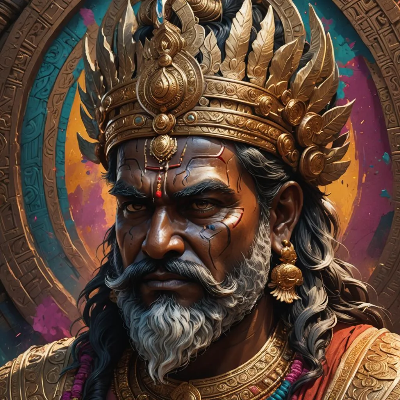
Sumali is the youngest of the three sons of Sukesa — the Rakshasa king who received Shiva's boon and fathered the three great lords of Lanka — and of Sukesa's wife Devavati. He is the brother of Malyavan and Mali, the co-ruler of Lanka during the brief period of the three brothers' joint dominion, and the survivor — alongside Malyavan — of the first Vishnu-intervention that ended their rule. He is the most genealogically consequential of the three brothers: after the retreat to Patala following Mali's death at Vishnu's hands, Sumali devised the scheme that would reclaim Rakshasa power in Lanka — he arranged the marriage of his daughter Kaikasi to the sage Vishrava, the son of the Prajapati Pulastya, specifically with the intention of producing a son of supreme power who would be both brahmin and Rakshasa and who could reclaim what the three brothers had lost. From this arranged marriage Ravana was born — the greatest demon king in the tradition, the ruler who reclaimed Lanka, conquered the three worlds, and whose career and death at Rama's hands constitute the central action of the Valmiki Ramayana. Sumali is thus the architect of Ravana's existence — the figure whose strategic foresight and long patience in Patala produced the being who would achieve the Rakshasa restoration that Sumali himself had failed to secure in his own generation. Sumali appears most substantially in the Uttara Kanda of the Valmiki Ramayana and in the Mahabharata's Vana Parva, with references in several Puranic texts.
✦ The Name
The name Sumali is a compound of su — good, excellent, auspicious — and mali — the garlanded one, from the same root that gives the names Mali and Malyavan — yielding the sense of "the excellently garlanded one," "he of the auspicious garland," or "the most honoured one." The three names Malyavan, Mali, and Sumali are thus all variations on the same garland-root — Malyavan meaning "he who possesses garlands," Mali meaning "the garlanded one," and Sumali meaning "the excellently garlanded one" — suggesting that the naming of the three brothers was deliberate and systematic, perhaps indicating the tradition's understanding of them as a unified triad of related power. The patronymic Sukesaputra identifies him as Sukesa's son. Kaikasitatah means "father of Kaikasi." Ravana-pitamaha means "grandfather of Ravana." Lankeshvara-kanishtha means "the youngest lord of Lanka."
✦ Lineage
- Father: Sukesa — the Rakshasa king, son of Vidyutkesa and the Apsara Salakatankata, who received Shiva's protective boon and fathered the three lords of Lanka by his wife Devavati.
- Mother: Devavati — the wife of Sukesa.
- Brothers: Malyavan — the eldest, who survived both cycles of Vishnu's intervention and counselled Ravana unsuccessfully before the Lanka war; profiled separately. Mali — the second, who engaged Vishnu directly and was killed; profiled separately.
- Wife: The Uttara Kanda names Sumali's wife as Ketumati. She is identified as a woman of great beauty and of Rakshasa lineage, and is the mother of Sumali's many children.
- Daughters: The Uttara Kanda gives a list of Sumali's daughters. The most significant is Kaikasi — described as a young woman of extraordinary beauty whom Sumali deliberately arranged to encounter the sage Vishrava with the specific intention of producing a powerful son. Kaikasi is the mother of Ravana, Kumbhakarna, Vibhishana, and Shurpanakha. Other daughters of Sumali named in the Uttara Kanda include Puspotkata and Raka, who are said to have been mothers of further significant Rakshasa figures.
- Sons: The Uttara Kanda names several sons of Sumali including Prahasta, Akampana, Vikata, Kalikamukha, Dhoomraksha, Danda, Suparsva, Samhrada, Prakvata, and Bhasakarna — warriors who became significant commanders in Ravana's Lanka army and who fought against Rama's forces in the Yuddha Kanda. Prahasta in particular is one of the foremost generals of Lanka and is killed by Nila — one of the monkey commanders — in the war's battles. Several of Sumali's sons thus appear as named warriors in the Yuddha Kanda's battle narrative.
- Grandson through Kaikasi: Ravana — born of Kaikasi's marriage to the sage Vishrava. Ravana is the greatest Rakshasa king in the tradition, the ruler of Lanka after reclaiming it from Kubera, the conqueror of the three worlds, and the abductor of Sita whose defeat at Rama's hands is the central action of the Valmiki Ramayana. Ravana's extraordinary power combined the brahmin learning of his father Vishrava's line with the demonic strength of his mother Kaikasi's Sumali ancestry — precisely the combination that Sumali had intended when he arranged the marriage.
- Other grandchildren through Kaikasi: Kumbhakarna — the giant warrior who was killed by Rama in single combat during the Lanka siege; Vibhishana — the righteous Rakshasa who sided with Rama and became Lanka's ruler after the war; and Shurpanakha — whose mutilation by Lakshmana and subsequent approach to Ravana precipitated Sita's abduction.
✦ The Establishment of Lanka, Mali's Death, and the Retreat to Patala
The narrative of the three brothers' establishment in Lanka and the subsequent conflict with Vishnu is shared across Malyavan's and Sumali's profiles and is narrated in full in the Malyavan profile. For Sumali specifically, the most consequential aspect of this episode is what happened after — not the defeat itself but the long strategic patience that followed it. When Mali was killed and he and Malyavan fled to Patala, Sumali did not simply accept the Rakshasas' loss of Lanka as a permanent condition. He spent the period of hiding in Patala thinking about how to reverse what had happened and how to produce a being powerful enough to accomplish what he and his brothers had been unable to sustain.
✦ Sumali's Strategic Vision — the Arrangement of Kaikasi's Marriage
The Uttara Kanda narrates the episode of Sumali's arrangement of Kaikasi's marriage to Vishrava with considerable care, and it is the most significant act of Sumali's biography — the one whose consequences dwarf everything else he did. Sumali's insight was this: the reason the three brothers had ultimately failed was that their power, though great, was purely Rakshasa in character — augmented by boons but fundamentally demonic in nature. What was needed was a being who combined Rakshasa power with brahminical learning and spiritual potency — a being who would be invulnerable not just to ordinary opponents but who would have access to divine weapons and sacred knowledge that pure Rakshasas could not possess. Such a being could only be produced by the union of a Rakshasa woman with a brahmin sage of the highest calibre.
The sage Vishrava — the son of the Prajapati Pulastya and a figure of immense learning and sacred power — was the ideal candidate for such a union. He was already known as a great sage, and the association of the Pulastya line with both sacred knowledge and Rakshasa ancestry — Pulastya is identified in some accounts as the progenitor of some Rakshasa races — made Vishrava's children by a Rakshasa mother potentially the most powerful beings the tradition could produce. Sumali sent his daughter Kaikasi to Vishrava at a specific time — the Uttara Kanda notes that Kaikasi approached Vishrava at a slightly inauspicious time of day, which Vishrava commented upon, warning that the children born from a union initiated at such a time would be of demonic rather than purely divine character. Kaikasi accepted this but asked that at least one of her children might be of righteous character — and Vishrava agreed that her last-born would be of dharmic virtue. This agreement produced the alignment: the first three children — Ravana, Kumbhakarna, and Shurpanakha — would be of the demonic character that Sumali had intended, while the fourth — Vibhishana — would be the exception of righteousness.
Sumali's arrangement thus worked precisely as he had intended — it produced Ravana, who reclaimed Lanka, conquered the three worlds, and restored Rakshasa supremacy to a degree far beyond what the three brothers had achieved. It also, through the timing that Vishrava had noted, embedded the conditions of Ravana's eventual destruction — the demonic overreach that would make him vulnerable to the divine intervention he could not avoid. Sumali, watching his grandson Ravana achieve the restoration he had envisioned, lived to see that restoration and presumably also lived through its subsequent undoing at Rama's hands, since there is no account in the primary sources of Sumali's death.
✦ Sumali's Return to Lanka Under Ravana
The Uttara Kanda narrates that after Ravana had grown to power, conquered Lanka from Kubera, and established himself as the lord of the Rakshasas, Sumali and his family — who had been living in Patala — returned to Lanka to live under Ravana's protection. The return of Sumali and the senior Rakshasas from their long exile in the underworld was the completion of the arc that Sumali had envisioned — the restoration of the Rakshasa family to Lanka through the instrument of the being he had deliberately produced. Sumali's sons — Prahasta, Akampana, and the others — became commanders of Ravana's army and are among the warriors who fought in the Lanka war.
✦ Sumali and the Infant Ravana
The Uttara Kanda contains a detail that gives Sumali's role in Ravana's formation a further personal dimension. When Ravana was a child and Kaikasi was raising her children in Vishrava's household, Sumali used to visit his grandchildren. The Uttara Kanda records that Sumali paid particular attention to the young Ravana — the child he had strategically produced — and observed his extraordinary qualities from an early age. It was Sumali who encouraged Ravana to seek boons from Brahma through austerities, recognising that the child's innate power needed the augmentation of divine boons to be fully realised. Sumali's advice and encouragement directed Ravana toward the austerities that ultimately produced his near-invincible boon from Brahma — the boon that protected him from death at the hands of gods, demons, celestials, and all beings except human beings and monkeys, the precise exceptions that Vishnu exploited in descending as Rama. Sumali thus not only produced Ravana but shaped the direction of his development, functioning as both grandfather and strategic advisor in Ravana's formative period.
✦ Textual Variants and Inconsistencies
The timing of Kaikasi's approach to Vishrava: The Uttara Kanda is consistent in stating that Kaikasi approached Vishrava at a slightly inauspicious time of day and that Vishrava warned her of the consequences for the character of the children to be born. The specific characterisation of the time and the exact terms of Vishrava's warning vary across manuscript traditions of the Uttara Kanda. The essential point — that the timing was inauspicious and that this shaped the children's demonic nature — is consistent.
The list of Sumali's children: The Uttara Kanda provides a list of Sumali's sons and daughters that varies across manuscript traditions. The names in the Lineage section reflect the most commonly attested versions. Not all Puranic texts that deal with Rakshasa genealogy give identical lists of Sumali's children.
Sumali's role in directing Ravana's austerities: The detail of Sumali encouraging the young Ravana to seek boons from Brahma is present in the Uttara Kanda's account. Some regional and devotional retellings of the Ramayana tradition present Ravana's decision to perform austerities as arising more from his own initiative and less from his grandfather's counsel. The Uttara Kanda's account, which attributes a significant advisory role to Sumali in this decision, is the primary canonical source for this detail.
✦ Theological and Philosophical Significance
Sumali's theological significance within the tradition is extraordinary for a figure who is not himself the protagonist of the tradition's most celebrated narratives. He is the hidden architect of the Ramayana's central conflict — the being whose strategic vision, patience, and genealogical engineering produced Ravana, and through Ravana produced the specific set of circumstances that required Vishnu to descend as Rama. The entire apparatus of the Ramayana — Sita's abduction, the alliance with the monkeys and bears, the building of the causeway, the war at Lanka, the Bhagavad Gita's distant ancestor in the tradition of Vishnu's earthly descent — is ultimately the consequence of Sumali's deliberate arrangement of Kaikasi's marriage and of his guidance of the young Ravana toward the specific boons that made Ravana both nearly invincible and precisely vulnerable to a human avatar of Vishnu.
The tradition presents this without explicit theological commentary — Sumali's actions are narrated as a Rakshasa grandfather's devotion to his clan's restoration, not as a cosmic design. But the structure of the Ramayana tradition makes Sumali's role cosmologically pivotal: without his arrangement, there would have been no Ravana; without Ravana, there would have been no occasion for Vishnu's descent as Rama; and without Rama, one of the tradition's most central theological statements about the nature of divine descent, the power of devotion, and the ultimate governance of cosmic order would not have been made. Sumali is the cosmic villain's grandfather who is simultaneously, in the tradition's larger theological perspective, an instrument of the divine plan's unfolding.
✦ Connection to the Wider Genealogy
Through his father Sukesa and grandfather Vidyutkesa, Sumali descends from the primordial Rakshasa ancestry traced back to the creative line of Brahma. Through his daughter Kaikasi's marriage to Vishrava — the son of the Prajapati Pulastya — Sumali's lineage converges with the brahmin sage tradition to produce Ravana and his siblings. Through Ravana, Sumali is the maternal great-grandfather of the most dominant figure in the Rakshasa tradition. Through his sons — Prahasta, Akampana, and the other commanders who served in Ravana's army — the Sumali branch of the three-brother lineage provided the military leadership of Lanka. Through Vibhishana — Kaikasi's righteous son — Sumali's lineage also produced the figure who survived the war, sided with Rama, and became the ruler of Lanka under Rama's authority, preserving the Rakshasa royal presence in Lanka in a transformed and righteous form even after the war's destruction. The full genealogical arc from Sukesa through Sumali to Ravana and Vibhishana is one of the most consequential dynastic sequences in the entire Sanskrit canonical tradition.
✦ References
Primary Sources
- Valmiki Ramayana, Uttara Kanda, chapters 4–14: The primary and most detailed source for Sumali's biography — his establishment in Lanka with his brothers, Mali's death, the retreat to Patala, the arrangement of Kaikasi's marriage to Vishrava, Vishrava's warning about the inauspicious timing and its consequences for the children's nature, the birth of Ravana and his siblings, Sumali's encouragement of the young Ravana to perform austerities, and the return of Sumali and the senior Rakshasas to Lanka under Ravana's rule.
- Valmiki Ramayana, Yuddha Kanda: The battle narrative in which Sumali's sons — Prahasta, Akampana, and others — fight as commanders of Ravana's army and are killed by Rama's forces; provides the narrative context of Sumali's family in the war.
- Mahabharata, Vana Parva, sections on Rakshasa genealogy: A compressed account consistent with the Uttara Kanda's narrative of the three brothers, confirming the essential genealogical facts.
- Vishnu Purana, Book 1, chapter 14: Genealogical material on the Rakshasa lineages including Sukesa and his sons.
- Brahma Purana: Contains genealogical material on the Rakshasa lineages descended from Sumali through Kaikasi and Ravana.
- Padma Purana: Contains genealogical and narrative material on the Lanka Rakshasa families including Sumali's line.
Modern Reference Works
- Vettam Mani, Puranic Encyclopaedia (1975): Entry on Sumali; comprehensive collation of primary references across the Ramayana, Mahabharata, and Puranas; summarises his genealogical position, his arrangement of Kaikasi's marriage, and his role as Ravana's maternal grandfather.
- Robert P. Goldman and Sally J. Sutherland Goldman (translators), The Ramayana of Valmiki — Uttara Kanda (2017): Critical translation with scholarly notes; the most authoritative English-language treatment of the Uttara Kanda's account of Sumali, including the detailed genealogical passages and the narrative of Kaikasi's marriage arrangement.
- Sukumari Bhattacharji, The Indian Theogony (1970): Contains analysis of the Rakshasa genealogical traditions and the theological structure of the Rakshasa-divine conflict cycles; relevant to understanding Sumali's position as the architect of the second cycle's conditions.
- A. K. Ramanujan, "Three Hundred Ramayanas: Five Examples and Three Thoughts on Translation" (1991): While primarily concerned with the diversity of Ramayana traditions, this essay contains observations relevant to how different versions of the tradition handle the Rakshasa genealogy and Ravana's origin, contextualising the Sumali narrative within the tradition's broader diversity.