
About
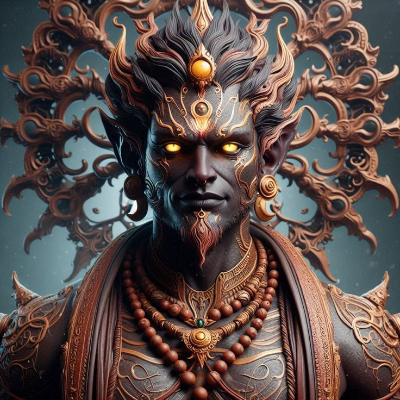
Mayasura — Danava Architect and Lord of Illusion
Maya · Mayasura · Mayadanava · Tripurasura · Mayavi
Mayasura is one of the most celebrated Danavas — the sons of the sage Kashyapa and his wife Danu, a class of beings who stand in primordial opposition to the Devas in the Hindu cosmological order. He is renowned across the Mahabharata, several Mahapuranas, and the Ramayana as the supreme architect and engineer among the Asuras, possessed of extraordinary skill in the construction of magical cities, weapons, and structures wrought from illusion. His most prominent role in the Mahabharata is as the builder of the Sabha — the celestial assembly hall — gifted to the Pandava prince Yudhishthira, eldest of the five sons of King Pandu of the Kuru dynasty. He is also identified in the Puranas as the architect of Tripura, the triple city of the Asuras destroyed by the god Shiva, and as the father of the Apsara Mandodari, who became the principal queen of the demon king Ravana of Lanka in the Ramayana tradition.
✦ The Name
The name Maya derives from the Sanskrit root that carries the sense of illusion, artifice, supernatural power, and the capacity to fashion deceptive appearances. In the context of this figure, the name functions both as a personal name and as a description of his defining attribute — his mastery over the construction of structures and weapons that confound ordinary perception. The suffix sura in Mayasura does not denote a deity in this usage but is a common element in Asura nomenclature. The epithet Mayavi, found in several texts, reinforces the same meaning, designating one who wields or embodies maya. In the Puranic accounts of Tripura, Maya is sometimes styled Tripurasura to indicate his role as the builder or presiding spirit of the triple Asura city.
✦ Lineage
- Father: Kashyapa — the great progenitor sage, son of the Prajapati Marichi who was himself born of Brahma the creator; Kashyapa fathered the Danavas through his wife Danu, and the Devas through his wife Aditi, making the two classes of beings half-siblings through a common father.
- Mother: Danu — one of the daughters of the progenitor Daksha and wife of the sage Kashyapa; the Danavas as a class take their collective name from her.
- Spouse: Hema — an Apsara, one of the celestial nymphs of Indra's court; their union is noted in the Ramayana tradition in connection with the birth of their daughter.
- Daughter: Mandodari — born of Mayasura and Hema; she became the foremost queen of Ravana, the ten-headed demon king and ruler of Lanka, and is counted among the five most virtuous women (Panchakanyas) in the Hindu tradition.
- Son: Mayavi — named in the Ramayana as a son of Maya; he is slain by the monkey-king Bali, elder brother of Sugriva, after a prolonged conflict.
- Son: Dundubhi — also named in the Ramayana as a son of Maya; a great buffalo-demon slain by the monkey-king Bali; his remains are later encountered by Rama, the prince of Ayodhya and avatar of the god Vishnu.
✦ The Building of the Sabha for Yudhishthira
The episode that gives Mayasura his most sustained narrative in the Mahabharata occurs in the Sabha Parva, the second book of the epic. Following the burning of the Khandava forest — a conflagration caused by the god of fire Agni, who was assisted by the hero Arjuna (third of the five Pandava brothers, son of Kunti and the god Indra) and the god Krishna (an avatar of Vishnu and cousin and close ally of the Pandavas) — Mayasura alone among the inhabitants of the forest escapes destruction. He had taken shelter near Arjuna during the fire, and in gratitude he offered to render whatever service Arjuna desired. Arjuna referred him to Krishna, who directed Maya to build an assembly hall for Yudhishthira, the eldest Pandava and righteous king.
Mayasura undertook the construction of a hall of surpassing wonder, drawing on his skill as the foremost architect among the Asuras. The Sabha he built at Indraprastha — the capital established by the Pandavas — was of extraordinary dimensions and incorporated elements that confounded mortal perception: surfaces of crystal that appeared to be water, pools of water that appeared to be smooth floors, and architectural illusions that deceived visitors unused to Asura craftsmanship. The Mahabharata records that for its construction Maya retrieved from the region of the Himalayas a great club, once the weapon of the Asura king Vrishaparva, which he presented to Bhima, the second Pandava and the mightiest of the brothers in physical strength. He also obtained the divine conch Devadatta, which was given to Arjuna. The hall became the seat of Yudhishthira's court and the site where the Rajasuya sacrifice was performed, and its splendours attracted the admiration — and eventually the envy — of the Kaurava prince Duryodhana, whose humiliation within it, when he mistook its illusory surfaces for solid ground and fell, contributed to the accumulating enmity that led toward the war of Kurukshetra.
✦ The Architect of Tripura
In the Puranic tradition, most extensively in the Shiva Purana and the Matsya Purana, Mayasura is identified as the architect who built Tripura — the three cities of the Asuras, constructed respectively of gold, silver, and iron, and set in the three regions of heaven, air, and earth. The Asura brothers Tarakaksha, Kamalaksha, and Vidyunmali — sons of the demon Taraka — had obtained from the god Brahma a boon that their three cities could be destroyed only simultaneously, and only by a single arrow. Mayasura's engineering genius produced fortresses of such magnificence and magical design that they were considered virtually impregnable. The gods, unable to overcome the Asuras by conventional means, appealed to Shiva, who ultimately destroyed all three cities with a single cosmic arrow at the moment when they came into alignment. The episode of Tripuradahana — the burning of Tripura — is one of the central mythological achievements of Shiva in the Puranas, and Mayasura's role as the builder places him at the structural heart of the story even as the Asuras are its vanquished party.
✦ Connection to the Ramayana
Mayasura's genealogical significance extends into the Ramayana through his daughter Mandodari and his sons Mayavi and Dundubhi. The Ramayana, attributed to the sage Valmiki, records that Mandodari was the beloved queen of Ravana, the ten-headed demon king of Lanka. Ravana — himself a figure of immense learning, austerity, and power, though cast in the role of principal antagonist in the epic — is consistently portrayed as holding Mandodari in the highest regard among his many wives. She is depicted as virtuous, wise, and earnest in her counsel to Ravana, repeatedly urging him to return Sita — the wife of the prince Rama of Ayodhya, whom Ravana had abducted — and avoid destruction. Her parentage from Mayasura and the Apsara Hema is noted in several recensions of the Valmiki Ramayana and expanded upon in the Adhyatma Ramayana and regional retellings.
The sons Mayavi and Dundubhi appear in the Kishkindha Kanda of the Ramayana. Dundubhi, taking the form of a mighty buffalo, challenged and was slain by Bali, the powerful monkey-king of Kishkindha. The bones of Dundubhi were later encountered by Rama and the monkey chieftain Sugriva — Bali's younger brother — and their disposition was used by Sugriva as part of a demonstration of Bali's strength in the context of negotiating Rama's alliance against Ravana. Mayavi similarly came into conflict with Bali, leading to a chase into a subterranean cave that resulted in Mayavi's death and a sequence of events that precipitated the estrangement between Bali and Sugriva.
✦ Textual Variants and Inconsistencies
The Puranic accounts of Tripura do not always name a single architect. Some versions attribute the cities to Maya alone; others distribute the engineering among several Asura craftsmen, with Maya as the chief. The Shiva Purana is the most detailed in specifying Maya's role, while the Matsya Purana and the Karma Purana offer variant details regarding the sequence of events and the nature of the boon obtained from Brahma.
Regarding Mandodari's parentage, not all recensions of the Ramayana agree. The Valmiki Ramayana in several manuscripts names her father as Mayasura and her mother as the Apsara Hema. However, certain regional and later retellings — including some versions of the Adhyatma Ramayana — present alternative accounts of her origin, including traditions in which she is identified as a transformed frog-princess or as having a different divine parentage altogether. The tradition of Mayasura and Hema as her parents is the most widely attested in the Sanskrit textual mainstream.
In the Mahabharata, Maya's identity as a Danava is explicit and consistent across the critical edition of the text. However, some later Puranic passages, particularly those elaborating on his cosmic role as the author of the astronomical treatise Surya Siddhanta, position him in a more neutral or even venerable light — as a transmitter of celestial knowledge — rather than purely as an adversarial Asura figure.
✦ The Surya Siddhanta Tradition
A tradition preserved in the Surya Siddhanta — one of the foundational texts of Indian astronomical and mathematical learning — identifies Maya as the recipient of a revelation of astronomical knowledge from the sun-god Surya or his emissary at the end of the Krita Yuga (the first of the four world ages). In this account, Maya is portrayed as a devoted student who received instruction in the movements of celestial bodies, the calculation of time, and the structure of the cosmos. This positions Mayasura not merely as an Asura craftsman but as a figure of considerable intellectual and scientific stature in the Indian learned tradition. The Surya Siddhanta frames its own contents as the teaching received by Maya, thus giving the text a mythological authority rooted in his name. This aspect of the figure sits alongside but somewhat apart from his role in the epics and the Puranic mythology of Tripura and the Khandava forest.
✦ Theological and Philosophical Significance
Mayasura occupies a theologically liminal position in the Hindu tradition. As an Asura and a Danava, he belongs to the class of beings understood to be in cosmological opposition to the Devas and to the divine order sustained by Vishnu and Shiva. Yet his specific attribute — mastery over maya, the power of creative illusion — aligns him paradoxically with a force that Hindu philosophy associates not with simple evil but with the fundamental creative and veiling power of the cosmos. The concept of maya in Advaita Vedanta and in the Shakta philosophical traditions is the very power by which Brahman, the ultimate reality, appears to manifest as a differentiated world. That the supreme Asura architect should bear this name and embody this power in narrative form gives him a philosophical resonance that extends beyond his role as an antagonist.
His role as the builder of the Pandava Sabha also introduces an irony that the Mahabharata itself seems to cultivate deliberately: the hall built by an Asura through the power of illusion becomes the instrument through which the Kaurava prince Duryodhana is humiliated, and that humiliation becomes one of the proximate causes of the great war. The Asura's craft, intended as a gift to the righteous, thus participates in the unfolding of dharmic conflict on a cosmic scale.
✦ Connection to the Wider Genealogy
Through his father Kashyapa and mother Danu, Mayasura belongs to the Danava lineage, one of the major subdivisions of the Asura category. Kashyapa — the great progenitor sage whose multiple wives gave rise to virtually all classes of beings in the Hindu cosmological scheme, including gods, demons, humans, serpents, birds, and animals — is thus the common ancestor linking Mayasura genealogically to the Devas through Aditi's sons, to the Nagas through Kadru's sons, to the Garudas through Vinata's sons, and to all other classes of beings descended from Kashyapa's various wives.
Through his daughter Mandodari's marriage to Ravana — whose own lineage descended from the sage Pulastya, one of the mind-born sons of Brahma — Mayasura becomes a maternal grandfather within the royal house of Lanka. This places him in genealogical relation to Meghanada (also called Indrajit), the son of Ravana and Mandodari, who was one of the most formidable warriors in the Lanka conflict and the slayer of the heroic monkey Lakshmana (temporarily) in the Ramayana. Through his sons Mayavi and Dundubhi, Mayasura also connects to the narrative lineage of Kishkindha and the monkey kingdom through the circumstances of their deaths at the hands of Bali.
✦ References
- Mahabharata, Sabha Parva (Book 2), Chapters 1–5: Primary source for Maya's survival of the Khandava fire, his offer of service to Arjuna and Krishna, and the construction of the assembly hall at Indraprastha for Yudhishthira.
- Mahabharata, Adi Parva (Book 1), Khandava Daha Parva section: Narrates the burning of the Khandava forest, the roles of Arjuna and Krishna, and Maya's escape; establishes the context for his subsequent service.
- Mahabharata, Sabha Parva, chapters describing the Sabha's features and Duryodhana's visit: Describes the illusory architecture of the hall and Duryodhana's humiliation within it.
- Valmiki Ramayana, Kishkindha Kanda: Records the episodes of Mayavi and Dundubhi as sons of Maya, their conflicts with Bali, and the narrative consequences for the alliance between Rama and Sugriva.
- Valmiki Ramayana, Sundara Kanda and Yuddha Kanda: References to Mandodari as daughter of Mayasura and principal queen of Ravana; her counsel to Ravana.
- Shiva Purana, Rudra Samhita, Yuddha Khanda: Extended account of the building of Tripura, naming Maya as its architect, and the destruction of the three cities by Shiva.
- Matsya Purana, Tripura episode: Variant Puranic account of the Tripura narrative, with details of the Asura boon from Brahma and Shiva's intervention.
- Surya Siddhanta, introductory section: Identifies Maya as the recipient of astronomical revelation from the sun-god's emissary; frames the text as knowledge transmitted through Maya.
- Vishnu Purana, Book 1, on Kashyapa's progeny: Establishes the genealogical framework placing the Danavas as sons of Kashyapa and Danu, within which Mayasura's lineage is situated.
- Adhyatma Ramayana: Contains variant traditions regarding Mandodari's parentage; useful for noting divergence from the Valmiki recension.
- Puranic Encyclopaedia by Vettam Mani (Motilal Banarsidass, 1975): Modern reference work providing a consolidated survey of Mayasura's appearances across Puranic and epic sources.
- The Mahabharata, translated by Kisari Mohan Ganguli (1883–1896): Complete English translation used for cross-referencing Sabha Parva and Adi Parva episodes.
- Valmiki Ramayana, translated by Robert P. Goldman et al. (Princeton University Press): Critical edition translation used for verifying Kishkindha Kanda and related passages concerning Maya's sons and Mandodari.