
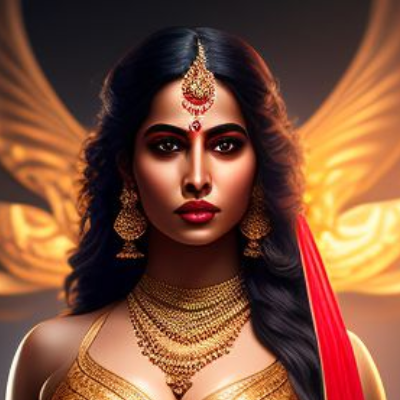
About
Hema — Celestial Apsara, Consort of Maya and Mother of Mandodari
Hema · Hemaa · Hema Apsara
Hema is a celestial Apsara in the Hindu scriptural tradition whose most consequential identity is as the wife of Maya — the supreme Asura architect, master of illusion, and greatest builder of the three worlds — and as the mother of Mandodari, who became the principal queen of Ravana, the ten-headed demon king of Lanka and the central antagonist of the Ramayana. Through this maternal relationship, Hema stands at a pivotal genealogical node: her daughter Mandodari is described across multiple sources as one of the five most virtuous women in the tradition, a figure of extraordinary piety and moral dignity whose husband is the greatest villain of the Ramayana epic. Hema also appears in the Mahabharata and in Puranic enumerative catalogues as a member of Indra's celestial court, and certain passages connect her to the sage Vishvamitra in a narrative episode separate from her marriage to Maya. She appears most substantially in the Uttara Kanda of the Valmiki Ramayana, the Brahma Purana, the Skanda Purana, and certain recensions of the Brahmanda Purana, as well as in enumerative passages of the Mahabharata. The question of whether the Hema who is Maya's wife and the Hema associated with Vishvamitra in the Mahabharata are the same figure or two distinct ones is addressed in the textual variants section.
✦ The Name
The name Hema is a Sanskrit word meaning gold or golden, derived from the root hema or heman, which denotes the metal gold and by extension anything possessing golden colour, golden radiance, or supreme value. Gold in the classical Indian aesthetic and theological imagination carries a dense cluster of associations: it is the colour of the sun, the symbol of divine luminosity, the material of the highest ornaments, and a marker of beauty, purity, and cosmic auspiciousness. A woman named Hema is therefore one whose beauty is figured as golden — radiant, precious, and of the highest conceivable order. This naming convention is consistent with the broader practice in the tradition of giving Apsaras names that encode the quality of beauty they embody. The name appears in other scriptural contexts as an element in compound names such as Hemavati and Hemalata, and as a standalone name for figures other than the Apsara, requiring care in distinguishing usages. No major epithets or alternative personal names specific to Hema the Apsara are recorded in the primary sources consulted.
✦ Lineage and Relationships
- Celestial class: Hema belongs to the Apsaras, the class of divine nymphs whose collective genealogy in Puranic schemes is traced either to the Samudra Manthan — the churning of the cosmic ocean performed by the gods and demons to obtain the nectar of immortality — or to descent from the progenitor sage Kashyapa by his wife Pradha, herself a daughter of Daksha, the Prajapati appointed by Brahma to oversee the generation of created beings. Neither account is applied specifically to Hema by name in the primary sources.
- Court affiliation: Indra, king of the gods and ruler of Svarga, the celestial realm. Hema is named among the Apsaras of his court in Mahabharata and Puranic passages describing the divine assembly.
- Husband: Maya, also known as Mayasura or Maya Danava, the supreme architect and craftsman of the Asuras — the demon class — and the greatest builder and artificer in the three worlds. Maya is described across the Mahabharata, the Ramayana, and the Puranas as the Asura counterpart to Vishvakarma, the divine craftsman of the gods, and as possessing unrivalled skill in construction, illusion, and the creation of magical structures. He is the builder of the celestial city of the Asuras, and in the Mahabharata he constructs the magnificent assembly hall of the Pandavas at Indraprastha as a gift to Arjuna. His marriage to the Apsara Hema represents a union between the celestial nymph class and the Asura architect lineage.
- Daughter: Mandodari, who becomes the principal wife and chief queen of Ravana, the ten-headed Rakshasa king of Lanka and the principal antagonist of the Valmiki Ramayana. Mandodari is consistently described as a woman of great virtue, beauty, and wisdom, and is counted among the Panchakanya — the five supremely virtuous women of the tradition — alongside Ahalya, Draupadi, Kunti, and Tara.
- Sons: Mayavi and Dundubhi, two demon sons born to Hema and Maya. Both are described as powerful beings whose episodes appear in the Ramayana tradition. Dundubhi is particularly significant in the Kishkindha Kanda of the Ramayana, where his skeleton is encountered by Rama, and his earlier defeat at the hands of the Vanara king Vali is described as evidence of Vali's extraordinary strength.
✦ The Marriage of Hema and Maya
The union between the Apsara Hema and the Asura architect Maya is recorded in the Uttara Kanda of the Valmiki Ramayana and elaborated in certain Puranic sources. Maya, whose skills in architecture and illusion made him the supreme craftsman of the Asura world, took Hema — a celestial nymph of the heavenly court — as his wife. The texts do not describe the circumstances of their meeting or courtship in extended narrative detail, presenting the marriage as an established fact within the genealogical framework of the Ramayana world rather than as an episode requiring narrative elaboration. Their union is notable as an instance of cross-class marriage between the celestial nymph community and the Asura architect lineage, a combination that produced offspring of remarkable qualities: a daughter of supreme virtue and beauty in Mandodari, and sons of formidable demonic power in Mayavi and Dundubhi.
Maya is a figure of considerable importance across multiple texts. In the Mahabharata he constructs the Pandava assembly hall at Indraprastha — a structure of such beauty and magical ingenuity that it deceived even the eyes of the gods — as a gift of gratitude to Arjuna, who had protected him during the burning of the Khandava forest. In the Ramayana he is identified as the father of Mandodari and the father-in-law of Ravana. In certain Puranic accounts he is credited with the construction of the golden city of Lanka itself, which Ravana later acquired. The marriage of such a figure to an Apsara of Indra's court reflects the tradition's consistent representation of the Asura world as possessing its own forms of celestial connection and aesthetic refinement, distinct from but parallel to the divine realm of the Devas.
✦ Mandodari — Daughter of Hema
Hema's most consequential contribution to the scriptural tradition is as the mother of Mandodari. The name Mandodari means one with a slender or soft belly — from manda meaning soft or gentle and udari, a feminine form related to the belly or abdomen — and carries connotations of graceful physical beauty. Mandodari is described in the Valmiki Ramayana and across the Puranic tradition as a woman of extraordinary beauty, intelligence, and virtue. She is counted among the Panchakanya — the five supremely pure women whose very names, when recited in the morning, are said to dispel sin — a list that places her alongside Ahalya the wife of the sage Gautama, Draupadi the wife of the five Pandavas, Kunti the mother of the Pandavas, and Tara the wife of the Vanara king Vali.
Mandodari's marriage to Ravana made her the chief queen of Lanka, and throughout the Ramayana she is depicted as a voice of wisdom and moral clarity within Ravana's court. She repeatedly counselled Ravana to return Sita — the abducted wife of the prince Rama, who was the seventh avatar of Vishnu — to her husband and to seek peace rather than war. Her advice was consistently rejected by Ravana, and her distress at his obstinacy and its consequences is described with considerable sympathy in Valmiki's account. After Ravana's death at the hands of Rama, Mandodari's lamentation over her husband's body is one of the most moving passages in the Uttara Kanda, in which she mourns not only his death but the pride and desire that brought him to ruin despite his extraordinary qualities. Following Ravana's death, certain textual traditions describe Mandodari being taken in marriage by Vibhishana — Ravana's virtuous younger brother who had defected to Rama's side — though this detail is not uniformly present across all recensions.
Mandodari's virtue is theologically significant in the tradition precisely because it exists within the most adverse possible context: she is the wife of the greatest demon of the age, living in a kingdom built on transgression and violence, yet she maintains her moral clarity, her devotion to dharma, and her compassion throughout. Her inclusion in the Panchakanya alongside figures from the epic tradition's most celebrated households reflects the tradition's recognition that virtue is not a function of one's circumstances or one's husband's character but of one's own inner commitment to righteousness. As the daughter of the Apsara Hema, Mandodari's beauty is her celestial inheritance; her virtue is her own achievement.
✦ Mayavi and Dundubhi — Sons of Hema
Hema and Maya's two sons, Mayavi and Dundubhi, are described as powerful demons who appear in the narrative of the Ramayana tradition, though neither approaches the significance of their sister Mandodari. Dundubhi is the more narratively prominent of the two brothers in the primary texts. He was a demon of enormous size and strength, described in the Kishkindha Kanda of the Valmiki Ramayana as having taken the form of a mighty buffalo or possessing buffalo-like power. Dundubhi challenged the Vanara king Vali — the eldest son of Indra and king of the monkey city of Kishkindha — to single combat. Vali defeated and killed Dundubhi with his bare hands, lifting his body and hurling it with such force that it flew through the air and fell near the hermitage of the sage Matanga. The blood that fell from Dundubhi's body as it was thrown defiled the hermitage, causing the sage Matanga to pronounce a curse that Vali could never enter that forest region without dying. The skeleton of Dundubhi is later encountered by Rama and Sugriva — Vali's exiled younger brother who becomes Rama's ally — and Rama's ability to kick the skeleton a great distance with his foot serves as a demonstration of his strength to Sugriva, who had doubted whether a human prince could match Vali. This episode is structurally significant in the Kishkindha Kanda as it establishes the basis of the alliance between Rama and Sugriva and explains the curse that restricts Vali's movements. Dundubhi's identity as a son of Maya and Hema is stated in these contextual passages.
Mayavi, the other son of Hema and Maya, appears in a separate but related episode also involving Vali. Mayavi challenged Vali to combat and, when Vali pursued him, fled into a cave in the earth. Vali followed him into the cave, instructing his brother Sugriva to wait at the entrance. After a long period with no sign of Vali, blood flowing from the cave's mouth led Sugriva to conclude that Vali had been killed. Sugriva sealed the cave entrance and returned to Kishkindha, where the Vanara community installed him as king in Vali's assumed absence. In fact Vali had killed Mayavi and eventually escaped from the cave, returning to Kishkindha to find Sugriva installed as king. Vali, enraged at what he took to be Sugriva's betrayal and usurpation, attacked and exiled his brother, took Sugriva's wife Ruma, and banished him from the kingdom. This chain of events — originating in Mayavi's challenge and Vali's pursuit — is the direct cause of the enmity between Vali and Sugriva that forms the political backdrop of the Kishkindha Kanda and that leads Sugriva to seek Rama's help. Mayavi's role, while brief, thus initiates the sequence of events that shapes the entire Kishkindha episode of the Ramayana.
✦ Hema and the Sage Vishvamitra
The Mahabharata contains a passage in which an Apsara named Hema is described in connection with the sage Vishvamitra — a royal sage originally of the Kshatriya warrior class who pursued intensive austerities over many years in pursuit of the highest rank of sagehood. In the Mahabharata's account of Vishvamitra's long biography, multiple Apsaras are described as having been involved in episodes that interrupted his tapas at different stages of his journey. The Apsara Hema is named as one who lived with Vishvamitra for a period of five years, during which the sage remained absorbed in pleasure rather than austerities. At the end of this period, Vishvamitra resumed his austerities with renewed determination.
This episode is distinct from the more celebrated account of the Apsara Menaka's disruption of Vishvamitra's tapas, which produced the daughter Shakuntala and which is narrated at considerably greater length in the Mahabharata's Adi Parva. The Hema episode and the Menaka episode are placed at different points in Vishvamitra's biography and are presented as separate events. Whether the Hema of this Mahabharata episode is the same figure as the Hema who is Maya's wife and Mandodari's mother is not stated in any primary source consulted, and this question is addressed directly in the textual variants section below.
✦ Enumerative Appearances
Beyond her narrative episodes, Hema appears in several enumerative passages across the primary sources. In the Mahabharata's Sabha Parva she is named among the Apsaras who populate Indra's celestial court in descriptions of the divine assembly's splendour. The Anushasana Parva includes her name in catalogues of the Apsaras enumerated in connection with descriptions of the celestial world and the rewards of righteous conduct. In Puranic texts including certain recensions of the Matsya Purana and the Brahmanda Purana she appears in lists of the principal Apsaras alongside Rambha, Urvashi, Menaka, Tilottama, Ghritachi, and others. The Uttara Kanda of the Valmiki Ramayana, beyond its genealogical reference to her as Maya's wife, also includes her name in passages describing the Apsaras of the celestial world. These appearances collectively confirm her established canonical membership within the community of Apsaras associated with Indra's court.
✦ Textual Variants and Inconsistencies
The primary textual question surrounding Hema is whether the Apsara named Hema who is identified as Maya's wife and Mandodari's mother in the Ramayana tradition is the same figure as the Apsara named Hema who is described in the Mahabharata as having lived with the sage Vishvamitra for five years. The primary sources do not explicitly address this question. They do not state that the two Hemas are the same figure, nor do they state that they are distinct. The two bodies of information about Hema come from different texts — the Ramayana tradition for her marriage to Maya, and the Mahabharata for her association with Vishvamitra — and neither text cross-references the other's account.
Given that Apsaras are celestial beings not bound by the constraints of mortal biography and not limited in their associations to a single figure or episode, it is entirely consistent within the tradition's logic for a single Apsara named Hema to have had a period of association with Vishvamitra in the mortal world and also to have entered into a more permanent conjugal union with Maya. The tradition does not require these to be treated as contradictions. At the same time, the name Hema is not so rare or distinctive that it could not have been applied to two separate minor celestial figures in two independent textual traditions. In the absence of explicit identification across sources, the most responsible position is to present both bodies of evidence while acknowledging that their connection cannot be confirmed from the primary texts alone.
A further variant concerns the parentage of Mandodari in certain regional and Puranic accounts. While the predominant tradition — represented by the Uttara Kanda of the Valmiki Ramayana and by major Puranic sources — names Hema as Mandodari's mother, a small number of regional traditions and later devotional texts give alternative accounts of Mandodari's origin. Some of these present Mandodari as having been born through other circumstances, including one tradition in which she arose from a frog transformed by the sage Galava. These variant accounts are peripheral to the main tradition and are not supported by the major primary sources. The Hema-Maya-Mandodari lineage as recorded in the Uttara Kanda and the principal Puranas represents the most consistent and authoritative account available.
The Uttara Kanda itself, it should be noted, is regarded by some scholars as a later addition to the Valmiki Ramayana rather than part of its original composition, and the genealogical material it contains — including the account of Hema's marriage to Maya — may represent a layer of the tradition that was developed after the core epic narrative. This does not diminish the authority of the account within the tradition as a whole, since the Uttara Kanda has been accepted as canonical across the major recensions of the Ramayana, but it is relevant context for understanding the textual stratigraphy of the material.
✦ Theological and Philosophical Significance
Hema's theological significance is primarily mediated through her daughter Mandodari. As the celestial mother of one of the Panchakanya, Hema stands as the origin point of a lineage in which divine beauty — her own golden Apsara nature — is transmitted to a daughter who embodies it in the most theologically charged possible setting: the court of the demon king. Mandodari's virtue within Ravana's Lanka is made more remarkable, not less, by the recognition that she inherited the luminous beauty of a celestial mother, since that beauty could so easily have been corrupted or misdirected in such surroundings. Instead it remained aligned with dharma, wisdom, and compassion. In this sense Hema's contribution to the Ramayana's moral architecture is carried entirely through Mandodari.
The marriage of Hema to Maya also carries a theological dimension: it represents a union between the celestial beauty of the divine nymph world and the supreme craft and illusory power of the Asura architect. Their three children — a daughter of supreme virtue and two sons of formidable but ultimately destructive power — embody the full range of possibilities produced by this combination. Beauty and craft together can produce wisdom and righteousness, as in Mandodari, or they can produce strength that ultimately serves no higher purpose, as in Mayavi and Dundubhi, whose power leads only to destruction.
✦ Connection to the Wider Genealogy
Hema's genealogical significance is concentrated in her children and their connections to the major dynastic and narrative lineages of the epics. Through her daughter Mandodari's marriage to Ravana, Hema becomes the maternal grandmother of Ravana's sons by Mandodari — including Meghanada, also called Indrajit, the greatest warrior of Lanka who defeated Indra himself in battle and who is one of the most formidable opponents faced by Rama's forces in the Ramayana war. Ravana himself is the grandson of the sage Pulastya — one of the ten Prajapatis or mind-born sons of Brahma — through Pulastya's son Vishrava, making the lineage into which Mandodari married one of considerable Brahminic genealogical distinction despite its demonic character. The Rakshasa royal family of Lanka thus sits at the intersection of Brahminic sage descent on Ravana's side and the Asura architect and Apsara lineages on Mandodari's side through Hema and Maya.
Through her sons Dundubhi and Mayavi, Hema is indirectly connected to the Vanara lineage as well: Dundubhi's death at Vali's hands and the subsequent events involving Mayavi and Vali together form the chain of cause and effect that produces the enmity between Vali and Sugriva, which in turn leads Sugriva to seek Rama's alliance and ultimately enables the recovery of Sita and the defeat of Ravana. In this way Hema's sons, despite their own destruction, are instruments in the narrative mechanism that drives the Ramayana toward its resolution.
Maya himself belongs to the Danava lineage — the class of Asuras descended from the progenitor sage Kashyapa by his wife Danu, a daughter of Daksha. This places Maya's children, including Mandodari, within the broad genealogical tree rooted in Kashyapa, whose progeny in the Puranic framework encompass virtually every class of being in the cosmos. As an Apsara, Hema is herself placed in some Puranic genealogical schemes within Kashyapa's lineage through a different wife, Pradha, so that both parents of Hema's children may ultimately be traced to the same great progenitor by different lines — a genealogical convergence characteristic of the Puranic tradition's tendency to anchor all cosmic lineages in a small number of foundational figures.
✦ References
- Primary Sources
- Valmiki Ramayana, Uttara Kanda: Principal source for Hema's identity as Maya's wife and the mother of Mandodari, Mayavi, and Dundubhi; contains the genealogical statements that establish her family relationships within the Ramayana world.
- Valmiki Ramayana, Kishkindha Kanda: Contains the episodes of Dundubhi's defeat and death at Vali's hands and Mayavi's challenge to Vali that leads to the estrangement of Vali and Sugriva; identifies both as sons of Maya without always explicitly naming Hema as their mother in all recensions, but establishing the paternal lineage that connects to her.
- Mahabharata, Adi Parva: Contains the account of Vishvamitra's long biography including the episode in which an Apsara named Hema lives with him for five years; also contains material on Maya as the builder of the Pandava assembly hall at Indraprastha, establishing his character and significance independently of his Ramayana role.
- Mahabharata, Sabha Parva: Names Hema among the Apsaras of Indra's celestial court in enumerative descriptions of the divine assembly; also contains the description of the assembly hall built by Maya for the Pandavas.
- Mahabharata, Anushasana Parva: Includes Hema in catalogues of the Apsaras of the celestial realms in passages dealing with the inhabitants of Svarga and the rewards of righteous conduct.
- Brahma Purana: Contains Puranic genealogical material identifying Hema as the mother of Mandodari and establishing the Maya-Hema family lineage within the broader Puranic genealogical framework.
- Skanda Purana: Includes accounts relevant to Maya's family and Mandodari's parentage, supplementing the Ramayana's genealogical statements with Puranic elaboration.
- Brahmanda Purana: Names Hema in Puranic catalogues of the Apsaras and contains relevant genealogical material on the Asura lineages that contextualise Maya's family.
- Matsya Purana: Includes Hema among enumerative lists of the principal Apsaras of the celestial court.
- Secondary Sources
- Mani, Vettam. Puranic Encyclopaedia. Motilal Banarsidass, 1975: Provides reference entries on Hema, Maya, Mandodari, Dundubhi, and Mayavi, identifying their family relationships and principal textual appearances and serving as a key cross-referencing tool for the connections between these figures.
- Dowson, John. A Classical Dictionary of Hindu Mythology. Trubner and Co., 1879: Contains entries on Maya and Mandodari identifying their principal textual sources and genealogical relationships, with relevant context for Hema's role as Maya's wife.
- Goldman, Robert P., and Sally J. Sutherland Goldman (trans.). The Ramayana of Valmiki, Vol. IV (Kishkindhakanda). Princeton University Press, 1994: Scholarly translation and annotation of the Kishkindha Kanda, providing textual and contextual analysis of the Dundubhi and Mayavi episodes in which Hema's sons appear.
- Monier-Williams, Monier. A Sanskrit-English Dictionary. Clarendon Press, 1899: Provides etymological analysis of the Sanskrit root hema and its derivatives, establishing the meaning and aesthetic connotations of the name.
- Ganguli, Kisari Mohan (trans.). The Mahabharata of Krishna-Dwaipayana Vyasa. 1883–1896: Full translation of the Mahabharata including the Vishvamitra narrative sections in the Adi Parva and the Sabha Parva account of Maya's assembly hall, providing accessible English rendition of the primary source material relevant to both dimensions of Hema's identity.