
About
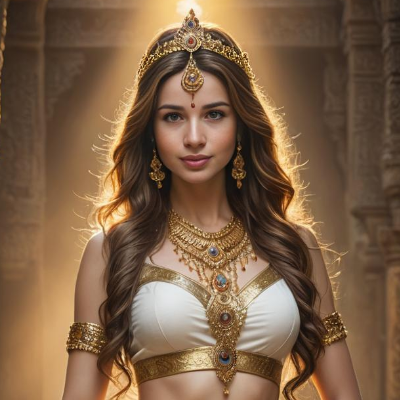
Romasha — Daughter of Brihaspati, Wife of King Swanaya, and Sage of the Rigvedic Tradition
Romasha · Romashaa · Brihaspatikanya · Swanaya-patni · Rigveda-drishta · Brahmavadini
Romasha is the daughter of Brihaspati — the divine preceptor of the gods, son of Angiras, and the deity identified with Jupiter — and the wife of King Swanaya, a figure identified in certain Vedic texts as a generous and learned king who subsequently became a rishi and lived a pious life alongside Romasha. She is a Brahmavadini — a woman of sacred learning who herself composed or is associated with hymns in the Vedic tradition — and her name appears in the Rigveda in the context of her learning and her distinctive physical description. The HinduPad source identifies her as a pure and chaste woman who shared her vast knowledge with others and who was known for selfless service and sincere devotion to Shiva. Her name Romasha is connected in the tradition to the word roma — body hair, specifically the fine hair that covers the body — and the tradition's description of her physical appearance as one covered with hair rather than with conventional clothing is a distinctive and unusual biographical feature that the primary texts preserve. She is a minor figure in terms of the extent of her primary source attestation, but her identity as Brihaspati's daughter, her Brahmavadini status, and her Rigvedic presence give her a biographical position of genuine interest within the broader framework of the Brihaspati family and the tradition of learned women in the Vedic canon.
✦ The Name
The name Romasha derives from the Sanskrit roma — body hair, the fine hair covering the skin — combined with the suffix sha or with the adjectival form romasha meaning "hairy," "covered with hair," or "possessing much hair." The name thus directly designates its bearer as one associated with hair in an unusual degree — whether this refers to abundant bodily hair, to the long hair of a forest ascetic, or to some other physical characteristic that distinguished her is not elaborated with full consistency across the texts that mention her. The tradition's description of her as covering her body with her own hair rather than with conventional garments reflects the ascetic mode of dress — or undress — characteristic of certain classes of forest sages and female ascetics in the tradition, and gives Romasha a profile consistent with the learned forest woman rather than the court lady or the conventional sage's wife. The patronymic Brihaspatikanya means "daughter of Brihaspati." Swanaya-patni means "wife of Swanaya." Brahmavadini means "one who speaks of Brahman" — the traditional designation for women of the Vedic period who engaged in sacred learning and philosophical inquiry as a primary vocation.
✦ Lineage
- Father: Brihaspati — the divine preceptor of the gods, son of Angiras, lord of sacred speech and wisdom. His profile is given separately in this series. Romasha as Brihaspati's daughter is thus the sister of Kacha — who appears in the same series — and the half-sister of Bharadvaja in the Brihaspati family. Through her father she descends from the Angirasa lineage and through it from Angiras and the primordial creative line of Brahma.
- Husband: King Swanaya — described in the HinduPad source and in the Rigvedic tradition as a king known for his generosity, kindness, and affection toward others, who subsequently became a rishi and lived a pious life alongside Romasha. The name Swanaya means "he of the dog's conduct" or "the one guided by the dog's virtues" — in some interpretations a name of unexpected positive qualities, since the dog in the Vedic tradition could represent loyalty, vigilance, and devoted service. Swanaya's name appears in the Rigvedic dana-stuti tradition — the praise of generous kings by Vedic poets — and the sources that name him associate him specifically with Romasha as a couple of joint ascetic and devotional life. He is identified in some accounts as the king whose generosity was praised in Kakshivat's dana-stutis in the first Mandala of the Rigveda — connecting Romasha's husband to the hymn-composing tradition of the same Angirasa lineage to which Romasha belongs through her father Brihaspati.
- Brother: Kacha — the son of Brihaspati who acquired the Mritasanjivani from Shukracharya and whose profile is given separately in this series.
- Half-brother: Bharadvaja — the son of Brihaspati and the founder of the Bharadvaja gotra, whose profile is given separately in this series.
- The primary sources do not record children of Romasha and Swanaya with any specificity.
✦ Romasha in the Rigvedic Tradition
Romasha's most significant attestation in the primary sources is in the Rigvedic tradition. The Rigveda's anukramani tradition — the index of hymn composers and their associated deities — mentions Romasha in the context of learned women who either composed hymns or are associated with specific hymnic passages. The Rigvedic passage most consistently associated with Romasha is in the eighth Mandala and concerns a dialogue or exchange in which Romasha's learning and her distinctive physical appearance are both referenced. The tradition identifies her as one of the Brahmavadini — the category of Vedic women who pursued sacred learning as their primary vocation, who engaged in philosophical inquiry and debate, and who contributed to the Vedic intellectual tradition as named participants rather than as anonymous beneficiaries of a male-dominated learning culture.
The tradition of the Brahmavadini in the Vedic period includes several named women — Gargi, Maitreyi, Lopamudra, Godha, Vishvavara, and others — who are preserved in the Rigveda and the Upanishadic literature as figures of genuine intellectual standing. Romasha's inclusion in this category, combined with her identification as Brihaspati's daughter, gives her a position in the tradition's account of women's intellectual and spiritual achievement as the daughter of the divine lord of sacred learning who herself pursued that learning as her vocation.
✦ The Physical Description and Its Significance
The tradition's description of Romasha as covered with hair and wearing no conventional clothing is a feature that places her in the specific category of the female forest ascetic whose renunciation of conventional dress was a mark of her renunciation of the social world more broadly. The Sanskrit tradition knows several categories of ascetic women whose physical appearance marked their vocation — the matted hair of the sannyasini, the ash-covered body of certain Shaiva female practitioners, and the hair-covered form are all physical expressions of a specific relationship to the social world. Romasha's hair-covered form, combined with her identity as Brihaspati's daughter and a Brahmavadini, suggests a figure who combined the divine intellectual inheritance of the divine preceptor's household with the ascetic renunciation of the forest sage — a combination that the tradition regards as one of the most complete possible expressions of the sacred feminine.
Her husband Swanaya's own transformation from king to rishi — a transition from the royal active life to the contemplative ascetic life — is consistent with this portrait of a household in which both members moved toward increasing renunciation and spiritual depth rather than toward worldly accumulation.
✦ Romasha's Devotion to Shiva
The HinduPad source specifically identifies Romasha's devotion to Shiva as one of her defining characteristics — she is remembered in the tradition for her sincere devotion to Mahadeva alongside her selfless nature and her sharing of sacred knowledge with others. This Shaiva devotional dimension of her biography connects her to the broader tradition of women whose spiritual identity was centred on Shiva worship, which is one of the most widespread and ancient devotional traditions of the Indian subcontinent. As the daughter of Brihaspati — who in the Shaiva tradition attained his position as Devaguru through austerities at Shiva's presence — Romasha's own devotion to Shiva would represent a continuation of the family's Shaiva orientation into the daughter's generation.
✦ Textual Variants and Inconsistencies
The primary textual limitation in Romasha's profile is the limited and somewhat diffuse nature of her attestation. The HinduPad source identifies her as Brihaspati's daughter and Swanaya's wife consistently. The Rigvedic anukramani tradition preserves her name in the context of learned women. No major Mahapuranic text gives her an extended independent narrative comparable to those of the tradition's principal figures. The details of her biography — the hair-covering, the devotion to Shiva, the life alongside Swanaya-turned-rishi — are consistent across the secondary sources consulted but are derived from a relatively small number of primary passages. This profile is accordingly proportionate to the available evidence.
✦ Theological and Philosophical Significance
Romasha's theological significance is concentrated in her identity as a Brahmavadini — a woman of genuine sacred learning in the Vedic tradition whose intellectual achievement is recognised in the tradition's own canonical record of learned women. As the daughter of Brihaspati the lord of sacred speech and learning, her vocation of sacred knowledge is the most natural possible expression of her inheritance — the daughter of the divine teacher who herself became a teacher. The tradition's preservation of her name alongside those of Gargi, Maitreyi, and the other celebrated Brahmavadini women is the most significant indicator of her standing in the tradition's account of women's intellectual and spiritual contribution to the Vedic world.
✦ Connection to the Wider Genealogy
Through her father Brihaspati and grandfather Angiras, Romasha descends from the primordial creative line of Brahma through the Angirasa lineage. Through her brother Kacha she is connected to the Mritasanjivani tradition and to the Devayani-Yayati genealogical chain. Through her half-brother Bharadvaja she is connected to the Bharadvaja gotra tradition and through Bharadvaja's son Drona and grandson Ashvatthama to the Mahabharata's central martial lineages. Through her husband Swanaya — if the identification with the patron king of Kakshivat's Rigvedic dana-stutis is accepted — she is connected to the Angirasa hymn-composing tradition through the social relationship between the king and the sage-poet. Romasha's position in the family of Brihaspati thus places her at the junction of the divine preceptor's tradition and the sacred feminine tradition of the Brahmavadini, with connections through her brothers and half-brothers to some of the most significant genealogical and narrative threads of both the Ramayana and Mahabharata traditions.
✦ References
Primary Sources
- Rigveda, Mandala 1, hymns associated with Kakshivat (for the Swanaya connection): The dana-stuti passages that reference King Swanaya as a generous patron; relevant to the identification of Romasha's husband and her connection to the Rigvedic social world of king-sage relationships.
- Rigveda, Mandala 8, passages associated with Romasha in the anukramani tradition: The Rigvedic passages in which Romasha's name appears in connection with sacred learning and the Brahmavadini tradition; the primary Vedic source for her identity as a woman of sacred learning.
- Rigvedic anukramani (Katyayana's Sarvanukramani and related texts): The traditional Vedic indices that preserve Romasha's name in the catalogue of women associated with specific hymns or passages in the Rigveda.
Modern Reference Works
- Vettam Mani, Puranic Encyclopaedia (1975): Entry on Romasha; identifies her as Brihaspati's daughter, Swanaya's wife, and a figure of the Rigvedic Brahmavadini tradition.
- A. A. Macdonell and A. B. Keith, Vedic Index of Names and Subjects (1912): Entry on Romasha; establishes the Vedic background of the figure and her position within the tradition of named women of sacred learning in the Rigvedic corpus.
- Stephanie Jamison and Joel Brereton (translators), The Rigveda: The Earliest Religious Poetry of India (2014): The most authoritative recent English-language critical translation of the Rigveda; provides the scholarly context for the Brahmavadini tradition and the passages associated with women of sacred learning including Romasha.