
About
Bhava — King of the Indus Region, Father of Swanaya, and Mortal Subject of Rigveda 1.126
Bhava · Bhavayavya · Swanaya-pita · Sindhu-tata-naresh · Rigveda-stavita · Dana-rajah
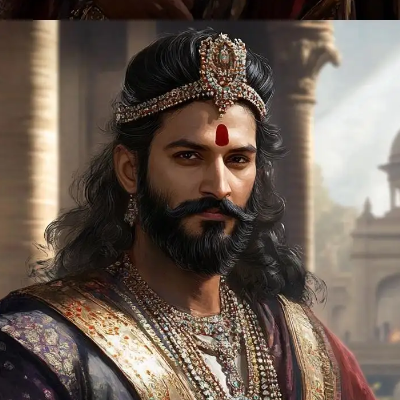
Bhava — also called Bhavayavya, meaning "descendant of Bhava" or "he of the Bhava lineage" — is a king of the Indus region in the Rigvedic period, the father of Swanaya, and one of the very few mortal human beings in the entire Rigvedic corpus to be the direct subject of a dedicated hymn. Rigveda 1.126 is the hymn dedicated to Bhava — a dana-stuti celebrating his generosity and his quality as a royal patron of the brahminical sacred tradition. Together with the preceding hymn Rigveda 1.125 — dedicated to his son Swanaya — the two form one of the most unusual consecutive pairings in the first Mandala: a father and son, both mortal kings of the Indus region, both honoured with dedicated hymns in the same section of the Rigveda's first book. The DBpedia entry on Bhava specifically notes that these two hymns are among the very few in the entire Rigveda dedicated to mortals, making Bhava and Swanaya together a distinctively rare pair in the tradition's canonical record. Bhava's association with the Indus river region — the great river of the northwestern subcontinent that was the geographical centre of the early Vedic world — places him in the heartland of the tradition's most ancient social and religious geography. He appears in Rigveda 1.126 and the associated anukramani tradition and is identified as Swanaya's father in the DBpedia and Macdonell-Keith Vedic Index sources.
✦ The Names
The name Bhava is one of the most fundamental and widely used words in the Sanskrit tradition — it derives from the root bhu, to be, to become, to exist, and carries the meanings of being, existence, becoming, welfare, and auspiciousness. As a personal name it designates "the existent one," "the auspicious being," or "he who truly is" — a name of ontological weight that in the tradition is also one of the epithets of Shiva as the ultimate being. Whether the king's name carried a specific Shaiva devotional connotation or simply used the root word's most general sense of being and auspiciousness cannot be established from the primary sources with certainty, but the name's resonance with the Shaiva tradition is a persistent background note in his nomenclature. The alternative designation Bhavayavya is a patronymic or clan name meaning "descendant of Bhava" — which when applied to Bhava himself functions as a tribal or lineage designation indicating his membership in a royal family whose ancestor was a figure named Bhava. The designation Sindhu-tata-naresh means "king of the Indus bank." Dana-rajah means "the royal giver" — the generous king.
✦ Lineage
- Paternal grandfather: Uttanapada — son of Svayambhuva Manu, the first Manu; father of the celebrated Dhruva, the devotee of Vishnu who became the Pole Star.
- Father: Dhruva — son of Uttanapada and his queen Suniti; the royal prince who, after being spurned by his stepmother Suruchi, performed intense austerities in the forest and was granted by Vishnu the imperishable station of the Pole Star (Dhruva Nakshatra). The Vishnu Purana (Book I, Chapter XIII) names Bhavya as one of the two sons of Dhruva by his wife Shambhu, the other being Slishti.
- Mother: Shambhu — wife of Dhruva; named in the Vishnu Purana as the mother of Bhavya and Slishti. No further details about her are recorded in the available sources.
- Brother: Slishti — the other son of Dhruva and Shambhu; father of five virtuous sons — Ripu, Ripunjaya, Vipra, Vrikala, and Vrikatejas — from whose line descended the Chakshusha Manu and ultimately the lineage that included the king Anga and through him the birth of Vena and Prithu.
- Identity with the Rigvedic Bhava/Bhavayavya: The Bhavya of the Vishnu Purana's Dhruva genealogy is identified in secondary scholarly tradition as the same figure as the king Bhava — also called Bhavayavya, meaning "the majestic or prosperous one" — who appears in Rigveda Mandala 1, Hymn 126, as the husband of Romasha and the father of Svanaya. The patronymic Bhavayavya applied to Svanaya in the Rigveda means "son of Bhavya," directly connecting the Rigvedic designation to the Puranic lineage. This identification is attested in the commentarial and secondary scholarly tradition, including the analysis of Sayana and modern scholars drawing on the Brihaddevata; it is presented here as a well-supported identification, noting that the primary texts themselves do not explicitly cross-reference the Puranic and Rigvedic accounts.
- Wife: Romasha — daughter of Brihaspati, the divine preceptor of the gods; Brahmavadini and composer of Rigveda 1.126.7. Sayana's commentary confirms Romasha as the wife of Bhavayavya (Bhavya). Romasha spoke directly in the Rigvedic hymn to assert her identity and worth when her husband initially regarded her as too young for full conjugal life.
- Son: Svanaya — king eulogised in Rigveda 1.125 for his extraordinary generosity to the sage Kakshivat. Sayana's commentary on Rigveda 1.125.1 identifies Svanaya explicitly as the son of Bhavayavya. Svanaya's full Rigvedic designation — Svanaya Bhavayavya — is a name-plus-patronymic construction meaning "Svanaya, son of Bhavya."
- Daughters: Ten daughters of Svanaya — Bhavya's granddaughters and Romasha's granddaughters — given by Svanaya in marriage to the sage Kakshivat, eldest son of Dirghatamas, along with lavish gifts of gold, horses, cattle, and chariots. Sayana's commentary on Rigveda 1.125.1 states this explicitly: it was Svanaya, not Bhavya, who bestowed the marriages and gifts.
✦ Rigveda 1.126 — the Hymn of Bhava
Rigveda 1.126 is the hymn dedicated to Bhava — a dana-stuti in the classic tradition of Rigvedic royal praise. The dana-stuti genre — as discussed in the Kakshivat and Swanaya profiles in this series — is the form in which Vedic sage-poets praised the generous gift-giving kings who supported the brahminical sacred tradition, recording both the specific gifts received and the celebration of the king's generosity as a cosmic virtue. The attributions within the anukramani tradition for RV 1.126 connect it to the same Angirasa-Kakshivat hymn-composing tradition that produced the adjacent hymn RV 1.125 for Swanaya, reinforcing the editorial logic of the consecutive placement.
The DBpedia source's description of Bhava as a king who "lived on the banks of the Indus and is eulogised" in RV 1.126 gives his geographical identity its primary definition. The Indus — called Sindhu in Sanskrit — was the most important river of the early Vedic world and the one whose basin contained the heartland of the Vedic settlements as evidenced by the Rigveda's own geographical references. A king of the Indus bank in the Rigvedic period was thus a king of the most central and historically significant region of the early Vedic world — his territory was not a peripheral or marginal zone of the Vedic cultural sphere but its geographical nucleus.
The specific content of RV 1.126 — what Bhava gave to the poet and what qualities of the king are celebrated — is preserved in the hymn's verses. The dana-stuti tradition typically records specific gifts: chariots, horses, cattle, gold, and slave women were the standard categories of royal generosity recorded in these hymns. The celebration of Bhava's specific gifts in this hymn was the mechanism by which his reputation for generosity was transmitted across generations — the king who gave to the brahmin received in return the permanent record of that giving in the most authoritative of all text-forms: the Vedic hymn whose preservation was guaranteed by its inclusion in the canonical collection.
✦ The Father-Son Pair in the Rigveda — a Unique Feature
The consecutive placement of hymns dedicated to Bhava (RV 1.126) and his son Swanaya (RV 1.125) in the first Mandala is a feature of the Rigvedic canon that has attracted the attention of Vedic scholars as an unusual instance of inter-generational commemoration within a single consecutive hymn sequence. The Rigveda's redactors — who organised the hymns within the Mandalas according to specific principles involving the identity of the deity addressed, the metre used, and the family tradition of the composer — placed these two mortal-subject hymns consecutively in a way that preserves the father-son relationship between their respective subjects as a visible structural feature of the canon's organisation. This editorial decision suggests that the tradition understood Bhava and Swanaya as a pair whose joint commemoration was meaningful — not merely two separate figures who happened to be praised in the same Mandala but a family whose generosity and relationship with the Angirasa brahminical tradition warranted recognition as a dynastic unit.
✦ Disambiguation from the Puranic Bhava
The name Bhava is shared across several distinct figures in the Sanskrit canonical tradition. The most significant disambiguation for this profile is from the Puranic Bhava who appears in the Bhagavata Purana and Vishnu Purana as a descendant of Priyavrata — the son of Svayambhuva Manu — through the line that includes Medhatithi and the rulers of Plaksha dvipa. This Puranic Bhava is a cosmological and genealogical figure in the Puranas' account of the division of the earth's territories among Manu's descendants, entirely unrelated to the historical Rigvedic king Bhava of the Indus region who is the subject of this profile. Any reference to "Bhava" in the Puranic genealogical tradition is most likely this Puranic figure rather than the Rigvedic mortal king, and the two must be clearly distinguished in any genealogical reference work.
✦ Textual Variants and Inconsistencies
The name Bhavayavya: The designation Bhavayavya — used in the DBpedia source and in certain Vedic scholarly traditions — functions both as a personal name and as a lineage designation. When it functions as a lineage name it means "the Bhava family" or "the Bhava-descended ones," and the specific individual whom it designates in the context of RV 1.126 is Bhava himself as the founder or senior member of that lineage. The variation between Bhava and Bhavayavya in the scholarly literature reflects different conventions for identifying the figure rather than references to two different kings.
The ordering of hymns 1.125 and 1.126: Rigveda 1.125 is dedicated to the son Swanaya and 1.126 to the father Bhava — the son's hymn comes before the father's in the canonical order. This ordering reflects the Rigvedic redactors' own organisational principles, which did not necessarily follow chronological or generational sequence but followed principles of metre, deity, and the compositional preferences of the specific hymn family's tradition. The reversal of generational order in the consecutive placement — son before father — is a feature of the editorial arrangement rather than an indication of any genealogical uncertainty.
✦ Theological and Historical Significance
Bhava's significance is historical as much as theological — he is one of the very few specifically named mortal individuals of the Rigvedic period whose existence is documented in the primary canonical corpus of the Vedic tradition. The Rigveda as a historical source is primarily a theological document — its hymns are addressed to divine beings and its primary concern is the sacred cosmos rather than the human historical world — and the handful of specifically named mortal individuals who appear as subjects of dedicated hymns are therefore among the most valuable historical witnesses to the social world of the early Vedic period. Bhava as a king of the Indus bank in the early Vedic period — documented in a contemporary canonical text rather than in the retrospective account of a later Purana — is a figure of genuine historical interest alongside his theological significance as a mortal honoured by the same hymnic tradition that primarily celebrated the gods.
✦ Connection to the Wider Genealogy
Through his son Swanaya's marriage to Romasha — the daughter of Brihaspati — Bhava is connected by the affinal relationship of his son's marriage to the Angirasa divine lineage and through it to the primordial creative line of Brahma. Through Romasha's brother Kacha, Bhava's family by affinity is connected to the Mritasanjivani tradition and to the genealogical chain that produced Devayani, Yayati, Yadu, and ultimately Krishna. Through the Kakshivat-Angirasa hymn-composing tradition that commemorated both him and his son in consecutive Rigvedic hymns, Bhava is documented within the social world of the most ancient brahminical poetic tradition. His placement on the banks of the Indus — the river that gave its name to the subcontinent and to the civilisation that developed on its banks — gives his biography a geographical anchoring in the most historically significant waterway of the early Vedic world.
✦ References
Primary Sources
- Rigveda, Mandala 1, hymn 126: The primary and sole major canonical source for Bhava's biography — the dedicated hymn celebrating the king of the Indus region, his generosity, and his relationship with the brahminical sacred tradition as documented by the Angirasa-Kakshivat hymn-composing tradition. One of the very few Rigvedic hymns dedicated to a mortal human being and one of an even rarer consecutive pair of such hymns with the preceding RV 1.125.
- Rigvedic anukramani (Katyayana's Sarvanukramani): The traditional index that attributes RV 1.126 and identifies Bhava as its mortal subject; confirms the genealogical relationship between Bhava and Swanaya through the consecutive placement and attribution of the two hymns.
Modern Reference Works
- A. A. Macdonell and A. B. Keith, Vedic Index of Names and Subjects (1912): Entry on Bhavayavya; establishes the Vedic background of the figure, his geographical association with the Indus bank, his relationship to Swanaya as the father, and his position in the first Mandala's social world as one of the very few mortal subjects of dedicated Rigvedic hymns.
- Stephanie Jamison and Joel Brereton (translators), The Rigveda: The Earliest Religious Poetry of India (2014): Critical translation of the full Rigveda including RV 1.126 with scholarly notes on the dana-stuti genre and the significance of the consecutive mortal-subject hymns; the most authoritative recent English-language treatment of the primary source.
- Wendy Doniger O'Flaherty (translator), The Rig Veda: An Anthology (1981): Contains selected translations with notes relevant to the historical and social context of the dana-stuti tradition and the mortal subjects of Rigvedic hymns.