
About
Vidyutkesa — Rakshasa, Son of Heti, and Progenitor of the Lanka Lineage
Vidyutkesa · Vidyutkesha · Vidyutkeśa · son of Heti
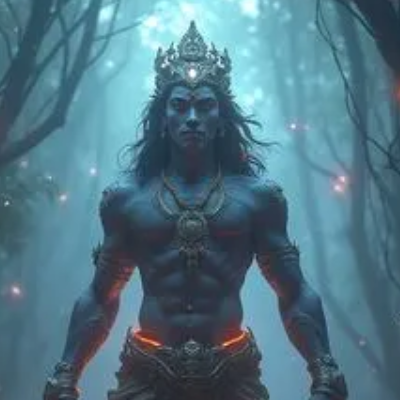
Vidyutkesa is a rakshasa of the second generation of the primordial rakshasa lineage, son of Heti — one of the two first rakshasas created by Brahma — and of Bhaya, a sister of Kala. His narrative appears in the fourth sarga of the Uttara Kanda of the Valmiki Ramayana, which the sage Agastya narrates to Rama in response to Rama's question about the origin of the rakshasas and their former occupation of Lanka. Vidyutkesa is described as radiant and powerful, and his significance in the tradition is genealogical: through his son Sukesa — whom he and his wife abandoned in the Himalayas — the entire rakshasa lineage of Lanka descends, culminating in Malyavan, Sumali, and Mali, and through Sumali's daughter Kaikashi in Ravana himself. Vidyutkesa thus stands as the critical generational bridge between the first rakshasas and the great rakshasa dynasty of Lanka. He appears in the Valmiki Ramayana, the Puranic Encyclopaedia tradition, and is referenced in several secondary Puranic accounts.
✦ The Name
The name Vidyutkesa is a Sanskrit compound of vidyut and kesa. Vidyut means lightning, and kesa means hair. The compound name thus denotes one whose hair is like lightning — a figurative description evoking brilliance, terrifying energy, or a crackling radiance. The Cologne Sanskrit Dictionary (Monier-Williams) entry for Vidyutkesa identifies the form as a name of a rakshasa appearing in the Ramayana. The Uttara Kanda primary text, in the Hari Prasad Shastri translation, describes him as possessed of the splendour of the sun — a simile consistent with the lightning-hair etymology. The name belongs to the class of epithetic compound names common among supernatural beings in the Puranic and epic tradition, in which physical attributes are used as personal identifiers.
✦ Lineage
- Father: Heti — one of the two primordial rakshasas born from Brahma at the beginning of the Krtayuga, described in the Uttara Kanda as the equal of Madhu and Kaitabha. While his brother Praheti chose a life of asceticism, Heti married and sought to found a family line. Heti is listed among the rakshasas who dwelt in the sun in the month of Madhu according to the Bhagavata Purana.
- Mother: Bhaya — described in the Uttara Kanda as a young girl who was the sister of Kala. Kala is a name applied in the tradition to Yama, the god of death and cosmic time, or to the principle of time itself; thus Bhaya was a daughter or sister of a deity associated with mortality. Her name in Sanskrit means fear, and she is described in the text as exceedingly terrifying. The Hinduism Stack Exchange discussion on the creation of rakshasas identifies Bhaya as the sister of Yama or Kala, which would make Vidyutkesa the nephew of the god of death through his mother's side.
- Wife: Salakatanka — also rendered Salatankaka, Shalatankaka, or Salakatankata across sources. The Uttara Kanda primary text identifies her as the daughter of Sandhya, the goddess of twilight. The Shastri translation of the text records that Heti, in the interests of his son, sought out the daughter of Sandhya as a match equal in beauty to Vidyutkesa, and that Sandhya, reflecting that a daughter must eventually be given to a stranger, consented to the marriage. Several secondary discussions also identify Salakatanka as the daughter of Surya and Sandhya, or simply as a daughter of the celestial Sandhya, making her a being of divine and semi-divine descent.
- Son: Sukesa — a rakshasa who, after being abandoned by Vidyutkesa and Salakatanka in the Himalayas, was found and blessed by Shiva and Parvati, who granted him immortality and a flying city. Sukesa went on to marry Daitya-vati (also called Devavati), a daughter of the gandharva Maniman or Gramani, and with her fathered the three brothers Malyavan, Sumali, and Mali — the founders of the rakshasa kingdom of Lanka and the paternal forebears of Ravana's generation.
✦ The Marriage and the Abandonment of Sukesa
The Uttara Kanda account, as transmitted in the Agastya-to-Rama narrative, records that Vidyutkesa grew rapidly to the bloom of youth and that his father Heti arranged his marriage to the daughter of Sandhya, seeking a bride of equal beauty for his splendid son. The text notes Sandhya's reflection that a daughter must inevitably be given away to a stranger — a sentiment that acknowledges both the social reality of marriage customs and the unusual nature of this particular match between a rakshasa and a celestial figure.
The most significant act attributed to Vidyutkesa in the primary text is the abandonment of his newborn son. The Uttara Kanda records that though a child was born to Vidyutkesa and Salakatanka, the two parents forsook the infant on the slopes of the Himalayas and went their own way. The text does not record the reason for this abandonment. At this critical moment the god Shiva and the goddess Parvati happened to pass by. Taking pity on the child, Shiva granted him a boon that conferred immortality and other divine gifts, and gave him the name Sukesa. The VedaPurana secondary account adds that Shiva also gifted the child a celestial city capable of travelling through the sky. This divine intervention by Shiva and Parvati over the abandoned rakshasa child is one of the foundational episodes of the entire Lanka-rakshasa narrative, since without it the lineage through Sukesa, Sumali, and Kaikashi to Ravana would not have been established.
✦ Significance in the Rakshasa Genealogy
Vidyutkesa occupies a structurally essential position in the genealogy that the Uttara Kanda establishes for the rakshasas of Lanka. Brahma created the first rakshasas, among them Heti and Praheti. Heti produced Vidyutkesa. Vidyutkesa and Salakatanka produced Sukesa. Sukesa and Daitya-vati produced Malyavan, Sumali, and Mali. These three brothers, through their marriages to the daughters of the gandharva woman Narmada, produced the children who would form the court and military of the Lanka kingdom: Malyavan's seven sons and one daughter Nala; Sumali's ten sons including Prahasta and his four daughters including Kaikashi; and Mali's four sons who later became ministers of Vibhishana. The India Forums discussion of this genealogy calculated that Vidyutkesa, as the son of a rakshasa father and a divine or semi-divine mother (sister of Kala), represents a first step in the gradual admixture of rakshasa and divine heredity that would continue through Sukesa's marriage to a gandharvi, and then through the marriages of Sukesa's sons to further gandharvi women — with Kaikashi's children by the brahmarshi Vishrava representing the final and most extreme fusion of rakshasa and brahmin lines that produced Ravana.
✦ Textual Variants
The primary text of the Uttara Kanda identifies Salakatanka simply as the daughter of Sandhya. A number of secondary discussions, including the India Forums thread on Ravana's heritage, identify her as the daughter of Surya and Sandhya — making her the daughter of the sun-god by his wife the twilight goddess, and thus a being of direct solar and celestial descent. The Vedadhara secondary account similarly identifies her as the wife of Vidyutkesa named Salakantaka without specifying her full parentage. The Glorious Hinduism summary account uses the simplified form Salakantaka and follows the Uttara Kanda in making no further statement about her parentage beyond the Sandhya connection. The India Forums thread notes a structural tension in identifying Salakatanka as both daughter of Sandhya and connected to the solar lineage, given that Yama was Surya's son and Bhaya was Yama's sister — which would make Vidyutkesa's parents-in-law and his mother relatives of each other, a point the discussion thread acknowledges is unusual but notes is not unprecedented within the conventions of ancient genealogical traditions.
A minor variant in the spelling and form of Salakatanka's name exists across sources: the Uttara Kanda text uses Salakatanka or Salakatankata; the Puranic Encyclopaedia uses Salakatanka; and a few secondary sources use Lankatankata. These are orthographic variations of the same name rather than substantively different figures.
✦ References
Primary Sources
- Valmiki Ramayana, Uttara Kanda, Sarga 4 — the definitive primary source for Vidyutkesa; narrated by the sage Agastya to Rama; records Heti's marriage to Bhaya, the birth of Vidyutkesa, Heti's search for a bride from the daughter of Sandhya, the marriage to Salakatanka, the birth and abandonment of Sukesa, and the divine intervention of Shiva and Parvati.
Modern Reference Works
- Wisdomlib, "Vidyutkesha: 3 definitions" — records the Cologne Sanskrit Dictionary identification of Vidyutkesa as a rakshasa named in the Ramayana, and refers to the Praheti entry for fuller details; confirms the primary text as the Uttara Kanda.
- Wisdomlib, Valmiki Ramayana, Uttara Kanda, Chapter 4 (Hari Prasad Shastri translation) — provides the direct English translation of the primary narrative passage, including Vidyutkesa's brilliance, the marriage arranged by Heti, and the abandonment of Sukesa.
- Wisdomlib, "Story of Rakshasa" (Puranic Encyclopaedia, Vettam Mani) — collates the Puranic Encyclopaedia summary of the rakshasa origin story from the Uttara Kanda, naming Vidyutkesa's parents and wife and recording the abandonment episode.
- Wisdomlib, "Story of Sukesa" (Puranic Encyclopaedia, Vettam Mani) — records Sukesa as son of Vidyutkesa and Salakatanka, providing the generational link and confirming the divine blessing of Shiva.
- VedaPurana, "Sukesa" entry — provides additional detail on Shiva's blessing of the abandoned child, including the gift of an aerial city.
- Tamil Brahmins Community thread, drawing on Puranic Encyclopaedia — summarises the full origin narrative from Heti through Vidyutkesa to the Lanka founding, including the daughters of Sumali and the marriage of Kaikashi to Vishrava.
- India Forums discussion thread, "How much of a Rakshasa was Ravana?" — provides a detailed secondary analysis of the lineage from Heti through Vidyutkesa identifying the mixed divine-rakshasa heritage of each generation; notes the relationship of Salakatanka to Sandhya and discusses the genealogical implications of Bhaya's identity as sister of Kala or Yama.
- Hinduism Stack Exchange, "How were Rakshasas created?" — cites the Uttara Kanda Sarga 4 account directly and names Vidyutkesa in the generational chain from Heti to Sukesa to Malyavan, Sumali, and Mali.