
About
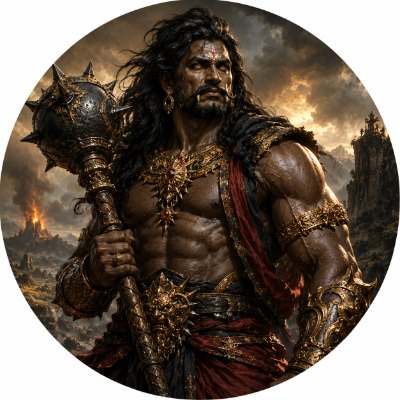
Heti — First of the Rakshasas, Born of Brahma's Anger
Heti · Rakshasa-adi · Brahma-krodha-sambhava · Bhaya-pati · Vidyutkesa-pita
Heti is one of the first two Rakshasas to exist — born at the very beginning of the Kritayuga from Brahma's anger, alongside his counterpart Praheti. While Heti was an evil Rakshasa, Praheti was a virtuous Yaksha — the two beings born simultaneously from the same act of Brahma's irritation representing opposite dispositions from a single origin. Heti married Bhaya, and their son was Vidyutkesa. Through Vidyutkesa and Salakatankata came Sukesa, and through Sukesa came Mali, Sumali, and Malyavan — the three great Rakshasa brothers who conquered Lanka. Heti is therefore the progenitor of the entire Lanka Rakshasa lineage and the distant ancestor of Ravana, Kumbhakarna, Vibhishana, and Shurpanakha.
✦ The Name
The name Heti means missile, weapon, or ray of light in Sanskrit — also used to denote a beam of the sun or a streak of fire. Its application to the first Rakshasa carries the sense of a destructive projectile force — something hurled outward with violent intent. The name's connection to light and fire also reflects his origin in the blazing anger of Brahma.
✦ Origin
The Uttarakanda of the Valmiki Ramayana records that at the beginning of the Kritayuga, when Brahma was reciting the Vedas, he felt very hungry and certain forms emanated from his face. Those born of his anger became Rakshasas; those born of his hunger became Yakshas. Heti and Praheti were the first born of these — Heti the Rakshasa and Praheti the Yaksha. The Glorious Hinduism source draws from the same account: Brahma's irritation produced both, with Heti being evil and Praheti being virtuous — a pairing that emphasises the tradition's understanding that the same creative impulse can produce beings of opposite moral character.
✦ Lineage
- Origin: Born from Brahma's anger at the beginning of the Kritayuga
- Twin (of a kind): Praheti — born simultaneously, a virtuous Yaksha rather than a Rakshasa
- Wife: Bhaya — the embodiment of fear; described in one source as the daughter of Kala (god of time and death), and in another as the sister of Kala
- Son: Vidyutkesa — who married Salakatankata, daughter of Sandhya
- Grandson: Sukesa — abandoned by his parents on the Himalayas; blessed by Shiva and Parvati with immortality and a sky-borne city; married Devavati, daughter of the Gandharva Gramani
- Great-grandsons: Mali, Sumali, and Malyavan — who conquered Lanka and became the progenitors of the Lanka Rakshasa race
- Distant descendants: Ravana, Kumbhakarna, Vibhishana, and Shurpanakha — through Sumali's daughter Kaikesi and Rishi Vishrava
✦ His Wife Bhaya
Heti's wife Bhaya — whose name means fear — is described as the embodiment of fear itself, and the daughter or sister of Kala, the personification of time and death. The Hindu Blog account notes the symbolic weight of this union: the first Rakshasa — born of Brahma's anger — married Fear itself, and from their union was born Vidyutkesa, whose name means he whose hair is like lightning. The marriage of strength and inevitability, as one source puts it, was a foretelling of the unshakeable power their descendants would wield.
✦ Cosmic Significance
Heti stands at the very beginning of the Rakshasa genealogy — the point from which the entire tradition of the Lanka Rakshasas, their conquest of the three worlds, and ultimately Ravana's conflict with Rama all trace their origin. He is the primal ancestor — the first being of his kind, born not of a cosmic design for creation but of a momentary flash of anger in the creator himself. That the entire Rakshasa lineage leading to the Ramayana's central antagonist begins in Brahma's irritation is one of the tradition's most compressed theological statements about the origin of evil in creation: not a separate force, but a shadow born of the same creative energy that produced everything else.
✦ Note on Available Information
Beyond his origin, his marriage to Bhaya, and his son Vidyutkesa, the tradition records nothing further about Heti's own life, deeds, or fate. He exists in the scriptural record as the first ancestor of the Rakshasa lineage rather than as a figure with an independent narrative.
✦ References
- Valmiki Ramayana — Uttarakanda: the primary canonical source recording the birth of Heti and Praheti from Brahma's anger and hunger at the beginning of the Kritayuga; Heti's marriage to Bhaya; the birth of Vidyutkesa; the genealogical chain leading to Sukesa, Mali, Sumali, Malyavan, and ultimately Ravana
- Puranic Encyclopaedia (Vettam Mani) — records Praheti and Heti as the first born Rakshasas; Heti's marriage to Bhaya, daughter of Kala; their son Vidyutkesa
- Wisdomlib — Story of Rakshasa: draws from the Uttaramayana to record Heti and Praheti's birth and the subsequent Rakshasa genealogy
- Glorious Hinduism — Lanka: records Heti as an evil Rakshasa and Praheti as a virtuous Yaksha; Heti's marriage to Bhaya; Vidyutkesa's marriage to Salakantaka; the lineage through Sukesa to Mali, Sumali, Malyavan, and Ravana
- Hindu Blog — Story of Sukesha: records Bhaya as the sister of Kala and the symbolic significance of the union of Heti and Bhaya