
About
Bhaya — Daughter of Vivasvat and Wife of Heti
Bhaya · Bhaya Devi · Surya-putri · Vaivasvati
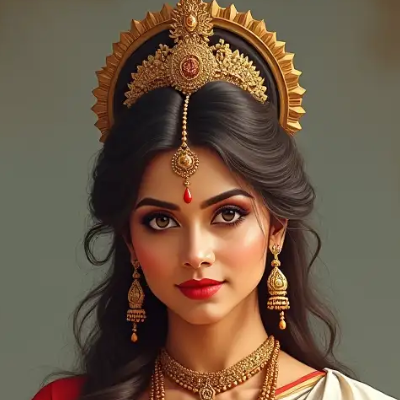
Bhaya is a daughter of Vivasvat — the sun god Surya, one of the twelve Adityas born to the sage Kashyapa and his wife Aditi — and the wife of Heti, a primordial Rakshasa or demon being who is identified in the Puranic tradition as one of the original progenitors of the Rakshasa race. Through her marriage to Heti, Bhaya is the mother of Vidyutkeshi — a Rakshasa whose lineage, according to the Valmiki Ramayana's account of the genealogy of the demons of Lanka, connects ultimately to the line from which the demon king Ravana and his kin descend. Bhaya is therefore a figure of genealogical significance in the Ramayana tradition as the solar divine ancestress — through her father Vivasvat — of a line that reaches down through the demon world to Ravana himself. She appears by name in the Uttara Kanda of the Valmiki Ramayana, where her identity as a daughter of Vivasvat and the wife of Heti is established in the context of the genealogical account of the Rakshasa lineage given by the sage Agastya to Rama. She receives no independent narrative episodes, no individual characterisation beyond her genealogical position, and no extended treatment in the major Puranas. This profile records what the primary sources establish about her identity and lineage with full transparency about the limits of the evidence.
✦ The Name
The name Bhaya derives from the Sanskrit root bhi, meaning to fear or to be afraid, and bhaya as a noun means fear, terror, or dread. As a personal name applied to a daughter of the sun god, the name Bhaya — meaning fear or the one who embodies terror — carries a striking semantic charge. It is unusual for a daughter of a solar Aditya to bear a name so directly associated with a negative and fearful quality, and the tradition does not provide an explicit explanation for why this name was given or what it was intended to express about this figure's character or nature. It is possible that the name reflects her role as the ancestress of the Rakshasa race — beings associated with terror and fear in the tradition — functioning as a prophetic or descriptive name that encodes the quality her descendants would embody. It is also possible that the name belongs to a tradition in which abstract qualities were personified as divine daughters without the name being understood as characterising the figure herself. The primary sources do not address this question, and the profile records the name and its meaning without speculating on the tradition's intention in applying it.
✦ Lineage
- Father: Vivasvat — the sun god Surya; one of the twelve Adityas born to the sage Kashyapa and his wife Aditi, daughter of the patriarch Daksha; the principal solar deity of the Vedic and Puranic tradition; father through various unions of Yama the lord of the dead, Yamuna the river goddess, Vaivasvata Manu the progenitor of the current human race, the Ashvini Kumara twins Nasatya and Dasra, Revanta the deity of horses and hunting, Sugriva the Vanara king, and — according to the tradition of the Uttara Kanda — Bhaya.
- Mother: The primary sources do not specify which of Vivasvat's wives or unions produced Bhaya. The Uttara Kanda identifies her as a daughter of Vivasvat without naming her mother. Given the extensive mythology of Vivasvat's wives — Saranyu, the shadow double Chhaya, and other unions attributed to him in various texts — it is not possible from the surviving sources to assign Bhaya to a specific maternal line.
- Paternal grandfather: Kashyapa — one of the seven great primordial sages; progenitor of gods, demons, Nagas, birds, and all orders of beings; son of Marichi, one of the mind-born sons of Brahma the creator.
- Paternal grandmother: Aditi — daughter of the patriarch Daksha; wife of Kashyapa; the boundless mother of all twelve Adityas including Vivasvat.
- Paternal uncles (through Vivasvat's Aditya brothers): Indra, Varuna, Mitra, Vishnu, Bhaga, Pushan, Aryaman, Amsha, Parjanya, Dhata, and Tvashtr — all twelve Adityas being sons of Kashyapa and Aditi and therefore brothers of her father Vivasvat.
- Siblings through Vivasvat: Yama — lord of the dead; Yamuna — the river goddess; Vaivasvata Manu — progenitor of the current human race; Nasatya and Dasra — the Ashvini Kumara twins; Revanta — deity of horses and hunting; Shani — the planet Saturn; Savarni Manu — Manu of the coming eighth cosmic age; and Tapati — the river goddess in some accounts. The specific siblings Bhaya shares through the same mother — whoever that mother was — cannot be determined from the primary sources.
- Husband: Heti — a primordial Rakshasa being identified in the Uttara Kanda of the Valmiki Ramayana as one of the original progenitors of the Rakshasa lineage; a figure whose own origin is not extensively narrated in the surviving primary sources but who is presented as an ancient and primordial demon being existing at the earliest phase of the present cosmic age.
- Son: Vidyutkeshi — a Rakshasa, the son of Bhaya and Heti; identified in the Uttara Kanda's genealogical account as the next generation of the Heti lineage; his own descendants through subsequent generations connect eventually to the main demon lineage of the Ramayana tradition.
✦ Textual Basis — The Uttara Kanda Genealogy
Bhaya's appearance in the primary sources is essentially confined to the Uttara Kanda of the Valmiki Ramayana — the seventh book of the epic, which many scholars regard as a later addition to the core six books of the Valmiki text. In the Uttara Kanda, the sage Agastya visits Rama at Ayodhya following Rama's victorious return and coronation, and at Rama's request delivers an extended account of the origin and genealogy of the Rakshasa race. This genealogical narrative traces the descent of the demons of Lanka — including Ravana — back through the generations to the original primordial Rakshasas of the present cosmic age.
Within this genealogical account, Agastya identifies Heti as one of the original primordial Rakshasas and names Bhaya — described as a daughter of Vivasvat — as Heti's wife. From this union was born Vidyutkeshi. The passage is genealogical in character rather than narrative — it does not describe Bhaya's personality, her qualities, her own story, or any episode in which she played an active role. She is a node in the lineage rather than a character with a developed individual presence. Her significance in the account is structural: she provides the solar divine connection — through her father Vivasvat — that makes the earliest Rakshasa lineage a product not of purely demonic origin but of a union between the demon world and the solar divine world, a genealogical hybrid that the Puranic tradition frequently employs to explain the extraordinary power of great demonic figures.
The Uttara Kanda's genealogical account of the Rakshasa lineage is one of the most significant passages in the text for understanding the tradition's construction of the demon world's origins, and Bhaya's identification as Vivasvat's daughter within it is a deliberate genealogical statement rather than an incidental detail. The solar divine ancestry she brings to the Heti-Vidyutkeshi line anticipates — at the genealogical level — the extraordinary solar qualities that the tradition attributes to figures such as Ravana and his kin: their power, their luminosity, their capacity for the kind of cosmic-scale action that ordinary beings cannot accomplish. These qualities, in the Puranic genealogical logic, derive ultimately from the divine ancestry that Bhaya introduced into the Rakshasa line through her marriage to Heti.
✦ Heti — Bhaya's Husband
Heti — Bhaya's husband and the father of her son Vidyutkeshi — is named in the Uttara Kanda as one of the primordial Rakshasas of the present cosmic age. The name Heti is connected in some commentarial traditions to the Sanskrit word for a weapon or missile — heti meaning a weapon or a ray of light used as a weapon — which is consistent with the demon world's association with destructive force and combat. Heti is not a figure who receives extended individual narrative treatment in the Valmiki Ramayana or in the principal Puranas; like Bhaya, he is primarily a genealogical node — the beginning of a lineage whose significance lies in what it eventually produces rather than in what he himself did or said. His primary textual function is as the primordial Rakshasa whose union with the solar divine daughter Bhaya initiated the line from which the great demons of the Ramayana ultimately descended.
✦ Vidyutkeshi and the Genealogical Continuation
Vidyutkeshi — the son of Bhaya and Heti — is the next generation of the lineage and the figure through whom Bhaya's solar divine ancestry passes into the Rakshasa world. The name Vidyutkeshi means the one with lightning for hair or the one whose hair resembles lightning — vidyut meaning lightning and keshi meaning haired — a name that combines the luminous solar quality inherited through Bhaya with the fierce demonic power inherited through Heti. The combination of solar light and demonic lightning in his very name reflects the genealogical hybrid that Bhaya's union with Heti produced.
Through Vidyutkeshi and the subsequent generations traced in the Uttara Kanda's genealogical account, the lineage passes eventually through several further generations to the figures who connect to the principal Rakshasa families of the Ramayana — the lineage that ultimately includes Ravana, Kumbhakarna, and Vibhishana through the sage Vishravas and the Rakshasa king Sumali and his descendants. The specific steps of this genealogical progression are given in the Uttara Kanda and connect Bhaya's descendants through a chain of several generations to the world of the main narrative of the Ramayana. The details of each generation in this chain belong primarily to the profiles of the figures who constitute those generations rather than to Bhaya's own profile, which is properly limited to what the sources say about her directly.
✦ Textual Variants and Inconsistencies
The primary textual issues concerning Bhaya relate to the status of the Uttara Kanda itself and to the specific genealogical account of the Rakshasa lineage it contains. The Uttara Kanda is regarded by many scholars of the Ramayana tradition as a later addition to the core six books of the Valmiki text — its narrative style, its theological orientation, and certain of its genealogical details are considered by several major scholars to belong to a different compositional stratum from the Bala, Ayodhya, Aranya, Kishkindha, and Yuddha Kandas. This does not make the Uttara Kanda's genealogical account without value — it is part of the canonical Valmiki Ramayana as it has been transmitted and received across the tradition — but it is relevant to note when assessing the authority of the specific detail that Bhaya was a daughter of Vivasvat.
The major Puranas that engage with the Rakshasa genealogy — including the Vishnu Purana, the Bhagavata Purana, and the Brahma Purana — do not consistently include Bhaya as a daughter of Vivasvat in their own accounts of the solar divine lineage. The tradition of Vivasvat's daughters is not as extensively developed in the Puranic genealogical literature as that of his sons, and Bhaya does not appear in most of the principal Puranic enumerations of Vivasvat's offspring that are consulted for this series. Her attestation is therefore limited primarily to the Uttara Kanda of the Valmiki Ramayana and to whatever secondary Puranic traditions draw upon that account.
The mother of Bhaya — not named in the Uttara Kanda — is a gap in the genealogical record that cannot be filled from the primary sources. Various manuscript traditions and commentaries have offered different possibilities, but none of these conjectural identifications is established with sufficient textual authority to be presented as a primary source fact.
✦ Connection to the Wider Genealogy
As a daughter of Vivasvat — one of the twelve Adityas born to Kashyapa and Aditi — Bhaya belongs to the solar divine lineage at one remove from the Adityas themselves. She is the granddaughter of Kashyapa and Aditi, and through the Aditya network she is the niece of Indra, Varuna, Vishnu, Mitra, Bhaga, Pushan, and all the other Adityas. Her siblings through Vivasvat include some of the most cosmically significant figures in the tradition — Yama, Yamuna, Vaivasvata Manu, the Ashvini Kumara twins, and Revanta among others.
What makes Bhaya's genealogical position particularly striking is the direction in which her lineage moves after her marriage to Heti. While her siblings' lineages connect to the divine order — to the realm of the dead, to sacred rivers, to the human royal dynasties, to the divine physicians — Bhaya's lineage through her marriage to Heti moves into the Rakshasa world, the demonic order that stands in perpetual conflict with the divine. Her solar divine ancestry thus becomes embedded within the demonic lineage — a presence of the divine creative principle within the world of the demons that the Puranic tradition's genealogical logic uses to explain why the greatest demons are never purely destructive but always carry within them a complexity and a capacity for cosmic action that ordinary beings do not possess. Ravana himself, as the eventual descendent of this line, is in some interpretations a being whose terrifying greatness reflects not only the demonic power he inherited through Heti but the solar divine quality that entered his line through Bhaya, Vivasvat's daughter.
✦ References
- Primary Sources
- Valmiki Ramayana, Uttara Kanda (Sargas 4–5, Agastya's account of the Rakshasa genealogy): The primary and most direct source for Bhaya's identity as a daughter of Vivasvat and wife of Heti; contains the genealogical account in which her name, her parentage, and her marriage to Heti are established in the context of the Rakshasa lineage's origin.
- Vishnu Purana, Book III (the lineage of Vivasvat's children): Contains genealogical material on the children of Vivasvat; consulted for cross-reference with the Uttara Kanda's identification of Bhaya as Vivasvat's daughter, though the Vishnu Purana's enumeration of Vivasvat's offspring does not consistently include Bhaya.
- Bhagavata Purana, Skandha IX (solar dynasty genealogy): Contains Puranic genealogical material on the solar lineage descending from Vivasvat; cross-referenced for Bhaya's identification, though she does not appear in this text's primary enumeration of Vivasvat's children.
- Secondary Sources
- Mani, Vettam. Puranic Encyclopaedia (1975): Entries on Heti, Vidyutkeshi, and the Rakshasa genealogy of the Ramayana; useful for cross-referencing the genealogical chain in which Bhaya appears and for identifying the primary passages in which the Heti-Bhaya-Vidyutkeshi lineage is recorded.
- Goldman, Robert P. (general editor). The Ramayana of Valmiki: An Epic of Ancient India, Volume VII: Uttara (Princeton University Press): Critical edition and translation of the Uttara Kanda with scholarly notes; provides the most authoritative modern scholarly treatment of the Rakshasa genealogical account in which Bhaya is named and contextualises its place within the Uttara Kanda's broader narrative purposes.
- Wisdomlib (wisdomlib.org), entries on Bhaya, Heti, Vidyutkeshi, and the Rakshasa genealogy: Aggregates verse references from digitised primary texts; useful for locating the specific passages in which Bhaya is named and for cross-referencing her identification across the available primary corpus.