
About
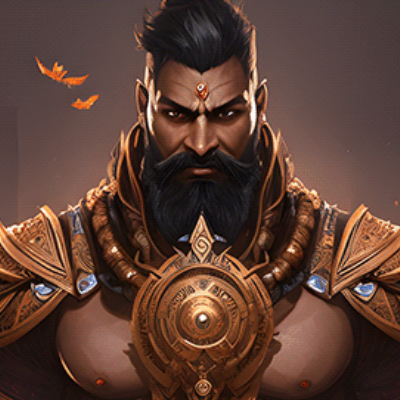
Mali — Second Son of Sukesa, Warrior Lord of Lanka, and First Slain by Vishnu
Mali · Sukesaputra · Devavatiputra · Rakshasayodha · Vishnunihata · Lankeshvara-madhyama
Mali is the second of the three sons of Sukesa — the Rakshasa king who received Shiva's boon and who fathered the three great Rakshasa lords — and of Sukesa's wife Devavati. He is the brother of Malyavan, the eldest, and of Sumali, the youngest, and together the three established Rakshasa dominion over Lanka and challenged the authority of the gods. Mali is distinguished from his brothers primarily as the warrior of the group — the one who went forward to engage Vishnu directly when the supreme deity descended to break the Rakshasas' power — and who was killed by Vishnu in that engagement, becoming the first of the three great Rakshasa lords of Lanka to fall at Vishnu's hands. His death marks the turning point of the first Rakshasa dominion of Lanka — after his killing, Malyavan and Sumali retreated to the underworld — and it anticipates the pattern of Vishnu's successive interventions against the Rakshasa world that the Ramayana tradition elaborates in greater detail in the figure of Ravana. Mali appears in the Uttara Kanda of the Valmiki Ramayana, the Mahabharata's Vana Parva, and in related Puranic genealogical accounts. His biography is substantially shorter than those of his brothers because his death precedes the major narrative developments of the Rakshasa tradition; this profile is accordingly proportionate to the available evidence.
✦ The Name
The name Mali derives from the Sanskrit mala or mali, associated with garlands, wreaths, or necklaces — the same root that appears in the name Malyavan. Mali thus means "the garlanded one" or "he of the garland" — a name of honour and distinction parallel to his elder brother's name. Some commentators have also connected the name to the sense of a gardener or a keeper of flowers, which would carry the connotation of someone who tends and cultivates beauty or abundance. The primary texts do not elaborate the etymology of the name in the passages where Mali appears. The patronymic Sukesaputra identifies him as Sukesa's son. Vishnunihata means "the one killed by Vishnu." Lankeshvara-madhyama means "the middle lord of Lanka."
✦ Lineage
- Father: Sukesa — the Rakshasa king, son of Vidyutkesa and Salakatankata, who received Shiva's protective boon and fathered the three lords of Lanka.
- Mother: Devavati — the wife of Sukesa, named in the Uttara Kanda as the mother of all three brothers.
- Brothers: Malyavan — the eldest, the wise counsellor who survived both cycles of Vishnu's intervention against the Rakshasas; profiled separately. Sumali — the youngest, who arranged Ravana's birth through Kaikasi's marriage to Vishrava; profiled separately.
- Wives: The Uttara Kanda names Mali's wives as Vasuda and others, though the list varies across manuscript traditions and is not given with the same consistency as Malyavan's wives in all versions of the text.
- Sons: The Uttara Kanda names several sons of Mali — Anala, Anila, Hara, and Sampati among them in some versions. These sons are described as warriors of Rakshasa power. Given Mali's death before the main events of the Rakshasa tradition, his sons are not given the kind of sustained narrative presence that the sons of Sumali's line — who include Ravana — receive.
✦ The Boons and the Establishment of Lanka
Mali, together with his brothers Malyavan and Sumali, performed austerities before Brahma and obtained boons of great protective power. The specific nature of the boon obtained by Mali is described in the Uttara Kanda as conferring invulnerability in conventional warfare — a protection from death at the hands of ordinary divine and human warriors. The three brothers then established themselves in Lanka and ruled it jointly in great prosperity. The Uttara Kanda's description of Lanka under the three brothers' rule presents it as a city of magnificent wealth and military strength, rivalling the heaven of the gods in its splendour.
The brothers' increasing power and their harassment of the gods — attacks on sages, disruptions of sacrifices, and challenges to divine authority — eventually provoked the gods' appeal to Vishnu. This pattern — the Rakshasa acquisition of divine boons, the establishment of a great kingdom, the challenge to cosmic order, and the consequent divine intervention — is the foundational narrative cycle of the Rakshasa tradition, repeated in varying forms across multiple generations of the Rakshasa world.
✦ Mali's Engagement with Vishnu and His Death
The Uttara Kanda narrates that when Vishnu descended to oppose the Rakshasa forces, Mali came forward as the primary warrior to engage him. The text describes a battle of great intensity in which Mali fought with extraordinary power and skill. Mali's boon — which protected him from ordinary divine and human fighters — was insufficient against Vishnu's direct intervention, which operates on a different order of cosmic power from that of even the most formidably boon-protected Rakshasa warrior. Vishnu struck Mali with his divine weapon and killed him.
The Uttara Kanda records that Mali's death was the decisive event of this conflict. When Malyavan and Sumali saw their brother killed by Vishnu — the one power that their boons did not protect against — they immediately recognised that continuing the battle was futile and withdrew. Mali's death thus simultaneously demonstrates the limit of Rakshasa boons and serves as the narrative mechanism by which the first Rakshasa dominion of Lanka ended. He is the sacrificed figure — the one who goes forward and falls — whose death purchases the survival of his brothers and thereby preserves the Rakshasa lineage through Sumali's eventual production of Ravana.
✦ Textual Variants and Inconsistencies
The weapon with which Vishnu killed Mali: Different manuscript traditions of the Uttara Kanda give different accounts of the specific weapon — the Sudarshana disc, a divine spear, or another weapon — with which Vishnu killed Mali. The essential fact of his death at Vishnu's hands is consistent across all major traditions; the specific weapon varies.
The list of Mali's wives and sons: As with Malyavan's list, the enumeration of Mali's wives and sons varies across manuscript traditions of the Uttara Kanda. The names given in the Lineage section reflect the most commonly attested versions but are subject to manuscript variation.
The relative sequence of the brothers in the battle: Some versions of the Uttara Kanda's account suggest that all three brothers engaged in some degree of fighting before Mali's death ended the conflict, while others present Mali as the sole primary combatant. The Uttara Kanda's account is the principal source and its various manuscript versions are the primary material for this distinction.
✦ Theological Significance
Mali's theological significance within the tradition is concentrated in his death. He represents the moment at which the limits of Rakshasa power — however augmented by divine boons — become apparent in the face of Vishnu's direct agency. The boon that protected him from ordinary opponents could not protect him from the supreme deity himself, because the supreme deity is the source from which all beings — including the gods who granted the boons — derive their power. Mali's death is thus a theological demonstration of the principle that boons obtained from limited divine beings cannot protect against the unlimited divine source. This principle is articulated in different forms across the Puranic tradition — it appears in the Narasimha episode (Hiranyakashipu's boon could not protect him from a being that was neither human nor animal, neither inside nor outside, neither by day nor by night — conditions that Vishnu fulfilled in a form the boon had not anticipated), and it is the same principle that applies to Mali's death. The boon protected him from the gods; Vishnu is beyond the gods.
✦ Connection to the Wider Genealogy
Through his father Sukesa and grandfather Vidyutkesa, Mali descends from the primordial Rakshasa ancestry. His own sons — Anala, Anila, Hara, Sampati, and others — carry the Mali branch of the three-brother lineage forward, though they are not given significant narrative development in the primary sources. The genealogically most consequential branch of the three-brother lineage runs through Sumali rather than through Mali, since it is through Sumali's daughter Kaikasi that Ravana is born. Mali's position in the wider genealogy is thus that of a significant ancestor — the warrior whose death defined the first generation's limitation — whose branch continued without producing the figures whose deeds shaped the subsequent tradition.
✦ References
Primary Sources
- Valmiki Ramayana, Uttara Kanda, chapters 4–12: The primary source for Mali's genealogy, his establishment in Lanka with his brothers, his engagement with Vishnu, and his death; the foundational narrative for his biography.
- Mahabharata, Vana Parva, sections on Rakshasa genealogy: A compressed account consistent with the Uttara Kanda's narrative; confirms the essential facts of Mali's position and death.
- Vishnu Purana, Book 1, chapter 14: Genealogical material on the Rakshasa lineages including Sukesa and his sons.
Modern Reference Works
- Vettam Mani, Puranic Encyclopaedia (1975): Entry on Mali; collates primary references and summarises his genealogical position and his death at Vishnu's hands.
- Robert P. Goldman and Sally J. Sutherland Goldman (translators), The Ramayana of Valmiki — Uttara Kanda (2017): Critical translation with scholarly notes; the most authoritative modern treatment of the Uttara Kanda's account of Mali and his brothers.