
About
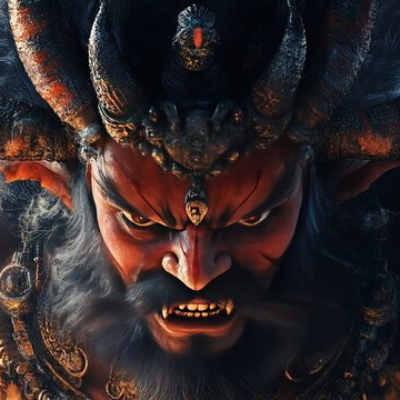
Malyavan — Elder Son of Sukesa, Lord of Lanka, and Voice of Wisdom in the Rakshasa Court
Malyavan · Sukesaputra · Devavatiputra · Rakshasadhipati · Ravana-pitamaha · Lankeshvara-purva
Malyavan is the eldest of the three sons of Sukesa — the Rakshasa king who received Shiva's boon of protection and who was himself the son of the Rakshasa Vidyutkesa and the Apsara Salakatankata — and of Sukesa's wife Devavati. Together with his brothers Mali and Sumali he established the Rakshasa dominion in Lanka, the great island fortress built by the divine craftsman Vishvakarma, and ruled it as a kingdom of extraordinary power and prosperity before the gods and Vishnu intervened to break their power. Malyavan is distinguished within the Rakshasa tradition not primarily for martial achievement — though his power was great — but for wisdom and counsel. He is the Rakshasa elder who, in the Valmiki Ramayana's Yuddha Kanda, came before Ravana during the siege of Lanka by Rama's forces and advised him with complete honesty to return Sita to Rama, warning that Rama was no ordinary mortal but a being of divine nature whose conquest of Lanka was inevitable. Ravana angrily dismissed this advice. Malyavan, having spoken the truth and been rejected, withdrew from active participation in the court's deliberations and survived the war that Ravana refused to avert. He is the grandfather of Ravana through the lineage of his brother Sumali, and his survival of the Lanka war makes him one of the few senior Rakshasa figures of that generation to live beyond the war's destruction. Malyavan appears most substantially in the Valmiki Ramayana's Uttara Kanda and Yuddha Kanda, and is referenced in the Mahabharata's Vana Parva and in several Puranic texts.
✦ The Name
The name Malyavan is a compound of malya — garland, wreath, or that which pertains to a garland — and the suffix van, indicating possession or abundance, yielding the sense of "he who possesses garlands," "the garlanded one," or "he of the garland." Garlands in the tradition are associated with beauty, honour, victory, and divine favour — the victorious warrior is garlanded, the god is offered garlands, and the garlanded being is marked as one of distinction. The name thus carries connotations of honour and distinction rather than of martial ferocity, which is consistent with the tradition's characterisation of Malyavan as the wise elder among the three brothers rather than the most powerful warrior. The patronymic Sukesaputra identifies him as Sukesa's son. Ravana-pitamaha means "grandfather of Ravana" — this relationship is indirect, through his brother Sumali's daughter Kaikasi and her son Ravana, making Malyavan Ravana's great-uncle rather than his direct grandfather. The tradition sometimes uses the term pitamaha loosely to indicate a senior figure of the preceding generation, and this usage should be understood accordingly.
✦ Lineage
- Father: Sukesa — the Rakshasa king who was the son of Vidyutkesa and the Apsara Salakatankata, who received Shiva's boon of protection, and who fathered Malyavan, Mali, and Sumali by his wife Devavati. Sukesa is the root of the three-branch Rakshasa lineage that established itself in Lanka.
- Mother: Devavati — the wife of Sukesa and the mother of the three brothers. She is named in the Uttara Kanda of the Valmiki Ramayana but is not given further narrative development beyond this genealogical identification.
- Brothers: Mali — the second of the three, a warrior of great power who was killed by Vishnu during the gods' campaign to break the brothers' dominion; profiled separately in this series. Sumali — the youngest of the three, who survived the defeat and eventually arranged the marriage of his daughter Kaikasi to the sage Vishrava, thereby producing Ravana, Kumbhakarna, Vibhishana, and Shurpanakha; profiled separately in this series.
- Wives: The Uttara Kanda of the Valmiki Ramayana names Malyavan's wives as Sundari, Anala, Anila, Hema, Bhrama, Dhanyamali, Vajramala, and Vikama in different manuscript traditions, though the consistency of this list varies across versions of the text.
- Sons: The Uttara Kanda names several sons of Malyavan — Vajramushti, Virupaksha, Durmukha, Suptaghna, Yajnakopa, Matta, and Unmatta among them — who are described as warriors of great power. These sons fought in the Lanka war against Rama's forces and were killed in the conflict, though their individual episodes are not narrated at length in the surviving primary texts.
- Daughter: Nala — named in some versions of the Uttara Kanda as a daughter of Malyavan, though her further biography is not elaborated in the primary sources with any narrative significance.
✦ The Three Brothers and the Establishment of Lanka
The Uttara Kanda of the Valmiki Ramayana narrates the early history of the three brothers and their establishment in Lanka with considerable elaboration. Malyavan, Mali, and Sumali — the sons of Sukesa and Devavati — grew to adulthood possessed of great physical power, martial skill, and the protection afforded by their father's boon from Shiva. Wishing to ensure that they would be invulnerable to the gods and all enemies, the three brothers performed austerities before Brahma and obtained boons of great power. The specific boons obtained by each brother are described in the Uttara Kanda, and together they made the three Rakshasa lords effectively invincible in conventional warfare against the divine forces.
With these boons secured, the three brothers established themselves in Lanka — the great island fortress that had been built by Vishvakarma at the command of Brahma. Some accounts present Lanka as originally a Yaksha territory associated with Kubera before the Rakshasas gained control of it; the Uttara Kanda presents the three brothers as taking possession of the city and beautifying and fortifying it further. Under their joint rule Lanka became a kingdom of extraordinary wealth and power — the Uttara Kanda describes it in terms of magnificent architecture, abundant resources, and military strength capable of defeating any force that came against it. The three brothers ruled Lanka in prosperity and extended the Rakshasa power across the surrounding regions.
Their power eventually led them into conflict with the gods. The three brothers began to harass the divine beings and their supporters — attacking sages, disrupting sacrifices, and challenging the cosmic order maintained by Indra and the Adityas. The gods, unable to defeat the brothers in conventional warfare because of the protective boons, appealed to Vishnu. Vishnu agreed to intervene, and the conflict between Vishnu and the three Rakshasa lords of Lanka marks the end of their joint dominion.
✦ The War with the Gods and the Retreat from Lanka
The Uttara Kanda narrates the conflict between Vishnu and the three Rakshasa brothers with the following essential facts. When Vishnu came against the Rakshasa forces, Mali — the second and most directly martial of the three brothers — went forward to engage him. The battle was fierce, but Vishnu's divine weapons exceeded the power of even the boons the Rakshasas had obtained. Mali was killed by Vishnu's discus or divine weapon — the Sudarshana — during the combat. The Uttara Kanda records this death as the turning point of the conflict.
Malyavan and Sumali, witnessing Mali's death and recognising that Vishnu's power exceeded what their boons could protect them against, withdrew from the battle and fled Lanka. They went into hiding in the underworld — Patala — where they remained for a long period, their dominion over Lanka ended and their remaining forces scattered. The retreat was not a shameful flight but a strategic withdrawal in the face of a power against which their protections were insufficient — the tradition's consistent message that divine boons, however impressive, do not protect against the supreme deity's direct intervention.
✦ Malyavan's Counsel to Ravana
Malyavan's most narratively significant moment in the primary texts is his counsel to Ravana during the siege of Lanka, narrated in the Yuddha Kanda of the Valmiki Ramayana. By this point in the tradition's chronology, Ravana — the son of Kaikasi and Vishrava, and thus Sumali's grandson and Malyavan's grandnephew — had reclaimed Lanka, established himself as the greatest Rakshasa lord of his age, conquered the three worlds, and abducted Sita the wife of Rama. Rama had arrived at Lanka's shores with his army of monkeys and bears, had built a causeway across the ocean to the island, and was besieging the city with devastating effect. The Rakshasa forces were suffering heavily.
Malyavan — described in the Yuddha Kanda as the elder statesman of the Rakshasa world, a figure of great wisdom and long experience — came before Ravana's assembly and spoke with complete honesty. He told Ravana that Rama was not a mere human king but a being of divine nature — Vishnu himself in mortal form — and that the current war was the fulfilment of a cosmic design that Ravana could not overcome by force. He advised Ravana to make peace with Rama, to return Sita, and to avert the destruction that was otherwise inevitable. He framed this not as cowardice but as wisdom — the same wisdom that had led him and Sumali to withdraw from Lanka rather than continue fighting Vishnu in the previous generation.
Ravana rejected the advice in anger. He accused Malyavan of speaking like an enemy rather than a friend, of being intimidated by Rama's reputation, and of failing to appreciate the strength of the Rakshasa forces. He dismissed Malyavan's counsel with contempt. Malyavan, having said what needed to be said and recognising that Ravana was not open to persuasion, withdrew from the assembly without further argument. The Valmiki Ramayana records that after this exchange Malyavan took no further active part in the war's direction.
This episode places Malyavan in a specific moral category within the Rakshasa world of the Ramayana — alongside Vibhishana, who also counselled Ravana to return Sita and was also rejected, and who ultimately went to Rama's side. Malyavan did not go as far as Vibhishana — he did not cross to Rama's side — but he spoke the same essential truth from within the Rakshasa court and was similarly dismissed. The tradition uses both figures to establish that even within the Rakshasa world there were those who understood what Ravana was doing and spoke against it, making Ravana's catastrophe a consequence of freely chosen blindness rather than of uniform demonic ignorance.
✦ Malyavan's Survival of the Lanka War
The Valmiki Ramayana records that Malyavan survived the Lanka war — one of very few senior Rakshasa figures of his generation to do so. His withdrawal from active participation in the war's direction after his rejected counsel to Ravana, combined with his physical survival, gives him a distinctive position in the post-war Rakshasa world. The tradition does not narrate in detail what became of Malyavan after the war and Ravana's death, and the primary sources do not follow his subsequent biography at length. The Uttara Kanda records the post-war disposition of Lanka under Vibhishana's rule and the departure of Rama's forces without giving an extended account of Malyavan's later existence.
✦ Textual Variants and Inconsistencies
The list of Malyavan's wives and sons: The Uttara Kanda's enumeration of Malyavan's wives and sons varies across manuscript traditions, and not all regional versions of the Ramayana give the same list. The names cited in the Lineage section reflect the most commonly attested version in the scholarly tradition but should be understood as subject to manuscript variation.
The manner of Mali's death: Different manuscript traditions of the Uttara Kanda vary in the specific description of how Mali was killed — whether by Vishnu's Sudarshana disc, by a divine spear, or by another weapon. The essential fact of Mali's death at Vishnu's hands during the conflict over Lanka is consistent across all major traditions.
The Mahabharata's account: The Mahabharata's Vana Parva gives a compressed account of the early Rakshasa history including the three brothers and their establishment in Lanka, consistent with the Uttara Kanda's narrative but without the same degree of elaboration. The two accounts are complementary rather than contradictory on the essential genealogical and narrative facts.
✦ Theological Significance
Malyavan's theological significance in the tradition operates at two related levels. As a figure of wisdom within the Rakshasa world — the elder statesman who counselled peace and truth — he represents the tradition's consistent teaching that correct understanding of cosmic reality, specifically of the nature of the divine, is not the exclusive property of the gods or of human devotees, but is available to any being capable of clear perception. His recognition of Rama as Vishnu and his counsel to Ravana to accept the inevitable is the application of exactly the same wisdom that animated Vibhishana's similar counsel. That it was rejected by Ravana in both cases speaks to Ravana's specific form of cosmic blindness — the pride that could not accept what was true — rather than to any failure in Malyavan's understanding.
At the cosmological level, Malyavan and his brothers' establishment in Lanka and their eventual defeat by Vishnu represents an earlier cycle of the pattern that the Ramayana's main action recapitulates — the Rakshasa appropriation of a divine space, the challenge to cosmic order, and Vishnu's descent to restore it. The Ramayana war in which Ravana is defeated by Rama-Vishnu is thus the second instance of the same cosmic pattern that Malyavan's generation experienced the first time. Malyavan is uniquely positioned as a figure who lived through both cycles — surviving the first, counselling against the repetition of its error, being ignored, and surviving the second as well.
✦ Connection to the Wider Genealogy
Through his father Sukesa and grandfather Vidyutkesa, Malyavan descends from the primordial Rakshasa ancestry traced back through Sukra to Sthanu or to Brahma depending on the text. Through his brother Sumali's daughter Kaikasi and her sons by Vishrava, Malyavan is the great-uncle of Ravana, Kumbhakarna, Vibhishana, and Shurpanakha — the central Rakshasa figures of the Ramayana. His own sons — Vajramushti and the others — fought and died in the Lanka war, meaning the Malyavan branch of the three-brother lineage suffered heavily in the second cycle of conflict with Vishnu. Malyavan himself, surviving both cycles, is the living genealogical link between the primordial Rakshasa world and the post-Ramayana order in which Vibhishana — his brother Sumali's great-grandson — rules Lanka under Rama's authority.
✦ References
Primary Sources
- Valmiki Ramayana, Uttara Kanda, chapters 4–12: The primary source for Malyavan's genealogy, his establishment in Lanka with his brothers, the conflict with Vishnu, Mali's death, and the retreat of Malyavan and Sumali to Patala.
- Valmiki Ramayana, Yuddha Kanda, chapter 35: Malyavan's counsel to Ravana during the siege — his identification of Rama as Vishnu, his advice to return Sita, Ravana's angry rejection, and Malyavan's withdrawal from active participation. The primary source for Malyavan's most narratively significant episode.
- Mahabharata, Vana Parva, sections on Rakshasa genealogy: A compressed account of the three brothers consistent with the Ramayana's Uttara Kanda; confirms the essential genealogical facts.
- Vishnu Purana, Book 1, chapter 14: Genealogical material on the Rakshasa lineages including Sukesa and his sons.
Modern Reference Works
- Vettam Mani, Puranic Encyclopaedia (1975): Entry on Malyavan; collates primary references and summarises his genealogical position, his establishment in Lanka, and his counsel to Ravana.
- Robert P. Goldman and Sally J. Sutherland Goldman (translators), The Ramayana of Valmiki — Yuddha Kanda and Uttara Kanda: Critical translations with scholarly notes; the most authoritative English-language treatment of the primary sources for Malyavan's biography.
- Alf Hiltebeitel, The Ritual of Battle: Krishna in the Mahabharata (1990): Contains discussion of the cosmic pattern of Rakshasa-divine conflict and Vishnu's repeated intervention that contextualises Malyavan's position across two cycles of the same pattern.