
About
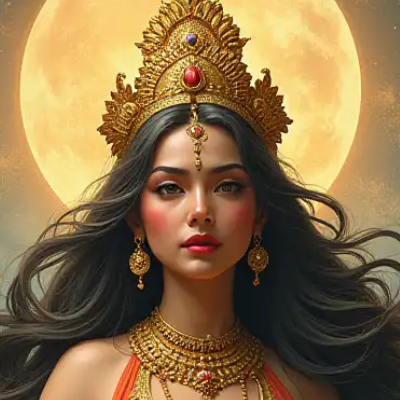
Sandhya — Mind-Born Daughter of Brahma, Personification of Twilight
Sandhya · Divaksanta · Sayamsandhya · Jayantika · Pratah-Sandhya · Brahma-manasaputri · Arundhati (second birth)
Sandhya is the mind-born daughter of Brahma, born when Brahma was in deep cosmic contemplation. She is the personification of twilight — both dawn and dusk — the liminal sacred moment that stands at the meeting point of day and night. The Shiva Purana describes her as a unique creation without equal in the three worlds or across the three periods of time, of matchless beauty, lustrous as the jasmine flower. She is called by several names — Sandhya, Divaksanta, Sayamsandhya, and Jayantika. She performed four yugas of intense tapas on the bank of the Brihallohita lake on Mount Chandrabhaga, received Shiva's darshan, obtained two great boons, and then gave up her physical body by entering the sacrificial fire of Sage Medhatithi's twelve-year Jyotistoma yajna — from which she was reborn as the golden-complexioned child Arundhati, who became the wife of Sage Vasishtha. She is also credited with being the mother of the Pitrs — the ancestral manes. The sun god Surya divided her body into the three twilights: Pratah-Sandhya (dawn), Madhyanha-Sandhya (midday), and Sayam-Sandhya (dusk) — establishing them in his chariot where they delight the gods and the ancestral manes respectively.
✦ The Name
Sandhya means twilight, junction, or meeting point in Sanskrit — from sam (together, complete) and dhi (to hold, to meet). It denotes the sacred juncture between day and night, the threshold moment that belongs to neither and partakes of both. The three daily junctions — dawn, noon, and dusk — are all called Sandhya, and all three rituals of Sandhya Vandanam performed by Brahmin householders are named in her honour. The Sandhya Vandanam — the daily ritual of salutation to the sun — is performed at each of the three junctures she represents, making Sandhya the presiding deity of one of Hinduism's most fundamental daily observances.
✦ Lineage
- Father: Brahma — from whose mind she was born during deep cosmic contemplation
- Brothers: Kamadeva and the Manasaputras — the mind-born sons of Brahma; she is the sibling of Kamadeva, who was created at the same time and whose arrows caused the initial crisis of her birth
- Children: The Pitrs — the ancestral manes; after Shiva glanced at her and freed her from the carnal desires aroused by Kama's arrows, she became the mother of the Pitrs
- Spiritual teacher: Vasishtha — who appeared to her in disguise as a brahmachari on Mount Chandrabhaga and instructed her in the method of penance
- Husband (second birth as Arundhati): Vasishtha — who was the brahmachari she had sought as husband while entering the yajna fire
✦ Birth and the Crisis of Kama's Arrows
Sandhya was born at the precise moment when Brahma created Kamadeva — the god of love and desire — as one of his first acts of creation. Kamadeva, fulfilling his cosmic function, immediately released his flower-arrows upon all present — upon Brahma himself, upon all the Prajapatis (the mind-born sons), and upon Sandhya. As a result, for the first time in creation, desire arose — and it arose simultaneously in the creator, his sons, and his daughter, all directed toward Sandhya's beauty. Brahma involuntarily gazed upon her, additional heads arose from his neck as he turned to follow her movement, and forty-nine animal forms were born from Brahma's body due to the force of his aroused thoughts.
Sandhya herself was also pierced by Kama's arrows and felt the same inappropriate desire. Shiva appeared at that moment, rebuked Brahma and the Prajapatis, and glanced upon Sandhya with protective grace — freeing her from the carnal feelings Kama's arrows had aroused. Shiva then cursed Kamadeva for initiating desire in an incestuous context.
Sandhya, deeply ashamed of the feelings that had arisen in her and in her father and brothers, resolved upon an extraordinary act. She declared that no living being should experience such lustful feelings at the moment of birth — and that she could not continue to inhabit the body that had generated such desire in her own family. She vowed to perform tapas to both purify herself and to establish this new cosmic law for all future creation.
✦ The Tapas on Mount Chandrabhaga
Sandhya went to Mount Chandrabhaga on the banks of the river Chandrabhaga to perform penance. Brahma, wishing to facilitate her austerities, instructed Vasishtha to go to the mountain and guide her — but to go in disguise, as a luminous brahmachari. Vasishtha arrived and Sandhya, not recognising him, revealed her purpose and sought instruction. Vasishtha instructed her to meditate on Shiva and recite the mantra Om Namah Shankaraya Om, to observe silence, to take bath while worshipping, to take only water during the first and second portions of the day, and to observe complete fast in the third. Sandhya practised this penance on the banks of the Brihallohita lake on that mountain. Four entire yugas passed.
✦ Shiva's Darshan and the Boons
After four yugas of tapas, Shiva manifested to Sandhya — both within her heart and externally in the sky. He bestowed upon her divine knowledge, divine speech, and divine vision. Pleased by her eulogy, Shiva granted her two boons. Her first boon was that no living being should have lustful feelings immediately after birth — the cosmic law she had vowed to establish. Her second boon was that no woman in the three worlds should match her in beauty. Shiva further granted that any person other than her husband who looked at her with lust would cause his own downfall and become a eunuch — and that her husband would be a great ascetic who would live with her for three kalpas.
✦ The Giving Up of Her Body and Rebirth as Arundhati
Having obtained her boons, Sandhya chose to give up her present body. Shiva directed her to the banks of the river Chandrabhaga where Sage Medhatithi was performing a twelve-year Jyotistoma yajna. She was to enter the sacred fire invisibly, and be reborn as Medhatithi's daughter. While entering the fire she was to remember her boons and to designate the brahmachari — Vasishtha in disguise — as her husband.
Sandhya entered the fire as instructed. When the twelve-year yajna concluded, Sage Medhatithi found in the sacrificial pit a girl of golden complexion, radiant as molten gold. He named her Arundhati. She grew up at Tapasaranya on the banks of the Chandrabhaga. At the age of five she declared that she would accept only the brahmachari she had seen as her husband. Brahma, Vishnu, and Shiva together arranged and solemnised her marriage to Vasishtha — the sage who had guided her in her previous life without her knowing who he was. She became thereafter the most celebrated pativrata of the tradition and Vasishtha's lifelong equal partner.
✦ The Three Twilights
Before her rebirth, the sun god Surya divided Sandhya's body. In the Shiva Purana account, he divided her into two parts: the upper half became Pratah-Sandhya (the dawn twilight) which delights the gods, and the lower half became Sayam-Sandhya (the evening twilight) which delights the ancestral manes. In the account preserved at Dollsofindia and drawn from other Puranic sources, Surya divided her into three parts — Pratah-Sandhya, Madhyanha-Sandhya, and Sayam-Sandhya — and established all three in his chariot. These three twilight forms are the presiding deities of the three daily Sandhya Vandanam rituals.
✦ Variant Traditions
The Brahma Vaivarta Purana records a different account in which Sandhya commits suicide because of her father's lustful regard — and Lord Vishnu revives her, gives her the name Rati, and gets her married to Kamadeva. The Matsya Purana identifies Shatarupa — the first woman born from Brahma's body — with Sandhya, among other names. Dowson's Classical Dictionary records that in one version of the Shiva Purana, Brahma attempted actual violence against his daughter and she changed herself into a deer to escape. These variant accounts across different Puranic traditions reflect the complex and layered nature of Sandhya's sacred identity.
✦ References
- Shiva Purana — Rudra Samhita, Sati Khanda, Chapter 2–7: the primary source for Sandhya's birth, the crisis of Kama's arrows, Shiva's intervention, her tapas on Mount Chandrabhaga, Vasishtha's guidance in disguise, Shiva's darshan and her two boons, her entry into Medhatithi's yajna fire, and her rebirth as Arundhati; the division of her body into two twilights by Surya
- Kalika Purana (Chapter 2, Verses 11–33) — records Sandhya's birth from Brahma's mind during meditation; Kamadeva's arrows causing incestuous desire in Brahma and the Prajapatis; Shiva's rebuke
- Brahma Vaivarta Purana — alternate account in which Sandhya is reborn as Rati, wife of Kamadeva
- Matsya Purana — identifies Shatarupa with Sandhya among other names
- Wisdomlib — Description of Goddesses Sandhya (or Twilight): detailed analysis of Sandhya as a minor goddess across Puranic literature, drawing from primary Shiva Purana passages
- Greenmesg — Penance of Sandhya; Sanskritimagazine — Penance of Sandhya: summaries drawing from Shiva Purana, Rudra Samhita, Sati Khanda 5
- Dollsofindia — Sandhya and Kama: records the three-fold division of Sandhya's body into Pratah-, Madhyanha-, and Sayam-Sandhya established in Surya's chariot