
About
Mandodari — Wife of Ravana, Daughter of Maya, Among the Five Pativratas
Mandodari · Mando-dari · Mandodari Devi · daughter of Maya · queen of Lanka
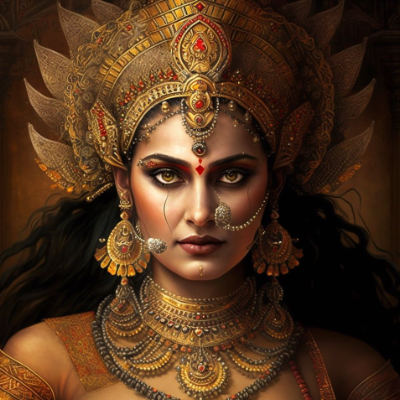
Mandodari is the principal wife and queen of Ravana, the demon-king of Lanka and principal antagonist of the Valmiki Ramayana. She is the daughter of Maya — the celebrated Danava architect and master of illusion, son of Kashyapa and Danu — and his wife Hema, an Apsara of the heavenly realms. She is described across the Valmiki Ramayana, the Adhyatma Ramayana, the Skanda Purana, and numerous other texts as a woman of extraordinary beauty, learning, and virtue — a figure whose moral clarity and righteous counsel stand in marked contrast to the destructive course pursued by her husband. She is the mother of Meghanada, also known as Indrajit, Ravana's most celebrated warrior son. The Hindu tradition counts Mandodari among the Panchakanyas or Panchapativratas — the five supremely virtuous women whose names, recited at dawn, are said to destroy sin — alongside Ahalya, Draupadi, Kunti, and Tara. This placement among the tradition's most honoured female figures reflects the degree to which the tradition recognises her virtue as operating independently of and in spite of the transgressions of her husband.
✦ The Name
The name Mandodari is a Sanskrit compound. The first element, manda, means "slow," "gentle," "soft," or "mild" — qualities associated with grace and dignified restraint. The second element, udari or udara, means "belly," "womb," or more broadly "generous" and "noble-hearted." The compound is most commonly interpreted as "she of the slender or gentle belly" — a reference to her celebrated physical beauty and grace of form. An alternative reading, less common but theologically suggestive, takes udara in its sense of "generous" or "noble," yielding "she who is gentle and noble-hearted." Both readings are consistent with her characterisation across the sources — beautiful in form and noble in disposition. Some regional traditions offer folk etymologies connecting the name to other Sanskrit roots, but the compound of manda and udara is the standard Sanskrit analysis.
✦ Lineage
- Father: Maya — also called Mayasura and Maya Danava, the pre-eminent architect among the asura races, son of Kashyapa and Danu. He is the builder of the Pandavas' illusory assembly hall in the Mahabharata, the cave palace of the Kishkindha Kanda of the Ramayana, and the triple city of Tripura destroyed by Shiva. His extraordinary skill in construction, illusion, and the arts of design made him the most celebrated craftsman of the demonic world, the counterpart of Vishvakarma among the divine beings. Through his mother Danu he belongs to the Danava lineage descending from Kashyapa and Danu, daughter of Daksha Prajapati.
- Mother: Hema — an Apsara of the heavenly realms, wife of Maya, and the owner of the cave palace in the Kishkindha Kanda tended by the ascetic Svayamprabha. Her union with Maya gives Mandodari a dual lineage — Danava on the paternal side through Maya and Danu, and Apsara on the maternal side through Hema — a combination that accounts in part for the tradition's consistent emphasis on her extraordinary beauty, which unites the power of the Danava inheritance with the celestial grace of the Apsara lineage.
- Sister or half-sister: Somaprabha — a daughter of Maya and Hema who became the wife of Nalakubara, son of Kubera, lord of wealth, as recorded in the Kathasaritsagara. Whether Somaprabha and Mandodari share the same mother Hema or have different mothers is not consistently stated across the sources.
- Sister or half-sister: Svayamprabha — named in the Kathasaritsagara as a daughter of Maya alongside Somaprabha, and identified in the Valmiki Ramayana's Kishkindha Kanda as the ascetic guardian of the cave palace built by Maya for Hema. The relationship between these two attestations is discussed in the textual variants section below.
- Husband: Ravana — the ten-headed, twenty-armed demon-king of Lanka, son of the sage Vishrava and his second wife Kaikesi, a Rakshasi and daughter of the demon Sumali. He is the principal antagonist of the Valmiki Ramayana, celebrated simultaneously for his extraordinary learning, his devotion to Shiva, his mastery of the Vedas and the arts, and for the catastrophic consequences of his pride, his violence toward women, and his abduction of Sita.
- Son: Meghanada — also known as Indrajit, meaning "conqueror of Indra," a name earned when he defeated and bound Indra in battle. He is Ravana's most celebrated warrior son, described across the Ramayana as a fighter of supernatural power who possessed the Brahmastra and other devastating divine weapons. He was ultimately slain by Lakshmana, the younger brother of Rama, during the siege of Lanka. Some sources name additional sons of Ravana through Mandodari, but Meghanada is the most consistently and prominently attested.
✦ Mandodari's Character and Virtue
The tradition's treatment of Mandodari is remarkable for the consistency with which it affirms her virtue despite her position as the wife of the tradition's greatest villain. Across the Valmiki Ramayana and its many retellings, Mandodari is presented as a woman of acute moral intelligence who perceives the wrongness of her husband's actions with clarity, counsels him repeatedly against his destructive course, and mourns the consequences of his transgressions with genuine grief rather than complicity. She is not a passive figure defined solely by her relationship to Ravana but an active moral voice within the narrative, whose counsel — had it been heeded — would have altered the course of the epic entirely.
The Valmiki Ramayana describes her beauty in terms that mark her as the most beautiful woman in Lanka — a distinction of some consequence given that Lanka was filled with the most beautiful women of the three worlds whom Ravana had gathered at his court. Yet the tradition insists consistently that her beauty was matched by her character, and that she was a woman of complete fidelity to her husband despite his faults, a complete dedication to dharma as she understood it, and a depth of perception that enabled her to see the reality of Rama's divine nature before many others acknowledged it.
✦ Mandodari's Counsel to Ravana
Among the most significant episodes associated with Mandodari is her repeated counsel to Ravana to return Sita to Rama and avoid the destruction that she foresaw as the inevitable consequence of his abduction. The Valmiki Ramayana preserves several instances of this counsel at different points in the narrative. Before the war began, Mandodari urged Ravana to recognise that Rama was no ordinary mortal — that the destruction of Khara and Dushana's army of fourteen thousand by a single man, the killing of Maricha, and the humiliation of Shurpanakha's disfigurement were signs of a being of superhuman power. She argued that Ravana's own extraordinary boons from Brahma had protected him against gods, Gandharvas, and demons, but that Rama was a human being — the one category conspicuously absent from the list of beings against whom Ravana was protected — and that this was not an accident but a providential design directed at Ravana's destruction.
Mandodari's perception of Rama's divinity — articulated before the war, before the great battles, before any of the dramatic reversals that might have forced such a recognition — is one of the tradition's ways of marking her as a woman of exceptional discernment. She counselled Ravana not from cowardice or defeatism but from a clear-eyed assessment of reality that her husband's pride prevented him from sharing. Ravana consistently dismissed her counsel, though the Ramayana presents him as doing so with the affection and respect he bore her rather than with contempt — he acknowledged her wisdom and her concern but remained captive to his own certainty and his own desire.
As the war progressed and Lanka's greatest warriors fell one by one — Kumbhakarna, Prahasta, Atikaya, and finally Meghanada — Mandodari's grief deepened and her counsels became more urgent. The death of Meghanada in particular is presented as a catastrophic loss for both Ravana and Mandodari, and the Ramayana's lament passages associated with his death are among its most emotionally intense. Mandodari mourned Meghanada as a son of extraordinary gifts whose end was brought about directly by his father's transgression.
✦ Mandodari's Lament over Ravana
The most celebrated passage associated with Mandodari in the Valmiki Ramayana is her lament over Ravana's body after his death at Rama's hands in the Yuddha Kanda. This lament is one of the epic's great passages of grief and moral reflection, in which Mandodari simultaneously mourns her husband with genuine love and grief, and articulates with devastating clarity the chain of causes — rooted in Ravana's insatiable desire, his violation of Vedic dharma, and his arrogance — that led inevitably to his destruction.
In her lament Mandodari does not merely grieve — she interprets. She traces the destruction of Lanka directly to the abduction of Sita, and through that act to the fundamental character flaw of uncontrolled desire that her husband could not overcome despite his learning, his devotion to Shiva, his mastery of the Vedas, and his incomparable physical and supernatural power. Her lament thus functions as an internal commentary within the Ramayana on the epic's own central moral teaching — that neither power, nor learning, nor even devotion, can substitute for the restraint of desire and the respect of dharmic boundaries. This interpretation, placed in the mouth of the woman who knew Ravana most intimately and who had counselled him most consistently, carries an authority within the narrative that no external commentary could match.
Mandodari also acknowledges in her lament that she had warned Ravana repeatedly and that he had not heeded her. This acknowledgement is not self-righteous but deeply sorrowful — the grief of a woman who foresaw the outcome, who did everything within her power to prevent it, and who must now witness its fulfilment. The Valmiki Ramayana presents this lament with great tenderness, and Rama himself is described as hearing it with respect and sorrow, acknowledging the dignity and grief of Lanka's queen.
✦ Mandodari's Marriage to Vibhishana
After Ravana's death, the Valmiki Ramayana records that Vibhishana — Ravana's righteous younger brother who had defected to Rama's cause and was crowned king of Lanka by Rama — took Mandodari as his wife. This episode is recorded in the Yuddha Kanda and has been the subject of varying interpretations across the tradition. The Ramayana presents it as occurring at Rama's suggestion or with his approval, and frames it within the conventions of dharmic levirate practice — a widow of high standing being taken in marriage by a close kinsman of her deceased husband to ensure her protection and social continuity. Vibhishana, as Ravana's brother, was the appropriate kinsman for this purpose under the customs of the tradition.
Later retellings of the Ramayana across various regional and linguistic traditions handle this episode with varying degrees of elaboration or discomfort, and some versions omit it or treat it differently. The Valmiki Ramayana's own account is brief and presents the marriage in a matter-of-fact manner consistent with the dharmic conventions it reflects rather than as a romantic or emotionally developed episode. The primary narrative focus remains on the conclusion of the war, the recovery of Sita, and Rama's return to Ayodhya.
✦ Mandodari as One of the Panchakanyas
The inclusion of Mandodari among the Panchakanyas — the five supremely virtuous women of the Hindu tradition — is theologically significant and has been the subject of considerable reflection within the tradition. The five women named in the standard formulation are Ahalya, Draupadi, Kunti, Tara, and Mandodari, each of whom is associated with circumstances that might in ordinary moral reckoning seem to complicate her virtue — Ahalya with her seduction by Indra, Draupadi with her five husbands, Kunti with her sons by different divine fathers, Tara with her marriage to Sugriva after Vali's death, and Mandodari with her position as the wife of the tradition's greatest villain.
The tradition's inclusion of Mandodari in this group reflects a sophisticated moral reasoning: that virtue is not simply a product of circumstances but of the disposition, intention, and conduct of the person within whatever circumstances fate places them. Mandodari did not choose to be Ravana's wife in the same way that she chose to counsel him consistently toward righteousness, to mourn his transgressions with clear-eyed grief, to perceive Rama's divine nature before it was universally acknowledged, and to maintain her own fidelity and integrity throughout. The tradition recognises these qualities as constituting a form of virtue that transcends the circumstances of her birth and marriage, and the Panchakanya formulation is the tradition's most concise expression of this recognition.
✦ Textual Variants and Inconsistencies
Several textual inconsistencies affect Mandodari's profile across the primary sources. The first concerns her maternal parentage. The most widely attested account identifies her mother as Hema, an Apsara, consistent with the Uttara Ramayana and with the identification of Hema as Maya's wife in the Kishkindha Kanda episode of Svayamprabha. Some sources, however, give different accounts of her maternal lineage, and the precise consistency of the Hema identification across all Puranic texts cannot be confirmed from the available evidence.
The second inconsistency concerns the number and names of Mandodari's sons through Ravana. The Valmiki Ramayana is consistent in identifying Meghanada as her most celebrated son, but different Puranic and regional texts name additional sons of varying prominence. The Adhyatma Ramayana and some Puranic texts give variant accounts of Ravana's children and their respective mothers among his wives, and these are not always consistent with one another.
The third concerns her relationship to Svayamprabha and Somaprabha. The Kathasaritsagara names Svayamprabha and Somaprabha as daughters of Maya, making them Mandodari's sisters. If all three are daughters of Maya and Hema, they are full sisters; if they have different mothers they are half-sisters. The sources do not specify this clearly, and the relationship is treated in this profile as sisterhood or half-sisterhood without further precision.
Some regional traditions additionally present variant accounts of Mandodari's origin — a few texts describe her as having been found or fashioned rather than born, or give her a different parentage entirely — but these are minority traditions not supported by the major primary texts and are noted here only in passing.
✦ Connection to the Wider Genealogy
Mandodari's genealogical position is among the most richly connected in the Puranic and epic tradition. Through her father Maya she belongs to the Danava lineage of Kashyapa and Danu. Through her mother Hema she is connected to the Apsara lineage of the celestial realms. Through her husband Ravana she is connected to the Pulastya sage lineage — Ravana is the son of Vishrava, who is the son of Pulastya, one of the Saptarishis and a mind-born son of Brahma — and through Ravana's half-brother Kubera to the divine household of the lord of wealth. Through her sister Somaprabha's marriage to Nalakubara she is connected to Kubera's family directly through her own sibling. Through her son Meghanada she is the grandmother of a lineage that continued in Lanka. Through her second marriage to Vibhishana she is connected to the righteous line of Lanka's post-war rulers. Her position as one of the Panchakanyas embeds her within the tradition's canonical formulation of supreme female virtue. These connections make Mandodari one of the most genealogically and narratively significant women in the entire Hindu canonical tradition.
✦ References
- Primary Sources
- Valmiki Ramayana, Yuddha Kanda: The principal source for Mandodari's narrative episodes — her counsel to Ravana during the war, her grief at the deaths of Lanka's warriors including Meghanada, her lament over Ravana's body, and her marriage to Vibhishana after Ravana's death.
- Valmiki Ramayana, Sundara Kanda: Contains descriptions of Mandodari as the most beautiful woman in Lanka, observed by Hanuman during his search for Sita, and establishes her identity and status as Ravana's principal queen.
- Valmiki Ramayana, Uttara Kanda: Provides background on Maya as Mandodari's father and on the family connections linking her to Ravana's lineage, as well as supplementary narrative detail on Lanka's royal family.
- Adhyatma Ramayana: A Sanskrit retelling of the Ramayana embedded in the Brahmanda Purana, which elaborates on Mandodari's character, her virtue, and her perception of Rama's divine nature, contributing to the tradition of her recognition as a figure of outstanding righteousness.
- Skanda Purana: Contains passages affirming Mandodari's place among the Panchakanyas and elaborating on the theological significance of her virtue as operating independently of her husband's transgressions.
- Kathasaritsagara, Madanamancukalambaka, Taranga 3 (Somadeva, 11th century CE): Names Svayamprabha and Somaprabha as daughters of Maya, establishing the sibling relationship between these figures and Mandodari within Maya's family.
- Secondary Sources
- Mani, Vettam. Puranic Encyclopaedia. Motilal Banarsidass, 1975: Provides a consolidated entry on Mandodari summarising her parentage, her marriage to Ravana, her counsel and lament, her son Meghanada, and her subsequent marriage to Vibhishana, with cross-references to the primary Ramayana passages.
- Goldman, Robert P. et al. (trans.). The Ramayana of Valmiki, Vol. 6: Yuddhakanda. Princeton University Press, 2009: Provides a critical translation and scholarly annotation of the Yuddha Kanda including Mandodari's lament passages and the account of her marriage to Vibhishana, with textual notes on variants.
- Sutherland Goldman, Sally J. and Goldman, Robert P. Mandobari and the Realm of the Dead: Queens, Sages, and Poets in the Valmiki Ramayana. Journal of the American Oriental Society, 2004: Provides scholarly analysis of Mandodari's lament and her role as a moral voice within the Ramayana, examining the theological significance of her placement among the Panchakanyas.
- Wisdomlib (wisdomlib.org): Offers cross-referenced citations of Mandodari across digitised Sanskrit texts, confirming her attestation in the Valmiki Ramayana, Adhyatma Ramayana, Skanda Purana, and related sources.