
About
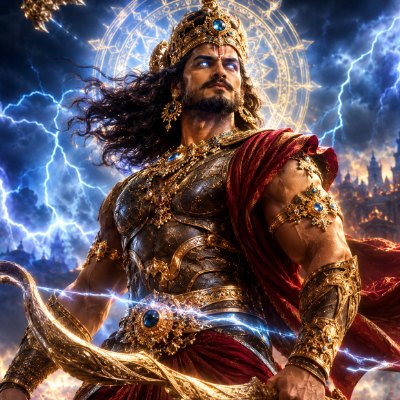
Indrajit — Conqueror of Indra, Crown Prince of Lanka, Greatest Warrior Son of Ravana
Indrajit · Meghanada · Indra-jit · conqueror of Indra · Ravani · Paulastya · crown prince of Lanka
Indrajit, whose birth name is Meghanada, is the eldest son of Ravana — the demon-king of Lanka — and his chief queen Mandodari, the daughter of Maya the Danava architect. He is the crown prince of Lanka and the greatest warrior among all of Ravana's sons, described across the Valmiki Ramayana, the Mahabharata, the Puranas, and numerous retellings of the Ramayana as a figure of supernatural martial power whose abilities exceed those of most gods and whose mastery of illusion, divine weapons, and aerial warfare made him the most formidable opponent Rama's forces faced during the siege of Lanka. His birth name Meghanada — meaning "roar of the clouds" or "thunder" — was given at his birth when his cry reportedly resounded like thunder. His epithet Indrajit — meaning "conqueror of Indra" — was earned through his actual defeat and capture of Indra, the king of the gods, an achievement unprecedented in the tradition and one that elevated him to a status beyond that of ordinary warriors. He is ultimately slain by Lakshmana — the younger brother of Rama — in one of the most celebrated and complex combat sequences of the Yuddha Kanda, after Lakshmana fulfils specific conditions that make the killing possible.
✦ The Names and Epithets
Meghanada, his birth name, is a Sanskrit compound of megha, meaning "cloud," and nada, meaning "sound," "roar," or "thunder." The compound means "roar of the clouds" or "thunder," encoding the cosmic scale of his birth cry. The Valmiki Ramayana preserves the tradition that when Meghanada was born, his cry was so powerful it sounded like the roar of thunder, which led to his name. This birth-name is used alongside Indrajit throughout the tradition, with different texts and different passages preferring one or the other.
Indrajit is a compound of Indra — the king of the gods — and jit, from the root ji, meaning "to conquer" or "to vanquish." The epithet thus means "he who has conquered Indra" or "conqueror of Indra," and it was conferred upon him specifically after his defeat and capture of Indra in battle, a feat for which Brahma granted him a boon. This is not a hereditary title or a name given at birth but an earned epithet that permanently replaced his birth name in popular usage — a measure of the extraordinary significance the tradition attaches to his defeat of the king of the gods.
Ravani is a patronymic meaning "son of Ravana." Paulastya is a further patronymic meaning "descendant of Pulastya," connecting him to his great-grandfather the Saptarishi. These patronymics are used in formal and genealogical contexts across the Puranic and epic literature.
✦ Lineage
- Father: Ravana — the ten-headed demon-king of Lanka, son of the sage Vishrava and the Rakshasi Kaikesi, daughter of the demon Sumali. A master of the Vedas, a devoted worshipper of Shiva, and a warrior of incomparable power, whose pride, violence toward women, and abduction of Sita led to the destruction of his dynasty. He is the principal antagonist of the Valmiki Ramayana.
- Mother: Mandodari — the chief queen of Ravana and the most celebrated of his wives, daughter of Maya the Danava architect and his wife Hema the Apsara. She is counted among the Panchakanyas — the five supremely virtuous women of the Hindu tradition — and is described across the Ramayana as a woman of extraordinary beauty, learning, and moral clarity who consistently counselled Ravana to return Sita and avoid destruction.
- Paternal grandfather: Vishrava — a celebrated sage, son of Pulastya and Manini daughter of Trinabindu, a king of the solar dynasty. He received the knowledge of Brahman directly from Pulastya and is described as a sage whose spiritual accomplishments were comparable to those of his father.
- Paternal great-grandfather: Pulastya — one of the ten Prajapatis and one of the Saptarishis, a mind-born son of Brahma the creator, and the transmitter of the Vishnu Purana from Brahma to Parashara.
- Maternal grandfather: Maya — the celebrated Danava architect, son of Kashyapa and Danu, the most renowned builder among the asura races, builder of the Pandavas' illusory assembly hall in the Mahabharata and associated with the construction of Lanka's magnificent structures.
- Maternal grandmother: Hema — an Apsara of the heavenly realms, wife of Maya.
- Paternal half-brothers: Atikaya — son of Ravana by Dhanyamalini, slain by Lakshmana through the Brahmastra; Akshayakumara — slain by Hanuman in the Sundara Kanda; Narantaka — slain by Angada; Devantaka — slain by Hanuman; Trishira — the three-headed son of Ravana slain by Rama himself.
- Paternal uncles: Kumbhakarna — Ravana's enormous brother slain by Rama; Vibhishana — Ravana's righteous younger brother who defected to Rama's cause and was crowned king of Lanka; Shurpanakha — Ravana's sister whose disfigurement by Lakshmana triggered the central conflict of the Ramayana.
- Paternal uncle: Kubera — the god of wealth and lord of the Yakshas, son of Vishrava by his first wife Ilavida, and Ravana's half-brother. Indrajit's grandfather Vishrava and Kubera's father Vishrava are the same person, making Kubera Indrajit's paternal uncle.
- Wife: Sulochana — also known as Prameela in some regional traditions, described in some Puranic and post-Valmiki texts as the wife of Indrajit, a Naga princess of great beauty and devotion. The Valmiki Ramayana does not name Indrajit's wife, and the identification of Sulochana as his wife belongs primarily to later Puranic and regional Ramayana traditions rather than to the primary epic text. She is celebrated in these traditions as a devoted wife whose grief at Indrajit's death is described with great pathos.
✦ Birth and Early Power
The birth of Meghanada is described in the Valmiki Ramayana's Uttara Kanda with details that establish his supernatural nature from the very moment of his entry into the world. His cry at birth was of such power and volume that it sounded like a clap of thunder — the sound that gives him his birth name. Even before his great achievements on the battlefield, the tradition presents him as a being of extraordinary capacity from birth, consistent with his parentage: the son of the most powerful Rakshasa king and the daughter of the most celebrated Danava architect, himself descended from a Saptarishi and ultimately from Brahma.
Meghanada is described as having performed tapas of great intensity from a young age, directed toward acquiring divine weapons and supernatural powers beyond those of his birth inheritance. His austerities were directed toward several deities — Brahma, Shiva, and others — and through these he obtained specific endowments that made him the most dangerous warrior of his generation. Among the most significant of these was the boon of the Brahmastra and access to other supreme divine weapons, and — most critically — the ability to perform a specific yajna, the Nikumbhila yajna, through which he could make himself completely invisible and invulnerable during battle. This yajna, dedicated to a form of the goddess, was the source of his most feared battlefield power: the ability to attack enemies who could neither see nor locate him.
✦ The Defeat and Capture of Indra
The episode that earned Meghanada the epithet Indrajit is narrated in the Valmiki Ramayana's Uttara Kanda as part of the broader account of Ravana's conquests. After obtaining his divine weapons through austerities, Meghanada accompanied Ravana in a war against the gods. The war between Ravana's Lanka and Indra's heaven resulted in a battle in which Meghanada faced Indra — the king of the gods, wielder of the thunderbolt Vajra, and the most powerful of the Vedic deities — directly in combat.
Meghanada defeated Indra in battle and — most remarkably — bound him using the Nagapasha, a serpent-weapon of supernatural power, and took him captive. The capture of Indra by a Rakshasa warrior was an event of cosmic significance, representing the most dramatic inversion of the divine order that the Puranic tradition records in the context of Ravana's career. Indra, the king and protector of the gods, the wielder of the Vajra and the destroyer of countless demons across the Vedic tradition, was bound and brought to Lanka as a prisoner.
Brahma intervened to secure Indra's release. He approached Ravana and negotiated with him, and Indra was freed — but in exchange for this release, Brahma granted Meghanada a series of extraordinary boons. These boons included: the ability to make himself invisible in battle and to fight from concealment; near-invulnerability as long as the Nikumbhila yajna remained uncompleted; and the possession of a divine chariot. It was at this point, upon the granting of these boons, that Brahma himself or the assembled gods conferred upon Meghanada the title Indrajit — he who has conquered Indra — the epithet by which he would be known for all time.
✦ Indrajit in the War of Lanka — First Phase
Indrajit's role in the war of Lanka is narrated across several sargas of the Yuddha Kanda and constitutes one of the most complex and dramatically sustained military narratives in the entire Ramayana. He enters the battle on multiple occasions, each time deploying a different aspect of his supernatural arsenal, and each time causing a crisis for Rama's forces that requires a specific counter or divine intervention to resolve.
In one of his earliest major interventions in the war, Indrajit fights from aerial concealment — rendered invisible by his supernatural power — and attacks Rama and Lakshmana with the Nagapasha, the serpent-weapon with which he had previously bound Indra. The Nagapasha binds both Rama and Lakshmana in coils of supernatural serpents from which they cannot free themselves by ordinary means. The two brothers lie bound on the battlefield, apparently defeated, causing consternation and grief among the Vanara forces.
The release from the Nagapasha comes through the intervention of Garuda — the divine eagle, vehicle of Vishnu and the natural enemy of serpents — who descends from the sky and through his mere presence dissolves the serpent bonds. Garuda's appearance to free Rama and Lakshmana is presented in the Ramayana as a significant divine intervention, and it serves simultaneously to liberate the brothers and to subtly signal Rama's divine identity as an avatar of Vishnu, whose vehicle Garuda is.
✦ Indrajit in the War of Lanka — The Shakti Weapon and the Deceptive Sita
In a subsequent phase of the war, Indrajit employs two further stratagems that demonstrate both his martial genius and his capacity for psychological warfare. First, fighting from aerial concealment, he uses the Shakti — a divine spear — against Lakshmana, striking him with a blow of such devastating power that Lakshmana falls unconscious on the battlefield, apparently dead. This episode is one of the most emotionally intense in the Yuddha Kanda — Rama, believing his brother dead, mourns with great grief, and only the intervention of Jambavan who knows the remedy and despatches Hanuman to the Himalayas to bring the Sanjeevani herb saves Lakshmana's life. Hanuman's famous journey to fetch the life-restoring herb — and his carrying of the entire mountain when he cannot identify the specific plant — is precipitated by Indrajit's use of the Shakti weapon against Lakshmana.
Second, Indrajit employs a stratagem of psychological warfare of extraordinary cruelty. He creates a magical illusion — a maya form — of Sita herself, brings this illusory Sita to the battlefield in his chariot where the Vanaras and Hanuman can see her, and before their eyes beheads the illusion. The Vanaras, believing they have witnessed the actual death of Sita for whom the entire war is being fought, are thrown into despair — if Sita is dead the war has no purpose. Hanuman in particular is described as being overcome with grief. Only the wise counsel of Vibhishana, who recognises that Indrajit would not actually kill Sita since Ravana desires her, restores understanding of what has happened. This episode — the use of a deceptive Sita illusion as a weapon of psychological warfare — is one of the most dramatic demonstrations of Indrajit's strategic intelligence throughout the war.
✦ The Conditions for Indrajit's Death and the Nikumbhila Yajna
The key to Indrajit's invulnerability and the key to his defeat lie in the same source — the Nikumbhila yajna, a specific sacrificial ritual performed at a sacred spot called Nikumbhila, dedicated to a form of the goddess. As long as this yajna was completed, Indrajit retained the boon of invulnerability granted by Brahma. However, the boon came with a specific condition: if the yajna were interrupted before completion — if Indrajit were disturbed and forced to abandon the sacrifice partway through — the protection it conferred would be lost and he could be killed.
Vibhishana, knowing the terms of his nephew's boon, reveals this critical intelligence to Rama and Lakshmana. He explains that if Lakshmana can reach the Nikumbhila grove while Indrajit is performing the yajna and interrupt the ritual before it is complete, Indrajit will lose his supernatural protection and can be killed. This intelligence transforms the entire tactical situation — the way to defeat the seemingly invulnerable Indrajit is not through superior weapons or greater strength but through the strategic interruption of his ritual.
Lakshmana is chosen for this mission and sets out with Vibhishana and a force of Vanaras toward the Nikumbhila grove. They find Indrajit in the midst of the yajna. Indrajit, seeing them arrive before the ritual is complete, abandons the sacrifice and engages Lakshmana in battle — the very abandonment of the yajna that Lakshmana's arrival forces upon him being the act that fulfils the condition for his defeat. The battle between Lakshmana and Indrajit at the Nikumbhila grove is the decisive encounter that will end Indrajit's life.
✦ The Final Battle and Death of Indrajit
The duel between Lakshmana and Indrajit at the Nikumbhila grove is one of the most extended and elaborately narrated combat sequences in the Valmiki Ramayana. The two warriors are evenly matched in skill — both are archers of supreme ability — and the battle goes through multiple phases, with each warrior calling upon progressively more powerful weapons and counter-weapons. Indrajit invokes a series of divine weapons drawn from different divine lineages — weapons of Brahma, of Indra, of Agni, of Vayu — and Lakshmana counters each with an equivalent or superior weapon drawn from the same traditions.
The climax of the battle comes when Lakshmana invokes the Indrastra — the divine weapon of Indra himself — and charges an arrow with its power. This choice of weapon carries specific narrative significance: Indrajit's epithet is "conqueror of Indra," and it is Indra's own weapon that ultimately kills him. The weapon that defines his greatest triumph — the subjugation of Indra — becomes the instrument of his defeat. Lakshmana releases the Indrastra and it strikes Indrajit with irresistible force, severing his head. Indrajit falls dead at the Nikumbhila grove, his yajna incomplete, his supernatural protection gone, killed by the weapon of the god he had conquered.
The death of Indrajit is presented in the Ramayana as the decisive turning point of the war. With the most powerful warrior on Lanka's side dead, Ravana's defeat becomes inevitable. The Valmiki Ramayana describes Ravana's grief at his son's death as more devastating than any of the other losses he has suffered — deeper even than the grief he feels for Kumbhakarna — because Indrajit was not merely his son but the one figure on whom the military survival of Lanka genuinely depended. Ravana's lament over Indrajit is one of the most emotionally powerful passages in the Yuddha Kanda, and it is this grief that drives Ravana to his final and fatal confrontation with Rama.
✦ Indrajit's Weapons and Their Theological Significance
Indrajit's arsenal of divine weapons is among the most extensive and theologically complex of any warrior in the Ramayana. He possesses and uses the Nagapasha — the serpent weapon that binds enemies in supernatural serpent coils; the Brahmastra — Brahma's supreme weapon; the Shakti — the divine spear; various weapons drawn from different elemental traditions; and the ability to create maya illusions of devastating psychological impact. His mastery of the Brahmastra is particularly significant in theological terms, as this weapon is the highest in the tradition's hierarchy of divine arms and its possession marks its wielder as a warrior of the very highest order.
The breadth of Indrajit's divine arsenal reflects the principle that he had earned weapons from multiple sources through sustained austerity — he was not merely born with supernatural power but had actively acquired specific divine endowments through his own tapas and through the consequences of his extraordinary military achievement in defeating Indra. His weapons thus represent both his inherited capacity as the son of Ravana and the accumulated result of his own spiritual and martial effort.
✦ Indrajit's Character and the Tradition's Moral Assessment
The tradition's moral assessment of Indrajit is more complex than its treatment of most of Ravana's other sons. He is the product of a righteous mother and a transgressive father, and his own character in the Ramayana reflects this dual inheritance. He is deeply loyal to his father and to Lanka, fights with extraordinary skill and genuine courage, and his death is mourned even by some of those who oppose him. At the same time, his use of deception — fighting from invisible concealment, creating the false Sita illusion, using the Nagapasha to bind opponents who cannot see him — represents a form of warfare that the Ramayana tradition codes as adharmic, inconsistent with the open-field archery duels that constitute honourable combat in the epic's ethical framework.
Later Puranic and regional traditions develop Indrajit's character in varying directions. Some regional retellings — particularly Bengali and Southeast Asian traditions — present him as a more sympathetic and even heroic figure, a loyal son who fights for his family's cause with everything at his disposal, and whose death is a genuine tragedy rather than merely the removal of a villain. The Bengali tradition in particular, as represented in Krittibas's Ramayana, gives Indrajit considerable moral complexity and presents his wife Sulochana's grief as one of the most moving episodes associated with him. These later developments reflect the tradition's ongoing negotiation with the moral complexity of a figure who was simultaneously the enemy of the heroes and a being of genuinely extraordinary qualities.
✦ Textual Variants and Inconsistencies
The Valmiki Ramayana is the primary and most authoritative source for Indrajit's narrative, and it is broadly consistent across its major recensions in the core account of his birth, his defeat of Indra, his role in the war of Lanka, and his death at Lakshmana's hands. Regional and later retellings vary considerably in their treatment of specific episodes — the number and nature of his weapons, the precise sequence of his battle appearances, the identity of his wife, and the details of his yajna — but the central narrative structure is preserved consistently.
One notable variant concerns the weapon with which Lakshmana kills Indrajit. The Valmiki Ramayana specifies the Indrastra — Indra's own weapon — as the killing weapon. Some regional retellings specify different weapons or give different accounts of the final exchange, but the Valmiki Ramayana's specification of the Indrastra is theologically the most satisfying and is the most widely accepted account.
The wife of Indrajit — Sulochana or Prameela depending on the regional tradition — is entirely absent from the Valmiki Ramayana and belongs exclusively to later Puranic and regional traditions. Her identity, her parentage as a Naga princess in some accounts, and the episode of her grief and sati after Indrajit's death are all post-Valmiki developments, attested in later texts and regional retellings but not in the primary epic.
✦ Connection to the Wider Genealogy
Indrajit's genealogical position is among the most richly connected of any figure in the Ramayana. Through his father Ravana he descends from Brahma through the Pulastya-Vishrava sage lineage — a great-great-grandson of the creator on the paternal side. Through his mother Mandodari he descends from the Danava Maya and the Apsara Hema, connecting him to the Danava lineage of Kashyapa and Danu on the maternal side. Through Mandodari's probable sisters Somaprabha and Dhanyamalini his maternal family extends to Nalakubara son of Kubera and to Ravana's own household. Through his paternal uncle Kubera he is connected to the divine household of the lord of wealth and through Kubera's sons Nalakubara and Manigriva to the Krishna narrative of the Bhagavata Purana. Through his defeat of Indra he stands in a unique narrative relationship with the king of the gods — the one figure in the tradition who physically conquered and bound the divine sovereign. Through Lakshmana's killing of him with the Indrastra he is connected in his very death to the god he conquered in life. He leaves no descendants recorded in the Valmiki Ramayana, his lineage ending with his death at the Nikumbhila grove.
✦ References
- Primary Sources
- Valmiki Ramayana, Yuddha Kanda: The principal and most detailed source for Indrajit's role in the Lanka war — his multiple battle appearances, his use of the Nagapasha against Rama and Lakshmana, his aerial invisible warfare, the Shakti weapon episode and Lakshmana's wounding, the false Sita illusion, the Nikumbhila yajna, and his final battle with and death at the hands of Lakshmana through the Indrastra.
- Valmiki Ramayana, Uttara Kanda: Narrates the background of Indrajit's birth as Meghanada, the source of his birth name, his austerities and acquisition of divine weapons, his war against the gods, his defeat and capture of Indra, Brahma's intervention to free Indra, and the granting of the epithet Indrajit along with the specific boons that made him nearly invulnerable.
- Valmiki Ramayana, Sundara Kanda: Contains Hanuman's observation of Lanka and its defences including references to Indrajit as the crown prince and most formidable warrior of Lanka, establishing his status before the war begins.
- Mahabharata, various books: Contains references to Indrajit as the conqueror of Indra and as one of the great warriors of the tradition, contributing supplementary epic attestation for his extraordinary status.
- Bhagavata Purana: Contains references to Indrajit within the broader context of Ravana's family and the Ramayana narrative, providing Puranic attestation for his genealogical identity.
- Adhyatma Ramayana: A Sanskrit retelling of the Ramayana embedded in the Brahmanda Purana, which elaborates on certain episodes of Indrajit's warfare and death with additional theological reflection on the significance of his defeat.
- Secondary Sources
- Mani, Vettam. Puranic Encyclopaedia. Motilal Banarsidass, 1975: Provides a comprehensive entry on Indrajit summarising his birth, his defeat of Indra, his weapons and powers, his role in the Lanka war, the conditions of his invulnerability, and his death at Lakshmana's hands, with cross-references to the primary Ramayana passages.
- Goldman, Robert P. et al. (trans.). The Ramayana of Valmiki, Vol. 6: Yuddhakanda. Princeton University Press, 2009: Provides a critical translation and scholarly annotation of the Yuddha Kanda including all of Indrajit's major battle episodes, the Nikumbhila yajna sequence, and his final combat with Lakshmana, with extensive textual notes on variants and theological significance.
- Pollock, Sheldon. The Language of the Gods in the World of Men: Sanskrit, Culture, and Power in Premodern India. University of California Press, 2006: Discusses the Ramayana tradition including the significance of Indrajit's episodes within the broader cultural and theological framework of the epic.
- Wisdomlib (wisdomlib.org): Offers extensively cross-referenced citations of Indrajit and Meghanada across digitised Sanskrit texts, confirming his attestation across the Valmiki Ramayana, Mahabharata, Bhagavata Purana, and related sources.