
About
Atikaya — Son of Ravana and Dhanyamalini, Slain by Lakshmana
Atikaya · Ati-kaya · son of Dhanyamalini · prince of Lanka
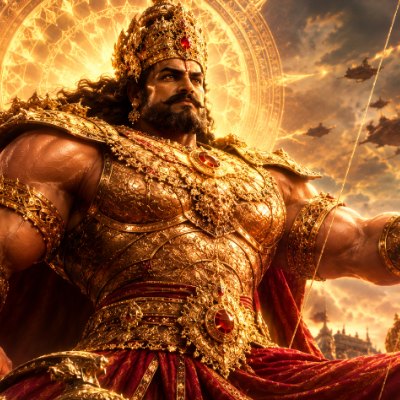
Atikaya is a son of Ravana — the ten-headed demon-king of Lanka and principal antagonist of the Valmiki Ramayana — and his second wife Dhanyamalini, as identified explicitly by Vibhishana in the Yuddha Kanda of the Valmiki Ramayana. He is one of the most formidable warriors among Ravana's sons, described as a figure of enormous physical stature and supernatural power, having received from Brahma the specific boon of divine armour impenetrable by ordinary weapons and mastery of the Brahmastra. He fights in the war of Lanka against Rama's forces after the deaths of many of Lanka's senior warriors, and is ultimately slain by Lakshmana — the younger brother of Rama — through the invocation of the Brahmastra, the only weapon capable of piercing the divine armour Brahma had granted him. His death is recorded in the Yuddha Kanda of the Valmiki Ramayana and is one of the significant martial episodes of the Lanka war.
✦ The Name
The name Atikaya is a Sanskrit compound of two elements. The first, ati, is an intensifying prefix meaning "exceeding," "surpassing," "very," or "beyond measure." The second, kaya, means "body" or "form." The compound thus means "he of the exceedingly large body," "he whose body surpasses all others," or more simply "the enormous one." This name directly encodes his most immediately distinctive physical characteristic — his vast size — which is consistently emphasised across all sources that describe him. The name is an epithet of physical description rather than of function or lineage, and it is entirely consistent with the Ramayana tradition's practice of naming Rakshasa warriors after their most prominent physical or martial attributes.
✦ Lineage
- Father: Ravana — the ten-headed, twenty-armed demon-king of Lanka, son of the sage Vishrava and his second wife Kaikesi, a Rakshasi and daughter of the demon Sumali. Ravana is described as a master of the Vedas, a devoted worshipper of Shiva, and a warrior of incomparable power whose pride, violence toward women, and abduction of Sita led to the destruction of his dynasty and the fall of Lanka at Rama's hands.
- Mother: Dhanyamalini — the second wife of Ravana, identified in some traditions as a daughter of Maya the Danava architect and therefore a sister of Mandodari, Ravana's chief queen. She appears by name in the Sundara Kanda of the Valmiki Ramayana. Her identification as Atikaya's mother is made explicitly by Vibhishana in the Yuddha Kanda.
- Paternal grandfather: Vishrava — a celebrated sage, son of Pulastya and Manini, daughter of Trinabindu, a king of the solar dynasty of the Nedishtha branch. He is the father of Kubera by his first wife Ilavida, and of Ravana, Kumbhakarna, Vibhishana, and Shurpanakha by his second wife Kaikesi.
- Paternal great-grandfather: Pulastya — one of the Saptarishis, a mind-born son of Brahma the creator, and the transmitter of the Vishnu Purana.
- Maternal grandfather: Maya — the celebrated Danava architect, son of Kashyapa and Danu, builder of the Pandavas' illusory assembly hall in the Mahabharata and of Lanka's magnificent structures. If Dhanyamalini is indeed Maya's daughter, then Maya is Atikaya's maternal grandfather, making Atikaya a grandchild of the most celebrated architect of the asura world.
- Paternal half-brother: Meghanada, also known as Indrajit — the eldest and most celebrated of Ravana's sons, born of his chief queen Mandodari. Indrajit defeated and bound Indra in battle, earning his epithet, and was the greatest warrior on Lanka's side during the war, ultimately slain by Lakshmana.
- Paternal half-brothers: Akshayakumara — a son of Ravana slain by Hanuman during his search of Lanka in the Sundara Kanda; Narantaka, Devantaka, and Trishira — sons of Ravana who fought and fell in the Lanka war; and Prahasta — a general of Lanka's forces, sometimes identified as a son of Ravana in some accounts though primarily as his commander-in-chief.
- Paternal uncle: Kubera — the god of wealth, lord of the Yakshas, and one of the eight Lokapalas presiding over the north, son of Vishrava by his first wife Ilavida. He is thus Ravana's half-brother and Atikaya's paternal uncle.
- Paternal uncle: Vibhishana — Ravana's righteous younger brother, who defected to Rama's cause and was crowned king of Lanka after Ravana's defeat. It is Vibhishana who identifies Atikaya by name to Rama in the Yuddha Kanda, explaining his powers and the means of his defeat.
✦ Atikaya's Boons and Powers
A central feature of Atikaya's characterisation in the Yuddha Kanda is the account of the boons he received from Brahma through his own tapas. The Ramayana describes him as having performed austerities directed toward Brahma and having obtained specific supernatural endowments as a result. Chief among these were the grant of divine armour — kavaca — of Brahma's own making, which no conventional weapon could pierce or destroy, and mastery of the Brahmastra, the supreme divine weapon of Brahma capable of destroying everything it was directed against. These two boons together made Atikaya a warrior of near-invincibility in the field of battle: his body was sheathed in armour that no arrow, no club, no ordinary divine weapon could penetrate, and he himself possessed the most devastating offensive weapon in the divine arsenal.
The Valmiki Ramayana also describes Atikaya as possessing great physical size — consistent with his name — and as being equipped with a magnificent chariot and formidable conventional weapons in addition to his divine endowments. He is presented as a warrior who combined supernatural protection with genuine martial skill and the awesome offensive capability of the Brahmastra, making him one of the most dangerous opponents Rama's forces faced during the war.
✦ Atikaya's Entry into Battle
Atikaya enters the battlefield of Lanka during the Yuddha Kanda after the deaths of many of Lanka's most celebrated warriors — including Prahasta, the commander of Lanka's forces, and Kumbhakarna, Ravana's enormous brother. His entry is described as a moment of terror for Rama's Vanara army: his vast body, his divine armour gleaming in the sun, his chariot drawn by powerful horses, and his commanding presence on the battlefield caused consternation among the allied forces. He challenged the Vanara forces and engaged them with devastating effect, his arrows and weapons causing great casualties.
The Vanara warriors — including several of the most capable fighters in Rama's army — attempted to engage Atikaya and found their weapons unable to harm him, deflecting off his divine armour without effect. The frustration of the Vanara forces in the face of Atikaya's invulnerability to conventional weapons is described at some length in the Ramayana, establishing the severity of the problem he posed before the resolution is reached.
✦ The Intervention of Vayu and the Brahmastra
The turning point in the encounter with Atikaya comes through the intervention of Vayu, the wind god. Vayu approached Lakshmana and revealed to him the critical information that Atikaya's armour had been granted by Brahma himself and could not be penetrated by any weapon except the Brahmastra — Brahma's own supreme weapon. Only the weapon of the creator could destroy the protection the creator had granted. Vayu's counsel directed Lakshmana to invoke this supreme weapon against Atikaya, specifying that nothing less would suffice.
Lakshmana, receiving this divine guidance, turned to face Atikaya directly. The two engaged in an extended archery duel described in the Yuddha Kanda with considerable detail, in which both warriors demonstrated great skill and in which Atikaya's divine armour continued to deflect Lakshmana's conventional arrows. Lakshmana then invoked the Brahmastra — charging an arrow with the power of Brahma's own weapon through the appropriate mantra — and released it at Atikaya. The Brahmastra penetrated the divine armour that had repelled everything else, and Atikaya fell. His death is described as a tremendous blow to Lanka's forces and to Ravana personally, the loss of another formidable son in the war whose ultimate cause was Ravana's own transgression.
✦ Vibhishana's Identification of Atikaya
A notable structural feature of Atikaya's episode in the Yuddha Kanda is the role of Vibhishana in identifying him to Rama. Throughout the Lanka war, Vibhishana serves as an intelligence source for Rama's forces, identifying enemy warriors, explaining their powers and histories, and advising on strategy. It is through one such identification that Dhanyamalini is named in the primary text at all — Vibhishana, pointing out Atikaya to Rama, identifies him as the son of Ravana by Dhanyamalini. This identification is the sole explicit statement of Atikaya's maternal parentage in the Valmiki Ramayana and the sole explicit naming of Dhanyamalini in a genealogical context within the primary text.
Vibhishana's role as identifier is itself theologically and narratively significant. As Ravana's own brother, he is uniquely positioned to know the identities, histories, and powers of Lanka's warriors, and his defection to Rama's cause transforms this intimate knowledge into a tactical asset for the righteous side. His identification of Atikaya is not merely genealogical information but tactical intelligence — knowing that Atikaya is protected by Brahma's armour is essential to defeating him, and it is this combination of genealogical identification and tactical counsel that makes the passage in which Dhanyamalini is named so consequential.
✦ Atikaya among Ravana's Sons
Atikaya is one of several sons of Ravana who fall during the war of Lanka, and his position within the sequence of these deaths carries narrative significance. The progressive elimination of Ravana's most powerful sons — each death bringing the catastrophe closer and each representing a further consequence of Ravana's initial transgression in abducting Sita — is one of the structural patterns of the Yuddha Kanda. Akshayakumara was slain by Hanuman during the Sundara Kanda, before the war proper began. Atikaya falls during the war itself. Indrajit-Meghanada, the greatest of all Ravana's sons and the last to die, falls to Lakshmana near the war's end. This sequence — from the least to the greatest of Ravana's sons — mirrors the escalating tragedy of Lanka's destruction and Ravana's inexorable movement toward his own end.
Among Ravana's sons Atikaya is distinguished by his specific combination of defensive invulnerability and offensive power. Where Indrajit is characterised primarily by his mastery of illusion and his use of the Nagapasha and the Brahmastra in attack, Atikaya is characterised primarily by his physical might and the impenetrability of his divine armour. They represent different aspects of the supernatural warrior tradition within the Rakshasa lineage of Lanka.
✦ Textual Variants and Inconsistencies
The attribution of Atikaya as the son of Dhanyamalini is explicit and consistent in the Valmiki Ramayana. However, some other sources and regional retellings of the Ramayana attribute Atikaya to Mandodari rather than Dhanyamalini, placing him among Ravana's sons by his chief queen. This variant is not supported by the Valmiki Ramayana text, which gives the attribution to Dhanyamalini through Vibhishana's identification, and the Valmiki text is the primary authority. The variant attribution to Mandodari is noted here as a textual inconsistency found in some secondary and regional sources but not in the primary epic.
Some later Puranic and regional texts enumerate additional children of Atikaya or provide details of a wife, but these are not attested in the Valmiki Ramayana itself and cannot be included without further primary source verification.
✦ Connection to the Wider Genealogy
Atikaya's genealogical position brings together several of the most significant lineage streams in the Puranic and epic tradition. Through his father Ravana he descends from Brahma through the Pulastya-Vishrava sage lineage, making him a great-great-grandson of Brahma on the paternal side. Through Ravana's maternal line he is descended from the Rakshasa lineage of Sumali and through Sumali's mother Ketumati from the broader Rakshasa genealogy. Through his mother Dhanyamalini — if the identification as Maya's daughter is accepted — he is connected to the Danava lineage of Kashyapa and Danu through Maya, and to the Apsara lineage through Hema. Through his paternal uncle Kubera he is connected to the divine household of the lord of wealth. Through his half-brother Indrajit and his paternal uncle Vibhishana he is connected to the principal surviving lineages of Lanka's royal family after the war. His death at Lakshmana's hands by the Brahmastra, invoked on the advice of Vayu, places him in a direct narrative relationship with three of the Ramayana's central divine figures — Lakshmana, Vayu, and Brahma whose weapon was both his protection and ultimately the instrument of his death.
✦ References
- Primary Sources
- Valmiki Ramayana, Yuddha Kanda: The principal source for Atikaya's narrative — Vibhishana's identification of him as the son of Ravana by Dhanyamalini, the description of his divine armour and Brahmastra boons, his entry into battle, the intervention of Vayu advising Lakshmana to use the Brahmastra, the duel between Lakshmana and Atikaya, and Atikaya's death.
- Valmiki Ramayana, Sundara Kanda: Names Dhanyamalini as a wife of Ravana, providing the context for Atikaya's maternal parentage established in the Yuddha Kanda.
- Valmiki Ramayana, Uttara Kanda: Provides background on Ravana's lineage and family, contributing context for Atikaya's position among Ravana's sons.
- Secondary Sources
- Mani, Vettam. Puranic Encyclopaedia. Motilal Banarsidass, 1975: Provides a consolidated entry on Atikaya summarising his parentage, his boons from Brahma, his battle with Lakshmana, and his death by the Brahmastra, with cross-references to the Yuddha Kanda passages.
- Goldman, Robert P. et al. (trans.). The Ramayana of Valmiki, Vol. 6: Yuddhakanda. Princeton University Press, 2009: Provides a critical translation and scholarly annotation of the Yuddha Kanda including the full account of Atikaya's battle and death, with textual notes on his characterisation and on variants in the attribution of his maternal parentage.
- Wisdomlib (wisdomlib.org): Offers cross-referenced citations of Atikaya across digitised Sanskrit texts, confirming his attestation in the Yuddha Kanda of the Valmiki Ramayana and in related Puranic sources.