
About
Dhanyamalini — Second Wife of Ravana, Mother of Atikaya
Dhanyamalini · Dhanya-malini · second consort of Ravana
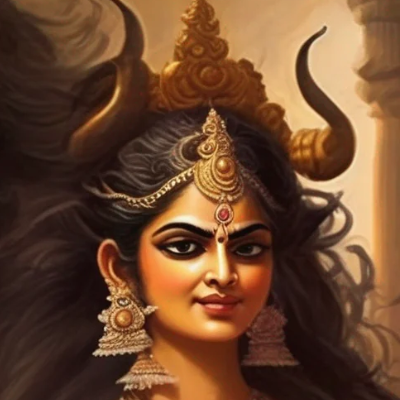
Dhanyamalini is the second wife of Ravana, the demon-king of Lanka and principal antagonist of the Valmiki Ramayana, his chief queen being Mandodari. She appears by name in the Sundara Kanda of the Valmiki Ramayana in a brief but narratively significant episode, and is identified in the Yuddha Kanda as the mother of Atikaya, one of Ravana's most formidable warrior sons who was slain by Lakshmana during the siege of Lanka. Some traditions identify her as a daughter of Maya the Danava architect and therefore a sister of Mandodari, though this parentage is not explicitly stated in the Valmiki Ramayana itself and belongs to secondary and regional traditions rather than to the core primary text. She is described across the sources that mention her as a woman of virtue and dignity who, like Mandodari, is presented as a figure of moral seriousness despite her position in the household of the epic's great villain.
✦ The Name
The name Dhanyamalini is a Sanskrit compound of two elements. The first, dhanya, means "fortunate," "blessed," "wealthy," or "productive" — a word of thoroughly positive connotation associated with abundance, good fortune, and prosperity, and also used in Sanskrit to mean "grain" or "cereals" in the sense of the wealth of the earth's produce. The second element, malini, means "she who wears a garland" or "she who is garlanded" — from mala, meaning garland or necklace of flowers. The compound name thus means "she who is garlanded with good fortune" or "the blessed one adorned with garlands" — a name of auspicious beauty combining the ideas of prosperity and floral adornment. It is a name entirely consistent with the tradition's tendency to give the wives of Ravana names of beauty and auspiciousness, regardless of the morally complex household they inhabit.
✦ Lineage
- Father: Maya — identified in some secondary and regional traditions as Dhanyamalini's father. Maya, also called Mayasura and Maya Danava, is the celebrated Danava architect and master of illusion, son of Kashyapa and Danu, and the most renowned builder among the asura races. He is the architect of the Pandavas' illusory assembly hall in the Mahabharata, the cave palace of the Kishkindha Kanda of the Ramayana, and the triple city of Tripura destroyed by Shiva. His wife Hema is an Apsara. His daughter Mandodari is Ravana's chief queen. This identification of Dhanyamalini as Maya's daughter is attested in secondary sources and regional traditions but is not explicitly stated in the Valmiki Ramayana, and should be understood accordingly.
- Mother: Hema — an Apsara of the heavenly realms, wife of Maya, if the identification of Dhanyamalini as Maya's daughter is accepted. The Valmiki Ramayana does not name Dhanyamalini's mother.
- Sister: Mandodari — the chief queen of Ravana, daughter of Maya and Hema, counted among the Panchakanyas — the five supremely virtuous women of the Hindu tradition. If Dhanyamalini is indeed a daughter of Maya, she and Mandodari are sisters, making both of them wives of the same husband Ravana — a situation that the tradition records without elaborating upon its domestic dynamics.
- Probable sister: Somaprabha — a daughter of Maya and Hema who became the wife of Nalakubara son of Kubera, as recorded in the Kathasaritsagara, and who would thus be Dhanyamalini's sister if the common parentage through Maya is accepted.
- Probable sister: Svayamprabha — named in the Kathasaritsagara as a daughter of Maya alongside Somaprabha, and identified in the Valmiki Ramayana's Kishkindha Kanda as the ascetic guardian of Maya's cave palace built for Hema.
- Husband: Ravana — the ten-headed demon-king of Lanka, son of the sage Vishrava and the Rakshasi Kaikesi, daughter of the demon Sumali. He is the principal antagonist of the Valmiki Ramayana, a figure of extraordinary learning, devotion to Shiva, and Vedic mastery whose career of conquest and whose abduction of Sita led ultimately to the destruction of his dynasty and the fall of Lanka.
- Son: Atikaya — a son of Ravana and Dhanyamalini, identified as such by Vibhishana in the Yuddha Kanda of the Valmiki Ramayana. Atikaya is described as a warrior of great size and supernatural power who had received boons from Brahma rendering him nearly invulnerable to conventional weapons. He was eventually slain by Lakshmana using the Brahmastra on the advice of Vayu, since only this supreme weapon could pierce the divine armour Brahma had granted him. His death is one of the significant battlefield losses of the Lanka war recorded in the Yuddha Kanda.
✦ The Episode in the Sundara Kanda
Dhanyamalini's appearance in the Valmiki Ramayana occurs in the Sundara Kanda, in the passage immediately following Ravana's failed attempt to persuade Sita to abandon her fidelity to Rama and accept him as her husband. Sita had refused him with complete composure and had spoken to him with clarity about the inevitability of his destruction if he persisted in his course. Ravana, unable to move her and restrained from using force by the curse of Nalakubara — which threatened that his head would split into seven pieces if he violated a woman against her will — withdrew in frustration and anger.
It is at this point that Dhanyamalini approached Ravana. She embraced him and attempted to redirect his desire toward herself, urging him to turn away from his obsession with Sita and to find satisfaction with her instead. She spoke dismissively of Sita as unworthy of his attention and offered herself as a more fitting object of his desires. Ravana, however, rejected her advance and departed, remaining entirely fixed in his obsession with Sita despite Dhanyamalini's intervention.
This episode is brief in the Valmiki Ramayana but serves a clear narrative function. It illustrates the completeness of Ravana's obsession with Sita — so consuming that it leads him to reject even the willing embrace of his own wife — and it provides a human dimension to the harem's response to the situation of Sita's captivity. Dhanyamalini's attempt to redirect Ravana is not presented as ignoble; she acts as a wife attempting to recall her husband's attention and to protect both him and herself from the consequences of his destructive fixation. Her failure to achieve this underscores the depth of Ravana's enthralment and the tragic inevitability of the path he was following.
✦ Dhanyamalini's Conduct and Character
Secondary and regional sources that elaborate upon Dhanyamalini beyond the Valmiki Ramayana's brief reference consistently present her as a woman of virtue and genuine moral concern, placing her within the same tradition of Ravana's wives as righteous figures distinguished from their husband's transgressions by their own conduct. Some regional traditions credit her with consoling Sita during her captivity in the Ashoka Vatika and with intervening when Ravana threatened to kill Sita during a moment of rage — physically placing herself between Ravana and Sita to prevent the act. These traditions, while not attested in the Valmiki Ramayana itself, reflect the broader tendency of the Ramayana tradition to present Ravana's wives as moral counterweights to his excesses.
The consistency with which Ravana's principal wives — Mandodari and Dhanyamalini alike — are presented as virtuous women who opposed or mourned his transgressions is itself a significant feature of the tradition's moral architecture. By surrounding Ravana with women of genuine virtue who counselled him toward righteousness, warned him of consequences, and maintained their own integrity within his household, the tradition emphasises that his destruction was not the result of an ignorant or unreflective character but of a wilful choice made in full awareness of the alternative — a choice all the more tragic for being made against the counsel of the wisest people closest to him.
✦ Atikaya and His Significance
Dhanyamalini's most consequential connection to the Ramayana's narrative is through her son Atikaya, whose identification as her son is the sole explicitly attested genealogical detail about her in the Valmiki Ramayana. Atikaya is described in the Yuddha Kanda as a warrior of immense stature — his very name means "he of enormous body" — and of supernatural power. He had propitiated Brahma and received specific boons: mastery of the Brahmastra and the grant of divine armour that could not be pierced by any ordinary weapon. In the battle of Lanka he was a formidable adversary against Rama's forces, and his near-invulnerability frustrated the Vanara warriors until Vayu, the wind god, advised Lakshmana that only the Brahmastra could penetrate Brahma's own armour. Lakshmana invoked the Brahmastra and slew Atikaya, ending the life of one of Ravana's most powerful sons.
The identification of Atikaya as Dhanyamalini's son is made explicitly by Vibhishana — Ravana's righteous brother who had defected to Rama's cause — in the Yuddha Kanda, where he explains to Rama the identity and powers of various warriors arrayed against them. This explicit attribution in the primary text is the most securely attested fact about Dhanyamalini in the entire Valmiki Ramayana.
✦ Textual Variants and Source Honesty
The principal textual question affecting Dhanyamalini's profile is the status of her identification as a daughter of Maya. The Valmiki Ramayana does not state her parentage. The identification as Maya's daughter and Mandodari's sister is found in secondary compilations and regional traditions, and is consistent with the broader pattern of Maya's family connections in the Ramayana tradition — it makes genealogical sense that Ravana, who married Mandodari the daughter of Maya, might also have married another daughter of the same family. However, consistency and plausibility are not the same as primary source attestation, and this profile records the identification honestly as belonging to secondary tradition rather than to the Valmiki Ramayana itself.
There is additionally some variation across sources in the enumeration of Dhanyamalini's children. The Valmiki Ramayana attests Atikaya as her son through Vibhishana's identification. Some secondary sources name additional children, but these are not consistently or securely attested in primary texts and are not included in this profile without further verification.
✦ Connection to the Wider Genealogy
Dhanyamalini's genealogical position, if the identification as Maya's daughter is accepted, connects her to the same complex network of lineages that surrounds her probable sister Mandodari. Through Maya she belongs to the Danava lineage of Kashyapa and Danu. Through her mother Hema she is connected to the Apsara lineage. Through her husband Ravana she is connected to the Pulastya sage lineage descending from Brahma, to the solar dynasty through Ravana's paternal grandmother Manini and great-grandfather Trinabindu, and to Kubera and the divine household of the lord of wealth through Ravana's half-brother. Through her son Atikaya she contributes to the martial lineage of Lanka's royal family, cut short by his death at Lakshmana's hands during the war. Through her probable sister Mandodari's second marriage to Vibhishana after Ravana's death, she is connected to the post-war governance of Lanka. These connections, taken together, place Dhanyamalini at the intersection of the same Danava, Apsara, Rakshasa, and sage lineages that characterise the broader family of Maya within the Ramayana tradition.
✦ References
- Primary Sources
- Valmiki Ramayana, Sundara Kanda, Sarga 22: The principal primary source for Dhanyamalini's appearance by name, recording her approach to Ravana following his rejection by Sita and her attempt to redirect his desire toward herself.
- Valmiki Ramayana, Yuddha Kanda: Contains Vibhishana's identification of Atikaya as the son of Dhanyamalini, providing the sole explicit genealogical attribution for her in the primary text, and narrates Atikaya's battle and death at Lakshmana's hands by the Brahmastra.
- Valmiki Ramayana, Uttara Kanda: Provides background on Maya as the father of Mandodari and on Lanka's royal family, contributing context for the secondary tradition identifying Dhanyamalini as Maya's daughter.
- Secondary Sources
- Mani, Vettam. Puranic Encyclopaedia. Motilal Banarsidass, 1975: Provides entries on Ravana's wives and on Atikaya, noting Dhanyamalini's identification as Atikaya's mother and her appearance in the Sundara Kanda.
- Goldman, Robert P. et al. (trans.). The Ramayana of Valmiki, Vol. 5: Sundarakanda. Princeton University Press, 1996: Provides a critical translation and scholarly annotation of the Sundara Kanda including the passage in which Dhanyamalini appears, with textual notes on her role within the episode.
- HinduPad (hindupad.com): Records the secondary tradition identifying Dhanyamalini as the daughter of Maya and sister of Mandodari, and notes the regional traditions of her consolation of Sita and her intervention to prevent Ravana from harming Sita; this information is included with the caveat that it belongs to secondary and regional tradition rather than the primary Valmiki Ramayana text.
- Wisdomlib (wisdomlib.org): Offers cross-referenced citations of Dhanyamalini across digitised Sanskrit texts, confirming her attestation in the Sundara Kanda and Yuddha Kanda of the Valmiki Ramayana.