
About
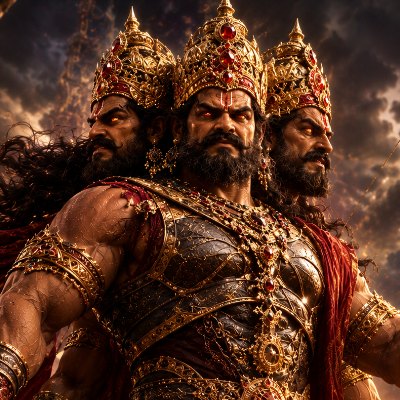
Trishira — Son of Ravana, Three-Headed Prince of Lanka, Slain by Rama
Trishira · Tri-shira · Trishiras · three-headed one · son of Ravana · prince of Lanka
Trishira is a son of Ravana, the demon-king of Lanka, named in the Yuddha Kanda of the Valmiki Ramayana among the princes of Lanka who fight against Rama's forces during the siege of Lanka. He is distinguished among Ravana's sons by his distinctive physical characteristic of possessing three heads, encoded directly in his name. He enters the battlefield in the same phase of the war as several of his brothers — Narantaka, Devantaka, and others — and is slain by Rama himself, making his death one of the few among Ravana's sons attributed directly to the epic's hero rather than to one of his allies. The primary sources do not specify his mother among Ravana's wives with consistency, and his profile is shaped primarily by his battle episode and his distinctive physical characterisation.
✦ The Name
The name Trishira is a Sanskrit compound of two elements. The first, tri, means "three." The second, shira or shiras, means "head." The compound thus means "he of three heads" or "the three-headed one" — a name that directly encodes a physical characteristic rather than a martial epithet or a quality of character. Multiple heads are a recognised mark of supernatural power and fearsome nature in the Rakshasa tradition, the most prominent example being Ravana himself with his ten heads. Trishira's three heads place him within this tradition of multi-headed Rakshasa beings, his number being less than his father's ten but still marking him as a being of superhuman nature. The name appears in variant forms Trishira and Trishiras across different manuscripts, both referring to the same Sanskrit compound with the same meaning.
✦ Lineage
- Father: Ravana — the ten-headed demon-king of Lanka, son of the sage Vishrava and the Rakshasi Kaikesi, daughter of the demon Sumali. He is the principal antagonist of the Valmiki Ramayana, a figure of extraordinary learning, devotion to Shiva, and mastery of the Vedas, whose abduction of Sita led to the destruction of his dynasty and the fall of Lanka at Rama's hands.
- Mother: The Valmiki Ramayana does not explicitly name Trishira's mother among Ravana's wives in the passages dealing with his battle and death. Some secondary sources and regional traditions group him among sons born of wives other than Mandodari, but no primary text gives a consistent and unambiguous maternal attribution for him that can be cited with confidence in this profile.
- Paternal grandfather: Vishrava — a celebrated sage, son of Pulastya and Manini, daughter of Trinabindu, a king of the solar dynasty of the Nedishtha branch descended from Vaivasvata Manu through the line of the emperor Marutta. He is the father of Kubera by his first wife Ilavida and of Ravana, Kumbhakarna, Vibhishana, and Shurpanakha by his second wife Kaikesi.
- Paternal great-grandfather: Pulastya — one of the ten Prajapatis and one of the Saptarishis, a mind-born son of Brahma the creator, and the transmitter of the Vishnu Purana from Brahma to Parashara.
- Half-brother: Meghanada, also known as Indrajit — the eldest and most celebrated of Ravana's sons, born of Mandodari, renowned as the conqueror of Indra and the greatest warrior on Lanka's side, ultimately slain by Lakshmana.
- Half-brother: Atikaya — son of Ravana by Dhanyamalini, identified explicitly in the Yuddha Kanda as such by Vibhishana, possessor of Brahma's divine armour, slain by Lakshmana through the Brahmastra.
- Half-brother: Akshayakumara — son of Ravana, slain by Hanuman during his search of Lanka in the Sundara Kanda.
- Brother: Narantaka — a son of Ravana who enters the battle in the same phase as Trishira and is slain by Angada, son of Vali.
- Brother: Devantaka — a son of Ravana who enters the battle in the same phase as Trishira and is slain by Hanuman.
- Paternal uncle: Kumbhakarna — Ravana's enormous brother, who fought in the Lanka war and was slain by Rama himself.
- Paternal uncle: Vibhishana — Ravana's righteous younger brother, who defected to Rama's cause, was crowned king of Lanka after Ravana's defeat, and serves throughout the Yuddha Kanda as Rama's principal intelligence source regarding Lanka's warriors and their powers.
- Paternal uncle: Kubera — the god of wealth, lord of the Yakshas, and one of the eight Lokapalas, son of Vishrava by his first wife Ilavida. He is Ravana's half-brother and thus Trishira's paternal uncle.
✦ The Battle and Death of Trishira
Trishira's principal episode in the Valmiki Ramayana occurs in the Yuddha Kanda during the same extended battle sequence in which his brothers Narantaka and Devantaka also fight and fall. He enters the battlefield as part of the group of Lanka's princes sent by Ravana following the deaths of senior commanders including Prahasta and Kumbhakarna, at a stage of the war when Ravana is compelled to commit his own sons to the fight. Trishira is described as a warrior of great power and terrible appearance, his three heads making him an imposing and fearsome figure on the battlefield.
Trishira engages in the battle with considerable ferocity, attacking the Vanara forces and inflicting damage before he comes to face Rama directly. The confrontation between Trishira and Rama is presented as a significant duel in the Yuddha Kanda — it is one of the instances in which Rama himself takes on a son of Ravana directly rather than leaving the encounter to his Vanara allies. Rama and Trishira exchange arrows in an extended archery duel, with both warriors demonstrating skill and power. Trishira's three-headed form is described as making him a fierce opponent, capable of attacking from multiple directions and displaying a ferocity that the single head of an ordinary warrior could not match.
Rama ultimately prevails in the encounter. He strikes Trishira with arrows of increasing power, and the climax of the battle sees Rama severing all three of Trishira's heads — an act that has a specific narrative resonance, since the three-headed nature that was Trishira's distinguishing physical characteristic becomes the specific focus of his defeat. The Ramayana's description of Rama severing the three heads has a visual and poetic symmetry — the defining feature of the warrior is the feature through which he is destroyed — consistent with the epic's tendency toward such narrative closure in its battle episodes.
Trishira's death at Rama's own hands distinguishes him from his brothers Narantaka and Devantaka, who fall to Angada and Hanuman respectively. That Rama himself kills Trishira signals the prince's relative status — he is considered a sufficiently formidable opponent to warrant Rama's personal engagement rather than being dispatched to one of the allied warriors. The death of Trishira is part of the progressive elimination of Ravana's sons that advances the Yuddha Kanda toward its culmination in the deaths of Indrajit and then Ravana himself.
✦ Trishira among Ravana's Sons — The Battle Sequence
The episode in which Trishira fights and dies is part of one of the Yuddha Kanda's most densely populated battle sequences, in which multiple of Ravana's sons enter the field simultaneously and are killed by different members of Rama's allied forces. This sequence — sometimes called the battle of the princes in secondary scholarship — represents a turning point in the war, as it depletes Ravana's most immediate family and military reserve before the final confrontations with Indrajit and Ravana himself.
Within this sequence the distribution of opponents is significant: Narantaka falls to Angada, establishing Angada as a warrior capable of killing Ravana's sons; Devantaka falls to Hanuman, confirming Hanuman's supreme fighting ability; and Trishira falls to Rama himself, maintaining Rama's central role as the primary agent of Lanka's destruction even as the allied forces take on many of the secondary opponents. This distribution reflects the Ramayana's careful management of its heroic hierarchy even within complex multi-combat sequences.
✦ Trishira and the Figure of the Same Name in the Dandaka Forest
It should be noted that the name Trishira is shared by at least one other figure in the Ramayana tradition — a Rakshasa of the same name who is mentioned in the Aranya Kanda as a companion of Khara and Dushana, the Rakshasa commanders whom Rama destroys in the Dandaka forest before the war of Lanka. This earlier Trishira of the Aranya Kanda is a different figure from the son of Ravana of the same name who appears in the Yuddha Kanda. The sharing of a name between these two figures reflects the broader Ramayana tradition's use of Trishira as a name for multi-headed Rakshasas — the name being descriptive of a physical characteristic that more than one Rakshasa might share — rather than indicating any identity between the two characters. The Aranya Kanda Trishira is killed by Rama in the forest long before the war of Lanka, and the Yuddha Kanda Trishira is a distinct individual who is Ravana's son.
✦ Textual Variants
The Valmiki Ramayana is the principal source for Trishira's battle and death as a son of Ravana. Regional retellings vary in some details of this battle sequence — the precise weapons used, the exact sequence of combats, and occasionally the identity of the warrior who kills Trishira — but the core identification of Trishira as a three-headed son of Ravana slain during the Lanka war is consistent across the major sources. The question of his maternal parentage remains unresolved in the primary texts, and this profile does not speculate beyond what the texts explicitly state. Some secondary compilations group Trishira among the sons of Ravana by his third unnamed wife, but this is not securely established in the primary sources.
✦ Connection to the Wider Genealogy
Trishira's genealogical significance is determined primarily by his paternal descent from Ravana through Vishrava, Pulastya, and Brahma — placing him as a great-great-grandson of the creator deity on the paternal side. Through Ravana's maternal lineage he is connected to the Rakshasa royal family of Sumali and through him to the broader Rakshasa genealogy. His death directly at Rama's hands connects him to the central theological axis of the Ramayana — the destruction of the Rakshasa lineage by the avatar of Vishnu — in a more direct way than those of his brothers who fell to the allied Vanara warriors. He leaves no recorded descendants in the primary sources, his lineage ending with his death in the Lanka war.
✦ References
- Primary Sources
- Valmiki Ramayana, Yuddha Kanda: The principal source for Trishira's identity as a son of Ravana, his three-headed physical form, his entry into the battle of Lanka, his duel with Rama, and his death at Rama's hands through the severing of his three heads.
- Valmiki Ramayana, Aranya Kanda: Contains the episode of a different Rakshasa named Trishira — a companion of Khara and Dushana slain by Rama in the Dandaka forest — whose identity as a distinct figure from Ravana's son of the same name is noted in this profile for the avoidance of confusion.
- Valmiki Ramayana, Uttara Kanda: Provides background on Ravana's lineage and family structure, contributing context for Trishira's position among Ravana's sons.
- Secondary Sources
- Mani, Vettam. Puranic Encyclopaedia. Motilal Banarsidass, 1975: Provides entries on both the Yuddha Kanda Trishira as a son of Ravana and the Aranya Kanda Trishira as a companion of Khara, distinguishing the two figures and recording the battle and death of Ravana's son at Rama's hands.
- Goldman, Robert P. et al. (trans.). The Ramayana of Valmiki, Vol. 6: Yuddhakanda. Princeton University Press, 2009: Provides a critical translation and scholarly annotation of the Yuddha Kanda including the battle sequence in which Trishira fights and falls, with textual notes on his characterisation and the narrative context of his death.
- Wisdomlib (wisdomlib.org): Offers cross-referenced citations of Trishira across digitised Sanskrit texts, confirming his attestation in both the Aranya Kanda and the Yuddha Kanda of the Valmiki Ramayana and distinguishing the two figures of this name.