
About
Narantaka — Son of Ravana, Slain by Angada
Narantaka · Nara-antaka · son of Ravana · prince of Lanka
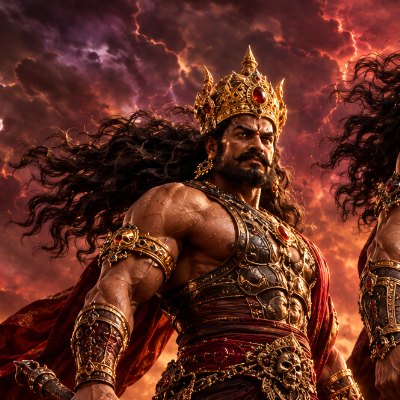
Narantaka is a son of Ravana, the demon-king of Lanka, named in the Yuddha Kanda of the Valmiki Ramayana among the princes of Lanka who enter the war against Rama's forces. He is one of several sons of Ravana who fall during the battle of Lanka, and his death at the hands of Angada — the son of Vali, the former king of Kishkindha — is one of the significant combat episodes of the Yuddha Kanda. The primary sources do not specify his mother among Ravana's wives with the same consistency as they do for Meghanada or Atikaya, and his individual profile is accordingly shaped primarily by the episode of his battle and death rather than by extensive genealogical or biographical detail.
✦ The Name
The name Narantaka is a Sanskrit compound of two elements. The first, nara, means "man" or "human being." The second, antaka, means "ender," "destroyer," or "he who brings to an end" — derived from the root anta, meaning "end" or "death," with the agentive suffix -ka. The compound thus means "destroyer of men" or "ender of human beings" — an epithet of martial ferocity encoding the capacity to kill human warriors with ease. It is a name of the same type as many Rakshasa warrior names in the tradition, where the naming convention directly announces the bearer's destructive power. The name stands in ironic contrast to his eventual fate — the destroyer of men is himself destroyed, not by a human but by Angada, a Vanara prince.
✦ Lineage
- Father: Ravana — the ten-headed demon-king of Lanka, son of the sage Vishrava and the Rakshasi Kaikesi, daughter of the demon Sumali. He is the principal antagonist of the Valmiki Ramayana, a figure of extraordinary learning and devotion to Shiva whose abduction of Sita led to the destruction of his dynasty.
- Mother: The Valmiki Ramayana does not explicitly name Narantaka's mother in the passages dealing with his battle and death. Some sources group him among the sons born of Ravana's wives other than Mandodari, but no primary text gives a consistent and unambiguous maternal attribution for him that can be cited with confidence in this profile.
- Paternal grandfather: Vishrava — a celebrated sage, son of Pulastya and Manini, daughter of Trinabindu, a king of the solar dynasty. He is the father of Kubera by his first wife Ilavida and of Ravana, Kumbhakarna, Vibhishana, and Shurpanakha by his second wife Kaikesi.
- Paternal great-grandfather: Pulastya — one of the Saptarishis, a mind-born son of Brahma the creator.
- Brother: Devantaka — named alongside Narantaka in the Yuddha Kanda as a fellow prince of Lanka who enters the war at the same time. The two brothers fight together and fall in the same extended battle sequence, often described in the sources as a pair. Devantaka is profiled separately.
- Half-brother: Meghanada, also known as Indrajit — the eldest and most celebrated of Ravana's sons, born of Mandodari, the greatest warrior on Lanka's side, slain by Lakshmana.
- Half-brother: Atikaya — son of Ravana by Dhanyamalini, possessor of Brahma's divine armour, slain by Lakshmana through the Brahmastra.
- Half-brother: Akshayakumara — son of Ravana, slain by Hanuman during his search of Lanka in the Sundara Kanda.
- Paternal uncle: Kumbhakarna — Ravana's enormous brother, who fought and fell during the Lanka war, slain by Rama himself.
- Paternal uncle: Vibhishana — Ravana's righteous younger brother who defected to Rama's cause and was crowned king of Lanka after Ravana's defeat.
✦ The Battle and Death of Narantaka
Narantaka's principal episode in the Valmiki Ramayana occurs in the Yuddha Kanda during a phase of the war in which several of Lanka's princes enter the battle simultaneously, following the deaths of senior commanders. He enters the battlefield mounted and armed, described as a warrior of great power and terrible aspect who causes devastation among the Vanara forces. The Ramayana describes him riding a horse of supernatural speed and wielding a spear — his preferred weapon — with which he attacks the Vanara army with tremendous effect, scattering and wounding many warriors.
Narantaka's rampage among the Vanaras draws the attention of Angada — the son of Vali, the former king of Kishkindha who had been slain by Rama, and one of the most capable warriors among the allied forces. Angada, observing the destruction Narantaka was causing, stepped forward to face him. The confrontation between Narantaka and Angada is described as a fierce and dramatic duel. Narantaka attacked Angada with his spear, which struck Angada and drew blood but did not incapacitate the Vanara prince. Angada, in response, struck Narantaka's horse with a tremendous blow, killing the animal and dismounting Narantaka. With Narantaka now on foot, Angada struck him again with devastating force — the Ramayana describes the blow as crushing Narantaka's head with Angada's palm or fist — and Narantaka fell dead.
The episode demonstrates Angada's status as one of the premier warriors of Rama's forces. His defeat of Narantaka is presented not as an accidental encounter but as a deliberate intervention by a powerful warrior who chooses to engage a dangerous opponent to protect his fellow Vanaras. Angada's lineage — as the son of Vali, one of the most powerful beings in the epic world — is implicitly invoked in these battle scenes, establishing that the physical power that made Vali nearly invincible has been inherited by his son.
✦ Narantaka and Devantaka as a Pair
In the Yuddha Kanda, Narantaka and Devantaka are frequently named together as brothers who enter the battle as part of the same sequence of Lanka's princes. They share a common narrative fate — both enter the war at roughly the same time, both fight with great ferocity, and both are killed in the same extended battle sequence, though by different hands. This pairing in the text is consistent with the Ramayana's broader practice of grouping Ravana's sons and brothers in clusters for narrative economy, a practice that also applies to the trio of Narantaka, Devantaka, and Trishira, who are sometimes grouped together as sons of Ravana who fall in the same phase of the war.
✦ Textual Variants
The Valmiki Ramayana is the principal source for Narantaka's battle and death. Regional retellings of the Ramayana vary in the details of this episode — some give different accounts of which Vanara warrior kills Narantaka, and some expand upon the combat in ways not found in the Valmiki text. The Valmiki Ramayana's Yuddha Kanda remains the primary and most authoritative account. The question of Narantaka's maternal parentage — which of Ravana's wives bore him — is not definitively resolved in the primary sources, and this profile does not speculate beyond what the texts explicitly state.
✦ Connection to the Wider Genealogy
Narantaka's genealogical significance is determined primarily by his paternal descent from Ravana and through him from Vishrava, Pulastya, and Brahma. He belongs to the same multi-generational lineage that descends from Brahma through the Pulastya sage line, and through Ravana's maternal lineage he is connected to the Rakshasa royal family of Sumali. His death at Angada's hands connects him narratively to the Kishkindha lineage — Angada being the son of Vali — and thereby to the Vanara royal line whose alliance with Rama made the defeat of Lanka possible. He leaves no recorded descendants in the primary sources.
✦ References
- Primary Sources
- Valmiki Ramayana, Yuddha Kanda: The principal source for Narantaka's battle, his mounted assault on the Vanara forces, his confrontation with Angada, and his death.
- Valmiki Ramayana, Uttara Kanda: Provides background on Ravana's lineage and family structure, contributing context for Narantaka's position among Ravana's sons.
- Secondary Sources
- Mani, Vettam. Puranic Encyclopaedia. Motilal Banarsidass, 1975: Provides an entry on Narantaka recording his identity as a son of Ravana, his battle against the Vanaras, and his death at Angada's hands.
- Goldman, Robert P. et al. (trans.). The Ramayana of Valmiki, Vol. 6: Yuddhakanda. Princeton University Press, 2009: Provides a critical translation and scholarly annotation of the Yuddha Kanda including the battle sequence in which Narantaka fights and falls.
- Wisdomlib (wisdomlib.org): Offers cross-referenced citations of Narantaka across digitised Sanskrit texts, confirming his attestation in the Yuddha Kanda of the Valmiki Ramayana.