
About
Devantaka — Son of Ravana, Slain by Hanuman
Devantaka · Deva-antaka · son of Ravana · prince of Lanka
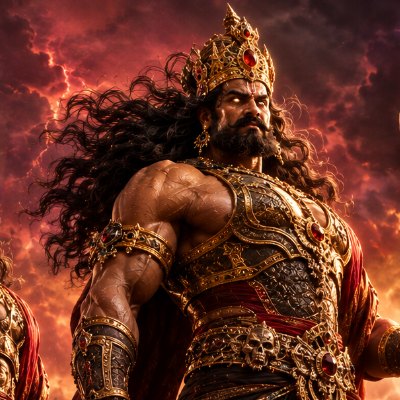
Devantaka is a son of Ravana, the demon-king of Lanka, named in the Yuddha Kanda of the Valmiki Ramayana among the princes of Lanka who enter the war against Rama's forces. He is the brother of Narantaka, with whom he is frequently paired in the narrative, and he falls in the same extended battle sequence of the Yuddha Kanda. His death is attributed to Hanuman — the son of Vayu and devoted servant of Rama — in the most widely attested account of this battle sequence. Like his brother Narantaka, the primary sources do not specify his mother among Ravana's wives with consistency, and his individual profile is shaped primarily by his battle episode rather than by extensive genealogical detail.
✦ The Name
The name Devantaka is a Sanskrit compound of two elements. The first, deva, means "god" or "divine being" — the class of celestial beings who inhabit the heavenly realms and who in the Puranic cosmological scheme are ranged in cosmic opposition to the asuras and Rakshasas. The second, antaka, means "ender," "destroyer," or "he who brings to an end," identical to the second element of his brother Narantaka's name. The compound thus means "destroyer of gods" or "ender of divine beings" — an epithet of the highest martial ambition, claiming the power to kill not merely men but the gods themselves. This name is a bolder claim even than his brother's — where Narantaka destroys men, Devantaka destroys gods — and is consistent with the tradition's characterisation of Ravana's sons as warriors of supernatural power whose ambitions and capacities exceeded those of ordinary beings. The pairing of the two brothers' names — Narantaka and Devantaka — thus together encodes the destruction of both the human and the divine orders, a totality of destructive power consistent with the ambition of Ravana's lineage.
✦ Lineage
- Father: Ravana — the ten-headed demon-king of Lanka, son of the sage Vishrava and the Rakshasi Kaikesi, daughter of the demon Sumali. He is the principal antagonist of the Valmiki Ramayana, a figure of extraordinary learning, Vedic mastery, and devotion to Shiva whose abduction of Sita led to the destruction of his dynasty and the fall of Lanka.
- Mother: The Valmiki Ramayana does not explicitly name Devantaka's mother in the passages dealing with his battle and death. As with his brother Narantaka, no primary text gives a consistent and unambiguous maternal attribution for him that can be cited with confidence in this profile, and speculation beyond the textual evidence is avoided.
- Paternal grandfather: Vishrava — a celebrated sage, son of Pulastya and Manini, daughter of Trinabindu, a king of the solar dynasty. He is the father of Kubera by Ilavida and of Ravana, Kumbhakarna, Vibhishana, and Shurpanakha by Kaikesi.
- Paternal great-grandfather: Pulastya — one of the Saptarishis, a mind-born son of Brahma the creator.
- Brother: Narantaka — named alongside Devantaka in the Yuddha Kanda as a fellow prince of Lanka who enters the war in the same phase. Narantaka is slain by Angada, son of Vali, in the same battle sequence in which Devantaka falls. Profiled separately.
- Half-brother: Meghanada, also known as Indrajit — the eldest and greatest of Ravana's sons, born of Mandodari, slain by Lakshmana.
- Half-brother: Atikaya — son of Ravana by Dhanyamalini, possessor of Brahma's divine armour, slain by Lakshmana through the Brahmastra.
- Half-brother: Akshayakumara — son of Ravana, slain by Hanuman in the Sundara Kanda.
- Paternal uncle: Kumbhakarna — Ravana's enormous brother, slain by Rama during the Lanka war.
- Paternal uncle: Vibhishana — Ravana's righteous younger brother who defected to Rama's cause and was crowned king of Lanka after Ravana's defeat.
✦ The Battle and Death of Devantaka
Devantaka's principal episode in the Valmiki Ramayana occurs in the Yuddha Kanda during the same extended battle sequence in which his brother Narantaka also fights and falls. He enters the battlefield as part of a group of Lanka's princes who have been sent by Ravana following the deaths of senior commanders, and he is described as a warrior of tremendous power who causes great damage among Rama's forces before he is killed.
The combat sequence in which Devantaka fights is among the more complex in the Yuddha Kanda, involving multiple simultaneous duels between Lanka's princes and the allied Vanara warriors. Devantaka is described as fighting with great ferocity, wielding powerful weapons and inflicting heavy casualties on the Vanara forces. The Valmiki Ramayana attributes his death to Hanuman — the son of Vayu, the wind god, and the most celebrated of the Vanara warriors — who engages Devantaka directly and kills him. The manner of Hanuman's killing of Devantaka reflects Hanuman's characteristic fighting style in the Ramayana — he frequently uses his fist, his palm, or improvised weapons such as uprooted trees, and his defeat of Devantaka is consistent with this pattern.
The deaths of Narantaka and Devantaka in the same battle sequence — by Angada and Hanuman respectively — pair two of the most formidable Vanara warriors against two of Ravana's sons, and the episode as a whole demonstrates the fighting quality of Rama's allied forces at a critical phase of the war. That both princes fall to Vanara warriors rather than to Rama or Lakshmana directly is itself significant — it establishes the Vanara forces as independently capable of defeating supernatural opponents without relying solely on the divine brothers.
✦ Textual Variants
The Valmiki Ramayana is the principal source for Devantaka's battle and death. Regional retellings of the Ramayana vary somewhat in the details of this episode — some traditions give slightly different accounts of the combatants involved in this phase of the battle, and some regional versions attribute Devantaka's death to a different warrior or present the combat in a different sequence. The Valmiki Ramayana's Yuddha Kanda remains the primary authority. As with Narantaka, the question of Devantaka's maternal parentage is not definitively resolved in the primary sources.
✦ Connection to the Wider Genealogy
Devantaka's genealogical significance parallels that of his brother Narantaka and is determined primarily by his paternal descent from Ravana through Vishrava, Pulastya, and Brahma. Through Ravana's maternal lineage he is connected to the Rakshasa royal family of Sumali. His death at Hanuman's hands connects him narratively to the lineage of Vayu the wind god — Hanuman being Vayu's son — and thereby to one of the great Vedic deities whose power was ranged on the side of dharma in the Ramayana's cosmic conflict. He leaves no recorded descendants in the primary sources.
✦ References
- Primary Sources
- Valmiki Ramayana, Yuddha Kanda: The principal source for Devantaka's battle, his assault on the Vanara forces, and his death at Hanuman's hands in the same extended battle sequence that also claims his brother Narantaka.
- Valmiki Ramayana, Uttara Kanda: Provides background on Ravana's lineage and family structure, contributing context for Devantaka's position among Ravana's sons.
- Secondary Sources
- Mani, Vettam. Puranic Encyclopaedia. Motilal Banarsidass, 1975: Provides an entry on Devantaka recording his identity as a son of Ravana, his battle against the Vanaras, and his death at Hanuman's hands, with cross-references to the Yuddha Kanda passages.
- Goldman, Robert P. et al. (trans.). The Ramayana of Valmiki, Vol. 6: Yuddhakanda. Princeton University Press, 2009: Provides a critical translation and scholarly annotation of the Yuddha Kanda including the battle sequence in which Devantaka and Narantaka fight and fall.
- Wisdomlib (wisdomlib.org): Offers cross-referenced citations of Devantaka across digitised Sanskrit texts, confirming his attestation in the Yuddha Kanda of the Valmiki Ramayana.