
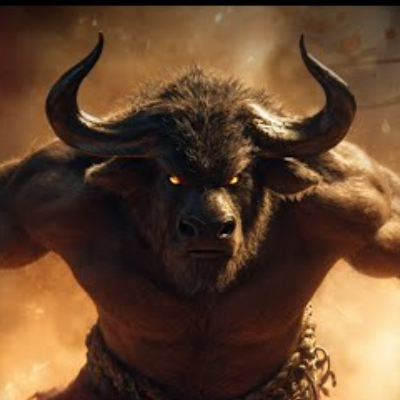
About
Dundubhi — Danava Buffalo-Demon, Son of Mayasura, Slain by Bali
Dundubhi · Mayadanava putra
Dundubhi is a Danava — a member of the class of demonic beings descended from the progenitor sage Kashyapa and his wife Danu — recorded in the Valmiki Ramayana as a son of Mayasura, the celebrated Asura architect and master of illusion. He appears in the Kishkindha Kanda of the Ramayana as a mighty demon who assumed the form of a great buffalo and challenged Bali, the immensely powerful monkey-king of Kishkindha and son of Indra, king of the gods. Dundubhi was slain by Bali in single combat, and his remains — the skeletal carcass hurled by Bali across a great distance — later became a point of reference in the negotiations between the exiled monkey-prince Sugriva and the hero Rama of Ayodhya, avatar of the god Vishnu, on the mountain Rishyamuka. Like his brother Mayavi, also a son of Mayasura, Dundubhi is a narratively catalytic figure whose primary importance lies in what his death demonstrates about Bali's legendary strength and in how that demonstration shapes the wider plot of the Ramayana.
✦ The Name
The name Dundubhi in Sanskrit denotes a large kettledrum or war drum, an instrument whose deep resonant sound was associated in the ancient Indian world with the proclamation of battle, royal power, and fearsome might. As a personal name applied to this Danava, it evokes the thunderous, overwhelming quality of his physical presence and his challenge — a being whose arrival and roar were themselves akin to the sounding of a war drum. The name carries no further epithet tradition in the primary sources beyond this single identity.
✦ Lineage
- Father: Mayasura — the foremost architect among the Danavas, son of the sage Kashyapa and Danu, celebrated for constructing the Asura triple-city of Tripura destroyed by Shiva, and the magnificent assembly hall built for the Pandava king Yudhishthira at Indraprastha.
- Paternal grandfather: Kashyapa — the great progenitor sage, son of the Prajapati Marichi who was himself born of Brahma the creator; through Kashyapa's wife Danu, the entire Danava lineage descends, while through his wife Aditi the Devas descend, making gods and demons half-siblings through a common father.
- Paternal grandmother: Danu — daughter of the progenitor Daksha; the Danavas as a class take their collective name from her.
- Brother: Mayavi — also a son of Mayasura; a Danava who challenged Bali and was pursued into a subterranean cave, where Bali slew him; the ambiguous circumstances of that episode caused a fatal misunderstanding between Bali and his younger brother Sugriva.
- Sister: Mandodari — daughter of Mayasura and the Apsara Hema; she became the foremost and most beloved queen of Ravana, the ten-headed demon king and ruler of Lanka, and is counted among the five most virtuous women in the Hindu tradition.
✦ The Challenge to the Ocean and the Mountain
The Valmiki Ramayana recounts that Dundubhi, possessed of enormous strength and arrogance, sought to test himself against the mightiest forces in the world. Taking the form of a great buffalo of terrifying proportions, he first went to the ocean — Samudra, the lord of waters — and issued a challenge for combat. The ocean, unwilling to engage, deflected the challenge by directing Dundubhi to Himavat, the lord of the Himalaya mountains, as a more fitting opponent. Dundubhi went to the mountains and issued his challenge there. Himavat similarly declined, stating that he was not a warrior and that such a conflict was not within his nature, and instead directed Dundubhi to Bali, king of the monkeys at Kishkindha, as the one being truly capable of matching his strength. This sequence of deflections — from ocean to mountain to monkey-king — serves in the narrative to establish that Dundubhi's quest was cosmic in scope, and that Bali alone among all beings was deemed worthy to meet it.
✦ The Battle with Bali and Dundubhi's Death
Directed to Kishkindha, Dundubhi arrived at the gates of the monkey city in his buffalo form and issued a thunderous challenge to Bali. The Ramayana describes him tearing up the earth with his hooves, goring the ground with his horns, and filling the city with a roar of challenge. Bali, who at that time was in the company of women in his inner quarters, heard the commotion and emerged. Despite being told who his challenger was, Bali showed no alarm. He grappled with Dundubhi in direct combat, seizing him by the horns and wrestling him with the full force of his divine strength — Bali having received from Indra the boon that half the physical power of any opponent who faced him directly would transfer to him in combat.
The battle was fierce but its conclusion was not in doubt. Bali overpowered Dundubhi and killed him. After the killing, Bali seized the enormous carcass of the buffalo-demon and, in a display of his superhuman strength, hurled it a great distance through the air. The carcass flew and fell near the hermitage of the sage Matanga — a great ascetic of formidable spiritual power — and drops of blood from the body fell upon the sage and his disciples, polluting the sacred precincts of the hermitage. Matanga, angered by this violation of his ashram, pronounced a curse upon Bali: that if Bali ever entered the region of Rishyamuka mountain, he would instantly die. It is this curse that later made Rishyamuka a refuge for Sugriva — Bali's younger brother, son of the sun-god Surya, who had been expelled from Kishkindha by Bali following the misunderstanding over the cave of Mayavi — since Bali could not pursue him there without incurring the curse's fatal consequence.
✦ The Bones of Dundubhi and the Test of Rama
When Rama, the prince of Ayodhya, came to Rishyamuka in search of allies in his mission to recover his wife Sita — who had been abducted by Ravana, the demon king of Lanka — Sugriva met him on the mountain. Before committing to alliance with Rama, Sugriva was concerned about whether Rama possessed the strength necessary to defeat Bali, whom Sugriva feared. To demonstrate the scale of Bali's power, Sugriva showed Rama the enormous skeletal remains of Dundubhi, which still lay where the carcass had fallen near Matanga's hermitage and had over time become a great heap of bleached bones.
Sugriva challenged Rama to move the bones as a test of his strength. Rama, with the tip of his foot alone, kicked the skeletal remains and sent them flying a great distance through the air — the Ramayana specifies a distance of several yojanas, a traditional unit of measurement. Sugriva, however, remained uncertain, noting that Bali had thrown the living buffalo with full flesh and blood, while Rama had merely kicked the dried and lightened bones. Rama then offered a further demonstration by shooting an arrow through seven sal trees standing in a row, the arrow passing through all seven and returning to his quiver — a feat Sugriva accepted as proof of Rama's sufficiency as an ally. The bones of Dundubhi thus served as a direct instrument in the forging of the alliance between Rama and Sugriva that became the foundation of the assault on Lanka.
✦ The Curse of Matanga and Its Consequences
The indirect consequence of Dundubhi's death — the pollution of Matanga's hermitage by the blood of his hurled carcass and the resulting curse upon Bali — is among the more structurally significant outcomes of any minor character's death in the Ramayana. The curse did not punish Dundubhi, who was already dead, nor did it materially harm Bali in the immediate term. Its effect was entirely prospective and geographical: it rendered Rishyamuka mountain inviolable to Bali. This geographical prohibition became the precondition for Sugriva's survival during his years of exile, since without a place beyond Bali's reach he could not have endured. The hermitage of Matanga on Rishyamuka, sustained by the sage's spiritual power, thus became the unlikely pivot point of the entire Kishkindha subplot, and it was Dundubhi's carcass — the instrument of the hermitage's pollution — that produced this pivot through the mechanism of the sage's curse.
✦ Textual Variants and Inconsistencies
The core narrative of Dundubhi's challenge to Bali, his death, and the subsequent curse of Matanga is consistent across the principal Sanskrit recensions of the Valmiki Ramayana. Minor variants exist in the specification of distances — the distance the carcass was thrown, the distance Rama kicked the bones — and in the precise phrasing of Matanga's curse, but these do not alter the substance of the episode. Later retellings, including the Adhyatma Ramayana and various regional vernacular versions, preserve the episode in its essential form. No primary source attributes to Dundubhi any episode or role beyond this single narrative sequence, and no independent theological, iconographic, or cultic tradition is associated with him in the textual record.
It should be noted that the name Dundubhi appears elsewhere in Hindu scripture applied to entirely different figures — including a gandharva of the same name and a serpent of the same name in certain Puranic lists — and these are distinct beings with no established connection to the Danava son of Mayasura described here.
✦ Connection to the Wider Genealogy
Through his father Mayasura and paternal grandmother Danu, Dundubhi belongs to the Danava lineage descending from the progenitor sage Kashyapa, whose unions with multiple wives gave rise to all the principal classes of beings in the Hindu cosmological order. The Devas — including Indra, whose son Bali was the instrument of Dundubhi's death — are descended from Kashyapa through his wife Aditi, making gods and Danavas genealogically half-siblings through their shared paternal ancestor. There is thus an irony embedded in the genealogy: Dundubhi, a Danava grandson of Kashyapa, was killed by Bali, a monkey-king who was the son of Indra, himself a Deva grandson of the same Kashyapa.
Through his sister Mandodari's marriage to Ravana — a descendant of the sage Pulastya, one of the mind-born sons of Brahma — Dundubhi is connected by kinship to the royal house of Lanka. Through his brother Mayavi, whose own fatal encounter with Bali inside a cave caused the rupture between Bali and Sugriva, Dundubhi shares a pattern of Danava-monkey conflict whose cumulative weight in the Kishkindha Kanda is to establish Bali's overwhelming power and the legitimacy of Sugriva's fear — both conditions being necessary to motivate and justify the alliance with Rama that drives the second half of the Ramayana.
✦ References
- Valmiki Ramayana, Kishkindha Kanda, Chapters 11–12 (approximate): Primary source for the episode of Dundubhi's challenge to the ocean and the mountain, his arrival at Kishkindha, his combat with Bali, his death, and the hurling of his carcass toward Matanga's hermitage.
- Valmiki Ramayana, Kishkindha Kanda, Sugriva's narration to Rama: Sugriva recounts Dundubhi's story and shows his bones to Rama as evidence of Bali's power; this passage also records Matanga's curse and its geographical consequences for Bali.
- Valmiki Ramayana, Kishkindha Kanda, the seven sal trees episode: Contextualises the demonstration involving Dundubhi's bones within Rama's negotiation of alliance with Sugriva and establishes the bones as a narrative instrument of that alliance.
- Adhyatma Ramayana, Kishkindha Kanda: Later Sanskrit retelling that preserves the core Dundubhi episode without significant deviation; useful for confirming the narrative's stability across recensions.
- Puranic Encyclopaedia by Vettam Mani (Motilal Banarsidass, 1975): Modern reference work providing consolidated entries on Dundubhi, his parentage, and his place within the Danava genealogy and the Ramayana narrative sequence.
- Valmiki Ramayana, translated by Robert P. Goldman et al. (Princeton University Press): Critical edition translation consulted for verifying chapter and verse details of the Kishkindha Kanda passages relating to Dundubhi, Bali, Matanga, and Sugriva.
- Valmiki Ramayana, translated by Desiraju Hanumanta Rao and K. M. K. Murthy (online critical edition): Additional English rendering used for cross-referencing the specific details of the combat episode and the curse of Matanga.