
About
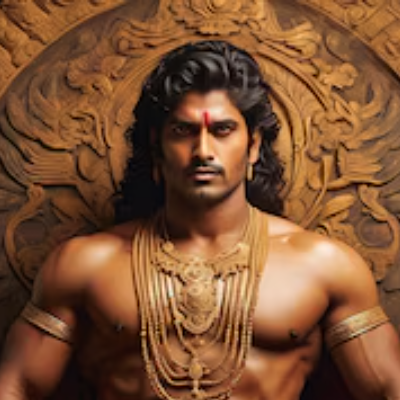
Lakshmana Kumara — Prince of Hastinapura and Son of Duryodhana
Lakshmana Kumara · Duryodhana-putra · Kaurava-rajputra
Lakshmana Kumara was a prince of Hastinapura and the son of Duryodhana, the eldest of the hundred sons of the blind king Dhritarashtra and his queen Gandhari, and the foremost prince of the Kaurava house. He fought on the Kaurava side in the Kurukshetra War and was killed by Abhimanyu — the son of the Pandava archer Arjuna and his wife Subhadra, and one of the most celebrated young warriors of the age — during the battle of the thirteenth day of the war, in the episode of the Chakravyuha, the wheel-formation of the Kaurava army. His death is recorded in the Drona Parva of the Mahabharata and is among the most narratively significant deaths of that day, both because of his identity as Duryodhana's own son and because of the circumstances surrounding Abhimanyu's own death on the same day. The tradition identifies Bhanumati — Duryodhana's principal queen — as his mother, this being the natural inference from her position as the foremost wife of Duryodhana, though the primary text does not in every instance explicitly name Bhanumati as his mother rather than simply identifying him as Duryodhana's son. Lakshmana Kumara is a figure of limited but clearly attested textual presence, remembered principally for his death at Abhimanyu's hands and for the grief that death caused his father.
✦ The Name
The name Lakshmana is derived from the Sanskrit root lakshman, meaning "one who bears auspicious marks" or "one endowed with favourable signs." The word is related to lakshana, meaning a distinguishing mark or characteristic, and to Lakshmi, the goddess of fortune and prosperity whose name shares the same root. The name therefore carries connotations of auspiciousness, divine favour, and distinguished marking — qualities appropriate to a prince of high royal birth. The name Lakshmana is most famously borne in the Hindu tradition by the younger brother of Rama, the avatar of Vishnu celebrated in the Ramayana, who accompanied Rama throughout his exile and the war against Ravana. The use of the same name for Duryodhana's son in the Mahabharata is therefore a naming choice that carried significant resonance in the tradition, though no thematic connection between the two figures named Lakshmana is drawn by the epic text itself. The suffix Kumara, meaning "prince" or "young man," is appended to distinguish this figure from other bearers of the name Lakshmana within the epic's vast cast, and from Lakshmana the daughter of Duryodhana who is a separate figure in the tradition. The patronymic Duryodhana-putra means "son of Duryodhana," and Kaurava-rajputra means "prince of the Kaurava royal house."
✦ Lineage
- Paternal grandfather: Dhritarashtra, the blind king of Hastinapura, eldest son of Vichitravirya of the Bharata royal line and the sage-born Ambika. Dhritarashtra's blindness, present from birth, disqualified him from direct kingship under the tradition's conventions, and the kingdom was administered during his reign with the effective authority resting in contested ways between him, the regent Bhishma, and ultimately the Pandava claimants.
- Paternal grandmother: Gandhari, daughter of the king of Gandhara, who bound a cloth over her own eyes upon her marriage to Dhritarashtra so that she would share her husband's condition of blindness. Gandhari was renowned for her virtue, self-discipline, and the power accumulated through her long practice of austerity.
- Father: Duryodhana, eldest of the hundred Kaurava princes, a warrior of great personal courage and supreme skill in mace combat, and the principal antagonist of the five Pandava brothers in the Mahabharata's central conflict. Duryodhana's refusal to cede the Pandavas their rightful share of the Bharata kingdom ultimately precipitated the Kurukshetra War. He was killed by Bhima, the second Pandava, on the eighteenth and final day of the war.
- Mother: Bhanumati, the principal queen of Duryodhana and the foremost consort of the Kaurava royal house, identified in the tradition as Lakshmana Kumara's mother by virtue of her position as Duryodhana's chief wife. The primary text does not in every passage make the maternal attribution explicit by name.
✦ The Thirteenth Day — The Chakravyuha
The thirteenth day of the Kurukshetra War is one of the most dramatically concentrated single days in the entire Mahabharata narrative, and it is within this day's events that Lakshmana Kumara's death occurs. On that day, Dronacharya — the revered martial preceptor serving as supreme commander of the Kaurava forces — arranged his army in the formation known as the Chakravyuha, a rotating wheel-shaped military array of extraordinary complexity. The Chakravyuha was designed to be penetrable only by a warrior who knew both how to enter and how to exit the formation; a warrior who knew only the entry but not the exit would be trapped inside and surrounded. Among the Pandava warriors, only Arjuna and Krishna possessed complete knowledge of the Chakravyuha. On this particular day, however, Arjuna had been drawn away from the main battlefield to a distant sector by a strategic diversion engineered by the Kaurava commanders, leaving the Pandava forces without their foremost warrior at the moment Drona deployed the formation.
In this crisis, Abhimanyu — the sixteen-year-old son of Arjuna, who had learned the method of entering the Chakravyuha while still in his mother Subhadra's womb but had not learned the method of exiting it — volunteered to breach the formation and hold it open for the other Pandava warriors to follow. Abhimanyu entered the Chakravyuha with extraordinary skill and fought his way through successive rings of the formation, killing warriors of the highest rank as he penetrated deeper. It is within this sustained combat that Lakshmana Kumara, fighting in the Kaurava formation, encountered Abhimanyu and was killed by him. The Drona Parva records Lakshmana Kumara among the named warriors slain by Abhimanyu during his penetration of the Chakravyuha — a list that includes warriors of considerable standing, establishing the scale of Abhimanyu's achievement on that day even as the day ended with his own death.
✦ Duryodhana's Grief
The death of Lakshmana Kumara is treated in the Mahabharata as a moment of acute personal devastation for Duryodhana. The epic, which rarely presents Duryodhana in registers of vulnerability or grief, acknowledges the father's loss with a directness that distinguishes it from the merely tactical accounting of battlefield deaths that makes up much of the war narrative's texture. Duryodhana's grief at his son's death is noted as a driving emotional force alongside his military calculations, and the loss of his direct heir in the middle of the war — before its outcome was determined — represents a personal catastrophe for the Kaurava prince that the text does not minimise. The death of Lakshmana Kumara thus functions in the narrative not only as a measure of Abhimanyu's prowess but as a humanising moment for Duryodhana, placing his later conduct in the war within a context of accumulated personal loss that the epic expects its audience to register.
✦ Abhimanyu's Death on the Same Day
The thirteenth day's events do not end with Abhimanyu's triumphal penetration of the Chakravyuha. Having entered so deeply into the formation that the Pandava warriors following him were cut off by Jayadratha — the king of Sindhu who used a boon from Shiva to hold back the Pandavas at the formation's entrance for that one day — Abhimanyu was left isolated inside the Chakravyuha without support. The Kaurava commanders, recognising that they could not defeat him in single combat, collectively abandoned the rules of honourable warfare: Drona, Karna, Kripa, Ashvatthama, Kritavarma, and others simultaneously attacked Abhimanyu together, cutting his bowstring, killing his horses, destroying his chariot, and finally overwhelming him. Abhimanyu fought on foot with a chariot wheel until he was killed. The death of Abhimanyu — the same warrior who had killed Lakshmana Kumara earlier that day — on the same day and in such circumstances of collective violation of the warrior's code is one of the most morally charged episodes of the entire war narrative, and it produces in turn the vow of Arjuna to kill Jayadratha before sunset the following day or immolate himself, driving the events of the fourteenth day. Lakshmana Kumara's death and Abhimanyu's death are thus connected within the same day's terrible symmetry.
✦ Connection to the Wider Genealogy
Lakshmana Kumara occupied the position of Duryodhana's direct patrilineal heir and therefore the presumptive future king of Hastinapura had the Kaurava cause prevailed in the war. His death on the thirteenth day meant that Duryodhana fought the remaining five days of the war without a living son, and that the Kaurava line through Duryodhana was extinguished in the male line before the war itself concluded. Through his father Duryodhana he was connected to the entire Kaurava genealogical network — the hundred sons of Dhritarashtra, the lineage of the Bharata royal house stretching back through Shantanu, Pratipa, and the ancient Lunar dynasty kings to its mythological origins. Through his mother Bhanumati — and conditionally, if the tradition identifying her as Bhagadatta's daughter is accepted — he would also have been connected to the Pragjyotisha royal line, the lineage of Narakasura, and through that to Bhumi the earth goddess and the Vaishnava avatar cycle. His death without issue meant that none of these connections descended through him to subsequent generations.
✦ References
Primary Sources
- Mahabharata, Drona Parva (Book 7): The principal source for Lakshmana Kumara's death, recording his killing by Abhimanyu during the Chakravyuha episode on the thirteenth day of the Kurukshetra War, and providing the narrative context of that day's events including Abhimanyu's own subsequent death.
- Mahabharata, Stri Parva (Book 11): The parva of lamentation following the war's conclusion, within whose collective mourning the loss of Lakshmana Kumara as Duryodhana's son is contextually present, though he is not the subject of an individual lament in the text.
Modern Reference Works
- Vettam Mani, Puranic Encyclopaedia (1975): Provides a consolidated entry on Lakshmana Kumara identifying his parentage, his death at Abhimanyu's hands during the Chakravyuha, and his position within the Kaurava genealogical sequence.
- Wisdomlib (wisdomlib.org), entry on Lakshmana Kumara: Aggregates textual references to Lakshmana Kumara across the Mahabharata parvans, useful for cross-referencing his appearances in different sections of the war narrative.