
About
Drumasena — Son of Dushasana, Slayer of Abhimanyu
Drumasena · Durmasena · Durmashena · son of Duhsasana · son of Dushasana · Kaurava
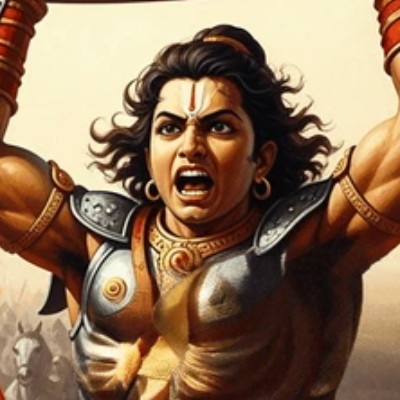
Drumasena is a son of Dushasana, the second eldest of the hundred Kaurava brothers and son of King Dhritarashtra and Queen Gandhari of the Kuru dynasty. He belongs to the generation of warriors who fought in the Kurukshetra war as young men, sons of the principal Kaurava princes. His one significant narrative moment in the Mahabharata is his mace duel with Abhimanyu — the son of Arjuna and Subhadra — inside the Chakravyuha formation on the thirteenth day of the war, in which he dealt the blow that ended Abhimanyu's life. He was killed the following day, the fourteenth, by Prativindya — eldest son of Yudhishthira and Draupadi, and thus one of the Upapandavas — in direct retribution for Abhimanyu's death. His narrative presence in the Mahabharata is confined entirely to these two days. The primary text of the Drona Parva (Ganguli translation) refers to him throughout as the son of Duhsasana without recording his personal name; the name Drumasena is attested in secondary sources drawing on the primary material.
✦ The Name
The name Drumasena is formed from the Sanskrit druma, meaning tree, and sena, meaning army or host. The compound thus carries the sense of one whose army is like a forest or whose forces are as numerous and dense as trees. It is a name type common in the Kshatriya naming conventions of the Mahabharata period, emphasising military strength through natural imagery. The variant form Durmasena, appearing in several secondary accounts, is likely a phonetic corruption in transmission rather than a distinct etymological form. The name is not recorded in the Ganguli translation of the Drona Parva passages in which this figure appears; it is given in the Bharatpedia, Wikipedia, and related secondary accounts drawing on the primary text.
✦ Lineage
- Father: Dushasana — second eldest of the hundred Kaurava brothers, son of Dhritarashtra and Gandhari, most devoted executor of Duryodhana's commands, responsible for dragging Draupadi by her hair into the Kaurava assembly during the dice game and for attempting her disrobing; killed on the sixteenth day of the war by Bhimasena, who fulfilled his oath by tearing open Dushasana's chest and drinking his blood.
- Paternal grandfather: Dhritarashtra — blind king of the Kuru dynasty at Hastinapura, son of the sage Vyasa by niyoga upon Ambika, widow of King Vichitravirya.
- Paternal grandmother: Gandhari — princess of the Gandhara kingdom, daughter of King Subala, mother of all hundred Kaurava brothers.
- Paternal great-uncle: Duryodhana — eldest of the Kaurava brothers, crown prince of Hastinapura, primary antagonist of the Mahabharata, and the figure in whose cause the war was fought.
✦ Day 13 — The Chakravyuha and the Duel with Abhimanyu
On the thirteenth day of the Kurukshetra war, Drona — then commander-in-chief of the Kaurava forces — arrayed his army in the formation of a Chakravyuha, a wheel-shaped configuration of immense tactical difficulty to penetrate and nearly impossible to exit once inside. Among the Pandavas, only Arjuna and Krishna possessed full knowledge of how to enter and exit this formation. Arjuna had been drawn away from the main battle by the Samsaptakas, warriors sworn to fight him to the death. In Arjuna's absence, Yudhishthira directed Abhimanyu — who knew how to enter the Chakravyuha but not how to exit — to break through its outermost ring and open a path for the Pandava army to follow. Jayadratha, king of the Sindhu kingdom, who held a boon from Shiva enabling him to check any one of the Pandavas other than Arjuna for a single day, closed the breach behind Abhimanyu once he had entered, leaving him isolated inside the formation without support.
Abhimanyu, alone inside the Chakravyuha, fought against the assembled Kaurava host with extraordinary skill and ferocity. The Drona Parva records that he defeated and routed Duryodhana, caused Karna to faint, defeated Shalya, killed Shalya's brother, killed the king of Kosala, and slew large numbers of warriors, horses, and elephants. The Kaurava commanders, recognising that a single young warrior was threatening to destroy their formation from within, devised a strategy at Karna's suggestion: six Maharathis — Drona, Karna, Kripacharya, Ashvatthama, Kritavarma, and the king of the Kosalas — would attack Abhimanyu simultaneously, violating the conventions of single combat that governed honourable warfare, in order to strip him of his weapons, chariot, horses, and armour.
Dushasana's son was present inside the Chakravyuha throughout this engagement and fought in archery against Abhimanyu before the final phase. The Drona Parva (Adhyaya 45, Ganguli translation) records that Dushasana's son pierced the four horses of Abhimanyu with four shafts, struck his charioteer with one, and pierced Abhimanyu himself with ten. Abhimanyu retaliated, striking him back with ten arrows, and then addressed him with the words that his father had fled the field like a coward but that he himself at least knew how to fight — and that he would not escape with his life that day. Ashvatthama intervened and cut Abhimanyu's arrow in flight, saving Dushasana's son. Abhimanyu subsequently proceeded towards Dushasana's son's chariot, crushed it and its horses into the earth, and deprived him of his vehicle. Dushasana's son then took up his mace on foot.
After Abhimanyu had been stripped of his chariot, bow, sword, and shield by the six Maharathis acting together, he too picked up a mace and fought on. The Drona Parva (Adhyaya 46, Ganguli translation) records that the two young warriors — described as cousins — met in a mace duel, striking each other with such force that both were felled simultaneously, falling like two uprooted standards of Indra. Dushasana's son rose first. He struck the prostrate and nearly senseless Abhimanyu on the crown of his head with his mace. The blow, delivered to an unarmed and exhausted warrior in the moment he was attempting to rise, ended Abhimanyu's life. The Drona Parva records the assembled Kaurava warriors surrounding the fallen Abhimanyu, and describes his body as resembling a wild elephant slain by hunters.
The death of Abhimanyu sent a wave of grief and rage through the Pandava camp. Arjuna, returning from his encounter with the Samsaptakas and finding his son dead, was inconsolable. He swore before the assembled army that he would kill Jayadratha — the man whose boon had sealed the breach through which no Pandava support could reach Abhimanyu — before the following sunset, or would himself enter fire. This oath set the course of the entire fourteenth day of the war.
✦ Death — Day 14, Drona Parva
On the fourteenth day, the Upapandavas — the five sons of Draupadi by the five Pandava brothers — fought with particular fury, motivated by the killing of their cousin Abhimanyu, who had been their companion since childhood in Dvaraka. Prativindya, the eldest of the Upapandavas and son of Yudhishthira and Draupadi, encountered Drumasena in single combat on this day. The encounter is recorded in secondary accounts of the Drona Parva as a deliberate act of retribution: Prativindya killed Drumasena in their duel. Beyond the identification of Prativindya as his killer, the primary text does not elaborate on the details of this encounter in the passages consulted.
✦ Textual Variants and Inconsistencies
The most significant textual problem attending this figure is the naming question. The Ganguli translation of the Drona Parva — the primary source for his entire narrative — refers to him only as the son of Duhsasana. He is never named in these passages. The name Drumasena appears consistently in secondary and encyclopaedic sources — Bharatpedia, Wikipedia, Wisdomlib-adjacent accounts — but its primary textual basis has not been independently verified in the Ganguli translation passages consulted. The Debroy translation may provide the name, but this has not been confirmed for this profile. The name is used here as the best available designation while its secondary-source origin is transparently noted.
A more complex problem is the question of whether Dushasana had one or two sons active in the Chakravyuha on Day 13. The Wikipedia article on the Kurukshetra War distinguishes a second son of Dushasana named Dushmanara, whom it states was killed by Abhimanyu inside the Chakravyuha, from the first son Drumasena, who is identified as the one who dealt the killing blow to Abhimanyu. This distinction would make Dushasana's family narratively significant across both sides of the Abhimanyu episode — one son killed by Abhimanyu, another killing Abhimanyu in turn. However, the Ganguli translation passages consulted for this profile do not clearly support the two-son distinction. The relevant Drona Parva adhyayas use the single designation son of Duhsasana throughout without distinguishing between two different sons. The two-son account may derive from a different recension, from the Debroy translation, or from an interpretive tradition that is not fully reflected in the Ganguli text. This profile treats Drumasena as the single primary figure — the son of Dushasana active in the mace duel and identified as Abhimanyu's killer — while noting the Dushmanara tradition honestly.
The spelling variants — Drumasena, Durmasena, Durmashena — all appear in secondary literature and are likely phonetic variants in transmission rather than references to distinct individuals.
✦ Narrative Significance
Drumasena's significance in the Mahabharata is narrow but structurally consequential. The killing of Abhimanyu is one of the most morally charged episodes in the entire war narrative — the Mahabharata presents it as a collective act of adharma, since Abhimanyu was attacked simultaneously by multiple great warriors after being deprived of chariot, bow, sword, and shield, in violation of the conventions of honourable combat. The final blow, dealt to a prostrate and near-senseless warrior in the act of rising, is the culmination of this violation. Dushasana's son, by rising first from their mutual fall and striking the killing blow, is the immediate agent of this act. His father Dushasana had boasted of being the one to slay Abhimanyu at the outset of the day's fighting; his son accomplished what his father could not. The direct continuity between Dushasana's acts of adharma — dragging Draupadi, attempting her disrobing — and his son's role in the adharmic killing of Abhimanyu is a structural element of the Mahabharata's account of the Kaurava family's conduct across both generations.
✦ Connection to the Wider Genealogy
Drumasena belongs to the Kuru dynasty through his paternal grandfather Dhritarashtra, who was fathered by the sage Vyasa on Ambika, widow of King Vichitravirya, a descendant of the lunar lineage through Kuru, Shantanu, and Vichitravirya. Through his paternal grandmother Gandhari he descends from the Gandhara royal house. He is a second-generation Kaurava — grandson of Dhritarashtra rather than son — placing him in the same generational cohort as the Upapandavas, Abhimanyu, Lakshmana Kumara son of Duryodhana, and other young warriors on both sides of the war. His killer, Prativindya, is grandson of Yudhishthira's mother Kunti through Yudhishthira and of Draupadi through her maternal line — a paternal cousin once removed of Drumasena's own generation within the extended Kuru family.
✦ References
- Mahabharata, Drona Parva, Abhimanyu-badha Parva, Adhyaya 45 (Ganguli translation, Sacred Texts Archive, m07/m07045.htm): Primary source for the archery encounter between Dushasana's son and Abhimanyu inside the Chakravyuha — the four-shaft attack on Abhimanyu's horses, the ten-shaft exchange, Abhimanyu's taunt, Ashvatthama's intervention, and Abhimanyu's destruction of Dushasana's son's chariot. The figure is referred to throughout as the son of Duhsasana; no personal name is given.
- Mahabharata, Drona Parva, Abhimanyu-badha Parva, Adhyaya 46 (Ganguli translation, Sacred Texts Archive, m07/m07046.htm): Primary source for the mace duel between Dushasana's son and Abhimanyu — their simultaneous fall, Dushasana's son rising first, and the killing blow struck on Abhimanyu's crown. The primary text for the killing itself.
- Mahabharata, Drona Parva, Abhimanyu-badha Parva, Adhyaya 73 (Ganguli translation, Sacred Texts Archive, m07/m07070.htm): The summary narration of the thirteenth day confirms that after being deprived of his chariot and weapons by six Maharathis, Abhimanyu was slain by Dushasana's son.
- Mahabharata, Drona Parva, Jayadratha-vadha section (Ganguli translation): The context for Drumasena's death on Day 14 — the Upapandavas' retaliatory fighting following Abhimanyu's killing; Prativindya's killing of Drumasena is attested in secondary accounts of this section.
- Wikipedia, Kurukshetra War article: Secondary reference for the identification of Dushasana's first son as Drumsena (Drumasena) and for the Dushmanara tradition — the claim that a second son of Dushasana was killed by Abhimanyu and that the first son Drumasena dealt the killing blow. This article is the primary source for the two-son distinction noted in the Variants section.
- Bharatpedia, Dushasana article: Secondary reference confirming Drumasena as the name of Dushasana's son who killed Abhimanyu and his death on Day 14 at Prativindya's hands.
- Vettam Mani, Puranic Encyclopaedia (Motilal Banarsidass, 1975): Secondary reference for cross-checking the figure's narrative placement within the Drona Parva.