
About
Jayadratha — King of Sindhu and Sauvira, Husband of Dussala, Agent of Abhimanyu's Entrapment
Jayadratha · Saindhava · Sindhuraja · Sauviraja · Sindhusauvirabhartha · son of Vriddhakshatra · Jayadratha of Sindhu
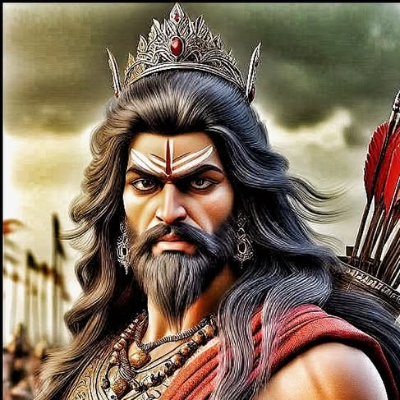
Jayadratha is the king of the Sindhu and Sauvira kingdoms, son of King Vriddhakshatra of the Puru lineage, and husband of Dussala — the only daughter of King Dhritarashtra and Queen Gandhari of the Kuru dynasty and sister of the hundred Kaurava brothers. His marriage to Dussala made him the brother-in-law of Duryodhana and a political and personal ally of the Kaurava side in the Kurukshetra war. He appears across multiple books of the Mahabharata: in the Adi Parva at Draupadi's svayamvara, in the Vana Parva in his attempt to abduct Draupadi and his subsequent penance to Shiva, in the Bhishma Parva and Drona Parva as a Kaurava warrior, and most consequentially on the thirteenth and fourteenth days of the war, when he used the boon obtained from Shiva to seal the Chakravyuha breach and trap Abhimanyu inside, and was himself killed by Arjuna the following day in a manner that fulfilled a protective curse laid by his own father. He is also indirectly referenced in the Ashvamedha Parva through the consequences of his death for his widow Dussala and his son Suratha. The Drona Parva identifies him as the rebirth of Jambha, a powerful demon defeated by Indra and Vishnu.
✦ The Names
The name Jayadratha is formed from two Sanskrit elements: jayat, meaning victorious, and ratha, meaning chariot. The compound thus means one who has a victorious chariot or the one whose chariot conquers. The patronymic-based epithets Saindhava and Sindhuraja both derive from the name of his kingdom — Saindhava meaning belonging to Sindhu or chief of the Sindhus, and Sindhuraja meaning king of the Sindhu rivers or rivers' king. Sauviraja designates him as king of Sauvira, the second of the two kingdoms he ruled. Sindhusauvirabhartha similarly means lord of Sindhu and Sauvira combined. These territorial epithets are used interchangeably in the war books to identify him.
✦ Lineage
- Father: Vriddhakshatra — king of the Sindhu kingdom, of the Puru lineage; a figure of advanced age and deep piety who performed severe austerities to obtain a divine boon protecting his son; he abdicated the throne to Jayadratha at a young age and retired to the forest to continue his austerities.
- Wife: Dussala — only daughter of King Dhritarashtra of Hastinapura and his queen Gandhari; sister of all hundred Kaurava brothers including Duryodhana; regarded by the five Pandavas as their own cousin-sister.
- Other wives: Secondary sources record that Jayadratha had additional wives from the Gandhara and Kamboja royal houses, though these are not named or individually attested in the primary Mahabharata passages consulted.
- Son: Suratha — born of Dussala; he did not participate in the Kurukshetra war; he ruled Sindhu after Jayadratha's death and died of grief and fear when Arjuna's forces approached during the Ashvamedha expedition.
✦ Birth and the Protective Boon of Vriddhakshatra
The Drona Parva (Adhyaya 146, and the Jayadratha-vadha section, Adhyaya 142 in the Ganguli translation) records the circumstances of Jayadratha's birth and the extraordinary boon connected to it. Vriddhakshatra had performed severe austerities over a long period before Jayadratha was born, and at the child's birth an incorporeal voice proclaimed that the child would become a foremost Kshatriya, worthy of both the Solar and Lunar races, but that in battle a great warrior would cut off his head. Vriddhakshatra, hearing this prophecy, is recorded in the Drona Parva (Ganguli translation, Adhyaya 142) as having made a pronouncement in the form of a curse: that any warrior who caused Jayadratha's severed head to fall upon the ground would have his own head immediately burst into pieces. Vriddhakshatra then retired to the forest of Samantapanchaka to perform continued austerities, having installed Jayadratha on the throne at a young age. Krishna, who knew of this curse, devised the manner of Jayadratha's killing so that the severed head would fall not on the ground but into Vriddhakshatra's own seated lap — causing Vriddhakshatra, startled, to let the head fall from his hands to the earth, so that it was Vriddhakshatra himself who caused the head to touch the ground, and Vriddhakshatra's own head that therefore burst asunder.
✦ Marriage and Early Hostility toward the Pandavas
The Adi Parva (Chapter 116, Verse 17) records that Jayadratha married Dussala, the daughter of Dhritarashtra and Gandhari. The Adi Parva (Chapter 185, Verse 21) records that he was present at the svayamvara of Draupadi, the daughter of Drupada, where Arjuna eventually won Draupadi's hand. Jayadratha did not succeed at the contest. The primary text thus establishes that Jayadratha's resentment toward the Pandavas — and toward Arjuna in particular — predates the abduction episode and has roots in this earlier public defeat.
✦ The Vana Parva — Abduction of Draupadi and the Shiva Boon
The Vana Parva (Chapters 264 to 272, Draupadi-harana Parva) records the episode for which Jayadratha is first narratively significant. While travelling toward the Shalva kingdom to arrange a marriage, he halted at the forest of Kamyaka, where the Pandavas were in exile. He saw Draupadi — the wife of all five Pandavas — alone at the hermitage threshold while the Pandavas had gone out to hunt. Overcome by desire, he sent his minister Kotika to approach her with an invitation to become his queen, which she refused. Jayadratha then abducted her by force and drove away in his chariot. The Pandavas, returning, pursued him. Bhimasena caught Jayadratha and beat him severely. Arjuna and Yudhishthira, moved by Draupadi's plea on Dussala's behalf, stopped Bhima from killing him. Instead, Bhima shaved his head with an arrow leaving five tufts of hair, a specific humiliation for a Kshatriya king, and released him under a public pledge of fealty.
Jayadratha, shamed, proceeded to Gangadvara and performed severe penance to Lord Shiva. Shiva granted him a boon: that he would be able to check in battle all four Pandavas — Yudhishthira, Bhima, Nakula, and Sahadeva — for a single day, with the explicit exception of Arjuna, whom Shiva named as invincible by virtue of his identity as Nara, eternal companion of Narayana, and his mastery of celestial weapons. This boon, limited both in scope (four Pandavas only) and duration (one day), is the instrument Jayadratha would use on the thirteenth day of the Kurukshetra war.
✦ The Kurukshetra War — Days 1 through 12
Jayadratha joined the Kaurava forces for the war, fighting under Duryodhana's banner. The Bhishma Parva records that on the first day he fought against Drupada. On the second day he attacked Bhimasena. On subsequent days across the Bhishma Parva he appears as part of the general Kaurava forces. On the eleventh day, under Drona's command, he defeated Drupada and the Panchala forces but was later checked by Abhimanyu. He was present at the dice game and is recorded in one secondary source as a witness to Draupadi's humiliation there, which adds a further layer of complicity to his association with the Kaurava cause.
✦ Day 13 — The Chakravyuha and the Sealing of the Breach
The thirteenth day is Jayadratha's most consequential day in the war. Drona arranged the Kaurava forces in the Chakravyuha formation, knowing that only Arjuna and Krishna possessed full knowledge of how to enter and exit it. The Samsaptakas — warriors sworn to fight Arjuna to the death — drew Arjuna away from the main field. Abhimanyu, son of Arjuna, who knew how to enter the Chakravyuha but not how to exit, was directed by Yudhishthira to break through its outer ring and open a path for the Pandava army. Abhimanyu penetrated the formation and wreaked devastating havoc from within.
Jayadratha, stationed at the breach Abhimanyu had made, now invoked his Shiva-granted boon. He held back Yudhishthira, Bhima, Nakula, and Sahadeva — and their allies — at the entrance of the Chakravyuha for the duration of that day. The four Pandavas and the Pandava forces behind them could not break through or bypass Jayadratha's position. Abhimanyu, receiving no support, fought alone against the assembled Kaurava host until, stripped of chariot, bow, sword, and shield by a combined assault of six Maharathis, he was killed by Dushasana's son in a mace duel. The primary text of the Drona Parva records that Krishna, describing these events later, stated simply that without Jayadratha's boon the four Pandavas would have entered the Chakravyuha and Abhimanyu would have lived.
✦ Day 14 — Arjuna's Oath and Jayadratha's Death
On the evening of the thirteenth day, Arjuna returned to find his son dead. His grief transformed immediately into a vow: he would kill Jayadratha before the following sunset or himself enter fire. The assembled warriors on both sides heard this oath. The Drona Parva records that Duryodhana, hearing the oath, went to Drona and insisted that Jayadratha be protected at all costs. Drona constructed for the fourteenth day a formation of exceptional complexity — a Sakata vyuha in the front and a Padma vyuha in the rear, with a Suchi vyuha at its core, Jayadratha positioned at the innermost point — and assigned Karna, Ashvatthama, Kripacharya, Shalya, Vrishasena, and Duryodhana himself to guard Jayadratha's position.
The fourteenth day's battle is one of the longest and most elaborately narrated days in the war books. Arjuna fought his way through multiple defensive arrays, killing vast numbers of warriors, while Krishna managed the chariot and devised tactical approaches. The Drona Parva (Adhyaya 142, Ganguli translation at sacred-texts.com) records the final approach in detail. As the sun neared the horizon, Jayadratha — believing the day was ending and his survival assured — emerged from his protected position to observe. Krishna, perceiving the moment, concealed the sun momentarily using his Sudarsana Chakra, creating the illusion of sunset. The Kaurava side celebrated, Jayadratha relaxed his guard and came forward, and at that instant Krishna revealed the sun still above the horizon. Arjuna, seizing the moment, fixed to the Gandiva bow a specially consecrated arrow of fiery effulgence, aimed and shot. The arrow severed Jayadratha's head and, directed by Krishna's instruction, carried it through the air to fall directly into the seated lap of Vriddhakshatra, who was performing austerities in the forest of Samantapanchaka. Vriddhakshatra, startled, stood up — and the head fell from his lap to the ground. The protective curse activated: Vriddhakshatra's own head burst into pieces and he died. The Ganguli translation records that loud cries of celebration rose from the Pandava side and of lamentation from the Kaurava side.
✦ Textual Variants and Inconsistencies
Two distinct accounts exist for the origin of the boon concerning Jayadratha's severed head. In the first, attested directly in the Drona Parva (Ganguli translation, Adhyaya 142), the incorporeal voice at Jayadratha's birth spoke of his eventual killing, and Vriddhakshatra responded by making a pronouncement — framed as a curse — that the head's killer would himself be destroyed if the head touched the ground. In the second account, attested in the Puranic Encyclopaedia and several secondary sources, Vriddhakshatra subsequently went to the forest and performed penance specifically to obtain from Shiva the boon of complete immortality for his son, but achieved only the lesser protection regarding the fallen head. The two accounts are not mutually exclusive — the birth-prophecy motivates the penance — but the Ganguli translation passage does not itself narrate the Shiva penance as the source of the boon, framing it instead as Vriddhakshatra's own pronouncement. The profile presents both layers as attested in their respective sources.
The weapon used by Arjuna to kill Jayadratha is described in some secondary sources as the Pashupatastra — the weapon of Shiva granted to Arjuna in the Vana Parva. The Ganguli translation of the Drona Parva (Adhyaya 142) describes the arrow as divinely consecrated and of fiery splendour, worshipped with incense and garlands, and inspired with divine mantras having the force of Indra's thunderbolt — but does not name it as the Pashupatastra specifically. The Pashupatastra attribution comes from the Debroy translation and secondary accounts. Both are noted.
✦ Cosmic Identity
The Drona Parva contains a passage in which Jayadratha is indirectly identified as a rebirth of Jambha — a powerful demon who had been defeated in a previous age by Indra and Vishnu, acting together with Shiva's permission. The text draws a comparison between the joy of the Pandavas and Krishna at obtaining the means to kill Jayadratha and the joy of Indra and Vishnu when they obtained Shiva's permission to slay Jambha. This cosmic framing places Jayadratha's killing within a larger pattern of divine order reasserting itself over demonic disruption — a theme consistent with the Mahabharata's broader identification of many Kaurava-side figures as rebirths of Asuras and demons.
✦ Connection to the Wider Genealogy
Jayadratha belongs to the Puru lineage through his father Vriddhakshatra, making him a distant kinsman of both the Kaurava and Pandava princes through the common Puru ancestry. Through his marriage to Dussala he entered the Kuru royal network directly. His son Suratha inherited the Sindhu kingdom and his unnamed infant grandson was installed by Arjuna as the kingdom's ruler during the Ashvamedha expedition. The Sindhu line thus continued beyond Jayadratha's death through Dussala's descendants, under Pandava suzerainty.
✦ References
- Mahabharata, Adi Parva, Chapter 116, Verse 17 (Wisdomlib, citing Vettam Mani): Records that Jayadratha married Dussala, daughter of Dhritarashtra and Gandhari.
- Mahabharata, Adi Parva, Chapter 185, Verse 21 (Wisdomlib, citing Vettam Mani): Records Jayadratha's presence at Draupadi's svayamvara.
- Mahabharata, Vana Parva, Chapters 264–272, Draupadi-harana Parva (Ganguli translation, Wisdomlib, sacred-texts.com Section CCLXII): Primary source for the abduction of Draupadi, the Pandavas' pursuit, Bhima's humiliation of Jayadratha, Draupadi's plea on Dussala's behalf, and Jayadratha's subsequent penance to Shiva and the boon received. The boon's specific limitation — four Pandavas only, excluding Arjuna — is established here.
- Mahabharata, Bhishma Parva, Chapters 45 and 79 (Ganguli translation, cited in Wisdomlib via Vettam Mani): Records Jayadratha's engagements on Days 1 and 2 — his combat with Drupada and his attack on Bhimasena.
- Mahabharata, Drona Parva, Abhimanyu-badha Parva (Ganguli translation): Records Jayadratha's use of his Shiva boon to seal the Chakravyuha breach on Day 13, holding back the four Pandavas and their allies while Abhimanyu fought and died inside.
- Mahabharata, Drona Parva, Jayadratha-vadha Parva, Adhyaya 142 (Ganguli translation, Sacred Texts Archive, sacred-texts.com/hin/m07/m07142.htm): Primary source for the birth-prophecy, Vriddhakshatra's protective pronouncement, the fourteenth day's battle, Krishna's concealment of the sun, Jayadratha's emergence from cover, Arjuna's killing shot, the trajectory of the severed head to Vriddhakshatra's lap, and the death of Vriddhakshatra as his own head burst asunder. The most fully attested passage for Jayadratha's death.
- Mahabharata, Drona Parva, Section LXXXI (Ganguli translation): Records the indirect identification of Jayadratha as a rebirth of the demon Jambha.
- Mahabharata, Drona Parva, Chapter 146 (Ganguli translation, cited in Wisdomlib via Vettam Mani): Records Vriddhakshatra's penance and the Shiva boon narrative as a supplementary account to the birth-prophecy passage.
- Vettam Mani, Puranic Encyclopaedia (Motilal Banarsidass, 1975): Comprehensive secondary reference compiling all Mahabharata appearances of Jayadratha with parva and chapter references; also notes his presence at the dice game and his cosmic identity as Jambha's rebirth.
- Wisdomlib, Jayadratha and Vriddhakshatra entries: Secondary reference for etymology, day-by-day war citations, and cross-checking of parva attributions.