
About
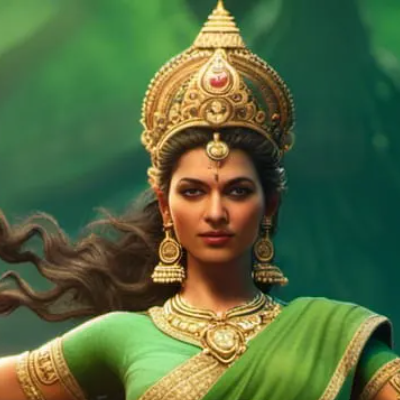
Ila — Daughter and Son of Vaivasvata Manu, Wife of Budha, and Progenitress of the Lunar Dynasty
Ila · Ida · Sudyumna · Vaivasvatakanya · Vaivasvataputra · Budhpatni · Chandravamshajanani
Ila is one of the most structurally unusual figures in the Puranic genealogical tradition — a being who is simultaneously recorded as both a daughter and a son of Vaivasvata Manu, the progenitor of the current human race and the seventh Manu of the present cosmic cycle, and who alternates between male and female existence under a divine curse. In her female form as Ila, she is the wife of Budha — the planetary deity identified with Mercury and the son of Chandra the moon god — and the mother of Pururavas, the first great king of the Chandravamsha, the Lunar dynasty, from whose line the principal royal and heroic figures of the Mahabharata descend. In his male form as Sudyumna, the same being is a king who fathers three sons of his own and whose royal acts contribute to the dynastic geography of the tradition. Ila thus occupies the extraordinary position of being simultaneously the founding ancestress of the Chandravamsha through her son Pururavas and a descendant of Vaivasvata Manu — the progenitor of the Solar dynasty's collateral lineages — giving the very first generation of the Lunar dynasty a double genealogical root in both the lunar and the solar cosmic orders. Ila appears in the Vishnu Purana, the Bhagavata Purana, the Mahabharata, the Harivamsa, and several other texts, with significant variation in the details of her story across these sources.
✦ The Names
The name Ila — also spelled Ida in some transliterations — derives from the Sanskrit root il or id, associated with refreshment, comfort, nourishment, and the earth. In the Rigveda, Ida or Ila is a goddess of nourishment, the sacred food-offering, and the earth's abundance, invoked in ritual as the embodiment of the sustaining principle of the sacrifice. The name thus carries ancient associations with the earth, with nourishment, and with the maternal or sustaining principle. The male name Sudyumna is a compound of su — good, excellent — and dyumna — glory, brilliance — meaning "the greatly glorious one" or "he of excellent splendour." The patronymic Vaivasvatakanya means "daughter of Vaivasvata Manu" and Vaivasvataputra means "son of Vaivasvata Manu" — a naming duality that reflects the figure's dual gender in the tradition. Budhpatni means "wife of Budha." The Rigvedic Ida, as a goddess of ritual nourishment distinct from the Puranic genealogical figure, is discussed further in the Textual Variants section below.
✦ Lineage
- Father: Vaivasvata Manu — the seventh and current Manu, son of Vivasvat the solar deity and the goddess Saranyu. Vaivasvata Manu is the progenitor of the present human race and the survivor of the great flood, which he navigated in a boat guided by Vishnu in the form of a great fish or horned fish. He is the father of ten sons — including Ikshvaku, the founder of the Solar dynasty — and of Ila. He presides over the current Manvantara, the Vaivasvata Manvantara, which is the seventh of the fourteen cosmic time-cycles constituting a day of Brahma.
- Paternal grandfather: Vivasvat — one of the twelve Adityas, the solar deity who is also called Surya, and the son of Aditi and the sage Kashyapa. Vivasvat is the presiding deity of the sun and the progenitor of both Vaivasvata Manu — from whom human beings descend — and Yama, the god of death, and Yami, his twin sister, through his wife Saranyu. He is also the father of the Ashvins through Saranyu's shadow-form Chhaya. Vivasvat connects Ila through three generations to the cosmic solar principle and to Aditi's divine household.
- Paternal grandmother: Saranyu — also called Sangya or Sangjna — the daughter of Tvashtr, the divine craftsman, and the first wife of Vivasvat. Saranyu is a figure of considerable significance in the tradition, known for having created a shadow-duplicate of herself — Chhaya — to remain with Vivasvat while she herself fled his excessive radiance, thereby generating two parallel sets of children: one by herself (Yama, Yami, and Vaivasvata Manu) and one by Chhaya (Shani, Tapati, and the Ashvins in some accounts).
- Siblings: Ila's male siblings as children of Vaivasvata Manu include Ikshvaku — the founder of the Solar dynasty (Suryavamsha) from whom Rama of Ayodhya descends — Nabhaga, Dhrishta, Sharyati, Narishyanta, Pransu, Nabhaga (a second of this name in some texts), Dis, Karushaka, and Prishadhra. The Vishnu Purana and Bhagavata Purana both enumerate these ten sons of Vaivasvata Manu as the founders of the major post-diluvian royal lineages. Ila-as-Sudyumna is in some accounts listed as one of these sons, in others as a daughter born additionally or separately. The precise relationship between Ila and the ten named sons varies across sources as discussed below.
- Husband: Budha — the planetary deity of Mercury, son of Chandra the moon god and of Tara (wife of Brihaspati) in the dominant tradition. Budha encountered Ila in her female form in the forest and became her husband. Their union produced Pururavas.
- Son: Pururavas — the first great king of the Chandravamsha and the subject of the celebrated love story with the celestial nymph Urvashi. Pururavas is the progenitor of the Lunar dynasty's royal line through his son Ayu, from whom descend Nahusha, Yayati, Puru, and ultimately the Pandavas and Kauravas.
- Sons in male form (as Sudyumna): In his male form, Sudyumna is recorded as the father of three sons — Utkala, Gaya, and Vinata — who became kings of specific regions. The Vishnu Purana identifies Utkala as the ruler of the territory of Utkala (corresponding roughly to Odisha), Gaya as the ruler of the region of Gaya (in present-day Bihar, sacred in the tradition as a site of ancestral rites), and Vinata as ruling a northern territory. These sons of Sudyumna are the founders of regional royal lines distinct from the main Chandravamsha descended through Pururavas.
✦ The Birth of Ila-Sudyumna
The circumstances of Ila's birth vary significantly across the primary texts and constitute one of the more complex variant traditions in the Puranic genealogical system. The Vishnu Purana presents the foundational account. Vaivasvata Manu, desiring a son to continue his line, performed a great sacrifice with the assistance of the sage Vasistha. The sacrifice was intended to produce a male heir. However, through an error or mispronunciation in the sacrificial rite — attributed in the Vishnu Purana to the officiating priest — the oblation was offered to Mitra and Varuna rather than to the deity intended, and the result was the birth of a daughter, Ila, rather than the intended son. Manu was distressed at this outcome and petitioned the sages — particularly Vasistha — to rectify the situation. Vasistha interceded with the gods, and through his intervention the child was transformed into a boy — Sudyumna. This transformation is presented in the Vishnu Purana as the resolution of the ritual error rather than as a subsequent curse.
The Bhagavata Purana's ninth book gives a somewhat different account. In this version, Manu performed a sacrifice for a son and the child was born male as Sudyumna from the outset. The subsequent transformation into female form occurred not at birth but later, when Sudyumna entered a forest grove sacred to Shiva and Parvati — a place where all beings, by virtue of a boon granted by Parvati to ensure her privacy with Shiva, were transformed into women upon entering. Sudyumna entered this grove and was transformed into Ila. In this version the birth is unambiguously male and the feminisation is a separate later event caused by the sacred grove's transformative power.
The Mahabharata's Adi Parva and Shanti Parva contain additional versions of this narrative that blend elements of both the Vishnu and Bhagavata accounts. The Harivamsa, as a supplement to the Mahabharata, provides yet another version with its own distinctive details. These variant accounts are discussed further in the Textual Variants section below.
✦ The Transformation and the Forest of Shiva
The episode of Sudyumna's entry into the sacred grove and transformation into Ila is narrated most elaborately in the Bhagavata Purana's ninth book. Sudyumna — a young king of great power and excellence — was engaged in a hunting expedition in the forests of the Himalayas when he and his companions inadvertently entered the grove of Shiva and Parvati. The grove was protected by Parvati's boon: any male being who entered it would immediately become female. Upon entry, Sudyumna and all his male companions — horses, soldiers, and attendants alike — were instantly transformed into women. Sudyumna became Ila. The companions became female attendants.
Ila, wandering in the forest in her new form and deeply distressed, encountered Budha in that same forest. Budha, captivated by her beauty, made her his wife. They lived together in the forest, and Ila bore Pururavas. Meanwhile, the sages who were attached to Sudyumna — particularly the sage Vasistha, the family preceptor of Manu's line — became aware of what had happened. Vasistha undertook worship of Shiva on Sudyumna's behalf to obtain a remedy. Shiva, pleased by Vasistha's devotion, offered a boon. Vasistha requested the restoration of Sudyumna's manhood. Shiva granted a partial restoration: Sudyumna would be male for one month and female for the following month, alternating indefinitely. This compromise meant that Sudyumna could resume some of his royal functions in the male months while remaining Ila — and Budha's wife — in the female months. The three sons Utkala, Gaya, and Vinata were fathered by Sudyumna in his male phases.
✦ The Reign of Sudyumna and the Succession
The Vishnu Purana and Bhagavata Purana both record that after Pururavas was born to Ila and the three sons were born to Sudyumna, the question of royal succession became pressing. Sudyumna's alternating condition made sustained kingship difficult — a king who was female for half the year could not, within the tradition's understanding of royal dharma, maintain the full functions of kingship continuously. Vasistha approached Manu on behalf of Sudyumna and requested that Manu appoint Sudyumna's heir. Manu, wishing to honour both his son and the legal and dharmic complications of the situation, arranged for the kingdom to be divided. The Puranas record that Sudyumna eventually ruled the city of Pratishthana — identified with modern Prayagraj or with a city near it on the Ganga — and that upon his retirement from active kingship he passed the rule to Pururavas, his son by Ila and Budha. Pururavas thus became the king of Pratishthana and the first active ruler of the Chandravamsha, while the three sons of Sudyumna received their own kingdoms in different directions.
✦ Ila in the Rigveda and Vedic Literature
The name Ila or Ida in the Rigveda designates a goddess of nourishment, the sacred food-offering placed on the ritual grass at the sacrifice, and the personification of the earth's sustaining abundance. This Rigvedic Ida is invoked alongside Sarasvati and Bharati as a triad of sacred feminine powers in the ritual context, and her identity is that of the embodied principle of the earth's generative and nourishing function. The Shatapatha Brahmana develops the figure of Ida at some length in connection with the creation story of Manu — narrating that Manu, the sole survivor of the great flood, performed a sacrifice from which the woman Ida was produced, and that from Manu's union with Ida the present human race descended. This Brahmana account is a distinct and earlier tradition from the Puranic genealogical account in which Ila is Manu's daughter rather than a being produced from his sacrifice. These two traditions share the name and the association with Manu but differ in the mechanism and relationship: in the Brahmana version Ida is a being created by Manu's sacrifice, while in the Puranic version Ila is Manu's child. The primary texts do not reconcile these two traditions explicitly.
✦ Textual Variants and Inconsistencies
The Ila-Sudyumna narrative is one of the most variant-rich in the entire Puranic genealogical corpus, and the inconsistencies between accounts are genuine and significant.
Female birth versus male birth transformed: The Vishnu Purana presents Ila as born female through a ritual error and subsequently transformed into the male Sudyumna through Vasistha's intervention. The Bhagavata Purana presents the child as born male as Sudyumna and only later transformed into female form upon entering Shiva's grove. These two accounts are structurally inverse: in one, the original state is female and the transformation produces a male; in the other, the original state is male and the transformation produces a female. Both accounts then converge on the same endpoint — the alternating male-female condition — but they differ on what the original gender was and what constituted the transformation. No harmonisation of these two versions is attempted within the primary texts.
The deity who granted the mitigation: The Vishnu Purana attributes the mitigation of the condition — the grant of alternating male and female months — to Vishnu, invoked by Vasistha. The Bhagavata Purana attributes it to Shiva, worshipped by Vasistha at the grove. These are the two dominant variants and they reflect the Vaishnava and Shaiva theological orientations of their respective texts. The Mahabharata and Harivamsa contain versions that in some passages ascribe the restoration to one deity and in others to the other, or are ambiguous between the two.
Whether Pururavas was born before or after the alternating condition was established: In the Bhagavata Purana's account, Ila encountered Budha and bore Pururavas during the period of continuous female existence in the grove, before the alternating condition was established. In the Vishnu Purana's account, the sequence is less clearly specified. The Mahabharata's genealogical account treats the birth of Pururavas as following from the union of Budha and Ila without specifying its precise relationship to the alternating condition. The texts broadly agree that Pururavas was born of Budha and Ila but differ on the exact temporal context within the narrative.
The Vedic Ida and the Puranic Ila: As discussed above, the Shatapatha Brahmana's figure of Ida — produced from Manu's post-flood sacrifice and the mother of the human race through union with Manu himself — is a distinct tradition from the Puranic Ila as Manu's daughter and Budha's wife. The two figures share a name and an association with Manu but differ in fundamental ways: in the Brahmana account Ida is generated by Manu and is his partner; in the Puranic account Ila is Manu's child and marries into the Chandra line. The texts do not explicitly address the relationship between these two traditions.
✦ Theological and Philosophical Significance
Ila's theological significance operates at multiple levels simultaneously. At the genealogical level, she is the hinge figure who connects the Solar line — through her father Vaivasvata Manu and her siblings including Ikshvaku — to the Lunar line — through her son Pururavas by Budha. This means that the very foundation of the Chandravamsha is laid by a figure who herself descends from the solar order, embedding a solar-lunar genealogical crossing at the deepest level of the tradition's dynastic history.
At the cosmological level, the alternating male-female nature of Ila-Sudyumna reflects the tradition's broader interest in the principle of transformation between states that are normally considered fixed — gender being the most fundamental of these. The monthly alternation of Ila and Sudyumna mirrors the monthly alternation of the waxing and waning moon — which is itself governed by Chandra, whose son Budha is Ila's husband — suggesting a cosmological encoding in which Ila's transformed nature is aligned with the lunar rhythm that governs her husband's divine identity. Whether this alignment is intentional or emerges from the juxtaposition of the narratives in the texts is a matter that the primary sources do not address directly.
The Rigvedic identification of Ida with the nourishing earth and with the sacred food-offering adds a further dimension: the Puranic Ila, as the one who gives birth to the entire Lunar dynasty, fulfils in genealogical terms the same function that the Rigvedic Ida fulfils in ritual terms — she is the nourishing, generative, sustaining principle from whose body the abundance of the dynasty flows.
✦ Connection to the Wider Genealogy
Through her father Vaivasvata Manu, Ila connects upward to Vivasvat the solar deity and through him to Aditi and Kashyapa — the universal progenitive household — and to the Adityas, making her genealogically a great-granddaughter of the cosmic creative order at the solar level. Through her brother Ikshvaku she is the sister of the founder of the Solar dynasty, from which Rama of Ayodhya — the seventh avatar of Vishnu and the hero of the Ramayana — ultimately descends. Through her son Pururavas by Budha she is the ancestress of the entire Lunar dynasty: Ayu, Nahusha, Yayati, and through Yayati's sons, all the major dynastic lines of the Mahabharata's world. Through her sons Utkala, Gaya, and Vinata as Sudyumna, she is the foundress of regional royal lines in the eastern and northern parts of the subcontinent. Ila thus connects in her single person the Solar and Lunar cosmic orders, the Rigvedic ritual world, the epic royal tradition, and the regional dynastic traditions of the subcontinent — a genealogical density that no other single figure in the Puranic tradition quite matches at this crossing point of the two great royal streams.
✦ References
Primary Sources
- Vishnu Purana, Book 4, chapters 1–2: The primary Mahapuranic source for the Ila-Sudyumna narrative in the version where Ila is born female through a ritual error and subsequently transformed into the male Sudyumna; narrates the subsequent encounter with Budha, the birth of Pururavas, the alternating condition, and the three sons of Sudyumna.
- Bhagavata Purana, Book 9, chapters 1–2: The Bhagavata Purana's version of the narrative in which Sudyumna is born male and transformed into Ila upon entering Shiva's grove; narrates Vasistha's worship of Shiva, the partial restoration, and Pururavas's birth and succession to Pratishthana. The primary source for the Bhagavata variant.
- Mahabharata, Adi Parva, sections 75–76; Shanti Parva: The epic's accounts of the Ila-Sudyumna narrative with their own characteristic variations; provides a third major version for comparison with the Vishnu and Bhagavata Purana accounts.
- Harivamsa, chapters 1–3: The most detailed genealogical account of the Chandravamsha's foundation through Budha and Ila-Sudyumna; contains distinctive details and some variation relative to the main Puranic accounts.
- Shatapatha Brahmana, Book 1, chapters 8.1 and 11.5: The foundational Vedic-stratum account of Ida produced from Manu's post-flood sacrifice; the distinct Brahmana tradition of Ida-as-Manu's-partner rather than Manu's-daughter, essential for distinguishing the Vedic from the Puranic tradition.
- Rigveda, Mandala 1, hymn 31 and the Apri hymns: The Rigvedic invocations of Ida as a goddess of ritual nourishment, establishing the ancient and distinct Vedic identity of the name Ila-Ida prior to its Puranic genealogical application.
- Matsya Purana, chapter 11: Contains the account of Vaivasvata Manu's sons and Ila-Sudyumna within the framework of the post-flood royal genealogies.
- Vayu Purana, chapters 85–86: Contains genealogical material on Vaivasvata Manu's progeny including Ila-Sudyumna and the Chandravamsha's foundation through Pururavas.
Modern Reference Works
- Vettam Mani, Puranic Encyclopaedia (1975): Entries on Ila and Sudyumna; comprehensive collation of all primary references and identification of the key variant accounts across the Vishnu Purana, Bhagavata Purana, Mahabharata, and Harivamsa.
- Wendy Doniger O'Flaherty, Women, Androgynes, and Other Mythical Beasts (1980): Contains extended analysis of the Ila-Sudyumna transformation narrative and its significance within the tradition's handling of gender fluidity, divine forests, and the relationship between sexual transformation and dynastic genealogy. Essential scholarly reference for the theological and narrative dimensions of this figure.
- A. A. Macdonell and A. B. Keith, Vedic Index of Names and Subjects (1912): Entry on Ida; establishes the Vedic background of the name and the distinct Brahmana tradition of Ida-as-Manu's-sacrificial-daughter, essential for distinguishing the Vedic and Puranic layers of the tradition.
- Sukumari Bhattacharji, The Indian Theogony (1970): Examines the genealogical and cosmological position of Ila-Sudyumna as the crossover figure between the Solar and Lunar dynastic traditions.
- J. A. B. van Buitenen (translator), The Mahabharata, Volume 1 (1973): Critical translation and notes on the Adi Parva genealogical sections including the Ila-Sudyumna narrative; provides textual apparatus for the epic's variant account.