
About
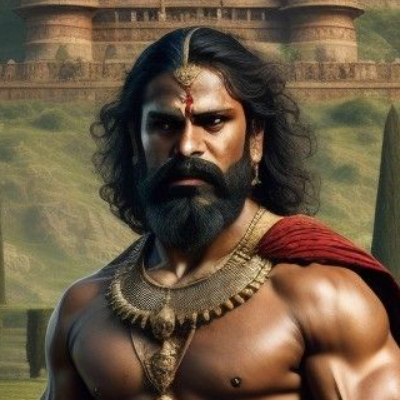
Pururavas — Son of Budha and Ila, First King of the Chandravamsha, Lover of Urvashi, and the Mortal Who Brought the Three Sacred Fires from the Gandharva World
Pururavas · Purūravas · Aila · Chandravamsha-prathama-nripa · Urvashi-pati · Budhananadana · Ila-putra · Treta-yuga-raja · Pratishthana-adhipati
Pururavas is the first celebrated king of the Chandravamsha — the Lunar dynasty — the son of Budha (son of Chandra the moon god) and of Ila, whose gender-alternating nature and extraordinary birth from Shraddhadeva Manu's sacrifice make Pururavas one of the most unusually generated figures in the tradition's dynastic genealogy. He is simultaneously the progenitor of the line from which the Yadavas, the Kauravas, and the Pandavas all eventually descended, and the central figure of one of the tradition's most celebrated narratives of mortal love for a divine being — his union with Urvashi the most beautiful of all Apsaras, the conditions that governed their life together, the deliberate violation of those conditions by the Gandharvas at Indra's behest, Urvashi's departure, Pururavas's desolate wandering, their reunion, the birth of six sons, and Pururavas's eventual transformation into a Gandharva to rejoin Urvashi in Svarga. His story is first narrated in the Rigveda's tenth Mandala in the form of a dialogue — Rigveda X.95 — making him one of the very few mortal kings of the Lunar dynasty to be given a dedicated presence in the Rigveda's own canonical hymns, and one of the most historically ancient named individuals in the Indian literary tradition. He appears in the Rigveda, the Shatapatha Brahmana, the Mahabharata, the Harivamsha, the Vishnu Purana, the Matsya Purana, the Bhagavata Purana, the Padma Purana, and Kalidasa's Sanskrit drama Vikramorvasiyam.
✦ The Names
The name Pururavas is a compound of puru — much, abundant, manifold — and ravas — sound, cry, noise, voice — yielding the sense of "he of the many-voiced cry," "the abundantly-sounding one," or "he whose voice fills the world." The Vedic Index notes that the name suggests a figure associated with the thunderous or resonant qualities of his presence — a king whose voice or whose fame resounded widely. The Wikipedia article notes he was born on Mount Puru, giving an alternative geographic derivation: "the one born on the Puru mountain." The alternative name Aila — meaning "son of Ila" — is used throughout the Mahabharata and the Puranas as a patronymic designation identifying his Ila-parentage. The epithet Chandravamsha-prathama-nripa means "first king of the Lunar dynasty." Pratishthana-adhipati means "lord of Pratishthana" — the city on the banks of the Ganga-Yamuna confluence at Prayaga from which he ruled.
✦ Lineage
- Father: Budha — the son of Chandra the moon god and Tara the wife of Brihaspati, born of the union that was the product of the Tarakamaya war. Budha is identified in the tradition with the planet Mercury and is the first human-mortal progenitor in the Chandravamsha's divine-to-mortal transition. His profile is referenced in this series in the context of the Tara and Rohini profiles.
- Mother: Ila — also called Sudyumna, born as the son of Shraddhadeva Manu through a priestly error at the sacrifice that had been intended to produce a son, transformed alternately into a woman named Ila and a man named Sudyumna by Shiva's curse in the Sharavana forest. In the female month-form as Ila, Budha fell in love with her and from their union Pururavas was born. The Mahabharata states that Ila was both his mother and his father — encoding the gender-alternating nature of his parent. The Ila profile is referenced earlier in this series.
- Paternal grandfather: Chandra — the moon god. His profile is given separately in this series.
- Wife: Urvashi — the most beautiful of all Apsaras, said to have emerged from the thigh of the sage Narayana in one account, and to have been cursed to live on earth and marry a mortal in the Puranic accounts that elaborate her descent. Her union with Pururavas is the tradition's most celebrated mortal-divine love story.
- Sons — six in the Mahabharata's primary account: Ayus (or Ayush), Dhiman (or Amavasu), Amavasu, Dridhayu (or Dridhayus), Vanayus, and Shatayu (or Satayus). The names vary significantly across the primary sources — see Textual Variants below. Ayus propagated the dynasty through his son Nahusha. Amavasu founded the line that eventually produced Vishvamitra.
✦ Pururavas in the Rigveda — Hymn X.95
The Rigveda's tenth Mandala Sukta 95 — eighteen verses in the Trishtup metre — is attributed in the anukramani tradition to Pururavas and Urvashi as the Rishis and Devatas simultaneously, meaning both figures are the speakers of the hymn's dialogue and the divine presences invoked by it. This is an extraordinarily unusual designation — a mortal king named alongside an Apsara as both the composer and the subject of a Rigvedic hymn. The hymn presents a dialogue at the point after Urvashi has left Pururavas. He finds her at a lake, having transformed into a swan among other swans. He speaks to her with anguish, begging her to return. She refuses with striking coldness — telling him that women are not to be trusted, that he made too much love to her, that the condition was violated and she has returned to her own world. The hymn ends with Urvashi's advice that he should do good deeds and perform the sacrifice to ascend to Svarga, and with Pururavas's agonised final words. The Shatapatha Brahmana XI.5.1 provides the narrative context for the dialogue that the Rigveda presents in isolation.
✦ The Urvashi Narrative — the Full Account
The narrative of Pururavas and Urvashi as given in the later elaborations — the Shatapatha Brahmana, the Harivamsha, the Vishnu Purana, and the Bhagavata Purana — provides the full context that the Rigvedic dialogue presupposes. Urvashi had been cursed — in different accounts by Mitra-Varuna who were inflamed with desire for her, by Brahma, or by Narada — to live on earth among mortals for a period. She came to the mortal world and encountered Pururavas — at the time engaged in defeating the demon Kesha who was abducting her and the Apsara Chitralekha. Pururavas rescued her and in the process Urvashi fell in love with him. She agreed to live with him as his wife under two specific conditions: that he must protect her two pet sheep and that she must never see him naked except during their union. The Padma Purana adds a third condition from other versions that during their intimate union no lamp should be lit.
They lived together for four years — or in some accounts a longer period — at Pururavas's capital Pratishthana on the Ganga-Yamuna confluence at Prayaga. Indra, missing Urvashi from Svarga's court, sent Gandharvas to create the circumstances for her return. The Gandharvas stole Urvashi's two pet sheep in the night while Pururavas was with Urvashi. Urvashi cried out in distress at the sheep's cries. Pururavas, stung by her words that he could not protect them, leaped up in the darkness without lighting a lamp, forgetting his nakedness. At that moment the Gandharvas flashed lightning — illuminating the room so that Urvashi saw him naked. Both conditions were thus violated simultaneously. Urvashi immediately left. Pururavas — grief-stricken — wandered across the land searching for her.
He eventually found her at Kurukshetra — in one version at a lake where she had transformed into a swan among five other swan-Apsaras. The dialogue of Rigveda X.95 represents this encounter. After their conversation Urvashi told Pururavas she was pregnant and instructed him to return to the same place in one year. She gave him one night with her and then a son. This pattern continued across multiple years — Urvashi returning once a year, spending a night with Pururavas, and bearing him a son — until six sons had been born. When the sixth was born Urvashi offered Pururavas a boon and told him to choose. He asked to be with her permanently. The Gandharvas then instructed him in the fire ritual — giving him a special Agni to maintain — and through his performance of the Agnistoma sacrifice Pururavas was elevated to the status of a Gandharva and reunited with Urvashi in Svarga permanently.
✦ Other Mahabharata References
The Vettam Mani compilation cites several Mahabharata references to Pururavas beyond the Urvashi narrative. In Adi Parva chapter 75 he stole the wealth of some brahmins who brought Sanatkumara to intercede — he refused to give it back, the brahmins cursed him and his prosperity declined, and he subsequently brought down three sacred Agnis from the Gandharva world and performed a yaga to restore his splendour. In Shanti Parva chapters 72-73 he engaged in discussions with Vayu about the origin of the four castes and with Kashyapa about yajnapurohitas — substantive philosophical conversations that give him a profile as a thoughtful and inquiry-driven king rather than merely a figure of the love narrative. The Vettam Mani source records that Ikshvaku gave Pururavas a sword — a detail that both connects him to the Solar dynasty through Ikshvaku's generosity and provides the specific sword which Pururavas in old age gave to his son Ayus.
✦ Pururavas in Classical Sanskrit Literature
Kalidasa's Vikramorvasiyam — "He who was won by the valour of Vikrama" — is one of the three celebrated dramas of Kalidasa alongside the Malavikagnimitram and the Abhijnanashakuntalam, and its subject is the love of Pururavas and Urvashi. Kalidasa's treatment expands and dramatises the narrative considerably — adding another wife of Pururavas, developing the emotional arc of the separation and reunion, and introducing dramatic incidents not found in the primary sources. The play is regarded as one of the masterpieces of Sanskrit dramatic literature and has kept the Pururavas-Urvashi story alive in the performative tradition across more than fifteen centuries.
✦ Textual Variants and Inconsistencies
The number and names of Pururavas's sons: This is the most significant textual inconsistency in Pururavas's biography. The Mahabharata's Adi Parva chapter 75 gives six sons: Ayus, Dhiman, Amavasu, Dridhayu, Vanayus, and Shatayu. The Urvashi Wikipedia article gives six different names from the same Mahabharata: Ayus, Shrutayus, Satyayus, Raya, Vijaya, and Jaya. The Vishnu Purana gives Ayu, Amavasu, Vishvayu, Shrutayu, Shatayu, and Dridhayu. The Padma Purana gives eight sons. The Bhagavata Purana gives its own variant list. The Manuscrypts source citing Mahabharata Adi Parva chapter 75 verse 24 specifically places Amavasu in the list. The only son whose name is consistent across virtually all sources is Ayus or Ayu — the eldest — whose son Nahusha is the next major figure in the Chandravamsha's central line.
The cause of Urvashi's descent to earth: Different texts give different causes — Mitra-Varuna's curse (Shatapatha Brahmana), Brahma's curse (Devi Bhagavata), Narada's curse triggered by a mistake in a drama performance (Padma Purana, Bhagavata Purana). These are genuinely different accounts that the different textual traditions preserve without harmonisation.
Whether Ila was Pururavas's mother or father: The Mahabharata states that Ila was both his mother and his father — which makes sense in the context of Ila-Sudyumna's gender-alternating existence. In the female state as Ila, Budha fathered Pururavas; in the male state as Sudyumna, Ila is Pururavas's father. The Vishnu Purana gives Budha as his father straightforwardly without the Ila-gender complexity.
✦ Theological and Historical Significance
Pururavas holds a unique position in the tradition as the figure at whom the Chandravamsha transitions from the cosmic-divine world of Chandra and Budha into the mortal-historical world of human kings. He is the first king — the first figure in the Lunar dynasty's line whose reign, capital, battles, and loves are narrated with the kind of biographical detail that characterises a historical rather than a purely cosmic figure. His Rigvedic presence — the dialogue of X.95 — gives him the most ancient textual attestation of any named mortal king in the Indian literary canon, placing him alongside the small group of figures (Bhava, Swanaya, Dirghatamas, Kakshivat) whose existence is documented in the Rigveda itself rather than only in the later epic and Puranic traditions. His transformation into a Gandharva through the fire ritual — ascending from the mortal world to Svarga to rejoin Urvashi — is the tradition's narrative of the fulfilment of mortal life in divine union: the king who began in the human world through a mortal-divine birth accomplished his life's deepest purpose by transcending the boundary between those worlds.
✦ References
- Rigveda, Mandala 10, Sukta 95 (18 verses): The primary and most ancient source — the dialogue between Pururavas and Urvashi at the lake, one of the Rigveda's rare hymns attributed to and concerning mortal individuals.
- Shatapatha Brahmana XI.5.1: The narrative context for the Rigvedic dialogue — the conditions, the violation, the separation, and the reunion through the fire ritual.
- Mahabharata, Adi Parva, chapter 75: The six sons of Pururavas and Urvashi; the brahmin-wealth episode and the three Agnis; the sword from Ikshvaku.
- Mahabharata, Shanti Parva, chapters 72–73: Pururavas's philosophical discussions with Vayu and Kashyapa.
- Vishnu Purana, Book 4, chapter 6: The Puranic account of the Urvashi narrative and the sons.
- Bhagavata Purana, Book 9, chapter 14: The Bhagavata Purana's version of the Urvashi narrative with its own variant details.
- Kalidasa, Vikramorvasiyam (c. 4th-5th century CE): The Sanskrit dramatic elaboration of the Pururavas-Urvashi love story; one of the masterworks of classical Sanskrit literature.
- Vettam Mani, Puranic Encyclopaedia (1975): Comprehensive collation of all primary references including the several Mahabharata episodes beyond the Urvashi narrative.