
About
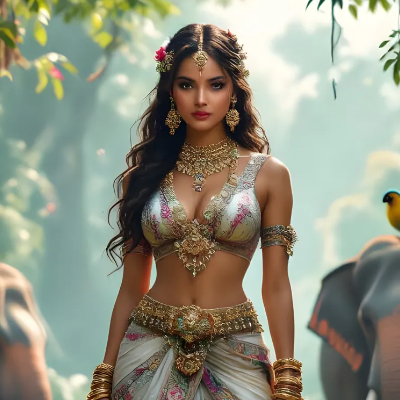
Urvashi — Celestial Apsara, Primordial Beauty of the Three Worlds
Urvashi · Urvasi · Uruvasi · Apsarasam Uttama
Urvashi is among the most ancient and most celebrated of all Apsaras in the Hindu scriptural tradition, distinguished from most others of her class by the fact that she appears not only in the later Puranic and epic literature but in the Rigveda itself, making her one of the very few Apsaras with a firm Vedic textual foundation. She is described across the Rigveda, the Shatapatha Brahmana, the Mahabharata, the Vishnu Purana, the Bhagavata Purana, the Padma Purana, and the Ramayana, among other texts. Her most celebrated narrative involves a love union with the mortal king Pururavas of the Aila dynasty — a son of Budha and the great-grandson of the moon god Chandra — and their eventual separation, which forms the subject of a celebrated dialogue preserved in the Rigveda and elaborated extensively in the Shatapatha Brahmana. She is also notable as a figure who, in one major tradition, did not emerge from the Samudra Manthan like many other Apsaras, but instead originated from the thigh of the sage Narayana — an avatar or form of Vishnu — making her origin myth distinct from that of most of her celestial peers. Urvashi is further known for an episode in which she curses Arjuna — the great Pandava hero of the Mahabharata — to live as a eunuch, a curse that later proves providential.
✦ The Name
The name Urvashi is derived from the Sanskrit elements urva, meaning wide or expansive, and ashi, a form related to pervading or filling. Together the name is traditionally interpreted to mean she who pervades the wide expanse or she who fills all space with beauty. Some etymological commentaries within the tradition connect the name to the root ur meaning the thigh, in direct reference to the account of her birth from the thigh of the sage Narayana, rendering the name as one born of the thigh. Both interpretations coexist in the textual tradition without one being definitively authoritative over the other. The epithet Apsarasam Uttama — foremost of the Apsaras — appears across multiple texts and functions as a standing honorific rather than a personal name. In certain regional and devotional contexts she is also called simply the first among Apsaras, reflecting her consistent ranking at the summit of the celestial nymphs in terms of beauty and precedence.
✦ Lineage and Relationships
- Origin: In the most prominent account, Urvashi was born from the thigh of the sage Narayana, a divine sage regarded in the Vishnu Purana and the Bhagavata Purana as a form or avatar of Vishnu, the preserver among the Hindu trinity. This birth occurred when the sage Narayana — engaged in austerities at the hermitage of Badari alongside his companion sage Nara — was visited by Apsaras sent by Indra to disrupt his penance. Narayana created Urvashi from his own thigh to demonstrate that the beauty of his own creation surpassed that of all the Apsaras Indra had sent. The visiting Apsaras, humbled, returned to Indra's court, and Urvashi remained as a being of supreme celestial beauty.
- Alternative origin: A smaller tradition, evidenced in certain Puranic lists, includes Urvashi among the Apsaras who emerged from the Samudra Manthan — the churning of the cosmic ocean — alongside Rambha and others. This account does not predominate, however, and most major sources treat her origin from Narayana's thigh as her defining birth narrative.
- Principal consort: Pururavas, a celebrated king of the lunar dynasty, son of Budha — who was himself the son of Chandra, the moon god — and Ila, a figure of complex gender identity in the tradition. Pururavas is the first human king described as entering into a union with Urvashi, and their relationship is one of the most detailed mortal-celestial love narratives in all of Hindu scripture.
- Children by Pururavas: The Vishnu Purana and the Bhagavata Purana name six sons born to Urvashi and Pururavas: Ayu, Dhiman, Amavasu, Dhridhayus, Vanayus, and Shatayu. Of these, Ayu is the most significant genealogically, as he becomes the ancestor of the main line of the lunar dynasty from which the Pandavas and Kauravas of the Mahabharata eventually descend.
- Celestial affiliation: Like all Apsaras, Urvashi is a permanent member of Indra's court in Svarga, the celestial realm, serving as a dancer and entertainer of the gods and as an occasional instrument of Indra's will in disrupting the austerities of those whose accumulated power threatens celestial sovereignty.
✦ The Vedic Dialogue — Urvashi and Pururavas
The oldest textual stratum in which Urvashi appears is the tenth mandala of the Rigveda, where a dialogue between Urvashi and Pururavas is preserved. This dialogue — among the most studied and interpreted passages in Vedic literature — captures a moment of separation between the celestial nymph and the mortal king she had lived with. Pururavas laments her departure and pleads for her return, while Urvashi's responses suggest a composed distance and an acknowledgment that the union between a mortal and a celestial being cannot be permanent. The Vedic text is allusive and its precise narrative context is not spelled out in the hymn itself, which functions as a dramatic exchange rather than a full narrative account. Later commentators, beginning with the Shatapatha Brahmana, provided the full narrative context that the hymn presupposes.
The Shatapatha Brahmana elaborates the full story. Urvashi descended to the mortal world and entered into a union with Pururavas under specific conditions she stipulated: two rams she was fond of were to be kept by her side at all times and were never to be taken from her, and Pururavas was never to be seen by her unclothed except during their intimate moments. The Gandharvas — celestial musicians associated with the divine realms — wished to retrieve Urvashi and arranged for both conditions to be violated on the same night. They stole her rams, causing her to cry out, and in the moment Pururavas rose unclothed to pursue the thieves, the Gandharvas illuminated the scene with lightning, causing Urvashi to see him in violation of her condition. She immediately departed, and Pururavas was left desolate. Wandering in grief, he eventually found her at a lake called Anyatahplaksha, where she was swimming with other Apsaras. She acknowledged him but told him she was already pregnant with his son and would meet him once more at a designated time. At that later meeting, the Gandharvas offered Pururavas a wish. He wished to become one of them, to dwell in the celestial world with Urvashi. The Gandharvas granted this by initiating him into the fire ritual — the Agnihotra — which, when properly performed, was said to transform a mortal and allow him to ascend. This portion of the Shatapatha Brahmana's account is of considerable religious-historical significance, as it presents the origin of the Agnihotra fire ritual as connected to Pururavas's desire to rejoin Urvashi.
✦ The Puranic Elaboration of the Pururavas Narrative
The Vishnu Purana, the Bhagavata Purana, and the Mahabharata's Shanti Parva all contain expanded Puranic versions of the Urvashi and Pururavas story that substantially develop the outline found in the Vedic and Brahmana sources. In the Vishnu Purana account, Urvashi descends to the mortal world after being present in the court of Indra and lives with Pururavas as his consort for a period described as many years. The conditions she set are similar to those in the Shatapatha Brahmana. After the Gandharvas cause the conditions to be broken and Urvashi departs, Pururavas wanders in grief until he finds her and she reveals she carries his child. She tells him he will see her on the last night of the year at a particular place. When he arrives, she is present with other Apsaras who have taken the form of swans on a lake. Urvashi and Pururavas speak, and she reveals she has borne their son. The Vishnu Purana names all six sons from this union and places them as founders of sub-lineages within the broader lunar dynasty. The Bhagavata Purana's ninth skandha treats this narrative with particular attention to the emotional and philosophical dimensions of the separation, presenting Pururavas's lament and Urvashi's responses in a way that later commentators interpreted as an allegory for the soul's yearning for reunion with the divine.
✦ The Curse upon Arjuna
One of the best-known episodes involving Urvashi in the Mahabharata occurs during the period when the Pandava hero Arjuna — the third of the five sons of King Pandu, renowned as the greatest archer of his age and a devotee of the god Indra, who was also his divine father — visited Indra's celestial court to receive divine weapons. Indra, wishing to provide Arjuna with pleasures befitting his status as a guest of heaven, requested Urvashi to visit Arjuna. Urvashi went to Arjuna's quarters, and Arjuna received her with profound reverence, addressing her as a foremother — since Urvashi had been the consort of Pururavas, ancestor of the Aila and lunar dynasties to which Arjuna's lineage was connected. Arjuna declined her advances on grounds of this ancestral relationship, treating her instead as he would treat his own mother.
Urvashi, insulted and angered by this rejection — since she regarded the bonds of mortal genealogy as inapplicable to an immortal Apsara — cursed Arjuna to become a eunuch, a neuter or impotent man who would live among women. When Indra learned of this, he consoled Arjuna by observing that the curse would prove a boon: during the thirteenth year of the Pandavas' exile, when they were required to live in complete concealment, Arjuna would be able to spend that year disguised as a eunuch dance instructor named Brihannala in the court of King Virata of the Matsya kingdom, and at the year's end the curse would be lifted. This is precisely what came to pass, confirming Indra's assessment. The episode appears in the Vana Parva of the Mahabharata and is one of the most structurally significant appearances of Urvashi in the epic, since the curse directly shapes the logistics of the Pandavas' critical thirteenth year in hiding.
✦ Other Appearances and Roles
Beyond her two principal narrative roles, Urvashi appears throughout the epics and Puranas in enumerative and laudatory contexts. She is consistently named first or among the first in catalogues of the great Apsaras, a position that reflects her seniority and primacy. In the Sabha Parva of the Mahabharata, she is described as a dancer and entertainer in the court of Indra when the sage Narada visits and describes its glories to the Pandava king Yudhishthira. In the Ramayana she is named among the Apsaras present in the celestial realms, though she does not feature in any independent episodic narrative within that text. Several Puranas include her name in lists of Apsaras associated with particular sacred tirthas — pilgrimage sites — suggesting a tradition of regional veneration or at least of her name being invoked in ritual contexts connected to sacred waters.
✦ Textual Variants and Inconsistencies
The tradition presents several points of inconsistency across its sources. The most fundamental concerns Urvashi's origin. The Vishnu Purana, Bhagavata Purana, and the Mahabharata's account in the Shanti Parva all support the narrative of her birth from the thigh of the sage Narayana at Badari. However, certain Puranic passages that enumerate the products of the Samudra Manthan include her name among those who arose from the churning. These two accounts are mutually exclusive and neither is harmonised in the texts themselves; they appear to represent independent traditions that were not fully reconciled in the compilation of the Puranas.
The number and names of her sons by Pururavas also vary between sources. The Vishnu Purana names six sons. The Bhagavata Purana's account agrees substantially but presents certain differences in the names. The Mahabharata references only Ayu as the relevant son for genealogical purposes, without enumerating the full set of brothers. The Rigveda itself names no children and the Shatapatha Brahmana names only that a son was born, without giving his name in the central episode. These variations reflect the standard pattern of Puranic elaboration adding genealogical detail to earlier, more compressed Vedic and Brahmana accounts.
The conditions under which Urvashi agreed to stay with Pururavas differ in their specific formulation between the Shatapatha Brahmana and the Puranic retellings, though the structural shape of the conditions — and the Gandharvas' role in engineering their violation — is consistent across versions. The Mahabharata's treatment of the Pururavas story in the Shanti Parva also presents a somewhat compressed version that does not include all the elements found in the Shatapatha Brahmana.
✦ Theological and Philosophical Significance
Urvashi occupies a position of unusual depth within the theological imagination of the tradition. Her Vedic origin — appearing in the oldest stratum of Hindu scripture rather than being a purely Puranic creation — gives her a gravity that most Apsaras lack. The dialogue between her and Pururavas preserved in the Rigveda has been interpreted by later commentators and by modern scholars alike as touching on fundamental questions about the nature of desire, the gulf between mortal and immortal modes of being, and the impossibility of permanent union between the human and the divine.
The Bhagavata Purana's treatment of the Pururavas episode in particular frames Urvashi's eventual departure as an occasion for the king's spiritual awakening rather than simply a tragedy of loss. In that reading, the grief of separation from Urvashi propels Pururavas toward renunciation and a recognition that attachment to transient beauty — however celestial — cannot yield lasting contentment. This moralising overlay does not erase the human pathos of the story but places it within the Puranic framework of desire as ultimately educative.
Her origin from the body of Narayana — a form of Vishnu — also gives her a theologically privileged position among Apsaras. Unlike figures born from the Samudra Manthan or produced by cosmic processes external to any deity, Urvashi is in one sense a direct emanation of the divine preserver himself, a detail that several Vaishnava commentators have noted with interest.
✦ Connection to the Wider Genealogy
Urvashi's genealogical significance for the Hindu tradition derives primarily from her union with Pururavas. Pururavas was the son of Budha, the deity of the planet Mercury, who was himself the son of Chandra — the moon god — and Tara, the wife of the sage Brihaspati, preceptor of the gods. The son born first among Urvashi and Pururavas's children, Ayu, became the progenitor of a major branch of the lunar dynasty. From Ayu descended Nahusha, from Nahusha descended Yayati, and from Yayati's sons Puru and Yadu descended the two great lineages — the Pauravas and the Yadavas — from which the Pandavas, the Kauravas, and Krishna himself eventually trace their ancestry. This places Urvashi at a foundational node in the genealogy of virtually the entire cast of the Mahabharata's central families, making her one of the few Apsaras whose union with a mortal has direct, traceable consequences for the epic's dynastic structure.
✦ References
- Primary Sources
- Rigveda, Mandala X, Hymn 95: The foundational Vedic text containing the dialogue between Urvashi and Pururavas; the oldest stratum of her narrative in the tradition.
- Shatapatha Brahmana, Book XI: Provides the full prose narrative context for the Rigvedic dialogue, including the conditions of Urvashi's stay with Pururavas, the role of the Gandharvas in engineering their separation, and the connection to the origin of the Agnihotra fire ritual.
- Mahabharata, Adi Parva: Contains genealogical references placing Urvashi's son Ayu within the lunar dynasty lineage that extends to the Pandavas and Kauravas.
- Mahabharata, Vana Parva (Aranyaka Parva): Contains the episode of Urvashi's visit to Arjuna in Indra's court, his rejection of her on grounds of ancestral reverence, and her curse condemning him to live as a eunuch.
- Mahabharata, Sabha Parva: Describes Indra's celestial court and its inhabitants, including Urvashi as a dancer and foremost Apsara, in Narada's account to Yudhishthira.
- Mahabharata, Shanti Parva: Contains a compressed retelling of the Pururavas and Urvashi narrative in the context of discussions of dharma and renunciation.
- Vishnu Purana, Book IV: Provides the principal Puranic account of the Pururavas and Urvashi narrative, names all six sons of their union, and places them within the genealogy of the lunar dynasty.
- Bhagavata Purana, Skandha IX: Contains an elaborated version of the Pururavas and Urvashi story with philosophical and devotional dimensions; also names their sons and their dynastic significance.
- Vishnu Purana, Book I: Contains the account of Urvashi's birth from the thigh of the sage Narayana at Badari, distinguishing her origin from that of Apsaras produced at the Samudra Manthan.
- Valmiki Ramayana: Names Urvashi among the principal Apsaras of the celestial realms in enumerative passages, without independent episodic narrative.
- Secondary Sources
- Mani, Vettam. Puranic Encyclopaedia. Motilal Banarsidass, 1975: Provides a consolidated reference entry on Urvashi drawing on multiple Puranic and epic sources and noting variant accounts.
- Macdonell, A. A. Vedic Mythology. Karl J. Trubner, 1897: Analyses the Vedic and Brahmana sources for the Urvashi narrative and provides comparative context for interpreting the Rigvedic dialogue.
- O'Flaherty, Wendy Doniger. Women, Androgynes, and Other Mythical Beasts. University of Chicago Press, 1980: Offers interpretive analysis of the Urvashi and Pururavas myth within the broader framework of gender, desire, and transformation in Hindu mythology.
- Dowson, John. A Classical Dictionary of Hindu Mythology. Trubner and Co., 1879: Contains a summary entry on Urvashi identifying her key appearances and their sources.