
About
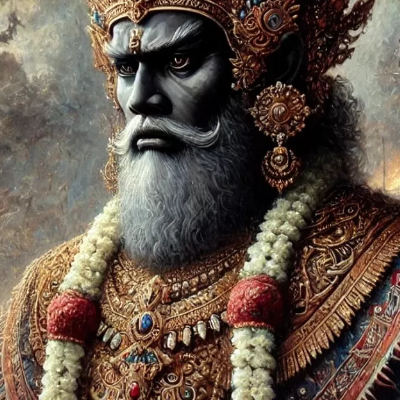
Prahasta — Son of Sumali and Commander-in-Chief of Lanka
Prahasta · Prahasta · Prahastha · senāpati of Lanka
Prahasta is a powerful rakshasa warrior, son of the demon chieftain Sumali and his wife Ketumati, and the chief commander of the army of Lanka under his nephew Ravana. He is among the most prominent military figures of the Yuddha Kanda of the Valmiki Ramayana, where he leads Lanka's forces against the army of Rama and is killed by the vanara general Nila. As the eldest brother of Kaikashi — Ravana's mother — Prahasta was one of Ravana's maternal uncles and a figure of central importance in the military organisation of the rakshasa kingdom. He appears in the Valmiki Ramayana, the Brahmanda Purana, the Vayu Purana, and the Agni Purana, among other sources. A later tradition records his rebirth as Purochana in the Mahabharata.
✦ The Name
The name Prahasta is Sanskrit, from the root hasta meaning hand and the prefix pra, denoting extension or prominence. The name thus carries the sense of one who has extended or outstretched hands — a physical or martial description suggesting reach, power, or readiness for combat. The Yuddha Kanda of the Valmiki Ramayana introduces him with an epithet describing his appearance as resembling a dark cloud.
✦ Lineage
- Father: Sumali — rakshasa chieftain, son of Sukesa and the gandharvi Daitya-vati, and one of three brothers who originally held Lanka before their defeat at Vishnu's hands.
- Mother: Ketumati — a gandharvi, daughter of the gandharva Narmada.
- Paternal grandfather: Sukesa — a rakshasa king, son of Vidyutkesha and Salatakanka; raised under the protection of Shiva.
- Brothers: Akampana, Vikata, Kalikamukha, Dhumraksha, Danda, Suparsva, Sanhradi, and Bhaskarna — all rakshasas and maternal uncles of Ravana.
- Sisters: Raka, Pushpotkata, Kaikashi, and Kumbhinasi — all given in marriage to the sage Vishrava.
- Nephew: Ravana — the ten-headed demon king of Lanka, son of Kaikashi and Vishrava, under whose command Prahasta served as senāpati.
- Sons: Eight sons including Jambumali are named in the Ramayana tradition. Jambumali was killed by Hanuman during the encounter in the Ashoka grove. The Saurapurana assigns Prahasta as a son not of Sumali but of Vishrava by Pushpotkata — a variant noted under Textual Variants below.
✦ Role as Commander of Lanka
Prahasta held the position of commander-in-chief of Lanka's army throughout the period of Ravana's reign. The Yuddha Kanda of the Valmiki Ramayana records that when Ravana surveyed the siege of Lanka by Rama's army and called his commanders together, Prahasta was among the first to speak, boasting of his ability to destroy the vanara forces single-handed. Ravana assigned Prahasta to the immediate defence of Lanka at the outset of the war, placing him in charge of the city's outer fortifications. Prahasta organised the entire defensive structure of Lanka's gates and garrison, stationing the army both within and outside the city according to Ravana's orders.
✦ Battle with Nila and Death
The fifty-eighth sarga of the Yuddha Kanda contains the detailed account of Prahasta's death. After the initial phases of the battle, Prahasta sallied forth from Lanka at the head of a substantial force. Rama, observing the demon general, enquired of Vibhishana — Ravana's righteous brother who had defected to Rama's cause and served as his principal intelligence resource regarding Lanka's forces — who this imposing figure was. Vibhishana identified Prahasta as the army's commander, guarded by a third of Lanka's total forces, experienced in wars against Yama, Kubera, the devas, and the asuras alike.
Nila, the vanara general and son of the fire-god Agni, engaged Prahasta directly. Prahasta advanced in a chariot described as resembling the colour of the sun and discharged a volley of arrows that pierced Nila and fell to earth like furious serpents. Nila, struck but unyielding, uprooted a great sala tree and struck Prahasta's horses, killing them, and then broke Prahasta's bow. Dismounting and seizing a large iron mace, Prahasta continued the fight on foot. The two commanders inflicted wounds on each other; Prahasta struck Nila on the forehead with his mace, drawing blood. Nila responded by seizing an enormous rock and hurling it at Prahasta's head. The rock shattered Prahasta's skull into many fragments. Prahasta fell dead, described in the Valmiki text as a tree felled at the root, with blood flowing from his head and body. His army, deprived of its leader, withdrew to Lanka in disorder. Ravana, on hearing of Prahasta's death, was overcome with rage and grief, and resolved to enter the battle himself.
✦ Later Tradition: Rebirth as Purochana
The Wikipedia article on Prahasta records the tradition that in his next birth Prahasta was reborn as Purochana in the Mahabharata, serving as Duryodhana's trusted ally and the man responsible for the Lakshagraha incident — the attempt to burn the Pandavas alive in a house of lac at Varanavata. This identification belongs to the broader framework of Puranic rebirth sequences in which figures from the Ramayana are assigned roles in the subsequent Dvapara Yuga of the Mahabharata, though the primary textual basis for this specific identification has not been directly verified in the sources consulted for this profile.
✦ Textual Variants
The standard identification of Prahasta as a son of Sumali and Ketumati, and hence as a maternal uncle of Ravana, is given in the Valmiki Ramayana and in the Agni Purana lineage. However, the Brahmanda Purana and the Vayu Purana assign Prahasta instead as a son of Vishrava by Pushpotkata — making him not Ravana's maternal uncle but rather Ravana's half-brother, a child of Vishrava by a different wife. The Saurapurana similarly assigns Prahasta to Vishrava and Pushpotkata. Under this variant, Prahasta would be a full sibling of Mahodara and Mahaparsva and a half-sibling of Ravana, Kumbhakarna, and Vibhishana. The Ramacharitamanasa of Tulsidas introduces yet another variant, presenting Prahasta as a virtuous son of Ravana himself who withdraws from the war. These variants are significant genealogical inconsistencies across the textual tradition and are stated here without resolution, as none of the primary sources reviewed for this profile achieves consensus on this point.
✦ References
Primary Sources
- Valmiki Ramayana, Yuddha Kanda, Sargas 8, 12, 58, and 59 — records Prahasta as commander-in-chief of Lanka, his boast before Ravana, his organisation of Lanka's defences, his battle with Nila, and his death.
- Valmiki Ramayana, Uttara Kanda — provides the genealogical background placing Prahasta as son of Sumali and Ketumati.
- Brahmanda Purana, III.8 — assigns Prahasta as a son of Vishrava and Pushpotkata rather than of Sumali.
- Vayu Purana, Chapter 70 — provides a parallel genealogy consistent with the Brahmanda Purana in assigning Prahasta to Vishrava.
- Agni Purana, Chapter 11 — records Prahasta among the sons of Sumali and Ketumati in the standard genealogical account.
- Ramacharitamanasa of Tulsidas — presents the variant in which Prahasta is a son of Ravana who opposes the war.
Modern Reference Works
- Wikipedia, "Prahasta" — summarises his role as commander of Lanka, his battle with Nila, and the tradition of his rebirth as Purochana.
- Wikipedia, "List of characters in Ramayana" — identifies Prahasta as son of Sumali and Ketumati and maternal uncle of Ravana.
- Wisdomlib, "Vishrava: 9 definitions" (Puranic Index) — gives the Brahmanda Purana and Vayu Purana assignments placing Prahasta among Pushpotkata's sons by Vishrava.
- Wisdomlib, "Pushpotkata: 7 definitions" — records Prahasta as among the sons assigned to Pushpotkata in the Brahmanda and Vayu Puranas.
- Valmikiramayan.net, Yuddha Kanda Sargas 58–59 — provides direct transliteration and prose translation of the battle between Prahasta and Nila from the primary Sanskrit text.