
About
Ayus — Eldest Son of Pururavas and Urvashi, Receiver of Ikshvaku's Sword, and Father of Nahusha
Ayus · Ayu · Ayush · Pururavas-jyeshtha-putra · Nahusha-pita · Khandava-dhipati · Chandravamsha-dvitiya · Pratishthana-uttaradhikari
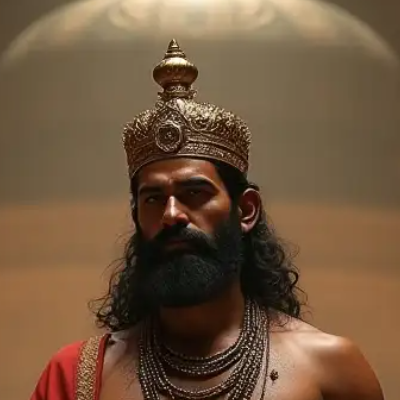
Ayus — also rendered Ayu and Ayush — is the eldest son of Pururavas and Urvashi and the figure through whom the Chandravamsha's central dynastic line was propagated. He is the second generation of the Lunar dynasty as a mortal-historical line, following his father Pururavas who was himself the first mortal king of the dynasty after the divine generations of Chandra and Budha. His genealogical position is one of genuine structural importance in the tradition — between his father Pururavas and his son Nahusha, without Ayus there is no Yayati, no Puru, no Kaurava-Pandava line, and no Yadu and therefore no Krishna. The Mahabharata establishes his genealogical position with consistency across multiple passages, and the Vettam Mani compilation records two biographical facts specific to Ayus that give him a profile beyond the purely genealogical: he received the sword given to Pururavas by Ikshvaku when Pururavas was old and passed it to his son, and he is consistently named in the Mahabharata as the son through whom the Chandravamsha propagated further while his brothers founded collateral lines. He appears in the Mahabharata, the Vishnu Purana, the Bhagavata Purana, and the Harivamsha.
✦ The Name
The name Ayus — also Ayu — derives from the Sanskrit root ayu, meaning life, vital force, lifespan, and the span of one's existence. It is one of the most fundamental words in the Sanskrit vocabulary — ayurveda, the science of life, takes its first element from this root. As a personal name Ayus designates "the living one," "he of abundant life," or "the one whose vital force is strong." The name is appropriate for the figure who was the dynasty's principal line-propagator — the one who most fully expressed the living continuation of the Chandravamsha. The epithet Nahusha-pita means "father of Nahusha." Chandravamsha-dvitiya means "the second of the Chandravamsha" — the second mortal generation.
✦ Lineage
- Father: Pururavas — profiled above.
- Mother: Urvashi — the most celebrated Apsara of Indra's court, who bore Pururavas six sons over successive annual reunions before Pururavas ascended to Svarga as a Gandharva.
- Paternal grandfather: Budha — son of Chandra.
- Wives: The Bhagavata Purana gives Ayus four wives — Svarbhanavi (daughter of Svarbhanu), Rathaviti (daughter of Rathaviti), Pathani (daughter of a king), and Amitatma's daughter — from whom five sons were born: Nahusha, Kshatravriddha, Rambha, Rajit, and Anena. The Vishnu Purana and Harivamsha give variant accounts of the wives' names and the sons' numbers, but the five-son account with Nahusha as the eldest is widely attested.
- Son — primary: Nahusha — the celebrated king who temporarily occupied Indra's throne while Indra was in hiding after the brahmahatya sin of killing Vritra, who was eventually deposed from heaven for his arrogance in demanding that sages carry his palanquin and for insulting Agastya, and who was cursed to become a serpent until Yudhishthira's riddle-exchange freed him in the Mahabharata's Aranya Parva. Nahusha's son was Yayati — the great king whose story of old age, youth-exchange with his sons, and the founding of the Yadava and Puru lines through his sons Yadu and Puru is one of the Mahabharata's most extended genealogical narratives.
- The sword of Ikshvaku: The Vettam Mani compilation states explicitly that "Ikshvaku gave Pururavas a sword which in his old age he gave to his son Ayus." This sword — passing from the Solar dynasty's founder Ikshvaku to Pururavas and then to Ayus — is a specific biographical detail that connects the two great royal dynasties of the tradition through an object of martial and dynastic significance. The sword's passage from Pururavas to Ayus at the time of Pururavas's old age is also the tradition's record of the formal succession — the moment at which the dynasty passed from the first to the second generation of mortal kings.
✦ Ayus and the Propagation of the Dynasty
The Dharmawiki source citing the Mahabharata states with direct clarity: "Ayush propagated the dynasty further." This single statement encodes the most essential fact of Ayus's position in the tradition — that among Pururavas's six sons it was specifically Ayus who carried the primary dynastic line forward while his brothers founded collateral branches. The Chandravamsha's main line thus runs: Chandra — Budha — Pururavas — Ayus — Nahusha — Yayati — Puru (from whom the Kaurava-Pandava line descends) and Yadu (from whom Krishna descends). Without the specific biographical fact of Ayus as the propagating son — the son who continued the main line — the entire subsequent genealogical world of the Mahabharata would not exist in the form it takes.
✦ Textual Variants and Inconsistencies
The names of Ayus's wives: The Bhagavata Purana, Vishnu Purana, and Harivamsha give different names for Ayus's wives with partial consistency. All agree that Nahusha was his eldest and principal son; the other sons' names and the wives' names vary across the sources.
Ayus's own narrative episodes: Beyond the genealogical position and the sword passage the primary sources give Ayus no extended independent narrative. He is a transitional figure — sufficient in his structural importance to warrant a compact profile, but without the biographical elaboration of his father Pururavas or his grandson Yayati.
✦ References
- Mahabharata, Adi Parva, chapter 75: Names Ayus as the eldest son of Pururavas and Urvashi who propagated the dynasty; records the sword passage from Pururavas to Ayus.
- Bhagavata Purana, Book 9, chapter 15: The Bhagavata account of Ayus's four wives and five sons including Nahusha.
- Vishnu Purana, Book 4, chapter 7: Genealogical confirmation of Ayus as Pururavas's son and Nahusha's father.
- Vettam Mani, Puranic Encyclopaedia (1975): Entry on Ayus; collates all primary references.